
Prevent Ruin: Bankroll Management With 1%–2% Units and Resizing Rules

Set your unit at 1% to 2% of your total bankroll (drop to 0.5% if you'd rather play it safe), pick a stop-loss and stop-win before you place a single bet, and don't touch your unit size again until the session ends. That's the whole rule. Everything else, unit lookup tables, staking systems, and resizing schedules, is just the machinery that makes this rule easy to follow instead of easy to abandon the first time you're stuck.
TL;DR:
- Betting 1% to 2% of your total bankroll per wager provides protection against large losing streaks and aligns with professional risk management standards.
- Using flat or proportional stake systems is advisable for most bettors, with fractional Kelly reserved for those tracking their edge meticulously over many bets.
- Set aside a separate bankroll with session limits and predefined stop-loss and stop-win rules to avoid emotional decision-making and tilt.
- Resizing units should be rule-driven, scheduled, and never adjusted during a session to maintain discipline and avoid chasing losses.
- Tracking key metrics like win rate, odds, and ROI over large samples helps identify variance patterns and confirms whether your edge is sustainable.
Table of Contents
- What Is Bankroll Management in Stake Betting?
- Which Staking System Should You Actually Use?
- How Much Should You Set Aside for Your Betting Bankroll?
- When Should You Resize Your Betting Units?
- What Should You Track to Manage Your Bankroll Well?
- How Do You Put the Rules Into Practice?
- Why Does Risk of Ruin Depend on Unit Size?
- Should Stake Size Change Based on Your Edge?
- Why Does Emotional Control Matter More Than Strategy?
- How Does Bankroll Management Differ Across Sports, Poker, and Casino Play?
- Should Your Bankroll Strategy Change Over Time?
- What Role Does Expected Value Play in Stake Sizing?
- Play the Long Game, Not the Big Win
- Use Stake Stats Tools to Enforce Your Own Rules
- Sources
- FAQ
What Is Bankroll Management in Stake Betting?
Bankroll management is the discipline of dividing your total betting funds into fixed units so no single wager can meaningfully damage your ability to keep playing. In gambling communities you'll also hear it called "stake sizing" or "unit staking," and the terms are used interchangeably. A "unit" is simply a fixed slice of your bankroll, usually 1% or 2%, that you use as your standard bet size regardless of how confident you feel about any particular wager.
Betting in units instead of raw dollar amounts solves a specific problem: confidence bias. Bettors tend to bet more when they feel sure of a pick, which is exactly when overconfidence does the most damage. A fixed unit removes that decision from the moment of emotion.
Here's how that looks with real bankroll sizes:
| Bankroll | 1% Unit | 2% Unit |
|---|---|---|
| $200 | $2 | $4 |
| $500 | $5 | $10 |
| $1,000 | $10 | $20 |
| $2,500 | $25 | $50 |
| $5,000 | $50 | $100 |
A widely used rule of thumb among pros is to risk no more than 1% to 2% of your total bankroll on a single bet, and that range isn't arbitrary. It's built around how many units your bankroll can absorb before a losing stretch wipes it out.
- A $1,000 bankroll at 2% units ($20) gives you 50 units of cushion.
- The same bankroll at 1% units ($10) gives you 100 units.
- More units in reserve means more losses your bankroll can survive before you're forced to stop.
Smaller bankrolls and casual players should lean toward the conservative end, 0.5% to 1%, because a bad month hurts more when there's less behind it. Bettors with a large edge and a long track record can push toward 2%. Nobody outside professional syndicates has a good reason to go higher than that on a regular basis.
Which Staking System Should You Actually Use?
Three systems cover almost everyone: flat, proportional (percentage), and Kelly.
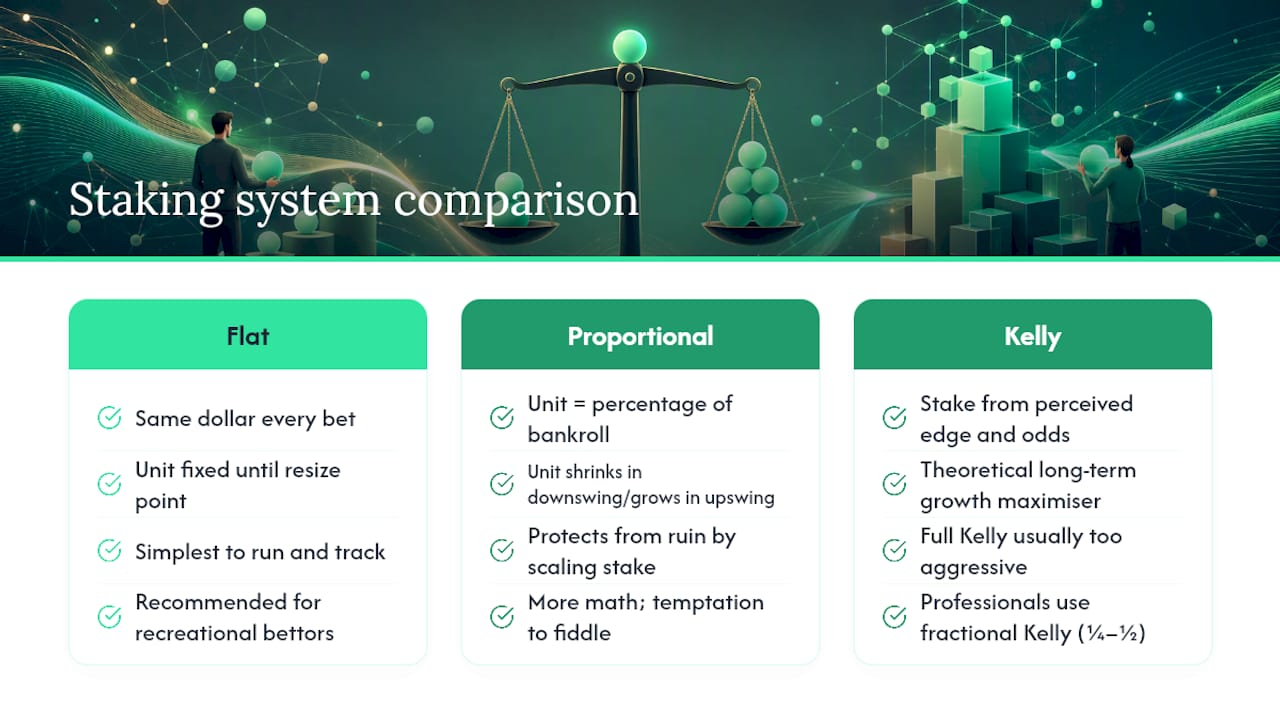
Flat staking means betting the same dollar amount every time, regardless of bankroll swings. If your unit is $20, it stays $20 whether you're up $300 or down $300, until you hit a planned resizing point. It's the simplest system to run and the easiest to track, which is exactly why most recreational bettors should start here.
Proportional (percentage) staking recalculates your unit as a percentage of your current bankroll, so the unit shrinks during a downswing and grows during an upswing. This protects you from ruin more elegantly than flat staking because your stake naturally scales down when things go wrong. The tradeoff is more math and more temptation to fiddle with your unit size too often.
Kelly criterion calculates the mathematically optimal stake based on your perceived edge and the odds offered. In theory it maximizes long-term growth. In practice, full Kelly is usually too aggressive for real bettors because it assumes your edge estimate is exact, and it rarely is. Overestimate your edge even slightly and full Kelly can size you into brutal drawdowns.
That's why professionals who use Kelly at all tend to use fractional Kelly, usually a quarter or half of what the formula recommends.
Quarter Kelly often lands right inside the 1% to 2% band that flat and proportional bettors already use for realistic sports betting edges, according to a breakdown of unit sizing and quarter Kelly. That convergence isn't a coincidence. It's a strong signal that the simple percentage rule most guides recommend is already doing most of what a mathematically optimized formula would do, without requiring you to estimate your own edge with precision you probably don't have.
Our take: use flat or proportional staking. Reserve fractional Kelly for bettors who track their edge with real data over hundreds of bets.
How Much Should You Set Aside for Your Betting Bankroll?
Your bankroll is money you can afford to lose completely without it touching rent, groceries, or bills. That sentence sounds obvious until you watch how many bettors treat their betting account as an extension of their checking account. Keep them separate, physically if you can, in a dedicated account or wallet, so the number you see when you open the app is never confused with money you need for anything else.
Once you've settled on a total bankroll, split it into session rolls so you're never exposing the whole thing on a single day or week.
- Weekly bettor with a $1,000 bankroll: a $100 to $150 weekly roll keeps you playing for two to three months even through a rough patch.
- Daily or near-daily bettor: a session roll of 10 to 15 units, so a bad day never costs more than a fraction of your monthly total.
- Casino or slots play: bankroll multiples run higher than sports betting because variance per spin is steeper. A common guideline is 50 to 100 times your unit size held in reserve for a single session.
Inside each session, set hard numbers before you start: a stop-loss (say, three to five losing units in one sitting), a stop-win (walk away after doubling your session roll), and a time cap so a session doesn't quietly run four hours past when your judgment checked out. Responsible bankroll plans build in stop-loss, stop-win, and time limits specifically because tilt does more damage than any single bad beat.
When Should You Resize Your Betting Units?
Resize on a schedule, not a feeling. The cleanest approach is a fixed date, the first of every month, where you recalculate your unit based on your current bankroll. An alternative is threshold-based resizing: adjust only after your bankroll moves 25% in either direction from where you last calculated it.
Either method works. What doesn't work is adjusting your unit size the same day you're up big or down big, because that's precisely when your judgment is least reliable.
Three rules keep resizing honest:
- Never resize mid-session. Whatever unit you started the session with, you finish with.
- Stop after a defined losing threshold. Three to five units down in a single session means you're done for the day, no exceptions.
- Never double your stake to chase a loss. Chasing is how a manageable downswing turns into a ruined bankroll in one sitting.
Hot streaks deserve just as much suspicion as cold ones. A string of wins can tempt you into "unit creep," quietly betting bigger without ever formally recalculating. Before you increase your unit, confirm the bankroll growth is real and sustained, not three good weekends in a row that variance handed you for free.
Pro Tip: Write your resizing date on a calendar reminder before you start betting, not after your first winning week. Deciding the rule while you're calm is the only time you'll actually follow it.
What Should You Track to Manage Your Bankroll Well?
A useful betting ledger needs six fields: date, market or game, stake (in units and dollars), odds, result, and running bankroll after the bet settles. That's it. Anything more elaborate usually gets abandoned within a week.
From those six fields you can calculate the two numbers that matter: win rate and return on investment. Neither number means much before 100 bets. Below that, you're mostly looking at variance, not skill. Past 100 to 200 bets, patterns start to separate from noise.
- Track your longest losing streak. It tells you whether your unit size actually matches the variance you're exposed to.
- Track average odds taken. Creeping toward heavier favorites or longer shots without noticing changes your real edge.
- Track ROI over rolling 50-bet windows, not lifetime totals, since lifetime numbers hide recent drift.
A tool like the Stake Stats profit & loss tracker automates these conversions so you're not rebuilding a spreadsheet from scratch every week.
How Do You Put the Rules Into Practice?
The whole system compresses into one line: pick your bankroll, pick your unit, pick your session roll, set your stop rules, record every bet. Each step has a tool that removes the guesswork.
- Use a bankroll analyzer to convert your total bankroll into a unit size and model what fractional Kelly would suggest for comparison.
- Use a profit and loss tracker to log every stake, result, and running total instead of trusting memory.
- Use provably fair verification tools to confirm the games you're playing on online platforms are running the odds they claim, since bankroll math means nothing if the underlying game isn't fair.
Author: Ian.
Why Does Risk of Ruin Depend on Unit Size?
Risk of ruin is the probability that a losing streak, a normal, expected one, wipes out your bankroll before your edge has a chance to show up in the results. It's not a fringe scenario. It's math, and it's brutal about small sample sizes.
Here's the intuition. The unit size doesn't change how often losing streaks happen. It changes whether you survive them.
This is the entire argument for staking 0.5% to 2% per bet instead of the 5% or 10% that feels more exciting. Variance doesn't care how confident you were on any given pick. A -110 coin-flip market will hand you five and six-game losing streaks on a long enough timeline no matter how good your process is.
Smaller units also buy you something less obvious: time to be wrong. Betting big units means a normal cold stretch can force you out of the game before your edge has accumulated enough bets to actually show up in your results. Betting small units means you're still at the table long enough for skill to outweigh noise. Survival isn't a side effect of good bankroll management. It's the entire point.
Should Stake Size Change Based on Your Edge?
Yes, and this is where flat staking starts to show its limits. A fixed unit treats every bet the same, but not every bet carries the same edge, and not every edge comes at the same odds.
The basic principle: bigger perceived edge and better odds justify a somewhat larger stake, within your overall cap. A pick you're genuinely confident in in poker with a well-calculated pot edge, or a sports bet where the line has moved clearly in your favor since you found it, carries more expected value per dollar than a coin-flip pick you're only lukewarm on.
The trap is that "confidence" and "edge" are not the same thing, and bettors conflate them constantly. Feeling sure about a pick is not evidence of an edge. An actual edge shows up as a documented, repeatable gap between your assessed probability and the odds offered, measured across enough bets to rule out luck. Adjusting your unit up because a game "feels right" is just gambling with extra steps.
Never bump size based on a hunch, a losing streak you want to recover from, or a "sure thing" narrative. Tools like an odds and implied-edge calculator can help translate a perceived edge into an actual number instead of a feeling.
Why Does Emotional Control Matter More Than Strategy?
Every staking system on this page fails against a bettor who won't follow it. That's not a moral judgment, it's just how the math works.
Tilt shows up in predictable patterns: doubling a stake after a loss to "get even," abandoning a stop-loss because you're "due" for a win, or increasing unit size mid-winning-streak because the money feels less real. Each of these is a rational-sounding story your brain tells you in the moment. None of them survive contact with a ledger reviewed a week later.
The fix isn't willpower. It's removing the decision entirely by writing your rules down before you're in a position to break them. A stop-loss decided at 9am is a rule. A stop-loss decided at midnight after three straight losses is a negotiation with yourself, and you will lose that negotiation more often than you'd like to admit. This is precisely why the resizing schedule in the earlier section specifies dates and thresholds instead of feelings, and why the tilt rules exist as hard stops rather than guidelines.
Bettors who succeed long-term usually aren't the ones with the best picks. They're the ones whose staking behavior looks identical on their best day and their worst day.
How Does Bankroll Management Differ Across Sports, Poker, and Casino Play?
Sports betting bankrolls are usually measured in flat units against a season or month, since bets are discrete events with clear odds attached.
Poker bankroll management typically runs on bigger multiples because variance within a single session can be extreme. Common guidance for cash games suggests holding 20 to 30 buy-ins for your stake level. For a $1/$3 no-limit game with a standard $300 buy-in, that puts a reasonably safe bankroll in the $6,000 to $9,000 range, more if you play aggressively or face tougher competition. Tournament players often hold even more buy-ins, sometimes 50 or higher, because tournament variance dwarfs cash game variance.
Casino games, including slots and table games, need the deepest multiples of all, since house-edge games grind bankrolls down steadily even with disciplined unit sizing. A session bankroll of 50 to 100 times your bet size is a reasonable floor for anything with meaningful volatility, like slots with high-variance math models.
The common thread across all three: define your unit relative to the game's own variance profile, not a single number borrowed from a different game entirely.
Should Your Bankroll Strategy Change Over Time?
Short-term and long-term bankroll management aren't the same discipline wearing different clothes. They optimize for different things.
Short-term management is about surviving the next session or week without catastrophic loss. It leans on hard stop-losses, conservative unit sizing, and strict session caps because the sample size is too small for skill to matter yet. On any given weekend, variance dominates. Your job is just to still have a bankroll on Monday.
Long-term management is about growing the bankroll over hundreds or thousands of bets, which means periodically resizing units upward as the bankroll grows (using the scheduled or threshold-based approach covered earlier) and tracking performance metrics closely enough to know whether you actually have an edge or you've just been running hot. This is where the ledger data from your tracking system starts to matter more than any single session's stop-loss.
The mistake bettors make is applying short-term thinking to long-term decisions, panicking and slashing unit size after one bad week that's well within normal variance, or applying long-term thinking to short-term decisions, refusing to stop a losing session because "it'll even out eventually." Both instincts are backwards. Session rules should be rigid and immediate. Bankroll size and unit adjustments should be slow and rule-based, evaluated over dozens of sessions, not one.
What Role Does Expected Value Play in Stake Sizing?
Expected value, or EV, is the average outcome of a bet if you made it an infinite number of times. A bet with positive EV is profitable on average even though any single instance can lose. EV is the number underneath every staking rule in this article, whether or not it's stated explicitly.
Flat staking implicitly assumes you can't calculate your edge precisely, so it applies a uniform, conservative unit regardless of EV per bet. Proportional staking adjusts that unit as your bankroll changes, but still applies a flat percentage across all bets. Kelly criterion is the one system that puts EV directly into the stake-size formula, sizing bets up when your calculated edge is larger and down when it's smaller or negative.
This is why full Kelly is so unforgiving: if your EV estimate is wrong, even a positive-EV bet you've mismeasured can get sized as though it carries more certainty than it does. Fractional Kelly softens that risk by discounting the formula's output, which is functionally an admission that most bettors' edge estimates carry real error bars.
The practical takeaway: never bet a market where you can't articulate, even roughly, why you think it's positive EV. A bet you can't justify with reasoning, only a feeling, isn't a stake-sizing decision. It's a guess wearing a unit-sized costume.
Play the Long Game, Not the Big Win
Bankroll rules aren't about maximizing any single bet. They're about staying solvent long enough for whatever edge you have to actually materialize across a large enough sample. Discipline beats talent here more often than bettors want to admit, because talent without discipline gets erased by one undisciplined week.
Write your rules down before you need them, unit size, session caps, resizing dates, and treat them the same way on a losing night as a winning one. The tools exist to make this easy. Use them.
— Ian
Use Stake Stats Tools to Enforce Your Own Rules
Writing a stake sizing rule down is easy. Sticking to it during a losing session is the hard part, and that's exactly the gap Stakestats tools are built to close.

The bankroll analyzer takes the guesswork out of every calculation in this article: enter your total bankroll, pick a percentage, and it outputs your unit size along with a session roll you can export before you ever place a bet. Pair that with the profit and loss tracker to log every stake and result automatically instead of relying on memory, and Stakestats's provably fair verification tools let you confirm the games behind your bets on stake.com are running honestly, so your bankroll math is built on a fair foundation. Start by entering your current bankroll into the analyzer and let it set your first unit for you.
Sources
For help with problem gambling, contact GambleAware or Gambling Therapy. Strategy fundamentals in this article draw on Matchbook's bankroll basics and Gambling101's bankroll management guide.
- How To Manage Your Sports Betting Bankroll
- The Bankroll Starter Kit: Unit Sizing and Quarter Kelly Without the Math Degree | Turtle +EV Labs
FAQ
What Does a Stake of 5 Units Mean?
A "stake of 5" typically means betting five of your standard units on a single wager, rather than your usual one unit, reflecting higher confidence or a larger perceived edge in that specific bet.
How Much Bankroll Do You Need for $25 Blackjack?
Casino games run higher variance than sports bets, so a reasonable bankroll for $25 table minimums is often 50 to 100 times the bet size, putting a workable session bankroll in the range recommended for such multiples.
What Is a Good Bankroll for $1/$3 Poker?
Standard cash game guidance suggests holding multiple buy-ins for your stake level, so for $1/$3 no-limit with a $300 buy-in, a bankroll sized accordingly provides reasonable cushion against normal variance.