
Is There Really a Best Time to Play Slots?

No time of day or day of week changes your odds on a single spin. Slot machines run on random number generators that fire continuously, so a Tuesday morning spin and a Saturday midnight spin carry identical probability. The only real exceptions are promotions and progressive jackpots, which change the size of the reward, not your chance of landing it. What actually moves your results is game selection, RTP, volatility, and how you manage your bankroll.
TL;DR:
- Playing slots at different times of day or week offers no advantage, since RNG results are independent of timing and change only with game modifications.
- Progressively larger jackpots increase potential winnings, but your chances of hitting them do not improve when playing during peak or off-peak hours.
- Using verification tools to check RTP and volatility provides more reliable insights for game selection than relying on myths about lucky hours.
- Managing your bankroll and setting clear session limits significantly reduces losses, regardless of perceived timing advantages or superstition.
- Focusing on game math and disciplined play, rather than chasing superstitions, yields better long-term control and potential success in slot gameplay.
Table of Contents
- How Slots Actually Work: RNG, RTP, and Volatility Explained
- Why Timing Myths About Slots Refuse to Die
- When Timing Actually Changes Your Value
- Practical Session Tips: Playing Smarter, Not Longer
- Why Verification Beats Guesswork When Picking Games
- What Years of Timing Questions Taught Us
- Check Your Games Before You Chase a Schedule
- Sources
How Slots Actually Work: RNG, RTP, and Volatility Explained
Every legitimate slot machine, physical or online, runs on a random number generator that produces results continuously and independently of the clock. There's no best time to play slots because the RNG doesn't know or care what time it is. Each spin is a fresh, unconnected event, the same way each flip of a fair coin ignores whatever came before it.
Two numbers determine what a slot actually delivers over time:
- RTP (Return to Player): the percentage of wagered money a game pays back over millions of spins, not your one session. A 96% RTP game returns $96 for every $100 wagered across its full statistical life, not necessarily your particular Tuesday night.
- Volatility: how the wins are distributed. Low-volatility games pay small amounts often. High-volatility games pay rarely but can hit big, which means longer dry spells between wins.
Volatility interacts directly with your bankroll. A $200 budget on a high-volatility game might vanish in twenty spins with nothing to show for it, while the same $200 on a low-volatility title could last an hour with steady small returns. Neither is inherently better. They just demand different budgets and different expectations. And no, a machine that hasn't paid out in a while isn't "due." That's the gambler's fallacy, and the RNG has no memory of your last fifty spins.
Why Timing Myths About Slots Refuse to Die
Ask around any casino floor and you'll hear the same three theories repeated as fact. None hold up against how the machines actually work.
- "Night and weekend play pays better." There's zero mechanical basis for this. Casinos don't reprogram RNGs by the hour, and time of day has no measurable effect on any individual spin's outcome.
- "Machines are due for a win after a cold streak." This assumes the machine tracks history. It doesn't. Independence means the odds reset with every pull, full stop.
- "A machine that just paid out is now cold." Same flaw, opposite direction. A jackpot five minutes ago has no bearing on the next spin's probability.
These beliefs survive because busy hours simply generate more spins, and more spins mean more visible wins. Confirmation bias fills in the rest. If you play at 9 p.m. and see three jackpot bells go off around you, it feels like proof the night shift pays better. Statistically, it's just more people pulling more levers, producing more observable outcomes. Test it yourself: track your own results across a few sessions at different hours. The variance you'll see has nothing to do with the clock.
When Timing Actually Changes Your Value

There's a narrow set of cases where "when" genuinely matters, and it's worth knowing the difference. Time-limited promotions and progressive jackpots don't touch your per-spin odds, but they do change what's on the table.
A deposit multiplier that runs Friday through Sunday raises your expected value through the bonus structure itself, not through any shift in the RNG. Read the wagering requirements before you chase one. A promotion that looks generous on the surface can quietly demand 40 times the bonus amount in play before you can withdraw anything, which erases most of the apparent edge.
Progressive jackpots work differently. As more players contribute to the pool, the potential prize grows, but your individual odds of hitting it stay exactly the same. Chasing a jackpot right before it's scheduled to drop can raise expected value simply because the prize is larger, though these windows are rare and easy to misjudge.
Before playing around any promotion or jackpot deadline, check:
- The wagering requirement and maximum cashout cap on any bonus
- Whether the jackpot has a "must drop by" clause or just grows indefinitely
- Game eligibility restrictions buried in the promotion's terms
Practical Session Tips: Playing Smarter, Not Longer
Since the clock won't fix your odds, use timing for something it's actually good for: putting you in the right headspace to make good decisions.
- Play when you're rested and undistracted. Recreational players tend to make sharper calls during mid-week mornings, when there's less noise, less social pressure, and less fatigue clouding judgment than a Saturday night out.
- Set a hard session budget before you start. A common approach is to set a spin limit: decide upfront how many spins your bankroll can absorb at your chosen bet size, and stop when you reach that limit regardless of outcome.
- Check RTP and volatility before committing real money. A quick look at a game's published RTP tells you what to expect long-term; matching volatility to your budget tells you how variable the ride may be.
- Run a small test session first. Fifty to one hundred spins at a low stake gives you a real feel for a game's short-term swings before you commit a larger bankroll.
- Watch for your own stop signals. Rising bet sizes to "win back" losses, playing past your planned time limit, or feeling frustrated instead of entertained are all cues to walk away.
Pro Tip: Treat your bankroll like a grocery budget, not a lottery ticket. Decide what you can spend before you walk in, and once it's gone, the session is over. No exceptions, no "just one more spin to break even."
Solid bankroll management protects you far more reliably than any theory about lucky hours ever could.
Why Verification Beats Guesswork When Picking Games
Chasing a mythical lucky hour wastes energy you could spend on something that actually works: verifying the math behind the game you're about to play. Provably fair systems let you check a server seed and nonce against the outcome of your own bets, confirming the result wasn't manipulated after the fact.
A practical workflow looks like this:
- Pull up the game's real-time RTP and volatility stats before you commit any money
- Run a small test session to see how the numbers actually behave in short bursts
- Set your spin cap and loss limit based on what that volatility profile suggests
- Verify individual bets using server-seed and nonce checks when you want proof a result was fair
Stakestats builds these checks into tools covering 2,500-plus Stake Engine games, so you're working from real numbers instead of hour-based hunches.
What Years of Timing Questions Taught Us
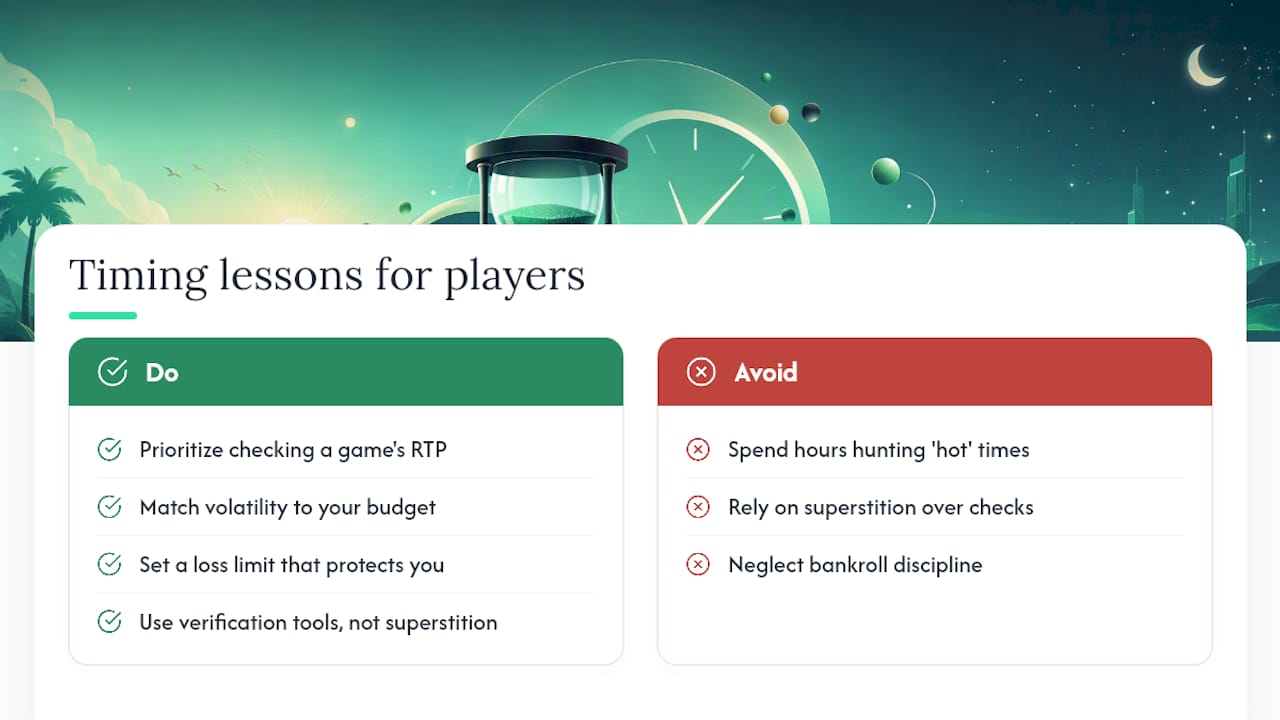
Players ask about lucky hours more than almost any other slots question, and it's understandable. A schedule feels like something you can control, while a random number generator feels like a black box. But every hour spent hunting for a "hot" time slot is an hour not spent checking RTP, matching volatility to your budget, or setting a loss limit that actually protects you.
The players who do best over time aren't the ones who cracked some hidden schedule. They're the ones who treat game selection and bankroll discipline as the real levers, and who use verification tools instead of superstition to decide where their money goes.
— Ian
Check Your Games Before You Chase a Schedule
Skip the clock watching and verify what actually determines your results. Stakestats gives you real-time RTP and volatility data across thousands of Stake Engine titles, so you know a game's payout behavior before you ever place a bet, instead of guessing based on what hour it is.

Three tools do the heavy lifting. The provably fair verification tool lets you check server seed and nonce data against your own bet history, confirming outcomes weren't tampered with. The bankroll analyzer helps you model session budgets and stop limits before you ever open a game, so a bad run doesn't turn into a worse one. And the bonus code aggregator surfaces time-limited promotions worth checking, with the terms laid out so you're not guessing at wagering requirements.
Run your next session through a quick check: pull the RTP, set your limit, then play. Start with the bankroll analyzer and build your budget before your next spin.
Sources
- Best Time to Play Slots? No — Time Does Not Change Your Odds
- Best time to gamble at a casino
- When is the best time of day to play slots?
- Timing Your Spin: Best Time of Month to Play Slot Machines
- Bankroll management