
Bet Hash Verification: 5 Browser Checks to Prove Bets Were Not Rigged

Bet hash verification is a two-step cryptographic check: confirm the revealed server seed matches the casino's published SHA-256 commitment, then recompute the round using the server seed, client seed, and nonce to see if the math matches your recorded outcome. It proves the casino picked the seed before your bet and never altered the result afterward. It does not prove the seed was random, and it does not touch house edge.
TL;DR:
- Bet hash verification confirms the casino committed to a seed before betting by matching the published SHA-256 hash with the revealed seed, ensuring no post-bet alteration.
- It relies on the server seed, client seed, and nonce to generate a deterministic HMAC-SHA256 output that reproduces the original game result.
- Verifying involves checking the initial commitment hash and recomputing the game outcome with the revealed seed, ideally early in the seed cycle for most reliability.
- Using independent, open-source, client-side verification tools enhances trust, as casino-hosted verifiers can have conflicts of interest.
- Successful checks validate seed existence before gameplay and outcome integrity, but do not prove seed randomness or eliminate the house edge.
Table of Contents
- What Is Bet Hash Verification and How Does It Differ From a Checksum?
- How Do Seeds and HMAC-SHA256 Turn Into a Game Outcome?
- How Do Casinos Reveal Seeds During a Provably Fair Round?
- How Do You Verify a Bet Step by Step?
- Which Verification Tools Are Safe to Use?
- What Does Hash Verification Actually Prove, and What Are Its Limits?
- Why Did My Bet Verification Fail? Common Mistakes to Check First
- How Stakestats Fits Into a Real Verification Workflow
- Why Most Players Verify the Wrong Thing
- Verify Your Stake Bets Without Leaving Your Browser
- Where to Read More on Hash Verification Standards
- Sources
- FAQ
What Is Bet Hash Verification and How Does It Differ From a Checksum?
A checksum answers one question: did this file change during transfer? A digital signature answers a different one: did this specific party approve this specific message? Bet hash verification borrows tools from both but solves a narrower problem unique to gambling: did the casino decide your outcome before it knew your bet, and did it report that outcome honestly afterward?
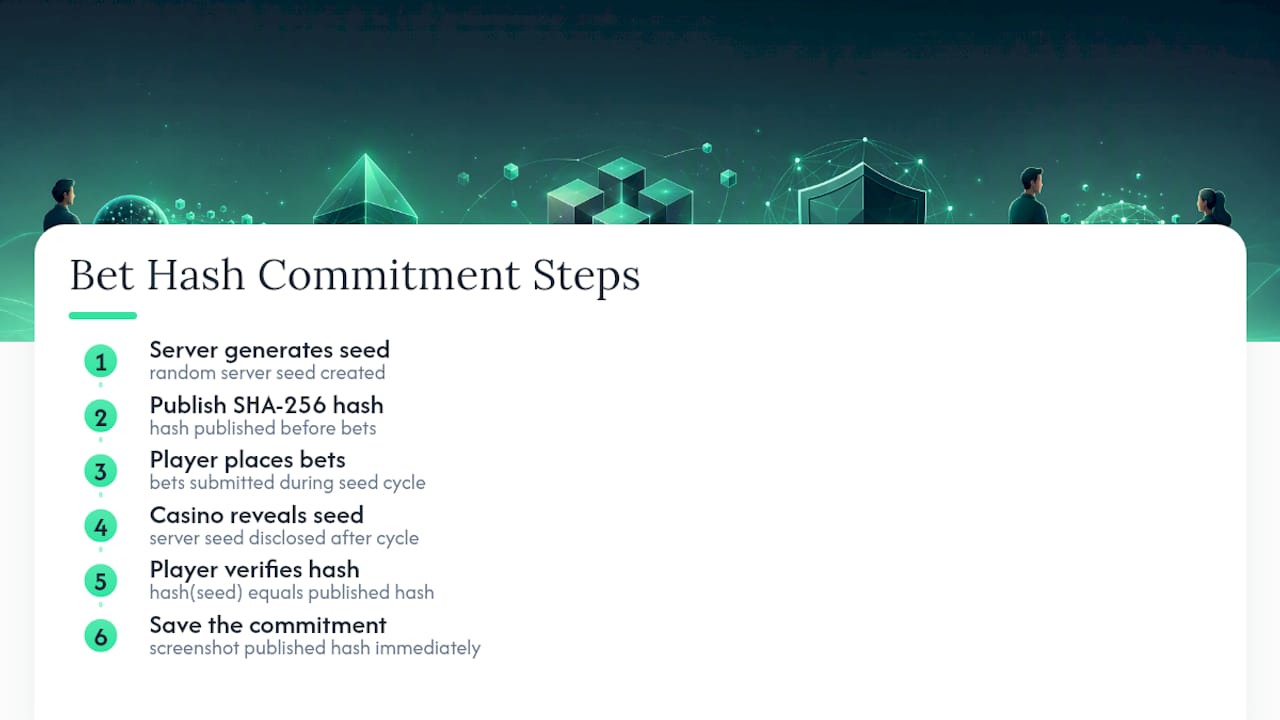
The mechanism is called a commitment scheme. Before you place a single bet in a seed cycle, the casino generates a random string called the server seed, hashes it with SHA-256, and publishes that hash. You can see it, but you cannot reverse it back into the original seed. That's the entire point of a one-way hash function: SHA-256's design, documented by NIST, makes it computationally infeasible to work backward from output to input, and infeasible to find two different inputs that produce the same output.
Once the seed cycle ends and the casino reveals the server seed, you run it through SHA-256 yourself. If your result matches the hash published days or weeks earlier, the seed genuinely existed before your bets. It wasn't swapped in after the casino saw how you were betting. That's what separates hash verification from a simple checksum: a checksum just confirms integrity of static data, while this confirms a timeline. The hash commitment pins the seed to a moment in time you can independently check.
Pro Tip: Screenshot or save the published commitment hash the moment a new seed cycle starts. Casinos rotate seeds, and if you wait until later to check, you're trusting the casino's archive instead of your own record.
Understanding bet hashes means understanding three separate cryptographic jobs happening at once: a one-way function (SHA-256) that creates the unbreakable commitment, and a keyed function (HMAC-SHA256) that turns your specific bet into a specific number. The next section breaks down how that second piece actually works.
How Do Seeds and HMAC-SHA256 Turn Into a Game Outcome?
Three inputs decide every provably fair round: the server seed, the client seed, and the nonce. The server seed is the casino's secret half, hidden until the cycle ends. The client seed is yours. Most sites let you set it manually, though many players never bother, and some platforms mix in a system-generated portion for extra entropy. The nonce is just a counter, starting at 0 or 1 and incrementing by one every single bet you place in that cycle.
The formula that turns those three inputs into a result is HMAC-SHA256, a keyed hashing algorithm. The server seed acts as the secret key, and a string combining the client seed and nonce acts as the message. In pseudocode, it looks roughly like this:
result = HMAC_SHA256(key = serverSeed, message = clientSeed + ":" + nonce)
outcome = convertToGameResult(result, gameType)
That result is a long hexadecimal string. Games don't use the whole thing. A dice game might read the first 8 hex characters, convert them to an integer, and take a modulo to land inside a 0 to 10,000 range. A Mines game might use a Fisher–Yates shuffle seeded by successive bytes from that same hash to decide where mines land on the grid. Crash and Limbo games typically feed the hash through a formula that produces a decimal multiplier, often skewed to favor lower crash points, which is where the built-in house edge lives.
Because HMAC-SHA256 is deterministic, the same three inputs always produce the same output. Run it a thousand times, get the same string every time. That determinism is the entire reason secure bet hash checks work at all. If the output changed depending on when you ran the calculation, verification would be meaningless.
How Do Casinos Reveal Seeds During a Provably Fair Round?
The lifecycle runs in three phases, and missing one of them is the most common reason players get confused about what they're even supposed to check.
Before play, the casino generates a server seed and publishes only its SHA-256 hash. You're betting against a locked, unseen value. You can also usually set your own client seed at this point, though many players stick with whatever the platform auto-generates.
During play, every bet increments the nonce by one. The server seed and client seed stay fixed for the entire cycle, so the only thing changing round to round is that counter. This matters more than most players realize: the nonce sequence is what stops you from replaying an old winning combination, since even one number off produces a completely unrelated hash.
After the cycle ends, either because you rotated your client seed or the casino rotated the server seed on a schedule, the casino reveals the original server seed in full. That's your cue to run the check.
Different Stake Engine games apply that HMAC output differently, and it helps to know the pattern before you try to verify one yourself:
- Dice reads a slice of the hash as an integer and compares it against your target number.
- Crash and Limbo convert the hash into a floating-point multiplier using a formula that biases toward an average return below 100 percent.
- Mines uses repeated hash segments to place mine positions across the grid via a shuffle algorithm.
- Keno draws multiple numbers from sequential hash slices, each mapped into the draw range.
- Plinko uses hash bytes to decide left or right movement at each peg row, building the final bucket landing.
The formulas differ, but every one of them starts from the same HMAC-SHA256 output. Once you understand that shared foundation, checking any individual game is really the same five-step process with a different last step.
How Do You Verify a Bet Step by Step?
Grab five pieces of information before you start. Miss one, and the whole check falls apart at step one.
- The published server seed hash (the commitment you saved or that the casino stored from before the round).
- The revealed server seed (available after the cycle ends).
- Your client seed at the time of the bet.
- The exact nonce for that specific bet.
- The recorded outcome the casino displayed for that bet.
With those five in hand, run the two checks that make up the whole process.
Step 1: Confirm the commitment. Hash the revealed server seed with SHA-256. If the result matches the hash published before the round started, the seed wasn't swapped after the fact. This is the check most guides recommend running first, because it's fast and it catches the most damaging kind of dishonesty: a seed substituted after the casino saw your betting pattern, as outlined in step-by-step provably fair guides.
Step 2: Recompute the result. Run HMAC-SHA256 using the revealed server seed as the key and clientSeed:nonce as the message. Feed that output through the game's specific conversion formula and compare it to what actually got recorded.
Here's a worked example for a simple dice bet:
If your recomputed number lines up with what the casino displayed, that single bet checks out. You can run this in a browser console with the Web Crypto API, in Node.js with the built-in crypto module, or with any command-line tool that supports HMAC-SHA256. Several open-source verifier scripts on GitHub walk through this exact process with working code you can read line by line, which matters if you don't want to just trust a black-box calculator.
For batch verification, loop through a range of nonces instead of checking one bet at a time:
for (n = startNonce; n <= endNonce; n++) {
  result = HMAC_SHA256(serverSeed, clientSeed + ":" + n)
  compareToRecordedOutcome(n, result)
}
Running fifty or a hundred rounds through that loop takes seconds and gives you a much stronger sample than eyeballing a single bet.
Which Verification Tools Are Safe to Use?
Every casino offers a built-in verifier, and that's precisely the tool you should trust the least on its own. A verifier hosted by the same company whose fairness you're questioning has an obvious conflict of interest if the underlying logic is ever tweaked. That doesn't mean it's dishonest. It means an independent, client-side check is worth running alongside it, not instead of it.
Look for these traits before trusting any verifier:
- Runs entirely in your browser, meaning your seeds never get sent to a third-party server. Client-side execution is the difference between checking your work privately and mailing your private key to a stranger, and it's a point provenly fair verification guides raise specifically because seed exposure is a real risk.
- Open-source code you or someone you trust can actually read, not a "trust us" button.
- HTTPS delivery, so nothing gets intercepted between the page and your browser.
- Visible derivation logic, meaning you can see exactly how the tool converts the HMAC output into a dice roll or crash multiplier, rather than a mystery number popping out the other end.
Stakestats built its provably fair explanation tool around that transparency standard, walking through the exact commitment and HMAC steps rather than hiding them behind a single "verified" checkmark. For players who bet across many rounds and want to check patterns rather than one bet at a time, the Stake Originals Analyzer pulls bet history and replay data so you're not copying nonces by hand from a scrollback list.
Pro Tip: Don't rely on one verifier permanently. Every few weeks, run the same bet through the casino's built-in tool and a separate independent, open-source one. If they ever disagree, that's the moment to stop playing and start asking questions.
What Does Hash Verification Actually Prove, and What Are Its Limits?
A successful check demonstrates three specific things. The server seed existed before your bet, since it matches a hash published earlier. The outcome formula wasn't changed after the fact, since recomputing it gives the same result the casino showed you. And the casino didn't substitute a different seed once it saw how you were betting.
It does not demonstrate three other things people often assume it does. It doesn't prove the server seed was generated randomly. A casino could commit to a seed it deliberately chose from a favorable set. As the hash commitment analysis points out, a commitment pins a seed in time, it doesn't certify how that seed was picked. It doesn't remove the house edge baked into the outcome formula itself. And a clean check on one bet says nothing about the ten thousand rounds you never bothered to verify.
The real threat isn't the math, it's ordering. If a casino let you see the server seed before locking in your client seed, it could theoretically pick a client seed pairing that favors the house. That's why the commitment always comes first, and why community discussions of hash-based fairness keep circling back to reveal timing as the real point of failure, not the hash function itself.
- Verify a few rounds right after every seed rotation, not just when you happen to remember.
- Sample bets across a session rather than checking only your biggest win or loss.
- Treat verification as proof of process, not a guarantee you'll come out ahead. Responsible gambling resources are the right place for questions about affordability and risk, not a hash calculator.
Why Did My Bet Verification Fail? Common Mistakes to Check First
Most failed checks aren't fraud. They're typos. Work through these in order before you assume something is wrong.
- Check the nonce first. It's the single most common error, off-by-one mistakes are everywhere, especially if a game increments the nonce differently than you expect.
- Check for pasted whitespace. A trailing space or line break copied from a chat window will silently break a hash calculation with zero warning.
- Confirm you're using the right seed cycle. If the client seed rotated between bets, an old client seed paired with a new server seed will never match.
- Re-copy the revealed server seed character by character. A single dropped character produces a totally unrelated hash, and this is one of the most frequent user errors reported in verification walkthroughs.
If the mismatch survives all four checks, stop playing that game immediately. Screenshot everything: the commitment hash, the revealed seed, the client seed, the nonce, and the recorded outcome. Contact casino support with that evidence, and if you get nowhere, escalate to an independent verifier community or the relevant licensing body.
How Stakestats Fits Into a Real Verification Workflow
Manually recomputing HMAC-SHA256 for every bet gets old fast once you're playing hundreds of rounds a session. Stakestats built its tools around that friction: the provably fair explanation page walks through commitment and HMAC logic in plain language, and the Stake Originals Analyzer pulls bet history automatically instead of asking you to copy nonces by hand.
The practical case is batch checking: instead of verifying one suspicious bet, you run a whole session and see if any single result breaks the pattern. That's the scenario where automated parsing earns its keep over a manual spreadsheet.
Why Most Players Verify the Wrong Thing
Most verification guides fixate on the math, and the math is genuinely the easy part. HMAC-SHA256 is deterministic and reproducible in a browser console in under a minute. What conventional advice underplays is timing discipline: saving the commitment hash the instant a new cycle starts, and checking early rounds right after a rotation instead of months later when you're relying on the casino's own archive of what it published.
I'd also push back gently on the idea that one clean verification settles the question of fairness for a whole session. It settles one bet. Seed-grinding and favorable-selection risks live in whether the seed was chosen randomly, not in whether the commitment matches. A single check tells you the casino didn't cheat after seeing your bet. It tells you nothing about what happened before that seed was ever generated.
If you take one thing from this: verify early, verify often, and treat a mismatch as evidence to preserve rather than a bug to explain away. The math will never lie to you. The seed cycle timing is where trust actually gets tested.
— Ian
Verify Your Stake Bets Without Leaving Your Browser
Running HMAC-SHA256 by hand for every round gets old, and copying nonces out of a scrollback list is exactly where the small mistakes that cause false mismatches creep in. Stakestats' provably fair verification tool runs the commitment check and the HMAC recomputation for you, client-side, against your actual seed and nonce data, so you're checking real bets instead of a demo example.
Pair it with the Stake Originals Analyzer if you want to check a whole session at once rather than one bet at a time. It pulls your bet history and flags what's worth a closer look, instead of making you scroll and copy nonces manually. Open your bet history now and run your last session through the verifier to see exactly where your numbers line up.
Where to Read More on Hash Verification Standards
For the underlying math, NIST's SHA-2 specification documents the algorithm properties this entire system relies on. GPWA's certification resources cover broader operator transparency programs. For gambling risk beyond the math, GambleAware offers independent support resources.
Sources
FAQ
How Do I Verify a Hash?
Run the revealed server seed through SHA-256 and compare the output to the commitment hash the casino published before the round. If they match character for character, the seed existed before play began, exactly as the hash commitment framework describes.
What Is Hash Verification in Betting?
It's a two-step check confirming a casino didn't alter a bet's outcome after the fact: matching the revealed seed to its published commitment, then recomputing the result with HMAC-SHA256 using the server seed, client seed, and nonce. Tools like the Stake Originals Analyzer automate both steps against your actual bet history.
Why Is SHA-256 Irreversible?
SHA-256 is a one-way function by design, meaning there's no practical way to work backward from the output hash to the original input. That property, documented in NIST's SHA-2 specification, is exactly what makes the commitment scheme trustworthy: the casino can prove it locked in a seed without revealing it.
How Do I Get a Hash Value Certificate?
There's no formal "certificate" for a bet hash the way there is for an SSL certificate. What you get instead is the published commitment hash from the casino before play, and the revealed server seed afterward, both of which you can independently recompute and compare using a client-side verifier or an open-source script.