
Online Blackjack RTP: What Return to Player Really Means

Online blackjack pays back a high percentage of every dollar wagered over the long run, with the top returns achievable only if you play perfect basic strategy on a player-friendly rule set. Deviate from basic strategy, add side bets, or sit at a table with a 6:5 payout, and your realized return drops, sometimes below 97%. Before you sit down at any table, check three things: the game's audit certification (eCOGRA, iTech Labs, or GLI), the rule card for payout and dealer-hit rules, and a verification tool like Stakestats for provably fair confirmation.
- Base RTP range: generally high under ideal rules with perfect play
- Realized RTP is almost always lower once misplay, side bets, and bonus wagering enter the picture
- Look for eCOGRA, iTech Labs, or GLI certificates in the game info panel before you bet real money
Key Takeaways
Preserving blackjack's published RTP requires 3:2 payouts, dealer-stands-on-soft-17 rules, flawless basic strategy, and independent verification of both the game's audit and your own bet outcomes.
| Point | Details |
|---|---|
| Base RTP range | Online blackjack typically pays 99% to 99.6% with perfect strategy and player-friendly rules. |
| Payout rule matters most | A 6:5 blackjack payout instead of 3:2 can cost over 1.3% in expected return. |
| Strategy errors cost real money | Composition-dependent misplays and routine side bets both quietly drag realized RTP below the published figure. |
| Verify before you bet | Check for eCOGRA, iTech Labs, or GLI certification in the game info panel or footer. |
| Confirm outcomes independently | Stakestats' provably fair tools and bankroll analyzer let you verify individual bets and model bet sizing against real volatility. |
Table of Contents
- What Does Blackjack RTP Online Actually Mean?
- Which Table Rules Change Your Blackjack RTP?
- How Do Skill and Side Bets Affect Real RTP?
- How Can You Verify a Game's Published RTP?
- How Do You Choose a Higher-RTP Blackjack Table Right Now?
- Publisher Perspective: Verifying Blackjack RTP in Practice
- Verify Your Blackjack RTP Before You Bet
- Sources
What Does Blackjack RTP Online Actually Mean?
RTP is a long-run average, not a promise for your next session. It tells you what percentage of total wagers a game returns to players over millions of hands, calculated mathematically from the rule set and optimal strategy. A 99.5% RTP means the house edge is 0.5%, but that number only converges over a huge sample size. Over 50 hands, you could easily be up 30% or down 40%, and both outcomes are perfectly normal.
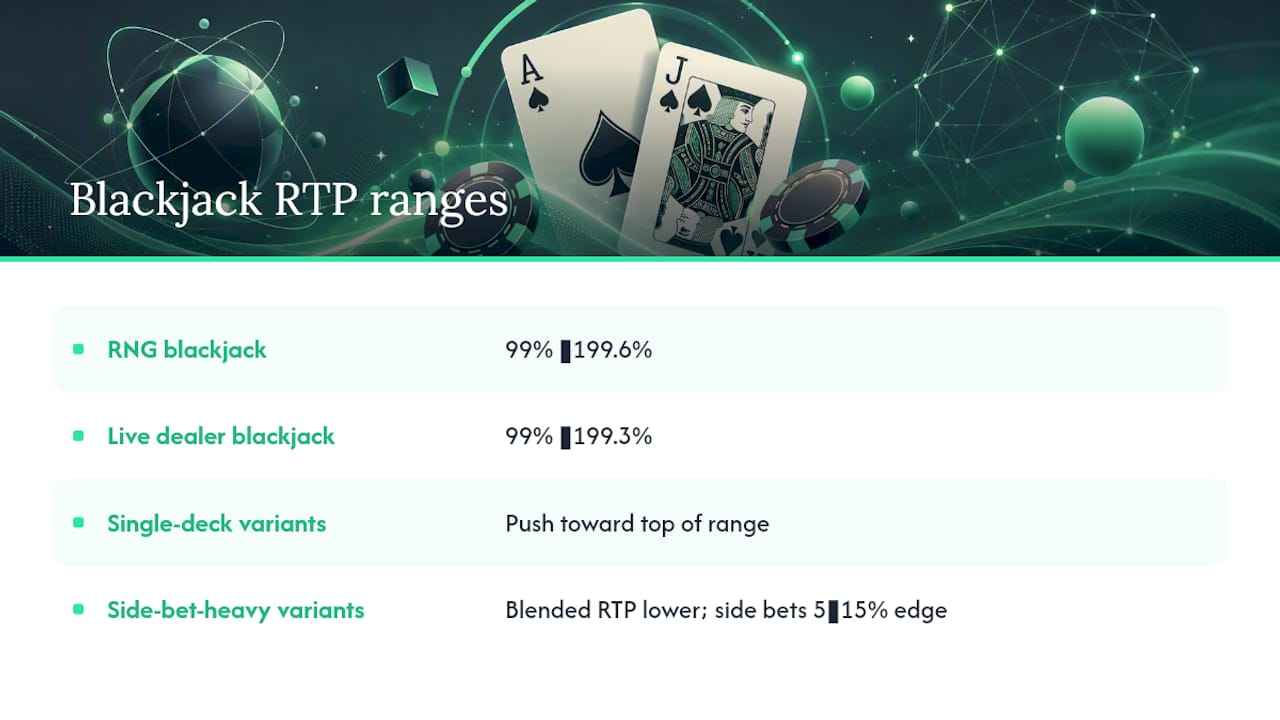
Typical ranges vary by game type. RNG blackjack titles built on solid rule sets often land between 99% and 99.6% RTP, according to BlackjackPilot's breakdown of blackjack return figures. Live dealer blackjack tends to sit slightly lower, usually in the 99% to 99.3% range, because studio overhead and slower dealing speeds don't change the math but the rule packages offered live are often less generous. Single-deck games with strong player rules can push toward the top of the range, while side-bet-heavy variants (Perfect Pairs, 21+3) drag blended RTP down because those side wagers carry house edges of 5% to 15% on their own.
Here's the part most players miss: blackjack's RTP is conditional, not fixed. A slot machine pays out the same theoretical percentage no matter how you press the spin button. Blackjack's return depends entirely on the decisions you make hand by hand, a distinction worth sitting with before you assume "99.5% RTP" applies to you automatically, as Sportsline explains in its RTP and volatility primer.
Pro Tip: Treat the published RTP as a ceiling, not a floor. It's the best you can do with flawless strategy, not what an average player actually walks away with.
Which Table Rules Change Your Blackjack RTP?
Rule variations move expected return by fractions of a percent to well over a full point, and most players never check for them before sitting down. The single biggest swing comes from the blackjack payout itself. A 3:2 payout on a natural blackjack versus a 6:5 payout can cost you more than 1.3% in expected return, according to Wizard of Odds' rule-variation data. That single change is often worse for your bankroll than every other rule at the table combined.
Rules that tend to reduce your expected return include less favorable blackjack payouts like 6:5 compared to 3:2.
- Dealer hits on soft 17 instead of standing (roughly 0.22% drop)
- No doubling after split
- No resplitting of aces or pairs
- More decks in the shoe (each added deck shaves a small amount off return)
Rules that help your return:
- 3:2 or better blackjack payouts, with rare 2:1 blackjack promotions adding over 2% in the other direction
- Doubling down on any two cards
- Surrender options, especially late surrender
- Fewer decks, particularly single-deck or double-deck shoes with otherwise standard rules
Here's the trap that catches a lot of online players: a table advertised as "single-deck" sounds like a good deal, but if it pairs that deck count with a 6:5 payout, you've actually made your odds worse, not better. Wizard of Odds' online survey of blackjack games confirms this pattern shows up repeatedly across software providers. Deck count alone tells you almost nothing. Read the whole rule card before you judge a table.
How Do Skill and Side Bets Affect Real RTP?
Published RTP assumes you play every hand with mathematically perfect basic strategy, and almost nobody does that consistently. Small, composition-dependent errors, like standing on a 16 against a dealer's 7 when the count says hit, add up over a session and quietly erode the return the game was designed to pay out. That gap between theoretical and realized RTP is the single biggest reason two players at the same table walk away with different results over time.

Side bets make the gap worse. Stakestats' blog covers how side bets shift a player's overall expected return in more detail.
A few habits preserve most of that theoretical RTP:
- Use a basic strategy chart matched to the exact rule set you're playing, not a generic one
- Skip side bets unless you're treating them purely as entertainment spend
- Practice with a strategy trainer or simulator until decisions become automatic
Pro Tip: Print or bookmark a strategy chart specific to the deck count and rules at your table. A six-deck, dealer-hits-soft-17 chart differs from a single-deck, dealer-stands chart in several key decisions.
How Can You Verify a Game's Published RTP?
Most licensed online casinos publish RTP directly inside the game. Look for an info icon or "i" button on the game screen, which usually opens a panel listing RTP, volatility, and the specific rule set in play. If it's not there, check the operator's footer or a dedicated "game rules" page.
Verification doesn't stop at reading the panel. Independent labs test and certify the math behind these games before they ever go live:
- eCOGRA audits RNG fairness and RTP accuracy for a wide range of online casino titles.
- iTech Labs certifies random number generators and game math for compliance with stated RTP.
- GLI (Gaming Laboratories International) provides testing used across regulated markets worldwide.
Certificates from these labs typically appear as a badge or seal in the game info panel or site footer, as Rotowire notes in its betting coverage.
Provably fair verification takes this a step further for crypto-based games. Instead of trusting a certificate alone, you can independently confirm that a specific bet outcome wasn't manipulated after the fact.
Stakestats builds tools around exactly that idea. Its Stake-specific transparency tools let you check server seed and nonce data yourself, alongside a bankroll analyzer that shows how your bet sizing interacts with a game's real volatility.
How Do You Choose a Higher-RTP Blackjack Table Right Now?
Run through this before you place a single bet:
- Confirm the blackjack payout is 3:2, not 6:5.
- Check whether the dealer stands or hits on soft 17 (standing is better for you).
- Verify you can double down on any two cards and double after splitting.
- Note the deck count, but only after you've checked the payout and dealer rules.
- Skip side bets like Perfect Pairs or 21+3 unless you're playing purely for fun.
- Look for an eCOGRA, iTech Labs, or GLI certificate in the info panel.
- Apply basic strategy matched to that exact rule combination.
- Size your bets using a bankroll rule, such as risking no more than 1% to 2% per hand.
Red flags to walk away from: a 6:5 payout on any blackjack, no double-after-split option, or a lobby that pushes side bets harder than the base game itself.
Sizing bets conservatively keeps a bad streak from erasing the mathematical edge you worked to preserve.*
Publisher Perspective: Verifying Blackjack RTP in Practice
RTP numbers on a lobby page are a starting point, not proof. Stakestats builds provably fair verification specifically so players can confirm server seed and nonce data behind individual bets rather than take a published percentage on faith. Pair that with a bankroll analyzer and ongoing RTP and volatility monitoring across Stake Engine games, and you get a clearer picture of whether a table's real performance matches its advertised math. Use the free tools before you commit real bankroll to a session.
— Ian
Verify Your Blackjack RTP Before You Bet
Reading a rule card tells you the theoretical edge. Confirming what actually happened during your session is a different job, and it's the one Stakestats is built for. Its provably fair verification tools let you check server seed and nonce data on individual hands instead of trusting a lobby's advertised percentage.

If you're deciding how much to risk per hand, the bankroll analyzer models bet sizing against a game's real volatility, so a small house edge doesn't get wiped out by oversized bets during a downswing. And if bonus wagering is part of your plan, Stakestats' bonus tools show which offers actually let blackjack count toward the requirement, so you're not grinding through a wagering rule the game doesn't apply to. Start by running your next session's bet sizes through the bankroll analyzer before you sit down.
Sources
- Rotowire - Betting (audit labs note)
- Wizard of Odds — Blackjack rule variations
- BlackjackPilot — Blackjack RTP explained (typical ranges)