
How to Calculate Expected Value Bets in 2026

What is expected value in betting, and how do you calculate it?
Expected value (EV) is the long-run average profit or loss per bet. It tells you not whether you'll win a single wager, but whether a bet is mathematically worth placing over hundreds of repetitions. A positive expected value (+EV) means the bet is profitable in the long run; a negative one means you're paying the sportsbook to take your money.
The core formula is straightforward:
EV = (True Probability × Decimal Odds) − 1

Or, with a stake included: EV = Stake × (p × d − 1)
Where p is your estimated true probability of winning and d is the decimal odds offered.
Key concepts you need before calculating:
- Implied probability: Calculated as 1 ÷ decimal odds. At 2.00 odds, implied probability is 50%. This is the break-even probability — the win rate at which EV equals zero.
- True probability: Your own estimate of the actual likelihood of an outcome, built from models, statistics, or expert analysis. This is what you compare against implied probability.
- Bookmaker vig (margin): Sportsbooks inflate implied probabilities so they sum above 100%, guaranteeing their cut. A two-sided market might show 52.4% + 52.4% = 104.8%, meaning 4.8% is the vig.
- Fair odds: Odds after the vig is stripped out. You must work with vig-removed probabilities to get an honest EV reading.
- +EV signal: A bet is +EV when your true probability exceeds the market's vig-removed implied probability. That gap is your edge.
Quick example: You estimate a team has a 55% chance of winning. The sportsbook offers decimal odds of 2.10. EV = (0.55 × 2.10) − 1 = 1.155 − 1 = +0.155, or +15.5% per dollar wagered. That's a strong +EV bet.
How to calculate expected value in your bets, step by step
Getting the math right requires doing the steps in order. Skipping vig removal is the single most common mistake beginners make.
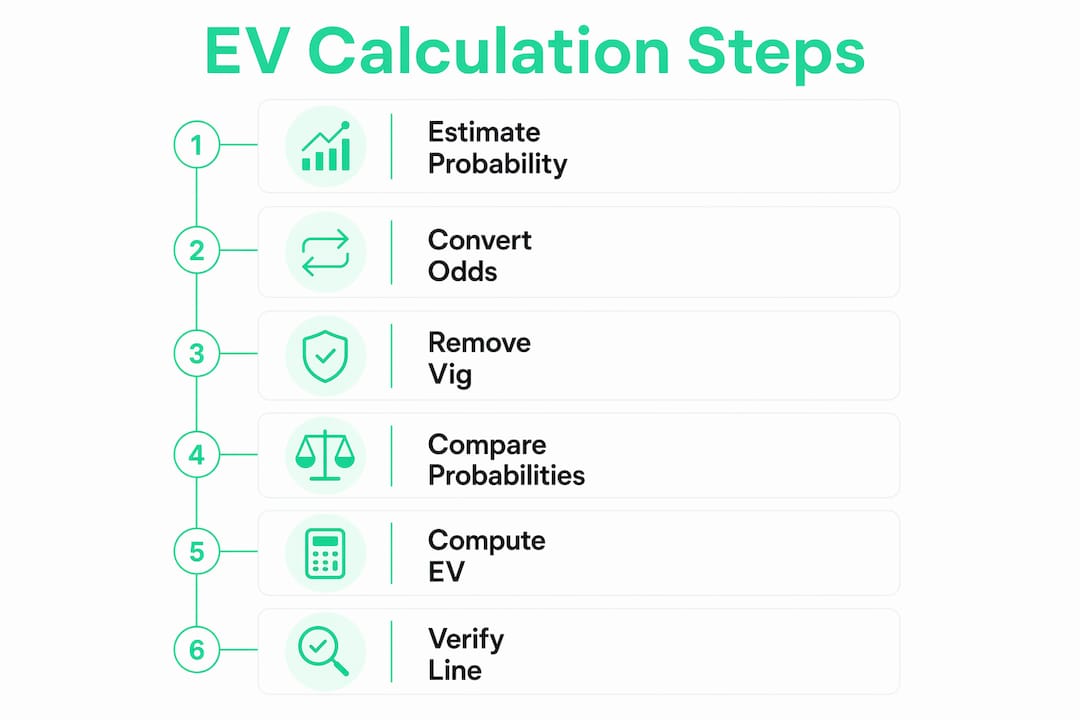
Step 1: Estimate true probability. Use team statistics, injury reports, power ratings, or a betting model. Your estimate doesn't need to be perfect, but it needs to be independent of the odds. If you reverse-engineer your probability from the sportsbook line, you're just confirming their number.
Step 2: Convert odds to implied probability. Divide 1 by the decimal odds. At 1.91 (standard -110 American odds), implied probability = 1 ÷ 1.91 = 52.4%.
Step 3: Remove the vig. Add the implied probabilities for both sides of the market. If they total 104%, divide each side's implied probability by 1.04. This gives you the vig-free fair probability. Removing the vig before comparing is non-negotiable — skipping it causes you to overestimate your edge and make losing bets you think are winners.
Step 4: Compare your true probability to the vig-free implied probability. If your estimate is higher, you have a potential +EV bet. If it's lower or equal, pass.
Step 5: Plug into the EV formula. EV = p × d − 1. A positive result confirms the bet has edge.
Step 6: Verify the line is still live. Odds move fast. A line that showed +EV an hour ago may have closed to a breakeven or negative number. Always confirm before placing.
Pro Tip: Most bettors skip Step 3 entirely and compare their probability directly to the raw implied probability. That's like measuring a room with a ruler that's 4% too short. Strip the vig first, every time, without exception.
Bankroll management and staking strategies for EV bettors
Expected value tells you the long-run average profit per bet, not the outcome of any single wager. That distinction matters practically: even a bet with +10% EV will lose roughly 4 out of 10 times. Without solid bankroll management, variance will wipe you out before the math has a chance to work.
Understanding variance: Short-term results can swing wildly even when every bet you place is +EV. Small edges require thousands of bets to reliably show profit. The law of large numbers eventually brings your results in line with your true edge, but "eventually" can mean a very long time at low volume.
The Kelly Criterion is the staking method professional bettors rely on to size bets proportionally to their edge. The formula:
Kelly % = (p × d − 1) ÷ (d − 1)
If your edge is +8% on a bet at 2.00 odds, Kelly says wager 8% of your bankroll. That sounds aggressive, and it is. Most serious bettors use fractional Kelly (typically 25%–50% of the full Kelly amount) to reduce variance without sacrificing much long-term growth.
Practical bankroll and staking tips:
- Never bet more than 2%–5% of your bankroll on a single wager, even with a large calculated edge.
- Track every bet with a profit-loss record so you can measure your actual edge over time.
- Treat your bankroll as a separate fund. Mixing betting money with living expenses is how bettors go broke during a normal losing streak.
- Use the bankroll analyzer at Stakestats to simulate how variance affects your results across different edge sizes and bet volumes.
- Bet volume matters. A 3% edge across 50 bets is statistically invisible. Across 1,000 bets, it's a real, measurable return.
The Kelly Criterion and fractional Kelly are not magic. They're guardrails that keep you in the game long enough for your edge to show up in your results.
Tools that help you calculate and verify EV bets
The math isn't complicated, but doing it manually for every bet is slow and error-prone. EV calculators can instantly compute EV, edge percentage, ROI, and break-even probability across decimal, fractional, and moneyline odds formats.
What to look for in an EV tool:
- Accepts multiple odds formats (decimal, American moneyline, fractional)
- Outputs EV%, edge in percentage points, break-even probability, and expected profit per dollar staked
- Includes a vig-removal function so you're comparing against fair probabilities
- Supports bankroll simulation to model variance over a sample of bets
| Tool Type | Input | Key Outputs | Best For |
|---|---|---|---|
| EV Calculator | Odds + true probability | EV%, edge, break-even | Single bet evaluation |
| Vig Remover | Both sides' odds | Fair probabilities | Pre-calculation cleanup |
| Bankroll Simulator | Edge%, bet count, bankroll | Variance range, ruin risk | Long-term planning |
| Profit-Loss Tracker | Bet history | Actual ROI, CLV | Performance review |
Stakestats provides a suite of tools built specifically for online gamblers on provably fair platforms. The Stake Engine tool lets you verify fair odds and calculate stakes within EV-based systems, while the Stakestats blog covers probability modeling and betting strategy in depth. For bettors on Stake.com, the platform's provably fair verification gives you a baseline of trust that most retail sportsbooks can't match.
Closing line value (CLV) is worth tracking as a secondary metric. The sharp closing line is the market's best estimate of true probability, refined by sharp money right up to game time. If you consistently get better odds than the closing line, you're demonstrating a real edge, not just lucky results.
How to adjust EV calculations for moneyline, spread, and totals bets
The EV formula stays the same across bet types. What changes is how you estimate true probability and how you interpret the odds.
Moneyline bets are the cleanest application. You're picking a winner, so your true probability estimate maps directly onto the formula. Convert American odds to decimal first: +150 becomes 2.50, and -200 becomes 1.50. Then apply EV = p × d − 1 as normal.
Point spread bets add a layer of complexity. The spread adjusts the effective probability of each side winning, theoretically to near 50/50. Your true probability estimate needs to account for the spread, not just the outright winner. If you think Team A wins by 7 points on average and the spread is +3.5 for Team B, your probability that Team A covers is higher than 50%. Build that into your estimate before running the EV formula.
Totals (over/under) work similarly. You're estimating the probability that the combined score lands above or below a set number. Weather, pace of play, and defensive matchups all feed into that estimate. The EV formula itself doesn't change: EV = p × d − 1, where p is your probability that the total goes over (or under) and d is the decimal odds offered on that side.
Parlays require multiplying the true probabilities of each leg together, then comparing that product against the combined decimal odds. EV = (p1 × p2 × combined odds) − 1. Parlays almost always carry negative EV because the payout doesn't compensate for the compounded probability, but a parlay built entirely from +EV legs can still carry positive overall EV.
The adjustment across bet types is always the same discipline: estimate true probability honestly, strip the vig, then run the formula.
Key Takeaways
Consistently finding +EV bets, removing the vig before every comparison, and sizing stakes with the Kelly Criterion are the three pillars of long-term betting profitability.
| Point | Details |
|---|---|
| Core EV formula | EV = (True Probability × Decimal Odds) − 1; a positive result means the bet has edge. |
| Vig removal is mandatory | Always strip the bookmaker margin before comparing your probability to implied probability. |
| Kelly Criterion for sizing | Kelly % = (p × d − 1) ÷ (d − 1); most bettors use 25%–50% of the full Kelly amount. |
| Volume unlocks the math | Small edges require thousands of bets before results reliably reflect your true EV. |
| CLV confirms real edge | Consistently beating the closing line is the strongest signal that your edge is genuine. |