
Casino Cooling-Off Periods: How They Work and How to Use One

A casino cooling-off period is a short, self-chosen break, usually from 24 hours to a few months, during which your account can't take deposits or place bets. It is not a permanent ban. At licensed US operators you switch it on in your account settings, it starts immediately, and in most cases you can't shorten it once it begins. This guide explains what the break does, how long it lasts, what happens to your money, and how to pair it with your own numbers so the break actually changes how you play.
TL;DR
- A cooling-off period blocks betting and deposits for a fixed time you pick, from 24 hours up to 6 months in Massachusetts, and at least 72 hours in states like Michigan and Virginia.
- It is shorter and lighter than self-exclusion, which runs for years and usually covers every licensed operator in a state.
- You can generally still withdraw your balance during the break, and the break can't be cancelled early.
- Rules differ by state and by operator, and offshore or crypto casinos may offer no formal tool at all, so build a session limit of your own.
- If a break isn't enough, move to self-exclusion and talk to a professional or a helpline.
Table of Contents
- What a cooling-off period is
- Cooling-off vs self-exclusion
- How long does a cooling-off period last?
- How to start one, step by step
- What happens to your balance, bonuses and withdrawals
- Can you cancel or shorten it?
- How the rules differ across the US
- Crypto and offshore casinos: no tool, so build your own
- When a cooling-off period isn't enough
- Use the break to look at your numbers
- Perspective
- FAQ
- Sources
What a cooling-off period is
A cooling-off period (also called a timeout or time-out) is a pause you impose on yourself. Michigan's Gaming Control Board describes it as a short break, running from 72 hours to several weeks, in which you can't deposit or place bets. In Massachusetts, regulation 205 CMR 254 requires sports wagering operators to offer a cooling-off program during which you can't log in to your sports wagering account and place wagers for a limited period, as a way to help address problem gambling behavior.
The point is friction. Most bad sessions don't start with a plan; they start with a bad run, a tilted mood and a deposit button one tap away. A cooling-off period takes that button away for a set time, before the next impulse arrives.
Cooling-off vs self-exclusion
Players often mix these up, and the difference matters when you choose.
| Cooling-off / timeout | Self-exclusion | |
|---|---|---|
| Typical length | 24 hours to 6 months (Massachusetts), 72 hours minimum in Michigan and Virginia | Years; Michigan offers 1 or 5 years |
| Scope | Usually one operator or one account | Often every licensed operator in the state |
| Early cancel | Generally not allowed | Strict removal rules |
| Best for | Stepping back after a rough stretch | Serious loss of control |
Michigan shows the gap well. Its cooling-off is the short break above, while its Responsible Gaming Database offers self-exclusion for 1 or 5 years across all Michigan-authorized online providers. There is also a lifetime Disassociated Persons List for Detroit commercial casinos, with removal possible after 5 years.
A simple rule of thumb: if you need a few days to reset, use a cooling-off period. If you keep returning to play you wish you hadn't, step up to self-exclusion.
How long does a cooling-off period last?
There is no single national standard. Each state sets a floor, and operators choose the menu above it.
- Massachusetts iLottery: the cool-off terms (effective July 27, 2026) list 24 hours, 3 days, 7 days, 15 days, 1 month, 3 months and 6 months.
- Michigan: the National Council on Problem Gambling's report on state rules cites Michigan administrative rules that require operators to honor a suspension of no less than 72 hours, with a Time Out mechanism for a period the participant specifies.
- Virginia: the state's administrative code requires sports betting permit holders to honor self-exclusion requests of at least 72 hours and to offer limits and timeouts such as cooling-off periods.
If you play in more than one state, check the menu for each. A 24-hour option that exists in one state may start at three days in another.
How to start one, step by step
The exact path varies, but the Massachusetts iLottery shows a typical flow. You log in, open the Cool-Off section under My Account, pick a duration from a dropdown and submit. It starts immediately.
In practice:
- Decide before you're tilted. Choose a duration when you are calm, not mid-session. If you're unsure, take the longer option you can live with, since you can't shorten it.
- Settle open bets. Let live wagers finish. Some operators handle pending wagers differently when you move to exclusion: BetMGM's Massachusetts house rules, for example, say a pending wager is canceled and funds returned if a patron self-excludes.
- Withdraw what you intend to keep. Move your balance to your bank or wallet now so it isn't sitting one tap from temptation.
- Screenshot your confirmation. Note the start and end time and the account it covers.
- Remove the shortcuts. Delete saved cards, log out of the app, and unsubscribe from promotional emails where you can.
- Put a date in your calendar for the end. Decide in advance what your limits will be when you return, rather than deciding at the login screen.
What happens to your balance, bonuses and withdrawals
This is the part most guides skip, and it's what players worry about most.
Your money is still yours. The Massachusetts Lottery says players in a cool-off can still withdraw funds, make account changes and access retail features, but online betting and deposits are restricted and direct marketing stops. Sports wagering rules in the same state require operators to let patrons withdraw funds whether the account is open or closed, and to honor withdrawal requests by the later of five business days from the request or ten business days from submission of required tax paperwork.
Bonuses are a separate question. Wagering requirements, expiry dates and forfeiture are set in each operator's own terms, and a timeout can run out the clock on a bonus you haven't cleared. Read the bonus terms before you start a break, and if a bonus has strict wagering rules, see how the math works in our guide to auditing reload bonus wagering.
Slow payouts are not part of the break. If a withdrawal looks stuck, that is a payment issue, not a cooling-off effect. For crypto payouts, our walkthrough on how to find the TXID and fix a pending withdrawal shows where to look.

Can you cancel or shorten it?
Generally, no. That is the feature. The Massachusetts iLottery terms say that once you're in a cool-off period you may not decrease, cancel or change its duration. When it expires, you can extend it or acknowledge the end and reinstate access.
Virginia's code points the same way for limits: bettors may make limits more restrictive at any time but not less restrictive until the prior restriction expires. Tightening is easy, loosening is slow. Plan around that, and don't expect support to override a break because you had a change of heart.
How the rules differ across the US
There is no federal cooling-off rule for online casinos. Each regulated state writes its own, and they keep changing. The National Council on Problem Gambling's comparison of seven states found that its Time Out standard was covered in Michigan and four other states, while a ban on reversing withdrawals was marked only for New Jersey.
Exclusion rules are moving too. NPR Illinois reported in September 2026 that regulators proposed adding six-month, one-year and three-year self-exclusion options, after the existing program allowed only five-year or longer terms. Check your state gaming regulator's page for the current menu before you rely on any length quoted in an article, including this one.
Crypto and offshore casinos: no tool, so build your own
State rules cover operators licensed in that state. Many crypto casinos sit outside that system, and what they offer, whether a timeout, a deposit limit or a self-exclusion form, depends on the site. A state program won't bind them, and a break on one site does nothing about the next tab you open.
That is why a single ban rarely holds for crypto players. We lay out the problem and what a layered approach looks like in our piece on why self-exclusion needs more than one ban. The short version: use every tool the site gives you, then add controls that don't depend on the site.
Make your own break rules
If the casino gives you a timeout, take it. Then back it with limits that work anywhere:
- Set a loss ceiling per session. A stop-loss based on the real variance of the game you play beats a gut number. Our guide to setting stop-losses with 2SD math shows how to size one.
- Size your bankroll before you size your bets. A five-step session plan for recreational bankroll management gives you a budget you decide in advance, and the principles in bankroll management with 1% to 2% units help keep any single session from becoming a crisis.
- Keep funds out of reach. Hold most of your money in a wallet or account that isn't connected to the casino, and fund each session deliberately.
- Add a hard stop to chasing. If you catch yourself raising stakes to win back a loss, that is the moment to log off for the day. Our breakdown of the hit and run approach shows how to set exit rules before you start.
When a cooling-off period isn't enough
A short break works when the problem is a bad stretch. It doesn't work if each break ends with the same pattern. Signs it's time to step up include going back the minute a break ends, using other sites to get around a block, borrowing to gamble, or hiding losses from people close to you.
The next step is self-exclusion, which in many states covers all licensed operators for a long term. Before you submit, check who runs the program, which venues and online accounts it covers, the duration options, how removal works, and whether it needs ID or notarization. Keep records of your balance and withdrawals first. Self-exclusion is an access block, not treatment, and it doesn't reach offshore sites, so it works best alongside support from a professional.

If gambling is causing you harm, contact the National Problem Gambling Helpline, which is run by the National Council on Problem Gambling, or your state's gambling treatment service, or see a doctor or licensed counselor. Fresno State associate professor Alyssa Wilson told NPR Illinois that shorter periods could lower barriers for people seeking help, which is a reminder that reaching out early is a good use of a break.
Use the break to look at your numbers
A cooling-off period is dead time unless you use it. A few days away from the screen is the best moment to look at what you actually did: how much you deposited, how long you played, what you chased.
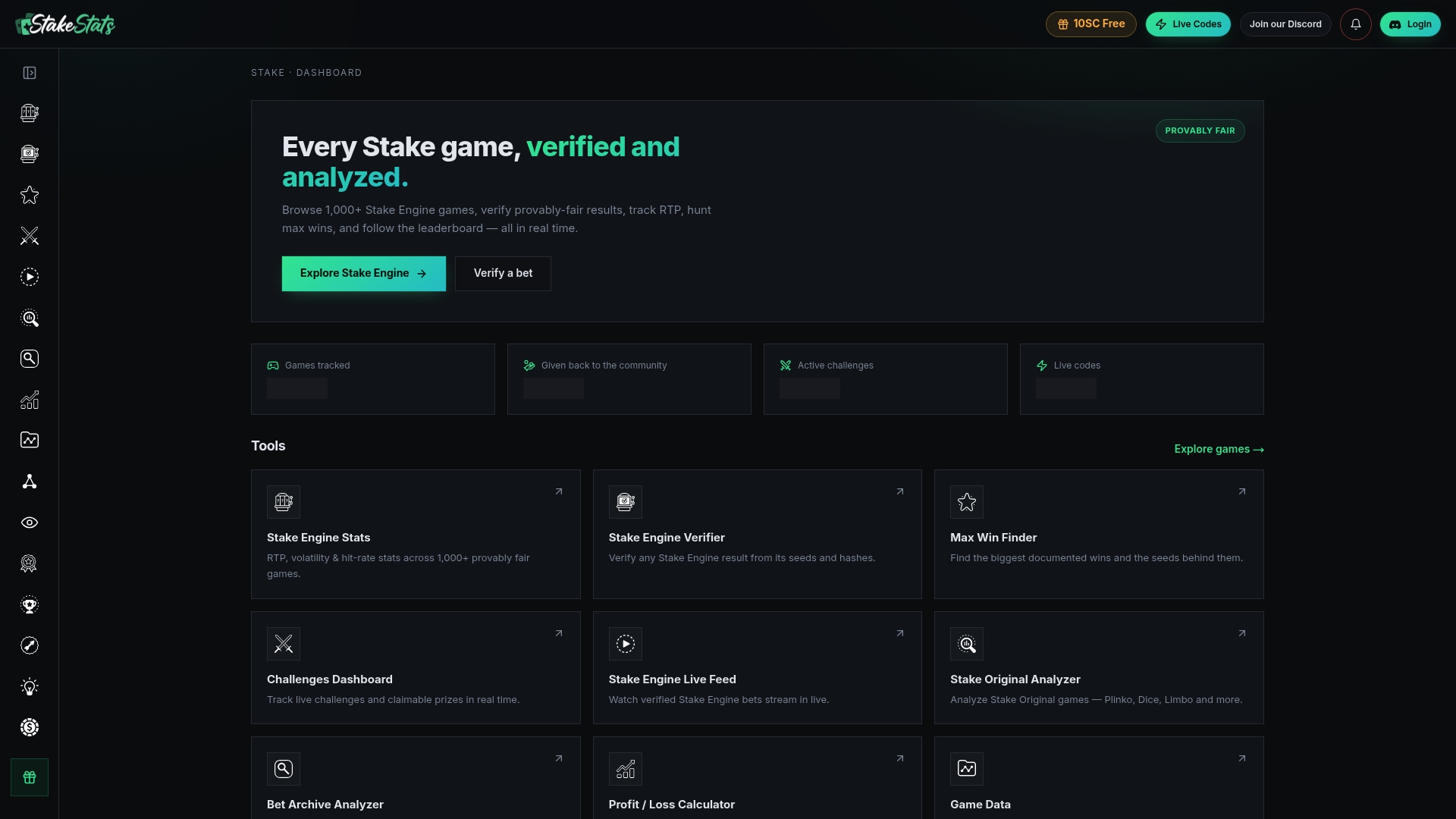
At Stakestats we build live analytics and verification tools for provably fair gambling, including bankroll analyzers and real-time RTP, volatility and hit rate stats for 2500+ Stake Engine games. Our guides focus on practical verification steps and transparent odds and payout data. Use a break to check the volatility of the games you favor and set limits that fit them, and explore the tools on Stakestats before you return to play.
Perspective
We built Stakestats because players deserve to see the math behind what they play. A cooling-off period belongs in that same toolkit: it is a decision you make with a clear head that protects the version of you who sits down tired, frustrated or chasing.
What we see in the way people talk about breaks is that they treat them as a verdict on themselves. They aren't. A timeout is a bankroll tool, like a stop-loss, and it works best when you pair it with numbers: how volatile your favorite game is, how big a swing your bankroll can absorb, and what a session is worth to you before it starts.
Our approach is to make that math visible. Our bankroll analyzers, session calculators and game stats are designed to help you set limits on facts rather than feelings, so when a break ends you return with a plan instead of a hunch.
Ian
FAQ
Is a cooling-off period the same as self-exclusion?
No. A cooling-off period is a short break you choose, such as 24 hours to 6 months in Massachusetts, and it usually covers one operator or account. Self-exclusion is longer, often years, and in many states applies to every licensed operator, with strict rules for getting back in.
Can I withdraw money during a cooling-off period?
In the Massachusetts example, yes: the state lottery says players in a cool-off can still withdraw funds, although deposits and betting are blocked. Sports wagering rules there also require operators to honor withdrawals from open or closed accounts. Check your own operator's terms for timing.
Can I end a cooling-off period early?
Usually not. The Massachusetts iLottery terms say you may not decrease, cancel or change the duration once it starts. When it expires, you can extend it or reinstate access, so pick a length you are comfortable keeping.
How long should my cooling-off period be?
Choose the shortest period that gives you a real reset, and go longer if you're returning to the same pattern. In states with a 72-hour minimum, such as Michigan and Virginia, that is the starting point. If a few breaks haven't changed anything, consider self-exclusion and speak with a professional.
Does a cooling-off period apply at crypto casinos?
Only if the site provides one. State rules apply to operators licensed in that state, and offshore or crypto sites set their own tools. If a site offers a timeout, use it, and back it with your own session and loss limits.
Sources
- Online Responsible Gaming Tools, Michigan Gaming Control Board
- Massachusetts Gaming Commission meeting materials, February 28, 2023
- iLottery Cool-Off Terms and Conditions, effective July 27, 2026
- Responsible Gaming, Massachusetts Lottery
- 205 CMR 248.12, Code of Massachusetts Regulations
- BetMGM Massachusetts House Rules, November 24, 2025
- 11VAC5-80-120, Protections for at-risk or problem bettors, Virginia Administrative Code
- U.S. Online Responsible Gaming Regulations evaluation, National Council on Problem Gambling
- Illinois regulators propose expansion to self-exclusion program, NPR Illinois