
Stake Dice Odds: A Practical Guide for Stake Players

Every bet you place on Stake Dice carries an expected loss of exactly $0.01 per dollar wagered, regardless of which win chance you pick. That's the core math: the multiplier formula is multiplier = 0.99 / win_chance, which locks the 1% house edge into every possible setting. The numbers change; the expected value (EV) does not.
What you can control is variance. High win-chance settings produce frequent small wins and a smoother session curve. Low win-chance settings produce rare large wins and a volatile ride. Pick your odds to match your session style, not to chase a mathematical edge that doesn't exist.
- Multiplier formula: 0.99 ÷ win_chance (expressed as a decimal)
- EV per $1 staked: −$0.01
- Quick examples: 49.5% → ~2.00x | 65% → ~1.5231x | 20% → ~4.95x
$0.01 — your expected loss on every single dollar you bet at Stake Dice, at every win-chance setting.
Key Takeaways
Every Stake Dice bet carries a fixed expected loss of $0.01 per dollar wagered, and no staking system or odds selection changes that number, only the variance around it.
| Point | Details |
|---|---|
| Multiplier formula | Multiplier = 0.99 ÷ win_chance; EV per $1 staked is always −$0.01. |
| Pick odds for variance | High win chance (65%+) smooths sessions; low win chance (under 10%) increases volatility with identical EV. |
| Bankroll sizing | Start at 0.5–1% of bankroll per roll; set a stop-loss at 20–30% of your session stack. |
| Verify with Stakestats | Use the seed verification helper and bankroll analyzer to confirm fairness and model progressions before real play. |
| Responsible play | Set time and loss limits before every session; check your state's law before wagering real money. |
Table of Contents
- How does Stake calculate dice multipliers from the win-chance slider?
- Why the 1% house edge fixes your expected loss no matter what
- What are the most common dice betting strategies and do any of them work?
- How should you size your bankroll for Stake Dice?
- How do you verify a Stake Dice roll is provably fair?
- Responsible gambling and U.S. legal considerations
- What should you actually do before your next Stake Dice session?
- Stakestats gives you the tools to play Stake Dice with real clarity
- Sources
How does Stake calculate dice multipliers from the win-chance slider?
The exact formula is:
multiplier = 99 ÷ win_chance%
Stake displays the result rounded to four decimal places. You can also flip between "roll under" and "roll over" modes; the math is identical since the win-chance percentage stays the same either way.
Common win-chance targets and their multipliers
Always check the displayed max-win figure before placing a high-multiplier bet, since the cap can cut your theoretical return significantly.
How to compute a payout for any target
- Choose your win-chance percentage (e.g., 30%).
- Divide 99 by that number: 99 ÷ 30 = 3.3000x.
- Multiply your stake by the result: $5 × 3.3 = $16.50 theoretical payout.
- Subtract your original stake to find net profit: $16.50 − $5.00 = $11.50.
- Cross-check against the displayed max-win cap before confirming the bet.
The dice probability calculator at GamblingCalc automates this and also models streak probabilities, which is useful when planning progressions. For a Stake-specific version with rakeback considerations, the Stake Dice Calculator at PlayOnStake covers platform limits and bonus effects on effective EV.
Why the 1% house edge fixes your expected loss no matter what
The algebra here is short. Expected value per $1 staked is:
EV = win_chance × multiplier − 1
Substitute the multiplier formula (0.99 / win_chance):
EV = winchance × (0.99 / winchance) − 1 = 0.99 − 1 = −0.01
The win_chance terms cancel. Over a long session, expected loss equals 1% of total volume wagered, a figure confirmed by the MathWorld dice probability reference on how fixed-probability games behave across large samples.
The practical implication: a player who wagers $10,000 in total volume across any session, at any win-chance setting, should expect to lose roughly $100 in the long run. No staking system changes that number.
Where things get complicated is variance. The EV is identical; the path to that EV looks completely different.
Finite sessions add another wrinkle. In any short run, variance dominates. That's why bankroll sizing matters far more than odds selection.
What are the most common dice betting strategies and do any of them work?
None of the popular strategies change EV. What they do is reshape variance, and that distinction is worth understanding before you commit real money to any of them.
Martingale
Double your stake after every loss, reset to base after a win. The idea is that one win recovers all prior losses plus a small profit. A $1 base bet becomes a $512 bet. A $5 base bet becomes $2,560. The Freetips dice guide documents this stake growth clearly: Martingale doesn't reduce losses, it concentrates them into rare but catastrophic events when the streak outlasts your bankroll.

Pros: Recovers losses quickly during normal variance; simple to execute. Cons: Exponential stake growth; one long streak wipes the bankroll; Stake's max-bet cap can make the required stake impossible before recovery.
Flat betting
Bet the same amount every roll. No progression, no chasing.
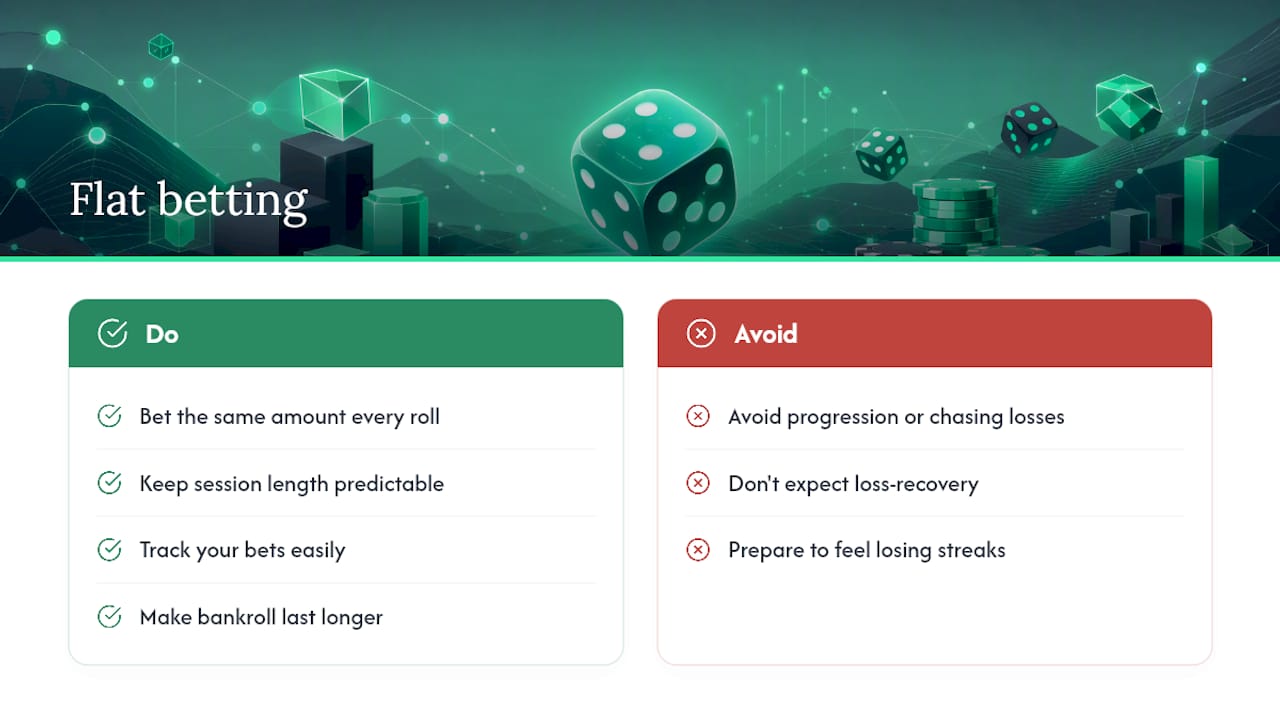
Pros: Predictable session length; bankroll survives longer; easy to track. Cons: No loss-recovery mechanism; you feel every losing streak directly.
Kelly Criterion
Bet a fraction of your bankroll proportional to your edge.
Pros: Mathematically grounded; prevents overbetting. Cons: Requires discipline; doesn't create an edge where none exists.
Reverse Martingale (Paroli)
Double after wins, reset after losses. You ride winning streaks and limit downside to your base bet per losing roll.
Pros: Losses are capped at the base stake; captures upside during hot streaks; lower ruin risk than standard Martingale. Cons: Winning streaks end, and you give back accumulated gains when they do.
D'Alembert
Increase stake by one unit after a loss, decrease by one unit after a win. Slower progression than Martingale.
Pros: Gentler stake growth; less catastrophic than Martingale on long streaks. Cons: Still a negative-progression system; doesn't change EV; can still deplete bankroll on extended losing runs.
Pro Tip: Reverse Martingale makes more sense than standard Martingale for entertainment players. Your worst case is losing your base bet repeatedly, which is manageable. Standard Martingale's worst case is a forced bet you can't cover, which ends your session immediately. Use a dice strategy calculator to model how many consecutive losses each system can absorb before hitting your bankroll limit.
How should you size your bankroll for Stake Dice?
The right starting bet depends on how much variance you can absorb without busting. Three practical profiles cover most players.
A 5-loss streak has several percent chance of occurring in any 5-bet sequence. A 10-loss streak is rare but possible; over many rolls, such streaks become expected to occur occasionally. The CleverCalculator dice probability tool enumerates these exact probabilities for any streak length.
That's more than four times the entire bankroll.
Practical rules for any profile
- Stop-loss: Set a session loss limit at 20–30% of your starting bankroll and walk away when you hit it.
- Stop-win: Lock in profits at 20–50% above your starting stack and don't give it back.
- Reserve capital: Keep at least 20% of your total bankroll untouched as a buffer outside the session.
- Stake-specific limits: Stake's minimum bet is typically $0.00000001 (in crypto terms), but the practical floor depends on the coin. Maximum bets vary by game and VIP level. High-multiplier settings (under 1% win chance) hit the max-payout cap quickly, making large-stake progressions infeasible. Check the displayed limits before committing to any progression system.
Rakeback and bonuses can nudge effective EV slightly. The Stake Dice Calculator factors in rakeback rates so you can model whether your volume qualifies for meaningful return. At low VIP tiers, rakeback is small enough to ignore for session planning. At high volume, it's worth accounting for.
How do you verify a Stake Dice roll is provably fair?
Stake Dice uses a provably-fair system built on three inputs: a server seed (hashed before the roll), a client seed (set by you), and a nonce (a counter that increments with each bet). Together, they determine the roll outcome. You can verify any roll after the fact by revealing the server seed and running the same hash yourself.
- Before betting: Note the hashed server seed displayed in the fairness panel. You can't see the raw seed yet, but the hash commits Stake to a specific outcome sequence.
- After betting: Click "Verify" on any completed bet. Stake reveals the raw server seed.
- Copy three values: raw server seed, your client seed, and the nonce for that specific bet.
- Run the verification: Paste those three values into a verification tool. The tool hashes the inputs using the same algorithm Stake uses and produces the roll result.
- Compare: If the computed result matches the recorded outcome, the roll was fair. Any mismatch indicates a problem worth reporting.
- Rotate seeds: After revealing a server seed, Stake generates a new one. Rotating your client seed periodically adds an extra layer of unpredictability.
The Stakestats provably-fair explanation walks through this process with Stake-specific UI guidance, including exactly where to find the seed panel and how to interpret the output.
What Stakestats adds to this process
- Seed verification helper: Automates the hash computation so you don't need to run scripts manually.
- Bankroll analyzer: Simulates progressions and estimates survival probability across thousands of rolls.
- Volatility and hit-rate stats: Covers 2,500+ Stake Engine games, including Dice, so you can compare variance profiles before choosing a game.
- Max-win and bet replay lookup: Lets you pull any historical bet by ID and confirm the outcome.
- Bonus and rakeback tracker: Aggregates current Stake promotional codes and rakeback rates so you can factor them into your EV calculations.
The Stake Engine tool is particularly useful for understanding how Dice compares to other Stake originals on volatility and RTP before you commit a session bankroll.
Responsible gambling and U.S. legal considerations
Set a session budget before you open the game, not after you've started losing. That single habit separates recreational players from those who develop problems. A few concrete rules:
- Decide your stop-loss and stop-win limits before the first bet.
- Never chase losses with a larger stake than your plan allows.
- Treat gambling losses as the cost of entertainment, not a debt to recover.
- If gambling is affecting your finances, relationships, or mental health, stop and get help.
If you need support, GambleAware offers free, confidential help and self-assessment tools. Gambling Therapy provides international support with U.S.-accessible resources. The National Council on Problem Gambling (NCPG) runs a 24/7 helpline at 1-800-522-4700.
On legality: online gambling law in the United States varies by state. Some states explicitly permit online casino-style games; others prohibit them. Stake.us operates under a social-casino model in most U.S. states, which is legally distinct from real-money gambling, but the rules shift frequently. Check your state's current law before wagering. This article is general information, not legal advice.
What should you actually do before your next Stake Dice session?
Three decisions cover everything that matters:
- Pick win chance for volatility, not EV. Want a calm session with frequent small wins? Stay above 49.5%. Want high-variance swings with rare big payouts? Go lower. The house edge is 1% either way.
- Use conservative staking rules. Start at 0.5–1% of your session bankroll per roll. Set a stop-loss at 20–30% of your stack and honor it.
- Verify rolls and track volume with Stakestats. Use the bankroll analyzer to model your chosen strategy before real stakes. Run seed verification on any session that felt statistically unusual.
What you can do is manage how that edge affects your session, protect your bankroll from catastrophic variance, and confirm the game is running fairly. That's the realistic scope of dice strategy on Stake.
Why I prefer predictable sessions over chasing multipliers
The math doesn't support that preference. The EV is identical, but the psychological experience is completely different, and psychology is where most bankrolls actually break.
When the session log shows I've wagered $2,000 in volume, I expect to be down roughly $20. If I'm down $200, variance is the culprit, not strategy failure. Knowing that distinction keeps the session rational.
One practical tip: set a time-based stop alongside your loss limit. Decide before you start that you'll play for 45 minutes maximum, regardless of outcome. Time limits catch the sessions where you're not losing fast enough to trigger the stop-loss but are still grinding toward a bad outcome.
Stakestats gives you the tools to play Stake Dice with real clarity
Most players go into a Stake Dice session with a rough strategy and no way to verify whether the game is running as advertised. Stakestats closes that gap.

The provably-fair verification tool lets you confirm any roll outcome using server seed, client seed, and nonce, without writing a single line of code. The bankroll analyzer lets you stress-test a Martingale or Reverse Martingale scenario across thousands of simulated rolls before you risk real funds. The bonus and rakeback tracker keeps current Stake promotional codes in one place so you can factor promotions into your effective EV. None of these tools change the house edge. What they do is give you accurate information so your decisions are based on math, not guesswork.
Start with the bankroll analyzer. Plug in your session budget, your chosen win chance, and your staking plan. The output will show you exactly how many consecutive losses your bankroll can absorb and where your ruin probability sits. That's the information worth having before the first roll.
Sources
- Stake Dice — 99% RTP, Martingale Math, and Why Duel Ships 100% RTP | TRUST-Play
- Crypto Dice Strategy Calculator - Odds & Multipliers
- Freetips
- Stake Dice Calculator | Crypto Dice Strategy Tool
- Gambleaware
- A die (Dice) — MathWorld
This article is general information, not a substitute for advice from a qualified financial advisor. Consult a qualified financial professional about your own circumstances before acting on anything here.