
Drawdown in Gambling: What It Is and How to Measure It

Drawdown in gambling is the drop from your bankroll's highest point to its lowest point afterward, measured in dollars or as a percentage of that peak. It is not the same as being down overall, and it is the number that tells you how much pain a session or a stretch of play actually put you through. We build Stakestats around that kind of transparency: bet verification, live RTP, volatility and hit rate stats, and bankroll analyzers, so you can see what your play really looks like instead of guessing.
This guide covers the formula, the recovery math that makes deep drawdowns so punishing, how stake size sets your drawdown, and a simple way to track it.
TL;DR
- Drawdown = peak bankroll minus current bankroll. Divide by the peak to get a percentage.
- Always measure from the running peak, not from where you started. Otherwise you understate the damage.
- Recovery is lopsided: a 50% drawdown needs a 100% gain to get back to the peak.
- Stake size is the lever you control. Bigger units mean deeper drawdowns, even on a fair game.
- A verified, provably fair game can still hand you a deep drawdown. Fairness and variance are different things.
Table of Contents
- What drawdown means when you gamble
- How to calculate drawdown
- Why a deep drawdown is so hard to climb out of
- Stake size decides how deep you fall
- What the research says about drawdown in a single session
- Provably fair does not mean drawdown-free
- A simple drawdown routine
- See your own drawdown in real numbers
- Our view: drawdown is a sizing decision
- FAQ
- Sources
What drawdown means when you gamble
The term comes from trading, where it describes the fall of an account from a peak to a later trough. Gambling borrows it for the same reason: your bankroll moves up and down in a jagged line, and what matters is how far it falls before it climbs again.
A drawdown starts the moment your balance drops below its highest point. It ends only when you reach a new high. Everything in between is one drawdown, even if it contains many small wins and many separate losing bets. That is why it differs from a single loss or a losing streak. A streak is a run of results. A drawdown is the full distance your bankroll fell across the whole stretch.
Two numbers describe it:
- Depth: how far you fell from the peak, in dollars or percent.
- Duration: how long it took, in bets or days, to get back to the old peak (or how long you have been underwater).
Maximum drawdown is the deepest one across a given period, such as a session, a month, or your whole history. Researchers use it as a standard risk measure: a 2026 Monte Carlo study of seven European roulette strategies tracked the largest bankroll decrease from a previous maximum alongside ruin probability, and found that progressive betting strategies had heavier loss tails than fixed-stake betting.
How to calculate drawdown
The math is simple. You only need your highest balance so far and your balance now.
- Drawdown in dollars = peak bankroll − current bankroll
- Drawdown in percent = (peak − current) ÷ peak × 100
Worked example. You deposit $1,000 and run it up to $1,200. Then a cold stretch takes you to $900.
- Dollar drawdown: $1,200 − $900 = $300
- Percent drawdown: $300 ÷ $1,200 = 25%
Notice the trap. Measured from your starting $1,000, you are only down $100, or 10%. That feels mild. But from the peak you have given back a quarter of your bankroll. Both facts are true, and only the second one describes how the ride actually felt and how much room you have left.
Measure from the running peak
The most common mistake is using the starting bankroll as the reference. If your balance climbs to $2,600 and then falls to $1,950, the drawdown is $650, or 25%. Against a $2,000 starting stake, that low looks like a 2.5% dip. The peak moves up every time you set a new high, so your reference point has to move with it.
Keep deposits and withdrawals out of it
Track only betting results. If you top up your account or cash out, the balance jumps for reasons that have nothing to do with how you played. Record the balance after each bet with transfers removed, keep a running peak, and compute the drawdown from those two numbers. A spreadsheet with three columns (result, balance, peak) is enough.
Why a deep drawdown is so hard to climb out of
Here is the part that surprises most players. Losses and gains are not symmetrical, because every gain is calculated on the smaller balance you have left.
The formula for the gain you need to get back to the peak is:
Required gain = drawdown ÷ (1 − drawdown), with the drawdown written as a decimal.
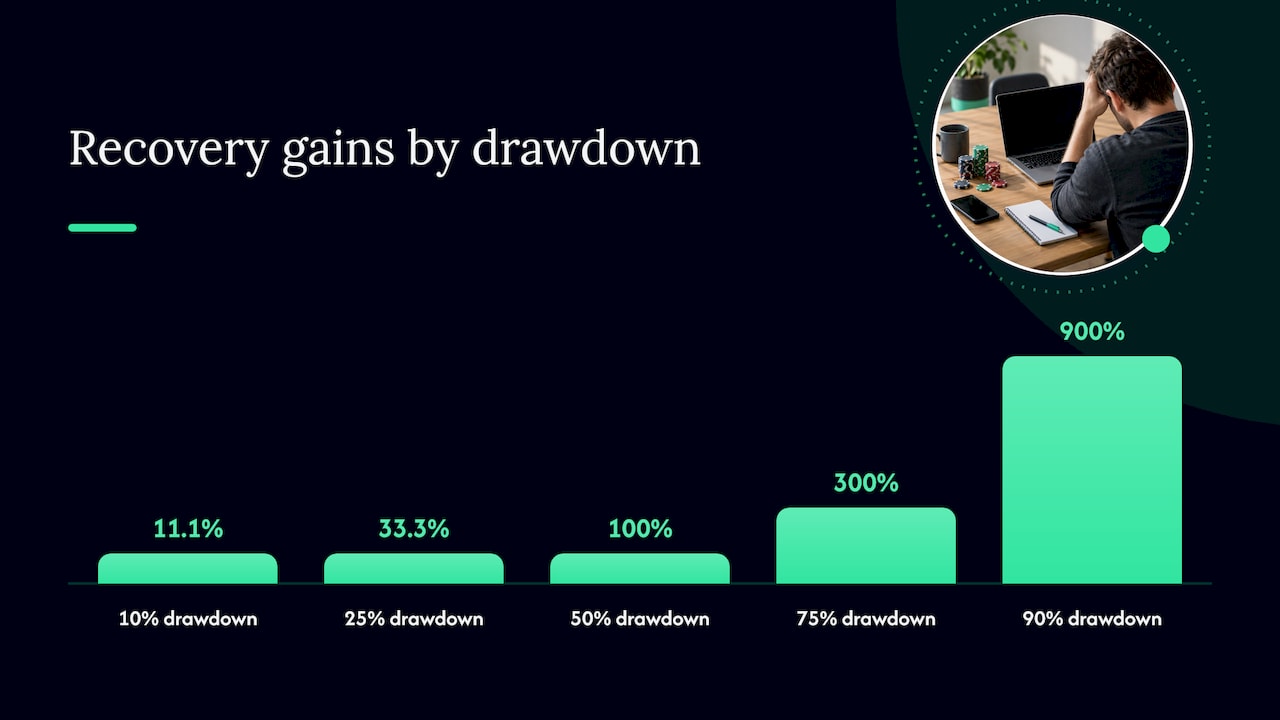
Take $1,000 down to $500. You lost 50%, but you now need to earn $500 on a $500 balance, which is a 100% gain. The bankroll must double just to break even.
| Drawdown from peak | Gain needed to recover |
|---|---|
| 10% | 11.1% |
| 25% | 33.3% |
| 40% | 66.7% |
| 50% | 100% |
| 75% | 300% |
| 90% | 900% |
The 10% and 50% pairs match InvestmentNews' drawdown table, which shows an 11% gain recovering a 10% loss and a 100% gain recovering a 50% loss. The other rows follow from the same formula.
This is why experienced players care more about avoiding the deep hole than about digging out of it. A 10% drawdown is routine. A 50% drawdown asks for a result that a game with a house edge may never hand you. And at 100% there is nothing left to grow, so recovery by percentage stops being possible at all.
A useful habit: before you raise a stake to "win it back," write down the gain you need. Seeing "+100%" next to a $500 balance is usually enough to slow things down.
Stake size decides how deep you fall
You cannot choose the dice, the slot's volatility, or the sequence of results. You can choose the size of each bet relative to your bankroll, and that choice drives drawdown depth more than anything else.
Here is a simple illustration with made-up numbers. Suppose you have a $1,000 bankroll and your results over a stretch are a net loss of 12 betting units from the peak.
- At $10 per unit, that is a $120 drawdown: 12% of the bankroll.
- At $25 per unit, that is a $300 drawdown: 30%, which needs a 42.9% gain to recover.
- At $50 per unit, that is a $600 drawdown: 60%, which needs a 150% gain.
The same luck produced three very different experiences. Doubling the unit more than doubles the pain, because the recovery requirement grows faster than the loss does.
This is the reasoning behind unit-based staking. Our guide to bankroll management with 1% to 2% units shows how to size units and when to resize them. If you want to go further into proportional sizing, the Kelly criterion for gambling explains why capping your bet at a fraction of the full Kelly amount keeps swings smaller, and Kelly stake sizing in dollars turns fractions into actual bet amounts.
What the research says about drawdown in a single session
Drawdown is not only a long-term concept. Within a single sitting, your balance can sink well below where you started before it recovers, or fail to recover.
A study from TU Dortmund simulated 100,000 sessions of 85 American roulette spins using a Paroli (positive progression) system. The median session dipped about 16 units below its starting level at its lowest point, and the extreme cases fell more than 50 units below. The authors concluded that these intra-session drawdowns are a key driver of the capital buffer a player needs. A bankroll sized only for the average outcome underestimates exposure.
The practical lesson: the balance you see at the end of a session hides the worst moment of it. If you only check your result when you log off, you never learn how close you came to your limit.
Provably fair does not mean drawdown-free
On provably fair sites, you can verify that each result came from the server seed, client seed and nonce rather than from manipulation. That is valuable, and it is the foundation of what we build. But verification answers one question: was this outcome generated honestly? It does not change the game's house edge, and it does not smooth out variance.
A fair game with a house edge still produces losing streaks, and a long enough one is a deep drawdown. Honest randomness is exactly what creates the swings. If you hit a rough patch on a verified game, that is consistent with the game working as designed, not evidence that something is wrong. Our piece on streak probability in slots shows how likely long losing runs actually are, and the gambler's fallacy explains why a streak never makes a win "due."
Two stats help you plan for drawdown before you play:
- Volatility: how widely results swing around the average. Higher volatility means deeper and longer drawdowns for the same stake.
- Hit rate: how often a bet pays anything at all. A low hit rate means long dry stretches between wins.
If your bankroll is small, a lower-volatility game gives drawdowns less room to grow. See verified low volatility Stake games for a $50 bankroll for an example of choosing by these numbers.
A simple drawdown routine
You do not need software. You need a habit and a rule you set before you start.
- Record the balance after each bet or at fixed intervals. Exclude deposits and withdrawals.
- Keep a running peak. Update it whenever the balance sets a new high.
- Compute the drawdown percent from the formula above.
- Set a review line in advance. For example, a 30% fall from the peak. Reaching it means stop and review your staking, not raise your stakes.
- Check the recovery gain. Write down what you would need to earn to get back to the peak. If the number looks unrealistic, the answer is a smaller unit, not a bigger bet.
- Resize when the bankroll changes. Units are a percentage of the current bankroll, so they shrink after a drawdown and grow after a run-up.
For turning a review line into a firm exit, setting stop-losses with 2SD math gives a method based on the expected spread of results rather than a gut feeling. And if you vary your bets within a session, bet spread control explains how to size stakes so a bad run does not get away from you.
If gambling stops feeling like entertainment, or you find yourself chasing losses, step away and talk to a counselor. Drawdown math is a tool for managing risk, not a promise that any approach wins.
See your own drawdown in real numbers
Tracking by hand works, but the inputs matter: the true volatility and hit rate of the game you are playing, and an honest record of your bets. Stakestats gives you live RTP, volatility and hit rate stats for 2,500+ Stake Engine games, server seed and nonce bet verification, and bankroll analyzers, so you can pick a game and a stake size that fit your bankroll before the first bet. Start at Stakestats.

Our view: drawdown is a sizing decision
Most players treat a deep drawdown as bad luck that happened to them. We see it differently: it is mostly a decision made before the first bet, when the stake was chosen.
The math leaves little room for debate. Because recovery is lopsided, every extra point of depth costs more to climb back than the last. That is why we put so much weight on numbers you can check: the volatility of the game, its hit rate, the verified record of your own bets. When those are visible, you can size a unit so that an ordinary rough patch stays an inconvenience.
Provably fair tools matter here for a specific reason. They let you confirm that a result was generated honestly, so you can separate the question "was this rigged?" from the question "was my stake too big for this game?" The second one is almost always the one worth asking.
Ian
FAQ
What does drawdown mean in gambling?
It is the decline from your bankroll's highest point to a lower balance afterward. You can state it in dollars or as a percentage of the peak. It lasts until your balance climbs back above that peak.
Why is a 50% drawdown harder to recover than a 10% one?
Gains are calculated on the smaller balance you have left. A 10% drawdown needs an 11.1% gain to recover, while a 50% drawdown needs a 100% gain, meaning your remaining bankroll has to double.
Is drawdown the same as a loss?
No. A loss is the result of one bet or one session, usually measured against where you started. Drawdown is measured against your peak, so you can be up overall and still be in a sizable drawdown, such as falling from $1,200 to $900 after starting with $1,000.
Can a provably fair game still cause a big drawdown?
Yes. Provably fair verification confirms that outcomes were generated honestly from the seeds. It does not remove the house edge or the variance of the game, so deep drawdowns remain a normal part of play, especially at high volatility or large stakes.
How do I reduce my drawdown?
Size each bet as a small share of your current bankroll, choose lower-volatility games when your bankroll is small, and set a review point, such as a 30% fall from the peak, before you start. Smaller units are the most direct way to shallow the drops.
Sources
- Drawdown glossary entry, InvestmentNews
- Analyzing Paroli and Let-It-Ride Betting Systems, TU Dortmund
- Comparison of the effectiveness of roulette betting strategies, Journal of Computer Science and Innovation