
Fair Play Audit for Online Casino Games: What It Proves

A fair play audit of an online gambling game answers one question: do the results the game produces match the odds it says it has? There are two ways to get that answer. A regulated operator hires an independent test lab to review the game before and after launch. On a provably fair site, you can check individual bets yourself with cryptography. Neither one tells you a game is a good bet, and neither one tells you a site is legal where you live.
This guide explains both kinds of audit, walks through a bet-level check step by step, and shows what the evidence can and cannot prove. It also covers how U.S. rules fit in, so you can judge a fairness claim before you deposit.
TL;DR
- A fair play audit checks that outcomes are random and match the published return to player (RTP). It does not remove the house edge or predict results.
- Regulated casinos rely on independent lab testing of the random number generator (RNG) and the game code. Provably fair sites let you check single bets with a server seed, a client seed and a nonce.
- A passed audit says nothing about legality. An offshore site can advertise verification without any U.S. regulatory approval.
- You can run a bet-level check in a few minutes. For a bigger picture, compare your own results against a game's long-run RTP, hit rate and volatility.
- Use fairness evidence to choose games and size your bankroll, never to expect a winning session.
Table of Contents
- What a fair play audit means in online gambling
- Two kinds of audit, side by side
- What an independent lab actually reviews
- How a provably fair check works
- What an audit can prove, and what it can't
- Fairness is not legality
- How to judge a fairness claim in five minutes
- Turning fairness data into better decisions
- Perspective
- Check your own bets with Stakestats
- FAQ
- Sources
What a fair play audit means in online gambling
The phrase has no single legal definition. Search it and you will mostly find household-management books and school equity programs, which have nothing to do with gambling. In casino games it covers a set of checks with one goal: the game behaves the way its rules and paytable say it does.
Those checks usually answer three questions:
- Is the randomness real? The code that produces outcomes must not be biased or predictable.
- Does the math match the paytable? Over a large number of rounds, the observed RTP should land close to the designed RTP.
- Is the software the same software that was tested? The version running live must match the version that was approved.
The UK Gambling Commission describes the conventional model in its guidance on how online gambling games are kept fair: approved test houses check games before release, and live performance is then checked against the designed RTP. That is a British rule, not a U.S. one, but it shows what a mature audit looks like. It is a useful yardstick for any fairness claim you read.
Two kinds of audit, side by side
Most confusion comes from mixing up a lab audit and a provably fair check. They answer different questions.
| Independent lab audit | Provably fair verification | |
|---|---|---|
| Who checks | A test laboratory, then a regulator | You, or any tool you use |
| What is checked | RNG, game math, source code, live RTP | One bet at a time |
| When | Before release and on an ongoing basis | After each bet, whenever you want |
| Evidence | A certificate or report | Seeds, nonce and a recomputed result |
| Covers long-run RTP | Yes, by statistical testing | Only if you gather many bets |
| Covers legality | Only inside a licensed market | No |
The two are complementary. A lab looks at the whole system. A provably fair check looks at your own bets, which is something a lab report can never do.
What an independent lab actually reviews
The GLI-19 standard for interactive gaming systems is a good reference. Its July 2026 v4.0 draft says an independent test laboratory must review the source code for the core randomness algorithms, scaling algorithms, shuffling algorithms and other functions that shape the final random outcome. It also calls for statistical tests, evaluated together at a 99% confidence level, on the outcomes the RNG produces. Because that document is a draft, treat it as a picture of where testing is heading, not as the final text.

U.S. states with regulated online gaming set their own technical rules. New Jersey's Technical Services Bureau, for example, asks for technical documentation, source code and compiled binaries, plus descriptions of the RNG, pay-evaluation routines, bonus features and how the device operates. Pennsylvania's published regulations include dedicated provisions for RNG standards, software authentication, game changes, fairness and logging.
What these have in common is that someone other than the operator looks at the code, and the result is tied to a specific software version. When a site says "audited," ask who audited it, which version, and when. A vague badge answers none of those.
How a provably fair check works
Provably fair games replace "trust the lab" with "check it yourself." The idea is a commitment scheme. According to Chainlink's technical guide, the operator publishes a hash of the secret server seed before play. Later the seed is revealed, and you compare hashes. You then use the revealed server seed, your client seed and the nonce with the system's hashing algorithm to reproduce the result.
Here is what each piece does:
- Server seed: a secret value the casino generates. You see only its hash while it is active.
- Client seed: a value you control and can change. It stops the casino from picking all the inputs alone.
- Nonce: a counter that goes up by one with each bet, so every bet on the same seed pair gets a different result.
- Hash: a fingerprint. Publishing the server seed's hash first locks the casino in. It can't swap the seed after seeing your bets without the hashes failing to match.
Step-by-step bet verification
- Note your active seed pair. Before you play, record the hashed server seed and your client seed.
- Play your session. Bets on that seed pair use nonce 0, 1, 2 and so on.
- Rotate the seed. Changing the seed pair makes the casino reveal the old server seed.
- Check the commitment. Hash the revealed server seed. It must equal the hash you saw before you played.
- Recompute the bets. Feed the server seed, client seed and a bet's nonce into the game's documented formula, and compare your result with what the game paid.
- Repeat for more than one bet. Check the first bet, the last bet and a few in between.
You don't have to do the hashing by hand. Our bet verification tool takes the seeds and nonce and reproduces the outcome, and our provably fair explainer walks through the logic in more detail.
What an audit can prove, and what it can't
This is the part most marketing skips. A narrow, honest reading of the evidence is the safest one.
The Coinfomania verification guide from July 2026 puts it clearly: provably fair technology does not remove the house edge, predict future outcomes or guarantee a winning session. What it can show is narrower. The revealed seed matches the earlier commitment, and the public inputs reproduce the settled result under the documented resolver and paytable.
In practice, a good audit or verification can tell you:
- The casino did not change the server seed after you bet.
- A specific bet's result follows from the inputs and the published formula.
- Over many rounds, results are in line with the stated probabilities.
It cannot tell you:
- That you will win, or that a losing streak is "due" to end.
- That the published paytable is generous. A game can be fair and still carry a house edge.
- That the operator will pay out, or that the site is licensed where you live.
- That the formula you are checking is the one the game truly uses, unless the formula is documented and reproducible.
That last point matters. A seed check only means something when the game's resolver is public. Verification against a formula nobody can inspect is just a ritual.
Fairness is not legality
A site can pass every cryptographic check and still be operating outside the law. The New York State Gaming Commission warns that online casinos, including sites claiming to be sweepstakes, are unlawful in New York. The same lesson applies elsewhere: an offshore site can advertise verification without any U.S. regulatory approval.
Keep two questions apart:
- Is the game fair? Answered by lab audits and seed verification.
- Am I allowed to play it, and who protects me if something goes wrong? Answered by your state's law and the operator's license.
Online casino rules differ widely by state, so check your own state's gaming regulator before you deposit anywhere. We cover fairness data. We can't tell you what is legal where you live, and a good fairness result never substitutes for that check.
How to judge a fairness claim in five minutes
Use this checklist on any casino or game page that says "fair," "audited" or "certified."
- Who is named? A real test lab or regulator, not just a logo.
- What was tested? The RNG alone, the game math, or the whole platform?
- Which version and when? Reports tie to software builds and have dates.
- Is the formula public? For provably fair games, the resolver should be documented well enough to reimplement.
- Can you check your own bets? Seed reveal, nonce and bet history should be available to you.
- Is the RTP stated? An honest game publishes its designed return, and you can compare it with what you observe.
- Is it legal for you? See your state regulator, not the casino's FAQ.
Operators sometimes publish their own audit descriptions too, such as monthly output reviews that compare observed events with theoretical probabilities. Those are useful, but they are the operator's account of itself. They carry more weight when an outside lab or regulator confirms them.
Turning fairness data into better decisions
Once you know a game is fair, the useful question is what it does to your bankroll. Three numbers matter most:
- RTP: the share of wagers a game is designed to return over the long run. A 96% RTP means a 4% house edge, spread over millions of rounds. It says nothing definite about one session.
- Hit rate: how often a round pays anything at all. A high hit rate usually means smoother, smaller wins.
- Volatility: how widely results swing. High-volatility games pay rarely and sometimes large. You need a bigger bankroll to ride out dry stretches.
Here is a worked example. Say you play two games with the same 96% RTP. One has a high hit rate and low volatility, so your balance drifts down slowly with small bumps. The other pays rarely, so you might lose through 40 rounds in a row, then hit once. The long-run cost is the same. The experience, and the bankroll you need, are very different. That is why matching volatility to your budget matters more than chasing a number.
Our game pages show live RTP, volatility and hit rate for 2,500+ Stake Engine games, and our bankroll analyzer helps you size bets against those figures. For Stake Originals, the Originals analyzer gives a similar view. Treat all of it as planning information. Gambling is entertainment with a built-in cost, and only money you can afford to lose belongs in play.
Perspective
Most "fair play" talk in gambling stops at a badge. We think that is backwards. A badge asks you to trust someone else's work, and provably fair design exists so you don't have to.
Our view is simple: fairness should be something you can check yourself, with your own bets, in minutes. That is why we built bet verification around the server seed, client seed and nonce, and why we publish RTP, volatility and hit rate for a wide catalog of games rather than a single site's headline numbers.
We also believe verification only counts when it is paired with math. Knowing a result is genuine is step one. Knowing what the game's odds and swings mean for your bankroll is step two. Players who do both make calmer, better-informed choices, and they stop mistaking variance for foul play or luck for skill.
Our aim is transparency first, with practical tools next to it, so that a fairness claim becomes a number and a check instead of a slogan.
Ian
Check your own bets with Stakestats
If you play on Stake or another provably fair site, you can put this guide to work right away. Use our bet verification tools to reproduce a result from its seeds and nonce, and look up live RTP, volatility, hit rate and max wins before you pick a game. Our Stakestats home page has the full set of tools, from bankroll analysis to bonus codes.
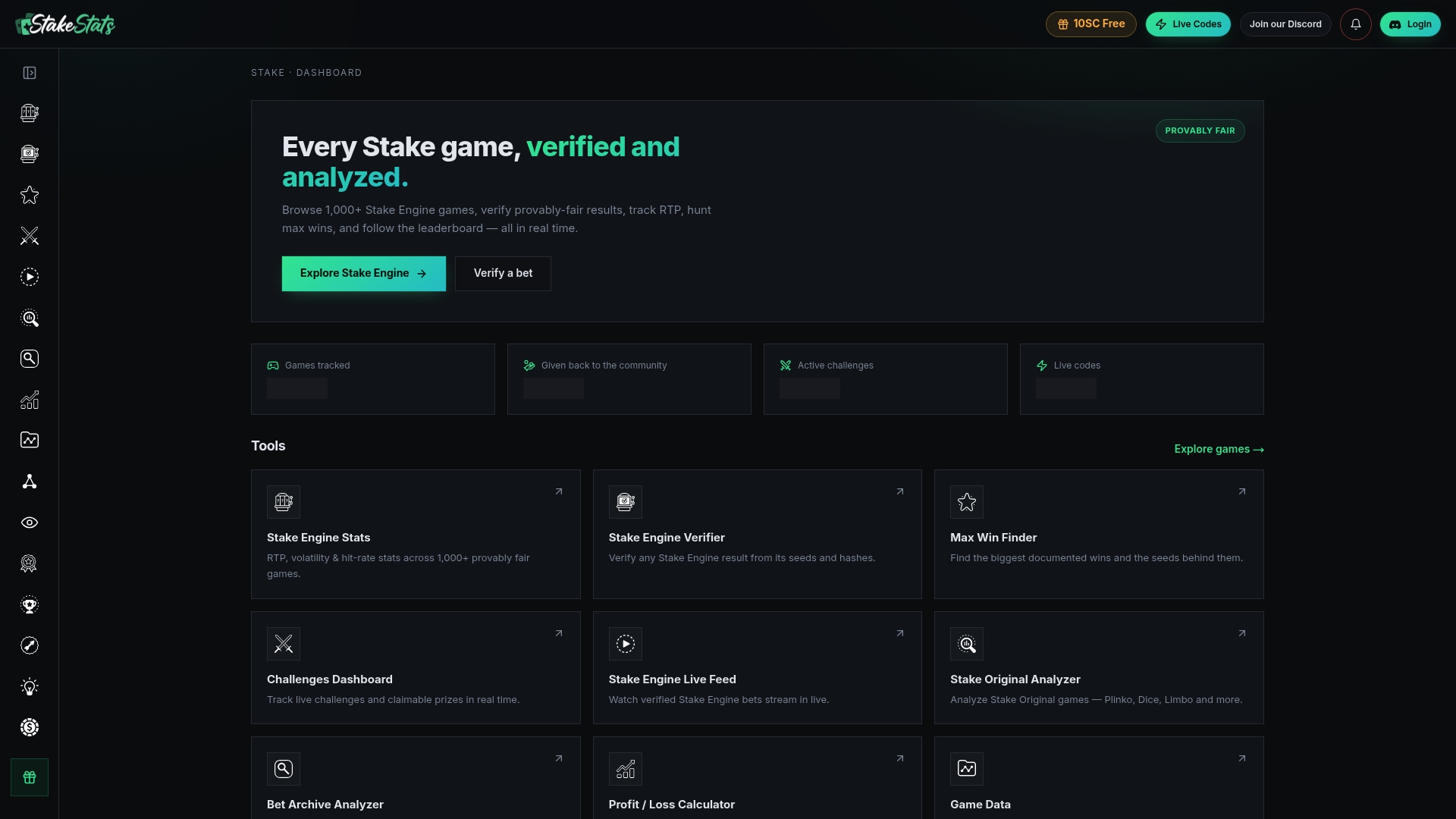
When you want to go deeper, our bet archive analysis lets you look back over past results, and the transparency page shows how we handle the data.
FAQ
What is a fair play audit in online gambling?
It is a set of checks that a game's outcomes are random and match its published odds and RTP. Regulated sites use independent test labs for this. Provably fair sites also let players verify single bets with seeds and a nonce.
Does a passed audit mean I will win?
No. An audit shows the game follows its stated math, and that math includes a house edge. It can't predict results or promise a winning session. Short-term results swing widely around the long-run RTP.
Can I verify a bet myself?
On provably fair games, yes. You need the revealed server seed, your client seed and the bet's nonce. Hash the server seed to confirm it matches the earlier commitment, then recompute the result with the game's formula. Our verification tool does the recomputation for you.
Is a provably fair casino legal in the U.S.?
Fairness and legality are separate questions. Regulators such as the New York State Gaming Commission have said unlicensed online casinos are unlawful in that state. Check your own state's gaming regulator before you play on any site.
How do I know if an audit claim is trustworthy?
Look for a named independent lab or regulator, the software version tested, a date, and a stated RTP. A bare badge with none of those gives you little to go on. For provably fair games, also confirm the formula is public.
Sources
- UK Gambling Commission: how online gambling games are kept fair
- Chainlink: Provably Fair Randomness, a technical guide
- Coinfomania: a practical guide to verifying crypto game results
- GLI-19 v4.0 draft, Interactive Gaming Systems
- New York State Gaming Commission: unlawful online gambling warning
- New Jersey Division of Gaming Enforcement: Technical Services Bureau submission instructions
- Pennsylvania Gaming Control Board: published regulations