
Stake HiLo Odds Explained: Per-Card Edge and Strategy

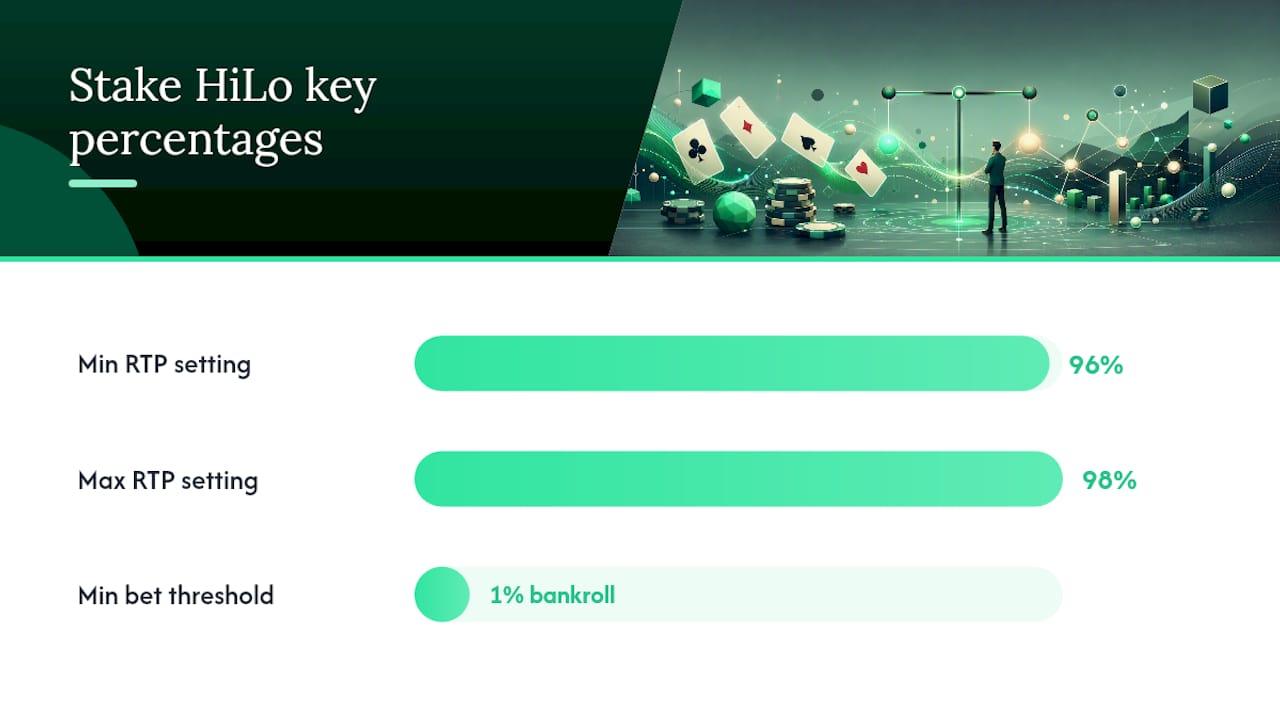
Stake HiLo runs at a reported RTP of 96%–98%, which means the house keeps roughly $2–$4 per $100 wagered over the long run. That range shifts depending on which base card you're dealt and which direction you bet — and a few cards tilt the math sharply against you.
Here's what matters before you place a single chip:
- RTP range: 96%–98% on Stake Originals HiLo
- House edge source: Payouts are set slightly below the mathematically fair multiplier, and ties (~1/13 draws) typically count as losses, adding hidden margin
- Best base cards for the player: Extreme ranks (Ace, 2, King, Queen) offer the clearest directional edge — the probability of a correct prediction is highest
- Worst base cards: 7 and 8 sit near the middle of the deck; neither "Higher" nor "Lower" gives you a meaningful probability advantage
- Can skill change the long-term edge? No. Card-awareness reduces variance and avoids the worst bets, but it cannot overcome a built-in house edge across thousands of rounds
Pro Tip: Avoid large bets when your base card is a 7 or 8. Use Stakestats verification tools to spot-check your round payouts against expected multipliers after each session.
Key Takeaways
| Point | Details |
|---|---|
| RTP range | Stake HiLo runs at 96%–98% RTP; the house keeps $2–$4 per $100 wagered long-term. |
| Best cards to bet | Extreme ranks (Ace, 2, King, Queen) give 94% win probability on the obvious direction. |
| Avoid 7 and 8 | Marginal cards offer ~— win probability in either direction — the worst EV on the board. |
| Tie-loss rule | Ties (~1/13 draws) count as losses on Stake HiLo, adding meaningful hidden house edge. |
| Bankroll rule | Use the 1% rule per round; cut to 0.5% on mid-range cards and skip marginal cards entirely. |
| Stakestats verification | Use Stakestats to verify round hashes, check session RTP, and replay bets for payout accuracy. |
Table of Contents
- What are the HiLo odds on Stake and how does a round work?
- Per-card payout multipliers and the house edge on every rank
- How volatility and streaks affect your HiLo session
- Which HiLo strategies actually change outcomes?
- How to verify a Stake HiLo round is provably fair
- Bankroll rules and responsible play for HiLo
- Stake-specific HiLo variants and rules that change your odds
- What I actually do in a live HiLo session
- Stakestats gives you the numbers behind every HiLo round
- Sources
What are the HiLo odds on Stake and how does a round work?
Stake HiLo is part of the Stake Originals suite, meaning it runs on Stake's own provably fair engine rather than a third-party RNG. A standard round follows a simple loop, but a few UI details change the effective odds in ways that catch players off guard.
Round flow:
- A start card is dealt face-up from a virtual 52-card deck
- You predict whether the next card will be Higher or Lower than the current card
- The round resolves: if correct, your multiplier compounds and you choose to cash out or continue; if wrong, you lose the bet
- A tie (same rank as the current card) typically counts as a loss on Stake HiLo — this is the rule to confirm before playing, since tie handling varies by platform and materially affects your effective RTP
- You can cash out at any point after a correct prediction; the multiplier locks in at that moment
What the Stake UI shows you:
- The current card and its rank
- Live odds for "Higher" and "Lower" on the next draw, displayed as multipliers
- Your running multiplier if you're mid-streak
- Bet size controls with table minimums and maximums
One thing worth noting: Stake displays the payout multiplier for each direction before you commit. That number already has the house margin baked in — it is not the fair-odds multiplier. The Stake UI's odds display is useful for quick directional awareness, but it doesn't tell you the implied house edge on that specific card. That requires the math in the next section.
Per-card payout multipliers and the house edge on every rank
This is where most HiLo guides stop short. Knowing the RTP range is useful; knowing which card is bleeding your bankroll is what actually changes decisions.
How the math works
A standard 52-card deck has 4 suits × 13 ranks. If your base card is a 5, there are 28 cards ranked higher (6 through King, 4 suits each = 32 cards, minus the 5s already accounted for — more precisely: ranks 6–K = 8 ranks × 4 = 32 cards higher, ranks A–4 = 4 ranks × 4 = 16 cards lower, and 3 remaining 5s as ties). The Wizard of Odds pay table formalizes this rank-by-rank for standard High–Low variants.

The fair multiplier for betting Higher on a 5 would be 51/32 ≈ 1.59×. Stake's actual payout is set slightly below that fair multiplier, and that gap is where the house captures its margin.
Per-card probability and house edge table
Win percentages calculated from remaining cards after dealing base card. Tie cards represent the remaining cards of the same rank.
The tie problem: With 3 tie cards in 51 remaining draws, roughly 1 in 17 draws is a tie. On platforms where ties count as losses, that adds a layer of house edge on top of the payout-multiplier reduction. DeucesCracked's probability analysis identifies this tie-loss rule as the single largest source of additional house advantage in HiLo.
Worked expected-value example: betting Higher on a 5
Here's the arithmetic on a $10 bet:
- Win probability (Higher): 32/51 ≈ 62.7%
- Tie probability (loss): 3/51 ≈ 5.9%
- Loss probability (Lower drawn): 16/51 ≈ 31.4%
- Assume Stake pays 1.52× on this card (illustrative, within the reported range)
- EV = (0.627 × $15.20) + (0.059 × $0) + (0.314 × $0) − $10
- EV = $9.53 − $10 = −$0.47 per $10 bet
The math always balances: higher certainty means lower payout, and the casino's margin lives in the gap between fair odds and offered odds.
How volatility and streaks affect your HiLo session
HiLo is a high-variance game by design. Compounding multipliers mean a five-prediction streak pays dramatically more than five separate single-prediction bets — but the probability of hitting that streak drops with every card.
- 1 correct prediction: ~60% chance
- 2 in a row: ~36%
- 3 in a row: ~22%
- 4 in a row: ~13%
- 5 in a row: ~8%
- 6 in a row: ~5%
What this means practically: a player who hits three correct predictions in a row hasn't found an edge. They've experienced a normal outcome that happens roughly 1 in 5 sessions. The danger is interpreting that streak as confirmation of a system, then scaling up bets before the variance corrects.
Short losing runs are equally normal.
Pro Tip: Set a fixed number of predictions per round before you start — two or three is a reasonable ceiling for most bankroll sizes. Cashing out at a predetermined point removes the in-session temptation to "ride the streak" into a compounding loss.
Which HiLo strategies actually change outcomes?
Most HiLo strategy content online is long on confidence and short on math. Here's what the numbers actually support.
The strategies players use most:
- Zone-based betting (A–6: bet Higher; 9–K: bet Lower): This is the only approach with a genuine mathematical basis. Extreme cards give you a 55%–94% win probability on the obvious direction. Staying in the "safe zone" means you're always betting where probability favors you.
- Martingale/ladder systems: Double the bet after each loss to recover. The math works in theory; in practice, it runs into table maximums and bankroll limits fast. A six-loss streak — which happens — requires 64× your starting unit to recover. Most players don't have that runway.
- "Take-wins" cashout discipline: Cash out after 2–3 correct predictions rather than chasing the big multiplier. This reduces variance without changing the house edge, but it does protect gains.
- Targeting extremes (A, 2, K, Q): These cards offer the highest win probability per prediction. The tradeoff is a low payout multiplier — around 1.04×–1.10× — so you need volume to accumulate meaningful returns.
Strategy comparison
| Strategy | Mathematical edge change | Variance effect | Bankroll requirement | Realistic verdict |
|---|---|---|---|---|
| Zone-based betting | None (reduces worst bets) | Reduces | Low–moderate | Best baseline habit |
| Martingale | None | Amplifies sharply | High | Dangerous at scale |
| Take-wins cashout | None | Reduces | Low | Practical and useful |
| Extreme-card targeting | None | Reduces | Low | Pairs well with take-wins |
| Marginal card betting (7/8) | Negative (worst EV) | Amplifies | Any | Avoid entirely |
No strategy eliminates the house edge. Mathematical approaches reduce variance and help session outcomes, but the built-in margin remains. Bankroll rules and conservative cashout thresholds are the most reliable ways to protect gains.
Bankroll rules that hold up:
- 1% rule: Never bet more than 1% of your session bankroll on a single prediction. On a $200 session bankroll, that's $2 per bet.
- 0.5% on marginal cards: If you're dealt a 6, 7, 8, or 9, cut your unit in half or skip the round.
- 2% ceiling on extreme cards: An Ace or King justifies a slightly larger unit — but 2% is still the ceiling, not a suggestion to go bigger.
- Table min/max impact: If the table minimum forces you above 1% of your bankroll, you're playing at the wrong stake level for your current balance.
Treat hitting either limit as a hard exit signal, not a suggestion.*
How to verify a Stake HiLo round is provably fair
Provably fair means the outcome of each round is cryptographically committed before you play, so neither you nor the casino can alter it after the fact. The three components are a server seed (hashed before the round), a client seed (you can change this), and a nonce (a counter that increments with each bet). Together they generate the card sequence for that round.
Verification steps:
- After a round ends, open the round's detail view in Stake and copy the server seed reveal, client seed, and nonce
- Navigate to the Stakestats provably fair explainer — it walks through the hash function and shows you how to reconstruct the card sequence from those three inputs
- Run the inputs through the verification tool; the output should match the cards dealt in your round exactly
- Cross-check the payout multiplier shown in your round history against the expected multiplier for that card and direction
- If the multiplier differs from what the Stake Engine documentation shows for that card rank, flag it
What Stakestats adds to this process:
- RTP and hit-rate stats across thousands of HiLo rounds, so you can see whether your session RTP is tracking near the 96%–98% range or running anomalously
- Bet replay lookup to pull any historical round by ID and inspect the full card sequence
- Payout multiplier checks that flag rounds where the displayed multiplier doesn't match the expected value for that rank
Pro Tip: Run a spot check on 10–20 rounds after every session rather than verifying every single bet. Anomalies tend to cluster — if one round looks off, check the five rounds around it. The Stakestats analytics hub makes this fast enough to do in under two minutes.
Bankroll rules and responsible play for HiLo
HiLo's volatility means the right unit size depends on which cards you're targeting and how many predictions per round you plan to make.
Unit sizing by card zone:
- Extreme cards (A, 2, K, Q): up to 1%–2% of session bankroll per round
- Mid-range cards (3–6, 9–J): 0.5%–1% per round
- Marginal cards (7, 8): 0.25%–0.5%, or skip the round
How fast a losing streak erodes a bankroll:
That's survivable.
Responsible-gambling resources:
- GambleAware — limit-setting tools, self-exclusion guidance, and support contacts for UK and international players
- Gambling Therapy — free international counseling and forums for players concerned about gambling harm
- National Center for Problem Gambling — U.S. helpline (1-800-522-4700), treatment referrals, and public-health resources
Setting limits before you play:
- Decide your session bankroll before opening the game
- Set a deposit limit on Stake's responsible-gambling settings if available
- Use the Stakestats bankroll analyzer to simulate how your chosen unit size holds up across different streak scenarios
- Log your sessions — even a simple note of start balance, end balance, and session length builds awareness faster than memory alone
Stake-specific HiLo variants and rules that change your odds
Not all HiLo games are the same, and Stake's implementation has a few specifics worth checking before you play.
Options and rules that affect effective RTP:
- Tie handling: On Stake HiLo, ties typically count as losses. Some platforms offer a tie-refund or push rule, which meaningfully improves effective RTP. Confirm the current rule in Stake's game info panel before your first bet.
- Deck reset: Stake HiLo uses a virtual shuffled deck that resets each round. There is no card-counting advantage across rounds — each round is independent.
- Odds display: Stake shows the payout multiplier for each direction before you commit. This is a transparency feature, not a strategy tool — the multiplier already reflects the house margin.
- Bet limits: Table minimums and maximums vary. If the minimum bet exceeds 1% of your bankroll, you're playing at a stake level that doesn't support the 1% rule.
- RTP setting: Some Stake Originals games let you adjust the RTP within the 96%–98% range. If HiLo offers this option, a higher RTP setting reduces the house margin per round — always play at the highest available RTP.
Side bets: Stake HiLo's standard format doesn't prominently feature side bets in the way some table games do.
Common HiLo variants you may encounter elsewhere:
- Push on tie: Tie returns your stake. Better for the player; look for this rule when comparing platforms.
- Suit prediction: Some variants add a suit-guess option with higher multipliers. The house edge on suit guesses is typically much steeper than rank-direction bets.
- Multi-deck HiLo: Dilutes the probability differences between ranks slightly; the zone-based strategy still applies but with smaller edges at the extremes.
What I actually do in a live HiLo session
Most strategy guides describe an idealized player who executes perfectly under no pressure. Live sessions don't work that way.
My personal approach: I set a session bankroll before I open the game — usually a fixed amount I'm comfortable losing entirely, because that's the honest framing. I cash out after two correct predictions, almost without exception. The compounding multiplier on a third or fourth prediction is tempting, but the streak probability drops fast enough that the expected value of continuing rarely justifies the risk to the accumulated gain.
The one rule I treat as non-negotiable: I stop when I hit my session loss limit, even mid-session. The emotional pull to "get back to even" is where most bankroll damage happens, and HiLo's fast pace makes it easy to blow through a stop-loss in minutes if you're not paying attention.
Pro Tip: Test any new approach with the smallest available bet size for at least 50 rounds before scaling up. Fifty rounds is enough to see whether your cashout discipline holds under real conditions — not enough to draw statistical conclusions, but enough to catch behavioral patterns.
This is a personal approach, not a prescription. Your risk tolerance, bankroll size, and session goals are different. Start small, track your results, and adjust.
Stakestats gives you the numbers behind every HiLo round
Understanding HiLo odds on paper is one thing. Stakestats is built for exactly that gap.

The platform covers the tools HiLo players need most: provably fair round verification (server seed, client seed, nonce), real-time RTP and hit-rate stats across Stake Engine games, bet replay lookup by round ID, and a bankroll analyzer that lets you simulate how different unit sizes hold up against HiLo's variance. The bonus aggregator also surfaces active Stake promotions, which can offset the house edge on short sessions.
For HiLo specifically, the most useful starting point is the transparency and verification tool — run your last session's rounds through it and compare the displayed multipliers against expected values for each base card. If something looks off, the replay lookup shows you the full card sequence. Head to Stakestats to run your first check.
Sources
- High Low - Wizard of Odds
- Crypto Hi-Lo Game Guide: Odds, Streaks & Strategy | DC
- How To Play High Low – High Low Rules For Beginners
- GambleAware