
HMAC-SHA256 Explained: How the Algorithm Actually Works

HMAC-SHA256 is a keyed message-authentication code that gives you integrity and authenticity, not confidentiality, by running your secret key and message through SHA-256 twice in a nested construction. That distinction matters because plenty of engineers reach for it expecting encryption and get something else entirely: cryptographic proof that a message hasn't been altered and came from someone holding the shared key.
Here's what you need to remember before writing a single line of code:
- It's HMAC + SHA-256. The "HMAC" part is a generic wrapper; SHA-256 is the specific hash function plugged into it.
- Output is always 32 bytes (256 bits), usually shown as 64 hex characters or a Base64 string of standard length.
- It's built for two-party authentication — webhook signatures, API request signing, JWT's HS256, and key derivation via HKDF.
TL;DR:
- HMAC-SHA256 proves message integrity and authenticity, but does not encrypt or guarantee message confidentiality.
- Proper key management involves hashing keys over 64 bytes to 32 bytes and zero-padding shorter keys to 64 bytes.
- Always sign raw, unparsed request bodies and verify signatures using constant-time comparison functions to prevent timing attacks.
- Use standard library implementations in Node.js or Python, and validate against RFC 4231 test vectors before deploying.
- The main risks in practice stem from encoding mismatches, re-serialization issues, or poor key hygiene rather than cryptographic flaws.
Table of Contents
- What Is HMAC SHA256, Precisely?
- How HMAC SHA256 Works, Step by Step
- Implementing HMAC SHA256 in Node.js and Python
- How Secure Is HMAC SHA256, Actually?
- Best Practices for Keys, Storage, and Verification
- Common Pitfalls That Break HMAC Integrations
- Where HMAC SHA256 Shows Up in Real Systems
- Why Authenticated Data Matters for Provably Fair Verification
- Put HMAC SHA256 to Work With Verified Data
- Key Takeaways
- The Real Lesson Behind HMAC SHA256
- Sources
What Is HMAC SHA256, Precisely?
The formal definition comes from RFC 2104, which specifies HMAC generically for any cryptographic hash function, and FIPS 198-1, NIST's standard covering the same construction with stricter key-length guidance. For SHA-256, two constants define the math:
- Block size B = 64 bytes. SHA-256 processes input in fixed-size chunks, and HMAC's padding logic is built around that number.
- Output length L = 32 bytes. Every HMAC-SHA256 tag produces a fixed-length output matching SHA-256's hash size.
- Key normalization comes first. If your key is longer than 64 bytes, you hash it down to 32 bytes with plain SHA-256. If it's shorter than 64 bytes, you pad it with zero bytes until it reaches exactly 64.
Once the key (call it K') is normalized to block length, the formula from RFC 2104 is:
H( (K' ⊕ opad) || H( (K' ⊕ ipad) || message ) )
Here, ipad is the byte 0x36 repeated 64 times, and opad is 0x5c repeated 64 times. XOR-ing the key against these two different constants produces two distinct keyed pads. That difference is the entire point: it guarantees the inner hash and outer hash operate on unrelated keyed inputs, so an attacker who can manipulate one can't leverage it against the other. Without that separation, you're back to a naive H(key || message) construction, which is breakable.
How HMAC SHA256 Works, Step by Step
Once you understand the formula, the actual computation breaks into four mechanical steps. This is the part worth pinning above your desk if you're implementing HMAC by hand instead of calling a library function.
- Normalize the key. If
len(key) > 64, replace it withSHA256(key), which yields 32 bytes. Then pad with zero bytes up to 64 total. Keys under 64 bytes just get zero-padded directly. - Build the inner hash. XOR the normalized key with
ipad, concatenate that with your message, and run it through SHA-256. Call this resultinner_hash— it's 32 bytes. - Build the outer hash. XOR the normalized key with
opad, concatenate that withinner_hash, and run SHA-256 again. This final 32 byte output is your HMAC tag. - Choose an encoding. Raw bytes are rarely transmitted directly. Hex encoding gives you a 64 character lowercase string; Base64 gives you roughly 44 characters. Pick one and be consistent on both ends of the wire.
Pro Tip: When debugging a mismatch, print the tag in both hex and Base64 on the sending side and compare against what the receiving side logs. Nine times out of ten, the "bug" is actually an encoding mismatch, not a math error.
Notice that step 2 and step 3 are structurally identical: pad, concatenate, hash. That symmetry is what makes HMAC implementable in a few lines almost anywhere SHA-256 already exists, which is exactly why it became the default keyed-hash choice across web infrastructure.
Implementing HMAC SHA256 in Node.js and Python
Both major runtimes ship HMAC-SHA256 support in their standard libraries, so you rarely need a third-party package. Here's the pattern that shows up in production code repeatedly, drawn from the same approach documented in practical Node.js and Python implementation guides.
In Node.js, you create an HMAC object, feed it the message, and extract the digest:
const crypto = require('crypto');
const hmac = crypto.createHmac('sha256', key);
hmac.update(message);
const signature = hmac.digest('hex'); // or 'base64'
For verification, never use a plain string equality check. Use crypto.timingSafeEqual(), which compares buffers in constant time regardless of where the first differing byte appears, closing off timing side channels.
Python's hmac module follows the same shape:
import hmac, hashlib
signature = hmac.new(key, message, hashlib.sha256).hexdigest()
Verification should call hmac.compare_digest(a, b) instead of ==, for the identical constant-time reason.
Cross-language mismatches are common enough that it's worth running through a short checklist before assuming your math is wrong:
- Confirm both sides sign the exact same byte sequence, not a re-serialized copy of it.
- Check whether trailing newlines or whitespace differ between what was signed and what you're re-signing.
- Verify the key encoding matches. A raw UTF-8 key and a Base64-decoded key are not the same bytes.
- Confirm both sides use the same digest encoding (hex vs. Base64) before comparing.
- Validate your implementation against RFC 4231's official test vectors, which give known key/message/output triples for HMAC-SHA256 specifically.
Running your own function against those test vectors before touching production code catches the majority of subtle bugs immediately, since you're comparing against fixed, published output rather than another system that might share your bug.
How Secure Is HMAC SHA256, Actually?
HMAC-SHA256's security rests on a specific assumption: that SHA-256's compression function behaves like a pseudorandom function when keyed. Under that assumption, RFC 2104 and FIPS 198-1 both treat HMAC as provably secure against forgery, meaning an attacker without the key can't produce a valid tag for a new message except by guessing.
A few concrete properties follow from that:
- Length-extension resistance. A naive
SHA256(key || message)MAC is vulnerable to length-extension attacks because Merkle–Damgård hash functions let an attacker append data and compute a valid new hash without knowing the key. HMAC's nested structure, wrapping the inner hash inside an independently keyed outer hash, closes that gap entirely. - Forgery probability. Guessing a valid 256-bit tag without the key is roughly a 1-in-2^256 chance, a number so small it's effectively unreachable by brute force with any foreseeable computing power.
- Real-world breaks target implementation, not math. Attackers exploit encoding bugs, weak keys, or non-constant-time comparisons, not the algorithm itself.
What HMAC-SHA256 does not give you matters just as much. It provides no confidentiality, so anyone can read the message even if they can't forge a valid signature over it. It provides no non-repudiation either, since both parties hold the same shared key and either could have produced a given tag. If you need to hide the message content, pair HMAC with encryption or switch to an AEAD cipher like AES-GCM. If you need a signature that proves specifically who sent something in a way a third party can verify, you want asymmetric signatures (RSA or ECDSA), not a shared-secret MAC.
Best Practices for Keys, Storage, and Verification
Getting the algorithm right is the easy part. Most HMAC failures in production trace back to how keys are generated, stored, and compared, not to the math itself.
- Generate keys with a CSPRNG, not a password or a predictable string. It is generally recommended that HMAC-SHA256 keys have sufficient entropy matching the hash's output length.
- Store secrets in a dedicated secret manager, never in source control, environment variable dumps that get logged, or URLs.
- Rotate keys periodically and use separate keys per environment and per purpose. A key used for webhook signing should never double as a JWT signing secret.
- Add replay protection. Include a timestamp or nonce inside the signed payload and reject requests whose timestamp falls outside an acceptable window, typically a few minutes.
- Compare tags with constant-time functions only.
timingSafeEqual()in Node.js andcompare_digest()in Python exist for exactly this reason; a naive==check leaks timing information an attacker can exploit byte by byte.
Pro Tip: Validate tag length before running a constant-time comparison. Some constant-time functions throw or behave unpredictably on mismatched lengths, which can accidentally reintroduce a timing leak at the boundary check itself.
Common Pitfalls That Break HMAC Integrations
Nearly every "HMAC doesn't work" bug report traces back to one of a handful of repeatable mistakes, and community debugging threads confirm the pattern shows up across languages and frameworks alike.
- Signing parsed JSON instead of the raw request body. Once a framework parses and re-serializes a payload, key ordering and whitespace can shift, changing the byte sequence entirely. Capture and sign the raw bytes before any parsing happens.
- Mixing hex and Base64 encodings between the signer and verifier, or missing a required prefix like
sha256=that some webhook providers expect in the signature header. - Rolling your own MAC with
hash(key + message)instead of using a real HMAC implementation, which reopens the length-extension vulnerability HMAC exists to close. - Comparing signatures with plain string equality, introducing a timing side channel that a properly built comparison function avoids.
When debugging, log a non-sensitive diagnostic hash of the raw payload on both sides. Comparing that diagnostic value quickly tells you whether the byte streams matched before signing even started.
Where HMAC SHA256 Shows Up in Real Systems
HMAC-SHA256's biggest real-world job is webhook verification, and providers implement it slightly differently. GitHub sends a hex-encoded signature with a sha256= prefix; Stripe signs a timestamp concatenated with the body to prevent replay; Shopify encodes its signature in Base64. Each variation, documented in implementation-focused guides, trips up developers who assume one provider's format applies universally.
Beyond webhooks, HMAC-SHA256 backs the HS256 algorithm in JSON Web Tokens, offering fast symmetric signing at the cost of non-repudiation, since anyone holding the shared secret could have issued the token. It also functions as the pseudorandom function inside HKDF for key derivation, and as a transcript binder in protocols that need to prove both sides observed the same handshake data. When confidentiality matters alongside authentication, reach for an AEAD scheme instead of layering HMAC on top of separate encryption.
Why Authenticated Data Matters for Provably Fair Verification
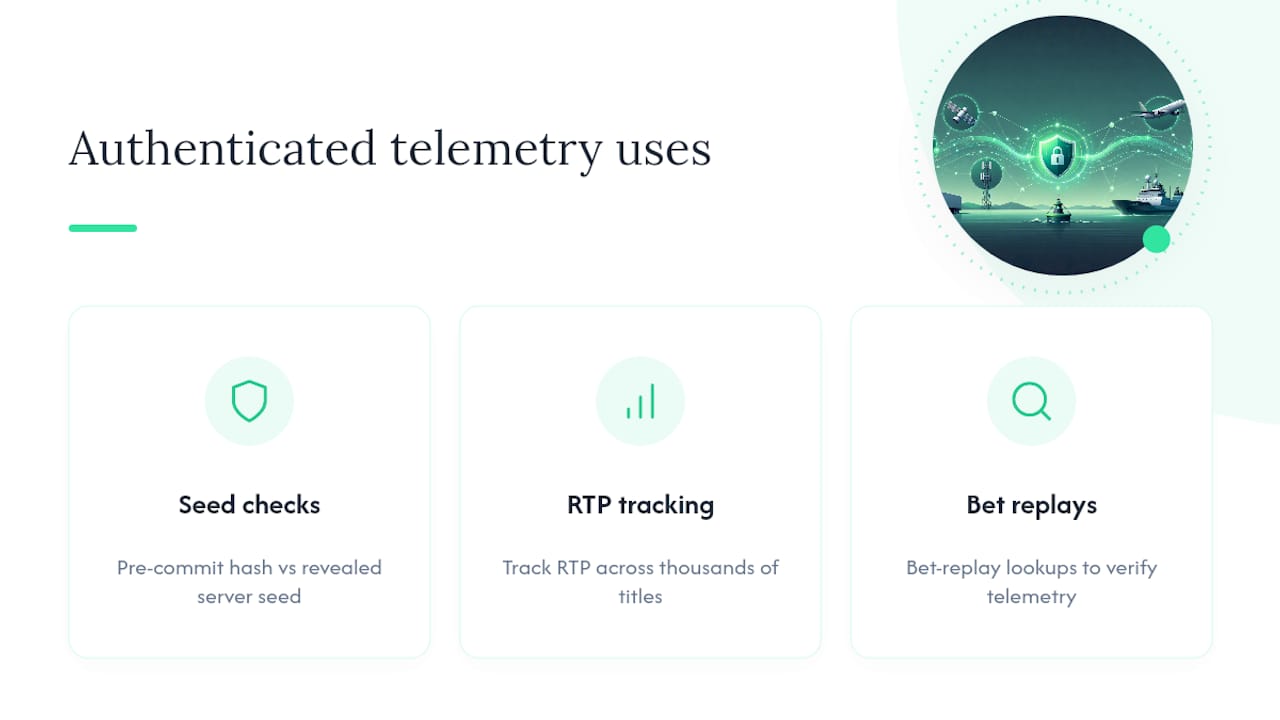
Provably fair gambling systems depend on the same guarantee HMAC-SHA256 provides everywhere else: proof that data traveled from point A to point B unchanged. When a casino publishes a server seed hash before a round and reveals the seed after, HMAC-style verification is what confirms that seed matches the pre-committed hash, and that game-state telemetry wasn't altered in transit.
Stakestats builds its verification tools around that principle. Server seed and nonce checks, RTP tracking across thousands of Stake Engine titles, and bet-replay lookups all depend on authenticated, tamper-evident data pipelines.
Authenticated telemetry is what turns "trust us" into "verify it yourself." That's the entire premise behind provably fair gaming, and it only works if the cryptographic binding between claimed and actual outcomes holds up under scrutiny.
Readers curious about the mechanics behind this can dig into Stakestats' provably fair explanation or explore verified outcome data directly through the Stake Originals Analyzer.
Put HMAC SHA256 to Work With Verified Data
Understanding the algorithm is one thing. Trusting the data flowing through a live casino platform is another, and that's where verification tools matter more than theory. Stakestats runs real-time RTP, volatility, and hit-rate analysis across more than 2,500 Stake Engine games, all built on the same authenticated-data principles covered above.
If you're evaluating whether a game's published odds match its actual behavior, or you want to verify a server seed against a specific round, Stakestats' provably fair explanation walks through the verification process in the same byte-level detail this article applied to HMAC. For players tracking their own results against verified game data, the bankroll analyzer turns that authenticated data into something actionable.
Key Takeaways
HMAC-SHA256 secures messages by nesting two nested SHA-256 hashes around a key normalized to a 64-byte block, producing a 32-byte tag that proves integrity and authenticity without encrypting anything.
| Point | Details |
|---|---|
| Know what it guarantees | HMAC-SHA256 proves integrity and authenticity, not confidentiality or non-repudiation. |
| Normalize keys correctly | Hash keys over 64 bytes down to 32; zero-pad shorter keys to the full 64-byte block. |
| Sign raw bytes only | Capture the exact request body before parsing to avoid re-serialization mismatches. |
| Verify in constant time | Use timingSafeEqual() in Node.js or compare_digest() in Python, never ==. |
| Add replay protection | Include a timestamp or nonce in the signed payload and reject stale signatures. |
The Real Lesson Behind HMAC SHA256
The conventional advice on HMAC treats it as a solved problem: call a library function, get a hash, move on. That's not wrong, but it undersells where the actual risk lives. Nearly every HMAC failure I've seen traced back in this research isn't cryptanalysis, it's an encoding mismatch, a re-serialized JSON body, or a string comparison that leaks timing.
What gets underestimated is key hygiene. Developers obsess over the hash function and barely think about where the key lives, how it was generated, or when it last rotated. A CSPRNG-generated, properly stored 32-byte key matters more than which SHA-256 library you picked.
If you take one thing from this: validate against RFC 4231's test vectors before you trust your own implementation. It's a five-minute check that eliminates the most common category of bugs before they reach production.
— Ian
Sources
For implementation questions this article didn't fully resolve, these are the primary sources worth consulting directly:
- FIPS 198-1: The Keyed-Hash Message Authentication Code (HMAC)
- HMAC-SHA256 Explained with Node.js and Python Examples
- HMAC-SHA256 in Node.js: 10 Steps, 20 Min 2026