
Hold and Win: Spot the Reset Rule and Verify Hits with Stakestats

Hold and Win is a bonus round where certain symbols lock in place while every other position on the reels respins, usually a set number of times. Land a new qualifying symbol during those respins and the counter typically resets, stretching the round out and stacking up locked values toward a final payout. The practical takeaway: it feels generous because you can watch the grid fill up in real time, but it also pulls a chunk of the game's return into one high-variance event, so the paytable and help screen are worth reading before you spin.
TL;DR:
- The reset rule for respins significantly impacts how long the Hold and Win feature can last, with full resets allowing dozens of spins and add-spins ending rounds faster.
- Variations in trigger count, starting respins, jackpot type, and grid structure alter a game's payout ceiling and how often the bonus rounds occur.
- Reported RTPs for Hold and Win slots usually stay between 94% and 97%, but high volatility means short-term results can sharply differ from long-term expectations.
- Using verification tools to check real-time RTP and hit rates helps players estimate a game's true trigger frequency and whether a bonus buy is mathematically worthwhile.
- Watching for the specific "reset" or "add" rules on the paytable helps identify whether a game favors longer, more lucrative bonus rounds or shorter, high-variance bursts.
Table of Contents
- How Hold and Win Works, Step by Step
- Common Variants and What to Check in the Paytable
- RTP, Volatility, and What It Means for Your Bankroll
- Templates You'll Actually Run Into
- Checking Hold and Win Frequency With Verification Tools
- Quick Checklist Before You Spin
- Why Players Keep Coming Back to Hold and Win
- Verify the Math Before You Chase the Jackpot
- Sources
- FAQ
How Hold and Win Works, Step by Step
Every Hold and Win round follows roughly the same skeleton, even though the dressing changes from studio to studio. Knowing the sequence means you can walk into any unfamiliar title and predict, within a spin or two, what's about to happen.
- Trigger. A minimum number of special symbols, usually coins, gems, or cash icons, land anywhere on the base game reels in a single spin. Some titles let you skip this and pay to launch the feature directly, a mechanic often called a bonus buy.
- Lock. Every qualifying symbol that triggered the round freezes on its position. The rest of the grid clears and becomes "open" territory for respins.
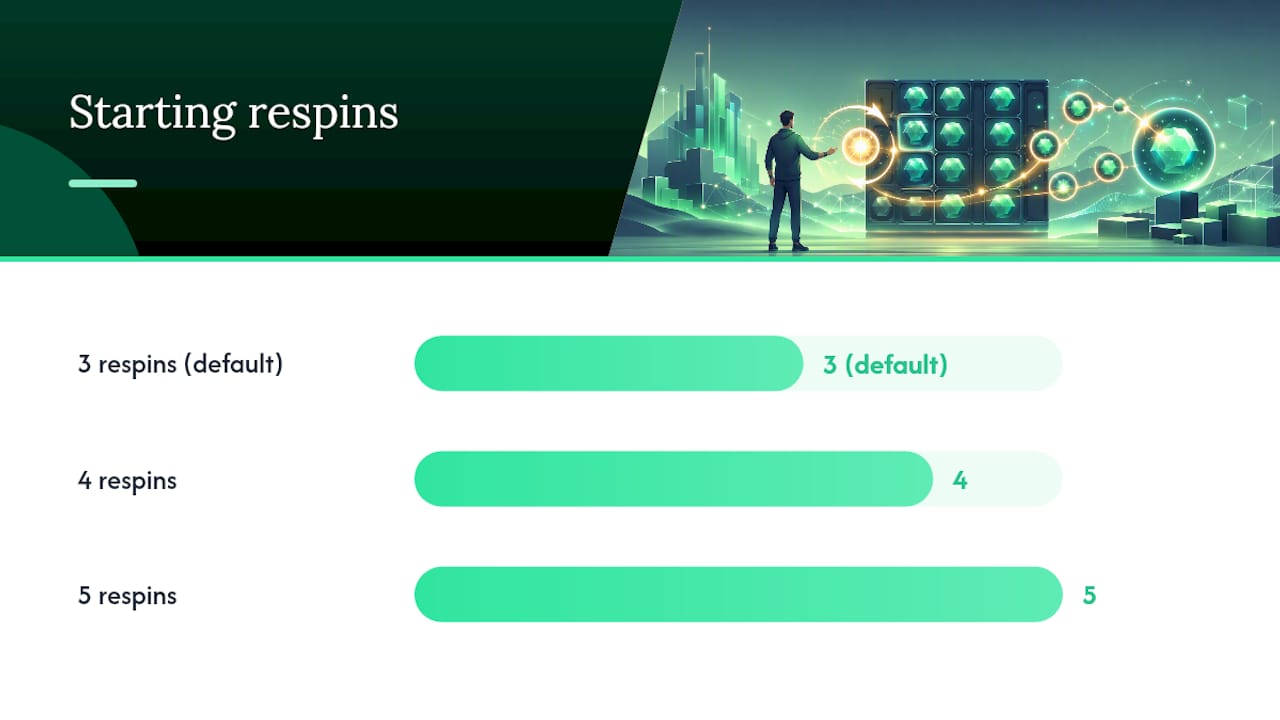
- Respin. The game spins only the open positions. A common starting counter is three respins, though four and five appear too, and this number is exactly what BGaming's breakdown of Hold & Win mechanics points to as the industry default.
- Reset or decrement. If a new qualifying symbol lands during a respin, it locks in place and the counter typically resets back to its starting value. If nothing lands, the counter ticks down by one. The round ends when the counter hits zero or the grid completely fills.
- Settlement. Once the round closes, the game totals every locked symbol's assigned value, applies any collectors or multipliers that landed during the sequence, and checks whether the filled grid triggered a fixed jackpot tier.
Picture a 3x5 grid needing six coin symbols to trigger. Respins two and three land nothing. The round ends, and the payout is the sum of all eight coin values, in this case a mid-size win rather than a jackpot, because the grid never filled completely.
That reset rule is the single most important variable in the whole mechanic, a point g7r's design analysis treats as the defining trait separating a "generous" Hold and Win game from a tight one. A game that resets to three respins on every new symbol can run for dozens of spins. A game that only adds one extra respin per new symbol, instead of a full reset, ends much faster and pays out less on average.
Common Variants and What to Check in the Paytable
No two Hold and Win features play identically, even when the marketing screenshots look the same. The differences that actually change your expected outcome sit in four places.
- Trigger count and starting respins. Some games trigger on six symbols and start with three respins; others trigger on eight and start with five. A lower trigger threshold with fewer starting respins is not automatically worse, but it does change how often you'll see the feature and how long it lasts once you do.
- Reset versus add-spin rules. Confirm whether a new symbol resets the counter to its starting number or simply adds one extra spin. This single rule field, according to SlotRandomizer's mechanics guide, swings feature length and payout potential more than any other variable.
- Grid structure. Standard 3x5 grids are common, but some titles run dual grids, expanding grids that grow as symbols lock, or feature a special jackpot tier only when the entire grid fills with special symbols.
- Jackpot type. Fixed jackpot tiers pay a set multiplier regardless of the individual symbol values collected. Sum-of-values models pay whatever the locked symbols add up to, sometimes boosted by multiplier symbols or a roaming collector that gathers value from other positions before landing.
- Buy-feature pricing. A bonus buy typically costs multiple times your base stake and skips straight to the trigger; check the help screen for the exact multiplier before buying. Check the help screen for the exact multiplier before buying; it directly tells you the break-even math for that purchase.
Pro Tip: Open the help screen before your first spin and look specifically for the words "reset" and "add." If the paytable doesn't use either term explicitly, assume a reset rule, since that's the more common template across the genre.
RTP, Volatility, and What It Means for Your Bankroll
Hold and Win games concentrate a large share of their total return into the bonus round instead of spreading it evenly through the base game. That's by design: locked symbols create visible progress, and visible progress keeps players spinning through dry stretches while the return on investment quietly waits inside a rare, high-paying event.
Reported RTP for Hold and Win style slots tends to sit between 94% and 97%, with volatility usually landing in the medium-high to high range depending on how much prize weight the studio pushes into the bonus versus the base spins. A higher share of total return locked in the bonus round generally means longer droughts between triggers and bigger swings when the feature finally lands.
Volatility in practice: because so much of the payout math lives inside a bonus that might trigger once every few hundred spins, your short-session results will look nothing like the long-run RTP. That gap is exactly why bankroll planning matters more here than on flatter, lower-variance games.
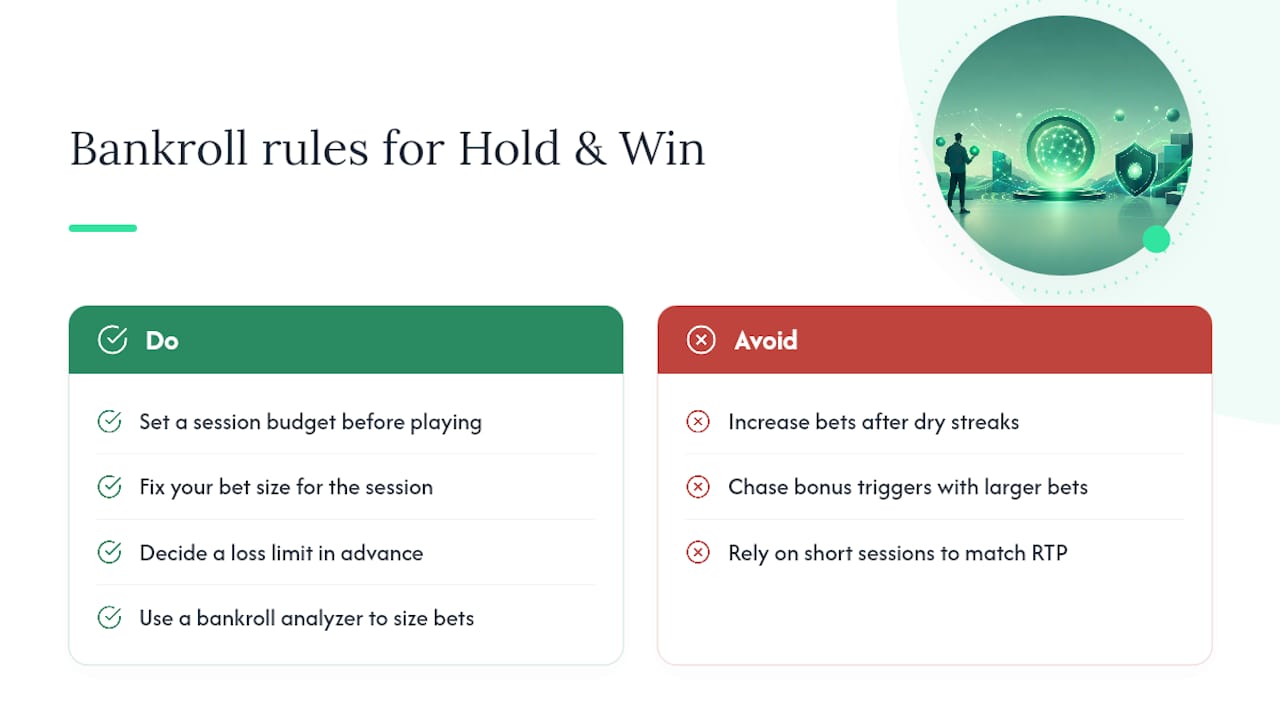
Set a session budget before you start and stick to a fixed bet size rather than adjusting it mid-session based on hot or cold streaks. GambleAware's guidance on bankroll management recommends deciding your loss limit in advance for exactly this kind of high-variance feature, where the temptation to chase a trigger can override a sensible stopping point. A bankroll analyzer can help translate a target session length into a workable bet size before you ever load the game.
Templates You'll Actually Run Into
Most Hold and Win games fall into a handful of recognizable templates, and once you can name the template, you can estimate roughly how the math behaves.
- The classic six-and-three. Six coin symbols trigger the round, respins start at three, and filling the entire grid awards a fixed jackpot tier on top of the summed symbol values. This is the template most players learn first.
- Fixed-tier jackpot models. The grid fills into named tiers (Mini, Minor, Major, Grand), each paying a preset multiplier no matter what individual symbol values landed. Fast to understand, but the ceiling is capped at whatever the top tier pays.
- Sum-of-values models. No fixed tiers; the payout is purely the total of every locked symbol, sometimes multiplied by a roaming collector. These can pay far beyond a fixed jackpot when variance runs hot, and far below it when the round ends early.
- Hybrid templates. Collector symbols or multiplier wilds land during respins and boost the eventual sum, layering extra volatility on top of the base Hold and Win structure.
Scan the help screen for trigger count, starting respins, and jackpot type, and you'll know within seconds which of these four buckets a new game falls into.
Checking Hold and Win Frequency With Verification Tools
The paytable tells you the rules. It doesn't tell you how often the feature actually triggers in practice, and that gap is exactly where independent verification tools earn their place in your routine. Stakestats builds real-time RTP and hit-rate statistics for Stake Engine titles, letting you compare a game's stated volatility against how it actually performs across a large sample of spins.
- Use provably fair verification to confirm a server seed and nonce match the outcomes you're seeing, rather than taking fairness on faith.
- Pull RTP and hit-rate stats for a specific title before deciding whether its Hold and Win round is worth chasing.
- Check the IOU calculator to replay past rounds and see exactly how a locked-symbol sequence resolved.
- Compare buy-feature cost against the game's average sum-of-values payout to judge whether the purchase price makes mathematical sense.
None of this changes the underlying odds. It just replaces guesswork with data, and pairs naturally with the bankroll and session limits GambleAware recommends for high-variance play.
Quick Checklist Before You Spin
Hold and Win concentrates most of a game's payout potential into one visible, high-variance round rather than spreading it evenly through base spins.
| Check before playing | Why it matters |
|---|---|
| Reset vs. add-spin rule in the help screen | Determines how long the feature can realistically run |
| Fixed-tier vs. sum-of-values jackpot | Changes your realistic payout ceiling |
| Reported RTP and volatility rating | Sets expectations for session length and drought frequency |
Buying the feature rarely makes sense unless the buy price sits well below the game's average payout for that round, and even then, keep it a small fraction of your total session bankroll.
Why Players Keep Coming Back to Hold and Win
The appeal isn't complicated: watching a grid fill up symbol by symbol gives you something a spinning reel never does, a visible, countable form of progress. That's a smart design trade, simplicity in exchange for engagement, but it also means the tension is compressed into one round instead of spread across a session. Be skeptical of marketing that leads with jackpot screenshots. Those numbers are real, but they're the tail of the distribution, not the average night.
— Ian
Verify the Math Before You Chase the Jackpot
Reading a paytable tells you the rules Hold and Win is supposed to follow. It doesn't tell you whether a specific title actually triggers as often as its volatility rating suggests, or whether a bonus buy is priced fairly against its real average payout. That's the gap Stakestats closes.

Some sites pull real-time RTP and hit-rate statistics across thousands of Stake Engine games, so you can check a Hold and Win title's actual feature frequency instead of relying on the help screen alone. Pair that with provably fair verification of the server seed and nonce behind any round, and a bankroll analyzer that helps estimate a workable bet size. If you're deciding whether a bonus buy is worth the price, start by pulling that game's transparency and verification data and comparing it against the buy-in cost before you commit a single bet.
Sources
- Hold & Win slot mechanics explained
- Hold & Win Slots Explained: Locks, Respins and Values
- Hold-And-Win Explained: The Design Pattern You Keep Seeing - Gaming
FAQ
What Is the $20 Rule on Slot Machines?
It's a bankroll guideline suggesting you move on from a machine, or a specific game, once you've spun through a fixed small amount without a meaningful win, though no casino or regulator sets this as an official rule.
Which Gambling App Pays Out the Most Money?
Payout depends on the individual game's RTP, not the app itself. Checking a title's actual RTP and hit-rate data through a tool like Stakestats tells you far more than any general claim about a platform's payouts.
What Is the $100 Slot Strategy?
It's an informal bankroll approach where a player sets a fixed session budget, bets a small fraction of it per spin, and stops once that budget is gone, regardless of how the session is going.
Does Every New Symbol Reset the Respin Counter in Hold and Win?
In most Hold and Win games, yes, a new qualifying symbol resets the counter to its starting value, but some titles only add one extra respin instead. Always check the help screen to confirm which rule applies.
Is It Worth Buying the Hold and Win Feature Directly?
Only when the buy price sits meaningfully below the game's average payout for that round, which you can estimate by checking a title's real hit-rate and payout data rather than the paytable alone.