
House Edge Gambling Explained: Your Practical Guide

The house edge is defined as the casino's long-run mathematical advantage over every player, expressed as a percentage of each wager the casino expects to keep. This built-in advantage varies dramatically across games: blackjack with basic strategy sits near 0.5%, American roulette carries 5.26%, and keno reaches as high as 35%. Every gambling session you play operates inside this mathematical framework, whether you know it or not. Understanding how house edge works is the single most useful thing you can do before placing a bet.
How is the house edge calculated?
The house edge is not a fee deducted from each bet. It is a long-term statistical percentage that describes average casino retention across thousands of wagers. Individual bets can win or lose by any amount. The edge only becomes visible over large sample sizes.
The formula for expected loss is straightforward:
Expected loss = stake × house edge × number of bets
Here is what that looks like in practice:
- A 1% house edge with $100 per bet over 100 bets produces a $100 theoretical loss.
- The same 1% edge with $10 bets over 1,000 bets still produces a $100 expected loss.
- A 5% edge with $50 bets over 200 bets produces a $500 expected loss.
The math is neutral. It does not care about streaks, feelings, or systems. What it does reveal is that bet size and number of bets are the two levers you actually control.
Pro Tip: Slowing your pace of play is one of the most effective ways to reduce total expected loss. Fewer bets per hour means fewer applications of the house edge to your bankroll.

House edge values across popular casino games
Game selection is the most direct way to control how much the house edge costs you per session. The difference between the best and worst games is not marginal. It is the difference between a 0.5% edge and a 35% edge.
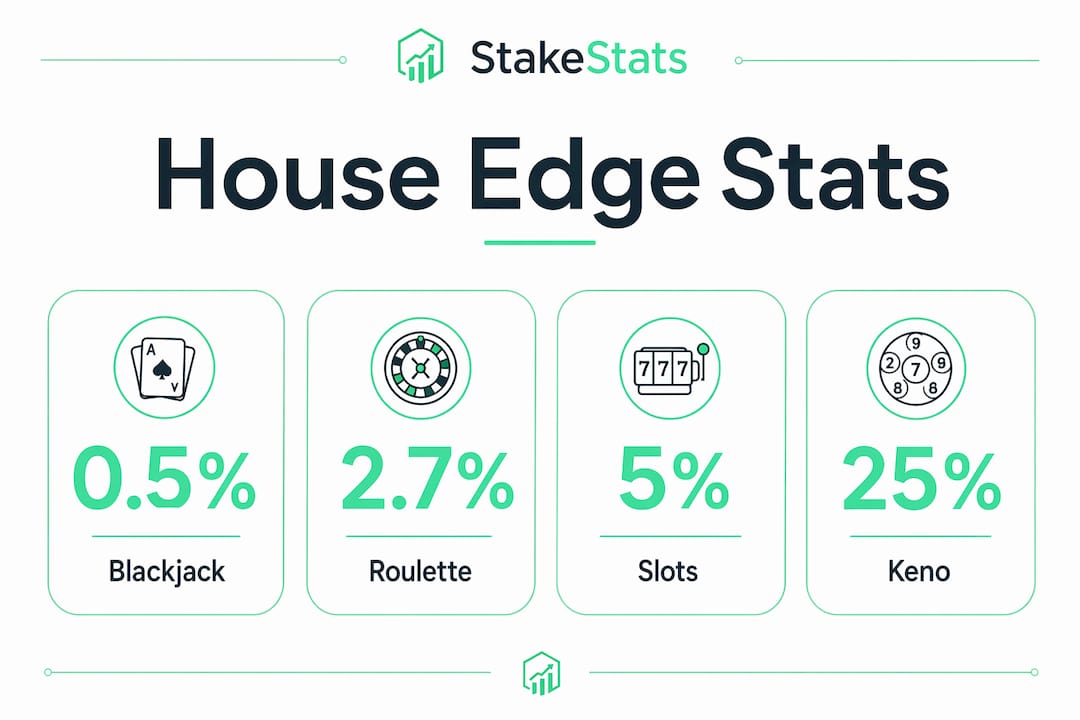
| Game | Approximate House Edge | Notes |
|---|---|---|
| Blackjack (basic strategy) | ~0.5% | Requires correct strategy application |
| Video poker (optimal play) | ~0.5%–1% | Varies by pay table |
| Baccarat (banker bet) | ~1.06% | Best bet on the table |
| Craps (pass line) | ~1.41% | One of the fairest bets in the casino |
| European roulette | ~2.7% | Single zero wheel |
| American roulette | ~5.26% | Double zero adds significant cost |
| Slots | 2%–15% | Varies widely by game and operator |
| Keno | 20%–35% | Highest expected cost per dollar wagered |
The gap between blackjack and keno is enormous. A player wagering $10,000 total at blackjack with basic strategy expects to lose around $50. The same $10,000 at keno could produce an expected loss of $2,000 to $3,500. That is not bad luck. That is math.
Player decisions matter inside individual games too. Blackjack with a 3:2 payout and no trick rules delivers a 0.5% edge when you apply basic strategy correctly. Without strategy, uninformed play pushes that edge to 2%–4%. In baccarat, the banker bet at 1.06% is clearly superior to the player bet at 1.24% and far better than the tie bet, which carries an edge above 14%.
Pro Tip: Print a basic strategy card for blackjack and use it at the table. Most casinos allow it. That single habit cuts your expected losses by up to 75% compared to guessing.
How does RTP relate to house edge and short-term results?
Return to Player (RTP) and house edge are two sides of the same coin. RTP equals 100% minus the house edge. A game with a 2% house edge has a 98% RTP. A game with a 5% edge has a 95% RTP. Neither number tells you what will happen in your next session.
Variance causes short-term results to swing far above and below the mathematical expectation. A player can win $500 in an hour at a game with a 5% edge. Another player can lose $800 in an hour at a game with a 0.5% edge. Both outcomes are statistically normal. Neither outcome means the house edge has changed.
This is where most players go wrong:
- They win a session and believe they have "beaten" the house.
- They lose a session and believe the game is rigged.
- They confuse a hot streak with a low house edge.
- They confuse a cold streak with a high house edge.
The house edge only becomes statistically reliable across tens of thousands of bets. A single session, or even a week of sessions, is too small a sample to reflect the true edge. Variance is the reason gambling feels exciting. It is also the reason players misread their results.
The Stakestats blog covers how variance interacts with house edge in provably fair games, which is worth reading if you want a deeper understanding of randomness in online casino environments.
Can betting systems or skill overcome the house edge?
No betting system can change the house edge. This is not a matter of opinion. It is a mathematical fact. Systems like Martingale only change how you size bets across a session. They do not alter the negative expected value attached to each individual bet.
Each bet in roulette, slots, or baccarat is an independent event. The game has no memory. A roulette wheel does not know it landed on red five times in a row. The probability on the next spin is identical to the first spin. Betting systems exploit the psychological comfort of patterns. They do not exploit any mathematical weakness in the game.
The key distinctions are:
- Skill-based games: Blackjack and video poker allow player decisions that directly affect the house edge. Mastery of basic strategy is the highest return on investment any player can achieve.
- Pure chance games: Roulette, slots, baccarat, and keno offer no decisions that affect the edge. Bet selection within a game matters (banker vs. tie in baccarat), but no system changes the underlying math.
- Betting systems and variance: A Martingale player may win frequently in short sessions. Those wins come from variance, not from any mathematical advantage. The risk of a catastrophic loss grows with every escalation.
Pro Tip: If a betting system sounds too logical to fail, test it on paper first. Track 500 simulated bets at a fixed house edge. The expected loss will appear exactly as the formula predicts.
Practical strategies to manage the house edge
Knowing the house edge is only useful if you act on it. These steps directly reduce the cost of playing:
Choose low-edge games. Blackjack, video poker, baccarat (banker bet), and craps (pass line) all carry edges below 1.5%. Proper game choice extends playing time and reduces expected loss rates more than any other single decision.
Learn basic strategy before playing blackjack. The difference between correct and uninformed play can multiply expected losses sixfold. A free strategy chart eliminates that gap entirely.
Slow your pace of play. Pace of play is a multiplier on expected losses. A fast-paced session at a 1% edge game can cost more than a slow session at a 3% edge game simply because of bet volume. Take breaks. Play slower.
Set a session budget based on expected loss. Use the expected loss formula before you sit down. If you plan to bet $25 per hand for 200 hands at a 1% edge, your expected loss is $50. Budget for that number, not for a miracle.
Read bonus wagering terms carefully. Bonuses often require wagering on higher house edge games. Game weighting in bonus terms can push your real cost far above what the bonus appears to offer. A 100% deposit bonus cleared through slots at 10% edge costs more than it returns.
The Stakestats bankroll analyzer lets you input your bet size, house edge, and session length to calculate your theoretical expected loss before you play. That kind of preparation is what separates disciplined players from those who are perpetually surprised by their results.
Key Takeaways
The house edge is the casino's permanent mathematical advantage, and understanding it is the most practical skill any gambler can develop.
| Point | Details |
|---|---|
| House edge definition | The casino retains a fixed percentage of every wager over the long run, not per individual bet. |
| Game selection matters most | Blackjack and video poker offer edges below 1%, while keno can reach 35%. |
| RTP and house edge are linked | RTP equals 100% minus the house edge; a 98% RTP game has a 2% house edge. |
| Betting systems do not work | No system alters the negative expected value per bet; variance creates illusions of success. |
| Pace and budget control losses | Fewer bets per hour and a pre-set session budget are the two most effective loss controls. |
Why most players never really grasp the house edge
The house edge is one of those concepts that sounds simple until you watch how people actually behave at a table. I have seen players walk away from a blackjack session up $300 and declare they "beat the system." I have seen others lose at a 0.5% edge game and conclude the game must be rigged. Both reactions come from the same misunderstanding: confusing short-term variance with long-term math.
What strikes me most is how rarely players think about pace of play. Everyone focuses on which game to choose, and that matters. But a player grinding 300 hands per hour at blackjack with a 0.5% edge is applying that edge 300 times. A player taking their time, chatting, and playing 80 hands per hour applies it 80 times. The expected loss difference over a four-hour session is not trivial.
The other thing I find underappreciated is the bonus trap. Players see a deposit match and think they are getting free money. Then they read the fine print and discover they must wager through slots with a 10% edge. The math on that deal is almost always negative before they clear the requirement. Reading wagering terms is not optional if you care about your bankroll.
My honest recommendation is this: pick one or two low-edge games, learn them properly, and play them slowly. The house edge is not your enemy if you understand it. It is just the price of the entertainment. The players who get hurt are the ones who never bother to learn what that price actually is.
— Ian
Stakestats tools for smarter bankroll decisions
Knowing the house edge is the foundation. Applying it to your actual play is where Stakestats helps.

The Stakestats platform offers tools built specifically for players on provably fair sites like Stake.com. The bonus analysis tool breaks down how wagering requirements interact with game house edges, so you can see the real cost of any promotion before you commit. The bankroll analyzer calculates your theoretical expected loss based on your bet size, edge, and session volume. Provably fair verification adds a layer of transparency that standard online casinos do not offer. If you want to put the math from this article to work, Stakestats gives you the tools to do it.
FAQ
What is the house edge in gambling?
The house edge is the long-run percentage of each wager a casino expects to retain. It is a statistical average across thousands of bets, not a fee taken from every individual wager.
Which casino game has the lowest house edge?
Blackjack played with basic strategy has one of the lowest house edges at approximately 0.5%. Video poker with optimal play is similarly competitive, depending on the pay table.
Does RTP mean the same thing as house edge?
RTP and house edge are inversely related and always sum to 100%. A game with 97% RTP has a 3% house edge. They describe the same mathematical relationship from opposite directions.
Can the Martingale system beat the house edge?
No. The Martingale system changes bet sizing but does not alter the negative expected value of each bet. Any short-term success from the system comes from variance, not a mathematical advantage.
How does variance affect my session results?
Variance causes individual session results to swing far above or below the expected loss predicted by the house edge. A single session is too small a sample for the house edge to be visible in your results.