
Cap Your Bet to 5% With the Kelly Criterion for Safer Gambling

The Kelly criterion tells you the exact percentage of your bankroll to wager on a given bet, based purely on your edge and the odds. The practical answer for most gamblers: calculate the full Kelly fraction, then bet half or a quarter of it, and only bet at all when your estimated edge is genuinely positive. Full Kelly is mathematically optimal for long-term growth, but its swings are brutal enough that almost nobody actually plays it straight. The math and the worked examples below show exactly why.
TL;DR:
- Using fractional Kelly (half or quarter) significantly reduces bankroll volatility while only moderately sacrificing long-term growth potential.
- Kelly only applies when you have a measurable, positive expected value, such as in card counting, skilled poker, or mispriced sports lines, not on house-edge games.
- Overestimating your edge leads to overbetting, which substantially increases risk, especially when relying on inaccurate probability estimates.
- Proper bankroll management should involve capping individual bets at 5% or less of your bankroll, regardless of Kelly calculations, to prevent large drawdowns.
- A Kelly calculator requires honest input of your estimated win probability and odds, and its output should be tested for sensitivity to avoid overconfidence.
Table of Contents
- What Is the Kelly Criterion in Gambling?
- How Do You Calculate a Kelly Bet Step by Step?
- Why Do Bettors Use Fractional Kelly Instead of Full Kelly?
- When Does the Kelly Criterion Actually Apply to Gambling?
- What Are the Biggest Risks of Using the Kelly Criterion?
- How Should You Manage Your Bankroll Alongside Kelly?
- What Should You Look for in a Kelly Calculator?
- How Stake Stats Helps You Apply Kelly Responsibly
- An Honest Take on Kelly's Limits
- Try the Bankroll Analyzer Before You Stake a Dollar
- Sources
- FAQ
What Is the Kelly Criterion in Gambling?
The Kelly criterion is a formula for calculating the bet size that maximizes the long-term growth rate of your bankroll, expressed as a compounding, or geometric, rate rather than a simple average. That distinction matters more than it sounds. A strategy that maximizes your expected winnings on any single bet can still bankrupt you over time if it swings too wildly, because compounding punishes big losses far harder than it rewards big wins of the same size. Kelly instead solves for the bet size that maximizes the expected logarithm of your wealth, which is mathematically equivalent to maximizing your bankroll's growth rate across a long sequence of bets.
For a simple binary bet, win or lose, the formula is:
f* = (bp − q) / b
Here's what each variable means:
- f* is the fraction of your bankroll to wager
- b is the net odds received on the bet (a bet paying 2 to 1 has b = 2)
- p is your estimated probability of winning
- q is the probability of losing, which is simply 1 − p
The Kelly criterion's binary formula reduces to one clean idea: your edge, scaled by the odds you're getting paid. Run the numbers and pay attention to the sign. A positive f means you have a mathematical edge and Kelly tells you how much to risk. A negative f means the bet has negative expected value for you, and the correct move is to not bet at all, regardless of how good the payout looks on paper.
One edge case trips people up: if f* comes out greater than 1, the formula is technically telling you to leverage your position beyond your entire bankroll. For a gambler without access to borrowed money, that result usually signals you've badly overestimated your edge, not that you should mortgage your rent money on a parlay.
Kelly also generalizes beyond simple win/lose bets to situations with multiple outcomes, like a horse race with several live contenders or a portfolio of simultaneous wagers. The math gets more involved there, but the underlying logic stays the same: size each position in proportion to your edge relative to the odds, and let the log-growth objective do the rest.
How Do You Calculate a Kelly Bet Step by Step?
Numbers make this concept click faster than any explanation. Here are two worked examples you can reproduce with a calculator or a spreadsheet.
1. Even-money bet with a 60% edge. Say you're betting on a coin-flip-style proposition at even money (b = 1), and you genuinely believe you'll win 60% of the time (p = 0.60, so q = 0.40). Plug that into the formula: f = (1 × 0.60 − 0.40) / 1 = 0.20. Kelly says wager 20% of your bankroll. On a $1,000 bankroll, that's a $200 bet. Push your win estimate down to a more conservative 55%, and f drops to 0.10, half the stake. That sensitivity is the whole point: a small error in your probability estimate swings the recommended bet size dramatically.
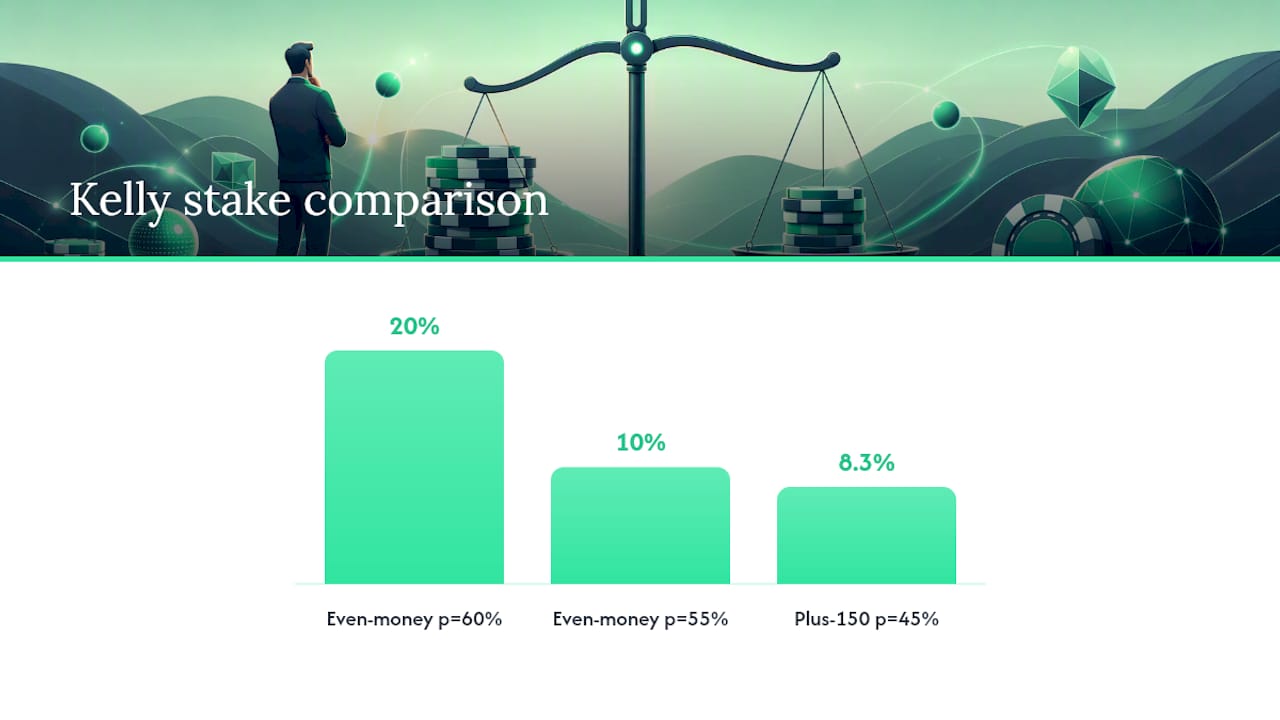
2. A sports bet at plus-150 odds. Decimal or American odds first need converting to net odds b. Plus-150 American odds pay $1.50 profit per $1 risked, so b = 1.5. Suppose your handicapping gives this side a 45% chance of winning (p = 0.45, q = 0.55). Then f* = (1.5 × 0.45 − 0.55) / 1.5 = (0.675 − 0.55) / 1.5 ≈ 0.083. Kelly recommends risking about 8.3% of your bankroll on that single wager.
A Kelly calculator does this arithmetic instantly. You feed it your bankroll, your estimated win probability, and the odds, and it returns a recommended stake as a percentage and a dollar figure, sometimes alongside an estimate of expected bankroll growth over many repeated bets.
Sensitivity checks, rerunning the same calculation with p shaved down a few points, are the cheapest insurance you have against your own overconfidence.
Why Do Bettors Use Fractional Kelly Instead of Full Kelly?
Fractional Kelly means deliberately betting less than the full f* the formula recommends, typically half (1/2 Kelly) or a quarter (1/4 Kelly) of the calculated stake. It's the standard adjustment among people who actually use Kelly for real money, and the math behind why is worth understanding rather than just accepting on faith.

Betting half the full Kelly amount cuts your bankroll's volatility by roughly 50%, while only costing you about 25% of your expected long-term growth rate, according to the analysis behind the Kelly criterion. That's a lopsided trade in your favor: you give up a quarter of the theoretical upside to remove half the stomach-churning swings. Quarter Kelly pushes that trade even further toward safety, sacrificing more growth for a smoother ride.
Here's how to decide which fraction fits your situation:
- Use full Kelly almost never, unless you have a long track record proving your edge estimates are consistently accurate and you have the emotional stomach for 40%+ drawdowns.
- Use half Kelly if you have real confidence in your edge (backed by data, not gut feel) and a bankroll you can afford to see cut significantly during a bad stretch.
- Use quarter Kelly if your edge estimate is a best guess rather than a proven number, or if a bad month would genuinely affect your life outside of gambling.
Advantage players, the card counters and poker grinders who actually have measurable, provable edges, still almost universally dial back to half or quarter Kelly. Professionals with real, quantifiable edges routinely reduce their stakes below the full mathematically optimal fraction simply because full Kelly's drawdowns break people psychologically even when their probability estimates are correct.
Pro Tip: Treat your fractional Kelly number as a ceiling, not a target. That extra guardrail protects you on the day your edge estimate turns out to be wrong.
When Does the Kelly Criterion Actually Apply to Gambling?
Kelly only makes sense when you have a genuine, positive expected value. That is the entire precondition, and it rules out more gambling situations than it includes.
Valid applications share one trait: a measurable, repeatable edge. That includes:
- Card counting in blackjack, where tracking the deck composition shifts the house edge into the player's favor at specific counts.
- Poker, where skill differences between players create a real, sustained edge over many hands.
- Mispriced sports lines, where a bettor's model or information disagrees meaningfully with the bookmaker's price.
- Bonus and promotional situations, like matched-value offers or free-bet structures, that create temporary positive EV independent of the underlying game's odds.
Standard casino games, slots, roulette, baccarat, house-edge table games, run the opposite direction. Plug their actual win probabilities into the Kelly formula and f* comes out negative every time, because the house edge guarantees q is large enough relative to b to make the numerator negative. Practical gambling guides confirm this is the expected and correct output: a negative Kelly fraction on a negative-EV game isn't a math error, it's the formula doing exactly what it's supposed to do. The correct action is simply not betting, not scaling the bet down to some small positive number.
Even in a genuine advantage situation, Kelly assumes a few operational conditions you need to meet in practice: a large enough number of sequential bets for the growth-rate math to play out, a reasonably stable edge over that stretch, and independence between individual wagers. Parlaying correlated outcomes, or betting the same underlying event across multiple markets, violates that independence assumption and quietly inflates your real risk beyond what a naive Kelly calculation shows.
What Are the Biggest Risks of Using the Kelly Criterion?
The single biggest danger with Kelly isn't the math, it's the input. Kelly is only as good as your estimate of p, and gamblers routinely overestimate their own edge.
Full Kelly's volatility is severe even when your edge estimate is dead accurate. That's precisely why full Kelly's theoretical optimality assumes an infinite betting horizon and exact probabilities, conditions no real gambler actually operates under. Most people who try full Kelly abandon the system the first time they watch their bankroll drop by a third, which defeats the entire long-run purpose of using Kelly in the first place.
The common mistakes stack up in predictable ways:
- Overestimating edge from a small sample of wins, mistaking short-term variance for a real advantage.
- Ignoring correlation between simultaneous bets, which understates true portfolio risk.
- Betting more than full Kelly, a rare but real error usually caused by miscalculating b or p.
- Skipping sensitivity checks, taking the calculator's output at face value without stress-testing the probability input.
The fix for most of this is unglamorous: track every bet's actual outcome against your predicted probability, shrink your Kelly fraction when your track record is thin, and backtest any system before staking real money against it.
How Should You Manage Your Bankroll Alongside Kelly?
Kelly gives you a ceiling. Good bankroll management gives you the guardrails around it. A workable, conservative framework looks like this:
- Recreational bettors without a proven statistical edge should default to flat staking, risking a fixed 1% to 2% of bankroll per bet regardless of what any formula says.
- Bettors using Kelly should cap any single bet at 5% of bankroll maximum, even if the fractional Kelly calculation technically clears you for more.
- Most people applying Kelly should default to a quarter or half fraction of the full calculation, reserving full Kelly for situations backed by a long, verified track record.
Sizing your bankroll itself depends on your goals and your tolerance for drawdown.
A repeatable routine keeps all of this from turning into guesswork every time you place a bet:
- Estimate your edge honestly, using real data rather than a hunch, and write down your probability estimate before you calculate anything.
- Compute the full Kelly fraction using f* = (bp − q) / b with your estimated p and the actual odds offered.
- Apply your fractional coefficient, typically 0.5 or 0.25, to that raw number.
- Cap the result against your absolute maximum per bet, and stake whichever number is smaller.
- Track the outcome against your original probability estimate so next month's edge estimate is better calibrated than this month's.
What Should You Look for in a Kelly Calculator?
A Kelly calculator needs three inputs to do anything useful: your current bankroll, your estimated win probability (p), and the odds offered, usually converted internally to net odds (b). The output is a recommended stake, expressed as both a percentage of bankroll and a dollar figure, and sometimes an estimate of expected long-term growth rate alongside the variance you're taking on to get there.
The output is only as trustworthy as the p you typed in, and that's the part no calculator can fix for you. Run the calculation once with your honest estimate, then run it again with p shaved down by 3 to 5 percentage points. If the recommended stake collapses or turns negative, your original edge was thinner than you thought, and you just avoided a much larger mistake than any tool could have caught for you.
Spreadsheets work fine for this if you're comfortable building the formula yourself, and they make sensitivity testing across dozens of scenarios faster than retyping numbers into a web form. Whichever tool you use, treat its output as a starting point for judgment, not a verdict to follow blindly.
How Stake Stats Helps You Apply Kelly Responsibly
Kelly is only useful when your inputs are accurate, and that's exactly where analytics tools earn their keep. Stake Stats builds tools around that exact problem for players using provably fair platforms.
The Bankroll Analyzer lets you project how different staking plans, full Kelly, fractional Kelly, or flat staking, play out over a simulated betting sequence, so you can see the drawdown risk before it happens to your real money. The Profit/Loss tracker gives you actual outcome data you can use to check whether your probability estimates are calibrated or just optimistic. The provably fair verification tools help confirm that the game outcomes feeding your edge calculations are legitimate in the first place, and the Bonuses tool surfaces temporary positive-EV situations where a Kelly-style approach can genuinely apply.
An Honest Take on Kelly's Limits
Full Kelly is a beautiful piece of math and a rough way to actually gamble. Watching a third of your bankroll evaporate in a bad stretch, even when your edge estimate was correct, breaks more people than any formula accounts for. Fractional Kelly isn't a compromise for the timid, it's the only version of this system that survives contact with a real person's nerves. My actual recommendation: calculate the number, cut it in half or more, cap it hard, and spend more energy tracking whether your edge estimate holds up than tweaking the formula itself.
— Ian
Try the Bankroll Analyzer Before You Stake a Dollar
Most Kelly explainers hand you a formula and leave you to guess whether your bankroll can survive it. Stake Stats gives you the missing piece: a way to actually see the outcome before you risk anything.

The Bankroll Analyzer lets you project full Kelly, half Kelly, or flat staking against your actual bankroll size and watch how each plan behaves across a long betting sequence, including the drawdowns that only show up in simulation, not in a one-line formula. Pair it with the Profit/Loss tracker to check your real results against your estimated edge over time, and use the Bonuses tool to spot the genuine positive-EV situations where sizing decisions like these actually matter. If you're serious about staking with discipline instead of gut feel, run your numbers through the Bankroll Analyzer before you place your next bet.
Sources
FAQ
Who bet $100 to win $1.7 million using a Kelly-style strategy?
Large multi-leg parlay wins that turn small stakes into life-changing payouts get attributed to Kelly betting online, but these are almost always high-variance longshot bets, the opposite of what Kelly actually recommends. Kelly is a bankroll-sizing formula for repeatable positive-EV situations, not a system for chasing rare, massive payouts.
What are the risks of using the Kelly criterion?
The main risks are misestimating your win probability, which causes overbetting, and underestimating how severe full Kelly's drawdowns can be, often 30% to 50% of bankroll even when your edge estimate is accurate. Correlated bets and small sample sizes compound both problems.
Does Warren Buffett use the Kelly criterion?
Buffett has spoken favorably about Kelly-style concentrated position sizing based on conviction and edge, though Berkshire Hathaway does not publicly disclose using the literal Kelly formula for portfolio allocation. The underlying logic, sizing positions in proportion to edge and confidence, echoes Kelly's core principle either way.
Is the Kelly criterion good for investing?
Kelly can apply to investing when you have a genuine estimate of expected return and risk, but the formula is only fully valid when outcome probabilities are precisely known, a condition markets rarely satisfy. Most investors who reference Kelly use a fractional version for the same volatility reasons gamblers do.
Should I use half Kelly or quarter Kelly for sports betting?
Use half Kelly if you have a well-tested, data-backed edge and can tolerate meaningful drawdowns; use quarter Kelly if your edge estimate is a best guess or a bad month would affect your finances beyond betting. Either way, cap your bet at a fixed maximum percentage of bankroll as a backstop against a miscalculated edge.