
Calculator First Kelly Stake Sizing: Convert Fractions to Dollar Bets

The Kelly criterion tells you what percentage of your bankroll to stake, not a fixed dollar amount, and it does so by weighing your edge against your risk of ruin. Run the formula, multiply the result by your bankroll, and you get a dollar figure. Most sharp bettors and investors then cut that number in half or to a quarter, because full Kelly is mathematically optimal but psychologically brutal. A calculator handles the arithmetic; the harder work is trusting your inputs.
TL;DR:
- Most bettors cut the Kelly stake in half or quarter to manage psychological stress, since full Kelly can lead to significant drawdowns and discomfort.
- Small errors in estimating your win probability or expected return greatly influence your recommended stake, emphasizing the need for conservative inputs and fractional Kelly use.
- When placing multiple correlated bets, scaling down individual Kelly fractions prevents overexposure and keeps total size within your bankroll limits.
- In investing, the continuous Kelly formula (μ divided by σ squared) is suitable only if your return estimates are accurate and your time horizon is long.
- Reliable probability estimates come from historical data, market-implied odds, or well-tested models; overconfidence in these estimates can quickly lead to bankroll loss.
Table of Contents
- What Is the Kelly Criterion Stake Formula?
- Worked Examples: Sports Betting, Poker, and Investing
- Why Fractional Kelly Beats Full Kelly in Practice
- How Do You Estimate Your Win Probability?
- Handling Multiple Bets and Correlated Positions
- Turning Kelly Math Into a Real Dollar Stake
- What Kelly Gets Right, and Where It Breaks Down
- Put Your Kelly Numbers to Work With Stakestats
- Sources
- FAQ
What Is the Kelly Criterion Stake Formula?
The Kelly criterion stake formula for a simple win/lose bet is:
f* = (b × p − q) / b
Here, f* is the fraction of your bankroll to wager, b is the net odds received on a win (decimal odds minus 1), p is your estimated probability of winning, and q is 1 − p, the probability of losing. If you're working with decimal odds (the format most sportsbooks and crypto casinos display), convert first: b = decimal odds − 1. This discrete version is the backbone of every Kelly stake calculator you'll find online, and it comes straight from the original bet sizing formula that expected value theorists still cite today.
For investors and traders working with continuous returns rather than discrete win/lose outcomes, the formula simplifies to:
f* = μ / σ²
Where μ is your expected excess return over the risk-free rate, and σ² is the variance of that return. This version has a direct relationship to the Sharpe ratio: both measure return per unit of risk, but Kelly turns that ratio into an actual position size rather than just a performance score.
A few assumptions sit underneath both formulas, and they matter more than most guides admit:
- You know your true win probability. Kelly assumes p is accurate, not estimated. Any error compounds every time you resize.
- You reinvest your winnings. The formula assumes compounding, not flat withdrawal.
- You're playing a long horizon. Kelly optimizes long-run geometric growth, not the outcome of any single bet.
- The market or game is frictionless. No transaction costs, no slippage, no house edge baked into your odds beyond what you've already accounted for.
If your calculated f comes out negative, the bet has no edge. Skip it. If f comes out above 1.0, the math is telling you to bet more than your entire bankroll, which usually signals either a wildly optimistic p or a continuous-form investing scenario implying leverage.
Worked Examples: Sports Betting, Poker, and Investing
Numbers make Kelly click faster than theory does. Here are three scenarios using the discrete and continuous formulas above.
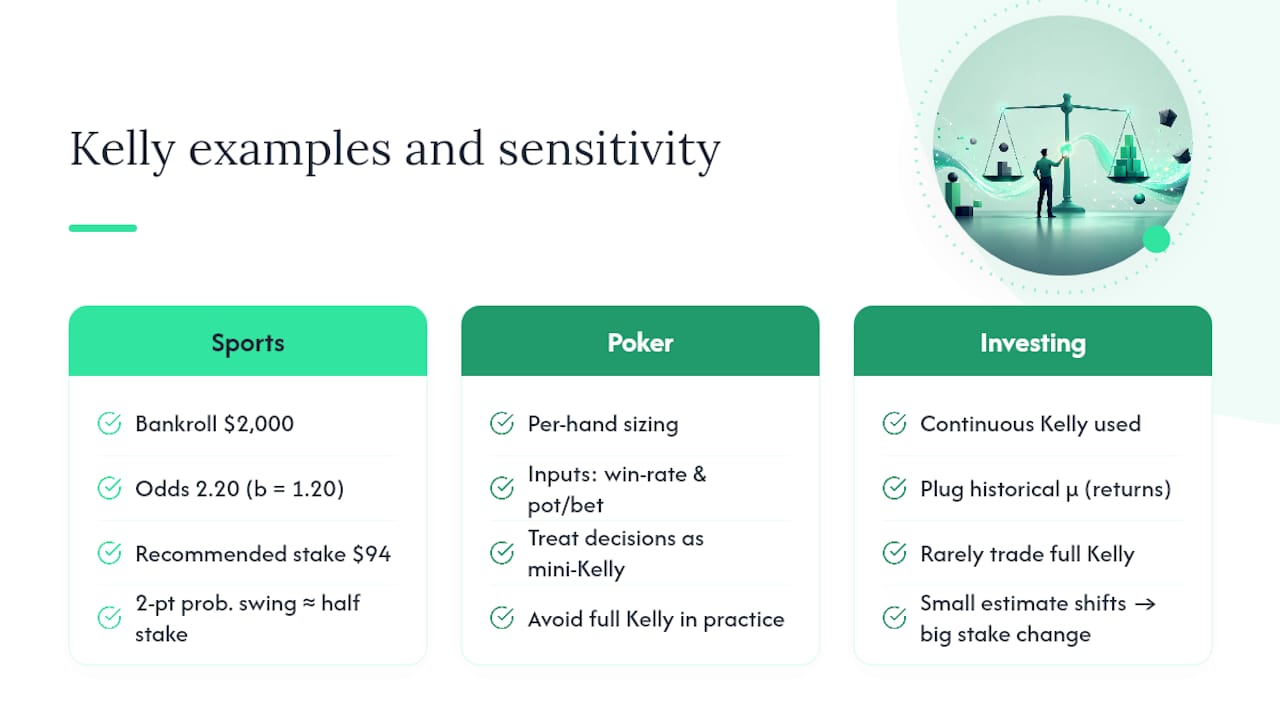
Sports betting. Say you have a $2,000 bankroll and you're looking at a bet with decimal odds of 2.20 (so b = 1.20). That's $94. A two-point swing in your probability estimate cuts your recommended stake nearly in half.
Poker per-hand sizing. Poker doesn't map perfectly onto binary Kelly because outcomes vary hand to hand, but many players use a simplified version: estimate your win rate per hand type and the average pot-to-bet ratio, then treat each significant decision point like a mini Kelly bet.
This is common with the continuous formula whenever historical equity return assumptions get plugged in directly, which is exactly why almost nobody trades full Kelly in practice.
Sensitivity is the real lesson across all three examples. A small shift in your estimate of p or μ produces an outsized shift in your recommended stake, which is the entire argument for staking conservatively rather than mechanically.
Why Fractional Kelly Beats Full Kelly in Practice
Full Kelly maximizes long-run growth, but it does so by tolerating drawdowns that would make most people quit betting or investing altogether. Half Kelly gives up some of that growth in exchange for a much smoother ride, and that trade-off is why it's become something close to an industry default.
Quarter Kelly trims growth further but reduces variance even more, which is why many cautious bettors with less confidence in their probability estimates often land there instead.
Most retail practitioners who use fractional Kelly also apply a hard cap, regardless of what the formula outputs. This protects against the scenario where your p estimate is simply wrong, not just imprecise.
A few situations call for shrinking your fraction even further:
- You're working with limited historical data or a brand-new model you haven't calibrated yet.
- The market or game has low liquidity, meaning you can't always get the odds your calculation assumed.
- Fees, rake, or vig eat into your edge more than your formula accounted for.
- You have a finite time horizon and can't ride out a multi-week losing streak the way the long-run math assumes.
Bettors who keep sizing off their old, larger bankroll number are often the ones who dig the hole deeper.*
How Do You Estimate Your Win Probability?
Every Kelly calculation lives or dies on the quality of p, and overestimating it is the single most common way bettors blow up their bankroll using a formula that's supposed to protect them.
Three approaches give you a defensible p:
- Historical frequency. If you've tracked similar bets or trades over a large enough sample, your actual win rate is a reasonable starting estimate, provided conditions haven't shifted.
- Model output. Statistical or machine-learning models can generate a probability directly, but only if they've been back-tested and aren't overfit to past data.
- Market-implied probability. Betting odds themselves embed a market consensus probability once you strip out the bookmaker's margin. Comparing your estimate against that baseline is a useful sanity check.
Calibration is the exercise most bettors skip. Large, consistent gaps between predicted and realized outcomes mean your p estimates are biased, usually toward overconfidence.
The conservative fix is simple: shrink your p estimate slightly toward the market consensus, then apply fractional Kelly on top of that already-discounted number. Two layers of caution beat one, especially since parameter uncertainty is the main reason professional traders avoid full Kelly in the first place.
Handling Multiple Bets and Correlated Positions
Placing several bets at once creates a problem the basic formula never anticipated: if you calculate an unconstrained Kelly fraction for each bet separately, the fractions can sum to well over 100% of your bankroll.

The fix is proportional scaling. Add up all your individual Kelly fractions, and if the total exceeds 1.0, scale every position down by the same ratio until the sum fits your bankroll. This keeps the relative sizing intact while respecting your actual capital limits, and it's the standard approach for multivariate Kelly sizing.
Correlation adds another layer. Bets on the same game, related markets, or the same underlying asset don't diversify each other the way independent bets do, so treating them as separate full-sized Kelly positions overstates your effective bankroll.
- Three correlated bets, each with an unconstrained Kelly fraction of 15%, sum to 45% of bankroll.
- Because they're correlated (say, same-game outcomes), apply a 30% discount to the combined figure.
- Scaled allocation becomes roughly 31.5% total, split proportionally across the three, rather than the raw 45%.
The heuristic is rougher than a full covariance-matrix calculation, but it's far easier to execute in real time and catches the worst overexposure mistakes.
Turning Kelly Math Into a Real Dollar Stake
Running the formula by hand works fine for one bet. Tracking dozens of bets over months requires a system, which is where a calculator earns its keep.
- Enter your current bankroll, the odds (or your estimated edge), and your probability estimate into a Kelly calculator to get f* instantly, then multiply by your bankroll for the dollar figure. Tools like Rational Odds' Kelly calculator let you toggle between full, half, and quarter Kelly modes so you can see all three dollar amounts side by side.
- Use the Stakestats bankroll analyzer to log each stake and outcome over time, which turns your calibration exercise from a mental guess into an actual drawdown chart you can look at.
- Run the Stakestats IOW calculator when you want to test how sensitive your recommended stake is to small changes in your odds or probability inputs before you commit money.
- When you're applying Kelly sizing to a provably fair game, confirm the underlying odds and outcomes weren't tampered with using the provably fair verification tools, since no staking formula protects you from a rigged input.
None of this replaces the actual work of estimating p honestly. A calculator computes the fraction correctly every time; it can't tell you whether your probability guess was any good.
What Kelly Gets Right, and Where It Breaks Down
Kelly is the correct tool when you have a genuine, quantifiable edge and you care about long-run geometric growth rather than the outcome of any single bet. That's a narrower use case than most people assume. The formula's real weakness isn't the math, it's the input: p and μ are estimates, not facts, and Kelly happily amplifies your overconfidence into an oversized stake. Use fractional Kelly, cap your per-bet exposure, and log every result. The formula rewards discipline more than it rewards precision.
*— Ian
Put Your Kelly Numbers to Work With Stakestats
Running the Kelly formula on paper gets you a fraction. Turning that fraction into a real stake you can actually track, verify, and adjust over dozens of sessions is a different job entirely, and it's the one Stakestats was built for. The bankroll analyzer logs every stake against your bankroll so you can see your drawdowns in real numbers instead of guessing whether half Kelly is actually protecting you.

Because Kelly sizing only works if the odds behind it are honest, pair your calculations with the transparency tools that verify Stake Engine game outcomes before you size your next position. If you're ready to move from formula to practice, open the bankroll analyzer and log your first Kelly-sized bet today.
Sources
The formulas and drawdown figures above draw on the Kelly criterion derivation, Wikipedia's overview, and Aldous's Berkeley notes on real-world Kelly betting.
- The Kelly Criterion: How to Size Your Bets Optimally · Expected Value
- Kelly Criterion Calculator - Rational Odds
- Kelly criterion — Wikipedia
FAQ
Is the Kelly criterion good for investing?
Yes, for investors with a genuine, quantifiable edge and a long time horizon, since the continuous form (f* = μ / σ²) links position size directly to expected excess return per unit of risk. Full Kelly often implies leverage when fed typical historical equity numbers, which is why most investors apply a fractional version instead.
Does the Kelly staking method actually work?
It works when your probability or return estimates are accurate, because it mathematically maximizes long-run geometric growth. It fails badly when those estimates are wrong, since Kelly has no built-in defense against bad inputs, only against bad outcomes given good inputs.
Does Warren Buffett use the Kelly criterion?
Buffett has never publicly confirmed using the formal Kelly formula, though his concentrated, high-conviction investing style is often cited as philosophically consistent with Kelly's logic of sizing bigger when your edge is bigger. There's no verified record of him applying the literal equation to his position sizing.
What are the biggest risks of using the Kelly criterion?
The largest risk is overestimating your win probability or expected return, since Kelly scales your stake up in direct proportion to an input you can't ever know with certainty. Full Kelly also carries a meaningful chance of substantial medium-term drawdowns even when your long-run edge is real, which is the core reason fractional Kelly exists.