
Load in 1.86 Seconds: Lightning Casino Deposits for Players (2026)

Yes, Lightning deposits let supported crypto casinos credit funds in seconds with fees that often run under a cent. You send a Lightning invoice from your wallet, the casino confirms it almost instantly, and your balance updates before you'd finish typing a support ticket. Withdrawals work differently and sometimes need a separate request, so test small before you commit real money.
TL;DR:
- Lightning deposits typically credit instantly with fees often below one cent, but large withdrawals may require separate requests due to liquidity constraints.
- Successful Lightning payments depend on sufficient channel liquidity on both your wallet and the casino's side, with failure common from expired invoices or insufficient routing capacity.
- Using small test deposits first helps confirm that your wallet and the casino's liquidity channels are properly set up and functioning before risking larger sums.
- Lightning's speed and low fees make it ideal for quick reloading, micro-stakes, and frequent transactions, but it's less suitable for large, one-time transfers due to channel capacity limits.
- Casinos often support Lightning deposits but may process withdrawals only via on-chain Bitcoin, so verify payout methods and liquidity before making large transactions.
Table of Contents
- How Lightning deposits work at a casino
- Step-by-step: making a Lightning deposit (player checklist)
- Wallets, funding, and setup: choosing the right Lightning wallet for casinos
- Speed, fees, and limits: Lightning vs on-chain Bitcoin for casino deposits and withdrawals
- Common failures, limits and troubleshooting (routing failures, expired invoices, wrong amounts)
- Withdrawals and casino support: what to expect when requesting Lightning payouts
- When to use Lightning (best use cases for casino players)
- Regulatory and legal aspects of using Lightning Network for online gambling deposits
- How casinos handle Lightning Network deposits on their backend
- Potential risks and scams related to Lightning Network deposits at casinos
- Comparison of Lightning deposits with other casino payment methods
- First-person perspective: how experienced players use Lightning safely
- Stake Stats: verifying games and managing bankrolls after fast deposits
- Sources
- FAQ
How Lightning deposits work at a casino
Lightning is a payment layer built on Bitcoin that moves value through channels instead of putting every transaction on the blockchain. According to the Lightning technical summary, it routes off-chain payments across these channels using time-locked contracts, which lets transactions settle almost instantly without needing on-chain confirmation for each one. The blockchain only gets involved when a channel opens or closes, or when a dispute needs resolving.
When you deposit at a casino that supports Lightning, the cashier generates an invoice, a text string that usually starts with "lnbc." That string encodes the amount, a destination, and an expiration window. According to Cryptowisser's Lightning gambling guide, players select the "Lightning" or "BTC (Lightning)" option in the cashier, which generates this time-limited invoice, then scan it or paste the string into a compatible wallet and confirm payment. Casinos commonly credit the balance immediately on success.
The invoice expires for a reason. Lightning payments route through a chain of channels between your wallet and the casino's node, and each hop along that route has to have enough liquidity to forward your payment. An expiration window keeps stale routes from lingering and protects both sides from a payment that gets stuck halfway. This is also why Lightning feels instant: instead of waiting for miners to include your transaction in a block, the payment simply moves through already-open channels, and settlement is confirmed the moment it reaches the destination.
The cashier flow, in practice, is short: you generate an invoice, pay it from your wallet, and the casino credits your balance. No block, no confirmation counter, no waiting screen. That said, the same guide's privacy note deserves attention: Lightning's privacy operates at the network layer, but regulated operators still tie invoices back to KYC-verified accounts. Faster payments do not mean anonymous ones. You're still logged into your account, your deposit is still tied to your identity on the casino's side, and the network-level privacy improvement doesn't change that.

Step-by-step: making a Lightning deposit (player checklist)
The first Lightning deposit is where most confusion happens, mostly because the process is unfamiliar rather than difficult. Follow this order the first time:
- Confirm your Lightning wallet has a balance and is capable of sending, meaning it has an open channel with enough capacity for the deposit you want to make.
- Log into the casino, open the cashier, and select "Lightning" or "BTC (Lightning)" to generate an invoice or QR code.
- Scan the QR code with your wallet's camera, or copy and paste the lnbc invoice string, then confirm the payment before the invoice expires.
- Check your casino balance immediately after sending. It should update within seconds.
- Save a screenshot of the invoice and the payment confirmation from your wallet in case you need to reference it later.
If the balance doesn't update within a minute or two, don't send a second payment. Check your wallet's transaction history first to confirm whether the payment actually went through, then check the casino cashier for a pending state before contacting support.
Pro Tip: Send a small test deposit (a dollar or two in sats) the first time you use a new wallet or a new casino, so you confirm the whole path works before committing a real bankroll.
Wallets, funding, and setup: choosing the right Lightning wallet for casinos
Not all Lightning wallets behave the same way, and the difference matters more than it looks once you're trying to deposit quickly during a live session.
Custodial wallets hold your funds and manage channel liquidity for you. You tap send, and the provider handles routing behind the scenes. Noncustodial wallets give you direct control of your keys and your channels, which means better privacy and self-custody but also more responsibility for keeping channels funded and open. According to Cryptowisser, wallets that manage channel opening automatically, or that rely on custodial liquidity providers, generally reduce failed sends for casual users, while experienced users can improve success rates by managing channels and liquidity manually.
For casino deposits specifically, look for:
- Automatic routing: the wallet finds a path for your payment without manual channel management.
- QR code support: scanning an invoice directly from the cashier screen speeds up the whole flow.
- Mobile-first design: most Lightning deposits happen from a phone during an active session, not a desktop.
Funding a noncustodial wallet usually means sending Bitcoin on-chain first, then opening a channel, which itself is an on-chain transaction with a fee and a wait. Custodial wallets skip that step: you buy in or transfer funds and you're ready to send. The tradeoff is liquidity. If a casino's own inbound liquidity is thin, or your channel doesn't have enough capacity on the right side, a larger deposit can fail even though a smaller one succeeds instantly.
Speed, fees, and limits: Lightning vs on-chain Bitcoin for casino deposits and withdrawals
The practical gap between Lightning and on-chain Bitcoin is the whole reason Lightning exists for casino play. On-chain Bitcoin deposits typically take 10 to 60 minutes to clear, with fees that move with network congestion, according to a guide to Bitcoin casino payments. Lightning deposits, by contrast, are typically credited in seconds with fees usually under $0.01, per the same guide.
| Payment method | Typical speed | Typical fee |
|---|---|---|
| Lightning deposit | Seconds | Under $0.01 |
| On-chain Bitcoin deposit | 10 to 60 minutes | Varies with congestion, from under $1 to several dollars |
A Voltage pilot processed 237,000 Lightning payments with a 99.94% success rate and an average settlement time of about 1.86 seconds, according to Bitcoin Magazine's report on iGaming payouts. That scale of real-world volume backs up what the fee and speed numbers suggest: Lightning is built for frequent, small, fast transactions rather than occasional large transfers.
The failure point is capacity, not speed. Routing a payment through Lightning channels works well for typical deposit sizes, but a very large transfer can exceed what the available route can carry, causing a failed or partially routed payment. This is the main reason to prefer on-chain Bitcoin for a large, one-time transfer: fewer routing constraints, and no channel capacity ceiling to run into, even though you'll wait longer and likely pay more in fees.
Common failures, limits and troubleshooting (routing failures, expired invoices, wrong amounts)
Most Lightning deposit problems trace back to a small number of root causes, and knowing them upfront saves a lot of back-and-forth with support.
- Expired invoice: invoices carry a time limit, and if you wait too long to confirm the payment, the casino cashier will need to generate a new one.
- Insufficient channel liquidity: your wallet, a hop along the route, or the casino's receiving node may not have enough capacity to complete the payment.
- Node or route offline: a node somewhere in the path can be temporarily unreachable, which forces the payment to fail rather than reroute silently.
- Invoice amount too large: a payment that exceeds what the available route can carry will fail even if your total balance is sufficient.
Cryptowisser's guide recommends sending a smaller amount, retrying, or switching to a wallet with better routing when a payment fails for these reasons. Before you try again, check your wallet's transaction log to see whether the payment shows as failed, pending, or succeeded but unconfirmed by the casino, since retrying a payment that actually succeeded creates a duplicate deposit you'll then need to sort out with support.
If you do need to contact support, come prepared. Record the invoice string, the timestamp of your payment attempt, a screenshot of the wallet confirmation, and the preimage if your wallet displays one, since that's the strongest proof a payment cleared.
Pro Tip: Keep a small on-chain Bitcoin reserve outside your Lightning wallet. It lets you open a new channel or top up liquidity quickly if a routing failure leaves you stuck mid-session.
Withdrawals and casino support: what to expect when requesting Lightning payouts
Deposits and withdrawals aren't the same feature. Some casinos accept Lightning deposits but process withdrawals only over on-chain Bitcoin or another rail, so check which type of support an operator offers before assuming payouts will be equally fast.
To receive a Lightning payout, you supply your own invoice, generated from your wallet, for the casino to pay. This is where inbound liquidity becomes the casino's problem rather than yours: the operator's node needs enough capacity on the right side of its channels to route your payout, according to the Lightning technical summary. Larger payouts sometimes get split across multiple payments or routed through operator-side liquidity management for this reason.
Some operators process Lightning withdrawals manually rather than automatically, which introduces a delay that doesn't exist on the deposit side. Practical guides caution that withdrawals may be processed manually or carry different limits than deposits, so treat "Lightning-supported" as a deposit claim first and verify payout behavior separately. If a withdrawal amount exceeds what the operator's Lightning liquidity can handle, expect a fallback to on-chain Bitcoin or a request to split the withdrawal into smaller amounts.
When to use Lightning (best use cases for casino players)
Lightning earns its place during live betting, quick reloads between sessions, and micro-stakes play where a $5 or $10 top-up needs to land instantly, not in the next block. If you're chasing a hot streak or reloading between hands, waiting 30 minutes for an on-chain confirmation defeats the purpose.
It's a weaker fit for very large or long-term transfers. A big bankroll move can bump into channel capacity limits on either side of the payment, and there's no upside to routing risk when speed doesn't actually matter for a transfer you're making once.
A practical hybrid: use Lightning for the deposits and reloads you make often, and fall back to on-chain Bitcoin when moving a large sum you don't need credited in the next ten seconds.
Regulatory and legal aspects of using Lightning Network for online gambling deposits
Lightning changes how a payment moves, not whether online gambling is legal where you live. The legality of playing at a crypto casino depends entirely on your local gambling laws and the licensing of the specific operator, and that framework doesn't shift just because the deposit rail is Lightning instead of a card or on-chain Bitcoin.
What does change is the identity layer around the payment. As Cryptowisser notes, regulated operators still link Lightning invoices to KYC-verified accounts, meaning the network's transaction-level privacy doesn't exempt you from the operator's identity checks. If a casino requires verification to withdraw, that requirement applies whether you deposited by card, on-chain Bitcoin, or Lightning.
Before depositing anywhere, confirm the operator is licensed for your jurisdiction and review its terms on cryptocurrency deposits specifically, since some licenses restrict crypto payments even when the operator accepts them elsewhere. Tax treatment of gambling winnings funded through crypto also follows your local tax rules, not the payment rail you used to fund the account. None of this is legal advice, and when the rules in your jurisdiction are unclear, that's a conversation for a professional who knows your local framework, not a payments guide.
How casinos handle Lightning Network deposits on their backend
On the operator's side, accepting Lightning deposits means running a Lightning node with enough open channels and liquidity to receive payments reliably from a wide range of players. That liquidity has a direction: incoming deposits need capacity on the casino's receiving side, while outgoing withdrawals need capacity on the sending side, and operators have to manage both continuously as volume shifts.

This is largely why the deposit experience feels effortless while withdrawals sometimes lag. Keeping channels funded for outbound payments ties up capital, and an operator processing a large volume of payouts may choose to rebalance channels, route through a liquidity partner, or fall back to on-chain settlement rather than let a channel run dry mid-payout.
The Voltage pilot reported in Bitcoin Magazine is a useful data point here: processing 237,000 payments at a 99.94% success rate takes deliberate channel and liquidity management on the operator's side, not just plugging in a Lightning node and hoping capacity holds. Operators that invest in that infrastructure tend to offer smoother two-way Lightning support, while those that don't often limit Lightning to deposits only.
Potential risks and scams related to Lightning Network deposits at casinos
The most common risk isn't theft, it's user error: sending a payment to an expired invoice, misreading an amount, or paying a phishing link disguised as a casino cashier. Always generate the invoice from inside the casino's own cashier page, never from a link sent by email, chat, or social media, and always double check the amount before confirming payment in your wallet.
A second risk sits on the operator side. A casino with poor liquidity management might accept deposits smoothly but struggle to honor withdrawal requests promptly, effectively holding your funds hostage to its own channel constraints rather than any dishonesty. This is why checking an operator's reputation and licensing before depositing matters more with newer or unlicensed sites, where an unreliable payout process is harder to challenge.
Fake wallet apps and fraudulent "Lightning-enabled" casino clones are the third category. Stick to wallets from official app stores or developer websites, and confirm you're on the casino's real domain before entering any payment details. None of these risks are unique to Lightning specifically, but the speed and finality of Lightning payments mean there's less room to catch a mistake after you've hit send, compared to a reversible card payment.
Comparison of Lightning deposits with other casino payment methods
Credit and debit card deposits are familiar and reversible through chargebacks, but they're often slower to clear for gambling specifically, and many card issuers restrict or decline gambling-related transactions outright. Lightning has no chargeback mechanism at all: once a payment routes and settles, it's final, which cuts both ways, since it also removes a common source of payment disputes and fraud holds.
On-chain Bitcoin deposits share Lightning's censorship resistance and lack of chargebacks but move far slower and cost more during busy network periods, per Beat The Fish's Bitcoin payments guide. For a player choosing between the two Bitcoin rails, Lightning wins on speed and fee for anything within normal deposit and withdrawal sizes, while on-chain Bitcoin remains the more dependable choice for very large, infrequent transfers.
Against both, Lightning's real edge is in the small, frequent transaction that would be uneconomical anywhere else: a $5 reload between hands costs a fraction of a cent to send and clears before your next bet, which neither a card network nor an on-chain Bitcoin transaction can match on that scale.
First-person perspective: how experienced players use Lightning safely
Players who rely on Lightning regularly tend to build the same small habits. Test a new wallet or casino with a tiny deposit before trusting it with a real bankroll. Screenshot every invoice and confirmation, and note the payment ID so you have something concrete if support needs proof. Keep a modest on-chain Bitcoin reserve on hand, since it's the fastest way to open a new channel if routing fails mid-session.
The other habit worth borrowing is verification. Fast deposits mean nothing if you can't confirm the game itself paid out fairly, which is where provably fair checks and independent analytics tools earn their place alongside a good wallet setup.
— Ian
Stake Stats: verifying games and managing bankrolls after fast deposits
Speed at the deposit stage only matters if you can trust what happens after the money lands. That's the gap Stake Stats fills for players who move fast on Lightning and want the numbers to back up their sessions.
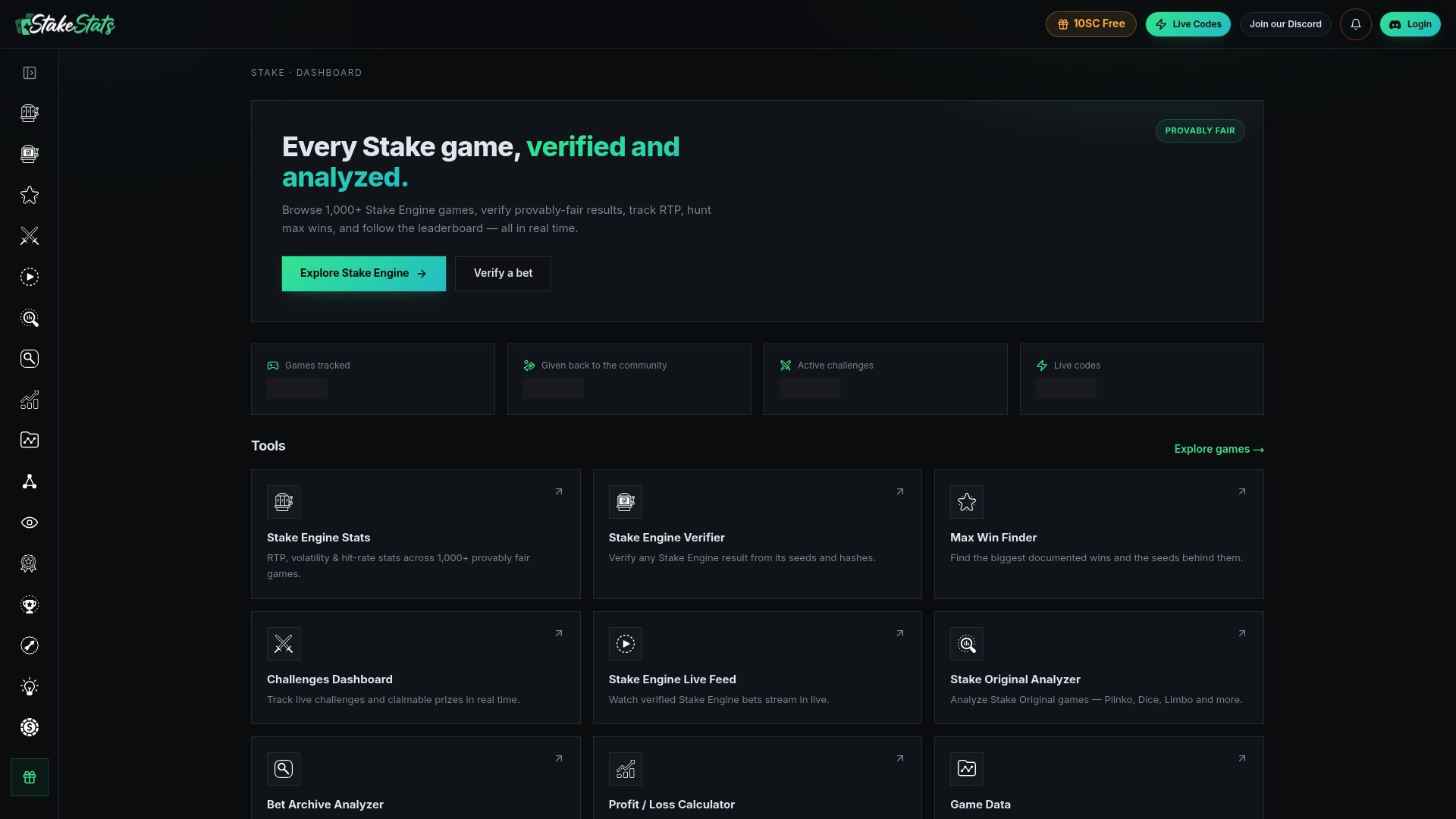
Once your balance updates, the Stake Stats bonuses calculator helps you work out the real value of a promotion before you commit a fast deposit to it, and the bankroll analyzer helps size test deposits and manage volatility once you're playing on a rail as quick as Lightning. For checking that a game actually paid out the way it should have, provably fair verification tools let you audit server seeds and nonces against real results rather than taking a payout on faith.
- Verify server seed and nonce data against actual bet outcomes before trusting a big result.
- Calculate real-time RTP, volatility, and hit rate across thousands of provably fair online casino games.
- Size your next deposit using bankroll data instead of guesswork.
Start with the provably fair verification tools to check your last session, or head to Stakestats to see the full toolset.
Sources
These sources cover the technical and practical details referenced throughout this guide.
- The 2025 Guide to Gambling With Bitcoin Lightning Network
- Lightning Network technical summary
- Bitcoin Lightning is turning iGaming payouts into a real-time rail: report
- How Bitcoin deposits and withdrawals work at US casinos
FAQ
How do you receive Bitcoin on the Lightning Network?
You generate a Lightning invoice from your wallet, which produces a string starting with "lnbc," and share that invoice with whoever is sending you funds. The sender scans or pastes the invoice and confirms payment, and funds typically show up in your wallet within seconds.
What are the risks of using the Lightning Network for casino deposits?
The main risks are user error, such as paying an expired invoice or a fake cashier link, and operator-side liquidity problems that can slow down withdrawals even when deposits work smoothly. Lightning payments are also final with no chargeback option, so a mistaken payment can't be reversed the way a card payment can.
How fast are transactions on the Lightning Network?
Lightning transactions typically settle in seconds rather than the 10 to 60 minutes a standard on-chain Bitcoin transaction can take, according to Beat The Fish. A large-scale industry pilot reported an average settlement time of about 1.86 seconds across 237,000 payments, per Bitcoin Magazine.
Do all crypto casinos support two-way Lightning payments?
No. Some casinos accept Lightning for deposits only and process withdrawals through on-chain Bitcoin or another method, so it's worth checking an operator's payout policy before assuming Lightning works both ways. Two-way support depends on the casino maintaining enough outbound channel liquidity to process payouts reliably.
Can I verify that a Lightning-funded casino session paid out fairly?
Yes, provably fair verification lets you check the server seed and nonce behind a bet against the actual result, independent of how you funded your deposit. Tools like the Stake Stats provably fair verification page let you run that check directly against your own session data.