
Limbo Odds on Stake: The Math, Payouts, and Verification

On Stake Limbo, your win probability for any target multiplier follows one formula: P = 99 / T. Pick a target of 2x and your hit chance is 49.5%. Every single target, from 1.01x and above, carries the exact same 1% house edge, meaning the game returns 99% of wagered funds over the long run.
That single rule has three practical consequences. Lower targets don't give you a mathematical edge over higher ones. They just change how often you win and how violently your balance swings. High targets are effectively lottery tickets with identical expected value per dollar wagered. And no interface trick, betting pattern, or "predictor" changes the 99/T relationship, so the only real lever you control is bet sizing and session structure.
- Hit chance and payout are inversely linked by design: the higher the multiplier, the rarer the win.
- Expected value per $1 wagered is $0.99 at every target, so switching targets doesn't beat the edge.
- Confirm rounds yourself with StakeStats' provably fair verification tools instead of trusting predictor claims.
99/T is the whole game. Multiply your target by your hit probability and you'll land on 0.99 every time, whether T is 1.5 or 1,500,000.
Key Takeaways
| Point | Details |
|---|---|
| Probability formula | Win chance equals 99 divided by your target multiplier (P = 99/T), constant across every target. |
| Expected value never changes | Every $1 wagered returns $0.99 in expectation, whether the target is 2x or —. |
| Low targets suit grinders | Frequent hits and low variance make 1.01x to 1.5x targets efficient for VIP progression and bonus wagering. |
| High targets are entertainment | Targets above 50x should come from a separate, dedicated budget you've already accepted losing. |
| No predictor beats provably fair RNG | Server seed, client seed, and nonce combinations lock outcomes before any bet is placed. |
| Verify with Stakestats | Stakestats' provably fair and bankroll analyzer tools let you confirm rounds and plan unit sizes based on real data. |
Table of Contents
- How Limbo Works on Stake: Interface, RNG, and the Bet Lifecycle
- Step-by-Step: Placing a Limbo Bet and Pre-Bet Safety Checks
- Odds for Limbo Games: Payout Math and Worked Examples
- RTP, House Edge, and What Stake's 1% Cut Means for Your Bankroll
- Risk-Tiered Limbo Strategies: Low, Medium, and High Volatility
- Why Common Limbo Strategies Fail
- Does a Limbo Predictor Work? Provably Fair Explained
- Verifying Limbo Rounds With StakeStats
- The Bottom Line on Limbo Odds
- A Methodical Approach Changes What You Notice
- Verify Every Round, Plan Every Bankroll With StakeStats
- Frequently Asked Questions
- Sources
How Limbo Works on Stake: Interface, RNG, and the Bet Lifecycle
Limbo strips slot mechanics down to a single number. You set a stake amount, pick a target multiplier, and hit play. The game generates a result multiplier behind the scenes, and if that result meets or exceeds your target, you win your stake times the target. If it lands below, you lose the stake. There's no reel, no board, no bonus round. Just a number versus a number.
The interface breaks into a few functional zones. The stake field controls bet size in your chosen currency, with quick multipliers (half, double) for fast adjustments. The target multiplier field is where you set T, and the game live-updates your win chance as you type, since it's calculating 99/T in real time even if it doesn't always spell out the formula. Below that sits the payout display, showing exactly what you win if the round hits.
Autoplay controls let you queue up dozens or hundreds of rounds without manually clicking each time. This is where stop-loss and profit-stop settings matter most: you can tell the system to halt autoplay if your balance drops by a set amount or climbs by a target amount. These aren't cosmetic. They're the closest thing to an actual discipline mechanism the game gives you.
The random multiplier itself comes from a provably fair random number generator. The outcome for any given round is technically already determined the moment the round's seed values are set, though you can't see it until you play. This is fundamentally different from a live dealer or physical device. It's math you can verify after the fact, not a process you can read in real time.
Pro Tip: Before committing real funds, run 20 to 30 test bets using Gold Coins or demo currency at your planned target. This won't change your odds, but it confirms your autoplay settings, stop-loss triggers, and payout display are all configured the way you expect before money is on the line.
A few checks worth running before you play seriously:
- Confirm your autoplay bet limit matches your intended session length, not an accidental 500-round default.
- Set stop-loss and profit-stop values before your first real bet, not after a losing streak starts.
- Check that your stake currency (crypto, Gold Coins, Stake Cash) matches what you intend to risk.
Step-by-Step: Placing a Limbo Bet and Pre-Bet Safety Checks
Placing a bet takes seconds. Protecting your bankroll before you do takes a little more discipline.
- Set your stake amount. Start with a fixed unit size, not a percentage you'll recalculate every round.
- Choose your target multiplier. This is the single decision that determines your hit chance and payout size.
- Confirm the displayed chance and payout. The interface shows both before you commit, so check them against your own mental math.
- Verify the round if you want proof of fairness. Use your active server seed and client seed pairing to cross-check outcomes through Stake's provably fair tool after the fact.
- Place the bet manually or set autoplay. For repeated low-target grinding, autoplay with stop conditions saves time and removes emotional decision-making mid-session.
Before any of that, a short checklist prevents most of the damage that turns a fun session into a bad night:
- Decide your total session bankroll before you open the game, not while you're playing.
- Use a unit size of roughly 0.5% to 2% of that bankroll per bet, scaled to your risk tier.
- Set a stop-loss (like negative 20% of session bankroll) and a profit target (like positive 30%) before you start.
- If Gold Coins or demo modes are available, test your target and autoplay settings there first.
None of this changes your odds. What it does is keep a bad fifteen-minute stretch from becoming a bad month. If you ever feel like you're betting to recover losses rather than for entertainment, GambleAware and the National Council on Problem Gambling both offer free assessment tools and support resources, and Stake's own site includes deposit limits and self-exclusion controls worth setting up before you need them.
Odds for Limbo Games: Payout Math and Worked Examples
The formula behind every Limbo round is simple enough to do in your head once you've seen it a few times: P = 99 / T, where T is your target multiplier and P is your win probability as a percentage. Stake bakes a 99% return rate into that numerator, which is how the platform enforces its declared 1% edge across every possible target without needing separate rules for low and high multipliers.
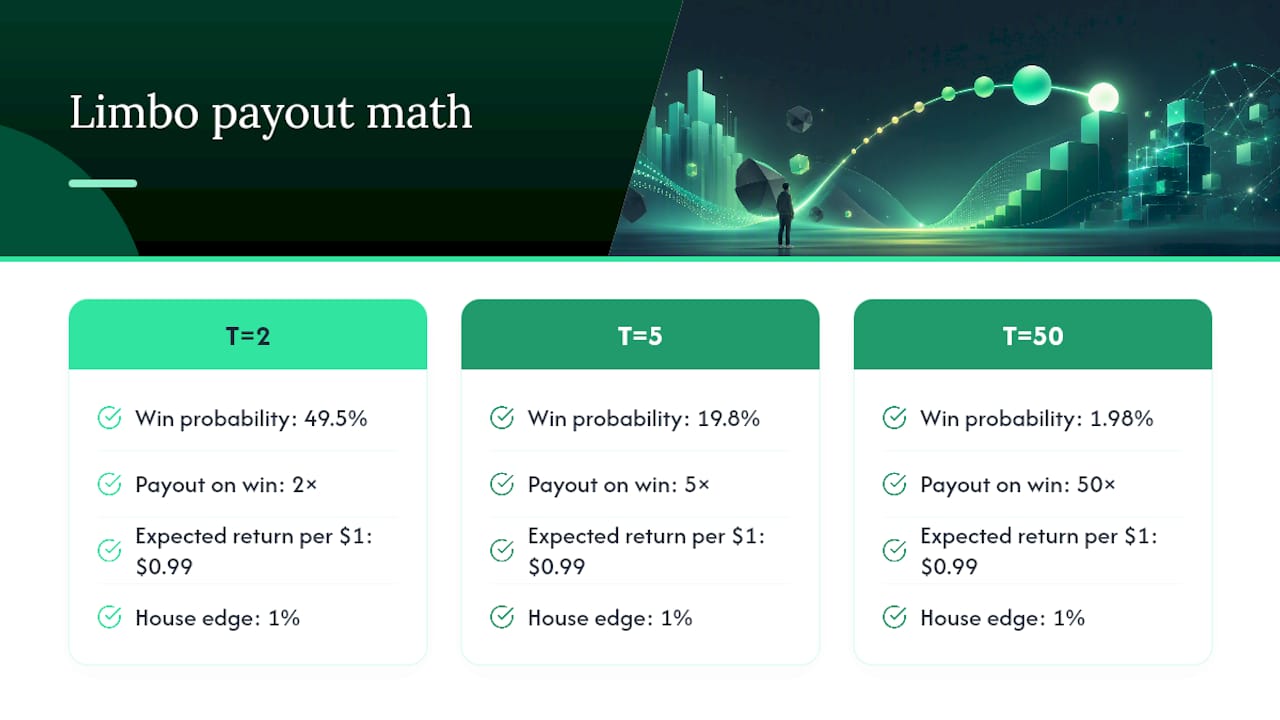
Rearranged slightly, this tells you something worth sitting with: your expected return per $1 wagered is always $0.99, no matter what T you choose. They just get there through wildly different variance profiles.
Here's how that plays out across common targets:
Notice the pattern in the last column. It never moves. That's not a coincidence, it's the entire design of the game. The 1% house edge is a constant, and the 99/T formula is simply how that constant gets distributed across every possible target you could set.
If you want to run these numbers yourself, the calculation fits on one line in any spreadsheet. Win probability equals 99 divided by your target. Expected value per dollar wagered equals that probability multiplied by the target, which always simplifies back to 0.99. The math never breaks, which is exactly the point.
What actually changes as T climbs is the shape of your outcomes, not their average. Both are the same bet in expectation. They feel like completely different games because they are, in terms of variance, even though the underlying math is identical. This is the core reason a limbo odds calculator is more useful for planning session shape than for hunting an edge that doesn't exist.
RTP, House Edge, and What Stake's 1% Cut Means for Your Bankroll
Over a large enough sample of bets, the platform keeps roughly one cent of every dollar wagered, and the 99/T formula is the mechanism that enforces this ratio identically across every target you could choose.
Here's what that looks like in practice. If you wager $1,000 total across a session, broken into any mix of targets, your expected loss is $10, on average, given enough rounds for the law of large numbers to apply. A single bet can obviously deviate wildly from that.
Pro Tip: If your goal is VIP progression or rakeback rather than a single big win, grinding low targets is the more efficient path. Lower variance means more completed rounds per dollar of bankroll before a bad streak knocks you out, and volume, not luck, drives most loyalty programs.
A few things worth keeping in mind about sizing:
- Unit size should scale with your risk tier, not your mood after a losing streak.
- The 1% edge applies per dollar wagered, not per session, so more total volume means more expected cost in absolute terms.
- Bankroll analyzers can turn this into a concrete session budget instead of a vague rule of thumb.
Risk-Tiered Limbo Strategies: Low, Medium, and High Volatility
Since every target shares the same expected value, your real decision in Limbo isn't which multiplier is "better." It's how much variance you can stomach and what you're actually trying to accomplish this session. That's the honest version of a limbo strategy stake, built around risk tolerance rather than a false hunt for an edge.

This tier suits grinders chasing VIP tiers, rakeback, or wagering requirements on a bonus, where volume matters more than any single outcome.
Session plans here benefit from explicit stop-loss and profit-stop rules, since variance is high enough to produce real losing streaks but not so extreme that a single bet can wipe a session in one shot.
A sane approach is a dedicated "lottery shot" budget, money you've mentally already spent, capped at a small fixed amount per week or month, with no expectation of recovery.
A few concrete sequences illustrate how each tier plays out:
- Flat low-risk grind: 200 bets of $1 at 1.4x (70.7% hit chance), autoplay with a 15% stop-loss.
- Balanced medium session: 50 bets of $5 at 4x (24.75% hit chance), stop-loss at $50, profit-stop at $75.
- Disciplined high-risk shot: 10 bets of $2 at 500x (0.198% hit chance) from a separate $20 entertainment bankroll, no chasing beyond that budget.
Simulation work on popular Limbo progressions backs this up directly. Large-scale runs of viral betting patterns show they redistribute variance without beating the edge, producing rare, shareable big wins alongside a much higher rate of severe median losses. The strategy doesn't change your math. It changes your odds of ending up in the highlight reel versus the much larger pile of forgotten losing sessions.
Why Common Limbo Strategies Fail
Martingale looks clever on paper. Double your bet after every loss, and the theory goes that your first win recovers everything plus a small profit. The problem is that a finite bankroll and table limits both cap how many times you can double before you're either out of money or out of room to bet.
Chasing losses runs on a related error: the belief that a losing streak makes a win "due." It doesn't. Each round is independent, and the 99/T probability for your next bet is identical regardless of what happened on the last ten. This is the gambler's fallacy in its purest form, and Limbo's simple mechanics make it unusually easy to fall into, since the moving target line feels like it's building toward something.
Predictor claims fail for a more structural reason: they conflict directly with how provably fair RNG actually works. Confirmation bias does the rest. A predictor "works" until it doesn't, and viral clips only show the sessions where it happened to line up.
A strategy can look successful for a hundred rounds and still be losing in expectation. Short-term variance and long-term edge are two different questions, and only one of them cares what happened last session.
Does a Limbo Predictor Work? Provably Fair Explained
No. There is no usable predictor that gives you a real-time edge on Stake Limbo, and the reason comes down to how the game's randomness is generated. Every round's outcome is tied to a combination of a server seed, a client seed, and a nonce, values that combine cryptographically to produce a result that can be verified after the round but not predicted before it.
Here's the simplified version of how it works. Stake generates a server seed and shows you its hashed version before you play, so it can't be altered after the fact without detection. You supply or are assigned a client seed. Each bet increments a nonce, a running counter, and the combination of all three values feeds into an algorithm that produces your round's result. Change any one input and the entire output changes.
What that means for predictor claims sold in forums or Discord servers:
- Claim: "This tool predicts your next multiplier before you bet." Fact: the outcome is cryptographically locked to seed and nonce values before you even open the predictor.
- Claim: "Verified by thousands of users." Fact: provably fair systems allow post-round verification, not advance knowledge, and viral proof clips almost always cherry-pick lucky streaks.
- Claim: "Works because it detects patterns." Fact: there is no pattern to detect across independent, cryptographically generated rounds.
Verifying Limbo Rounds With StakeStats
Confirming a round wasn't manipulated takes about a minute once you know where to look. Here's the process using StakeStats' tools.
- Locate your active seed pair. Your server seed (hashed until rotated) and client seed sit in your Stake account's fairness settings.
- Paste them into a verification tool. StakeStats' provably fair explanation page walks through matching a seed pair and nonce to a specific round's result.
- Replay the bet. Confirm the recalculated multiplier matches what the game displayed when you played.
- Cross-check hit-rate patterns. Use the Stake engine tool or the Stake Originals Analyzer to see whether your session's hit rate lines up with the expected 99/T curve over a larger sample.
A few things each tool actually does for you:
- The provably fair explanation page handles the seed and nonce math so you don't need to run the hash function yourself.
- The Stake engine tool surfaces the underlying odds calculations behind the interface, useful if you want to double-check a specific target's listed chance.
- The Originals Analyzer lets you review historical hit-rate and volatility data across past rounds, which is the fastest way to spot whether a suspicious streak is normal variance or worth a closer look.
If a session's results feel statistically off after checking a few dozen rounds this way, that's the signal to verify more carefully rather than assume foul play from a gut feeling.
The Bottom Line on Limbo Odds
Lower targets buy you frequency and smoother sessions. Higher targets buy you lottery-style variance. Neither buys you a better long-run outcome.
Your three practical paths forward: grind low targets for volume and VIP progress, run medium targets with clear stop-loss and profit rules for balanced sessions, or set aside a small, separate budget for high-target lottery shots you've already mentally written off.
- Size every bet against a bankroll you've decided on in advance, not one you're recalculating mid-session.
- If play ever starts to feel less like entertainment and more like a compulsion, GambleAware offers free tools and support to help you reset.
A Methodical Approach Changes What You Notice
Running low-target sessions with verification pulled up alongside the game changes how you play, even if it doesn't change your odds. You start noticing when a "streak" is just ordinary variance instead of a signal to chase. Checking a batch of rounds against expected hit-rate curves, using tools like StakeStats' analyzer, turns a vague feeling of "this seems off" into an actual answer.
The math never moves. What moves is how calmly you react when a session doesn't go your way.
Verify Every Round, Plan Every Bankroll With StakeStats
Reading the math is one thing. Confirming it's holding up in your own sessions is another, and that's the gap Stakestats closes. Our provably fair explanation tool walks you through checking your own server seed, client seed, and nonce against any round's result, so you're never taking a hit-rate claim on faith.

Beyond verification, Stakestats tracks live RTP, volatility, and hit-rate data across more than 2,500 Stake Engine games, so you can see how Limbo's numbers actually behave over real volume rather than a single session. Pair that with our bankroll analyzer to turn the unit sizes and stop-loss rules from this guide into a concrete plan for your own balance. If you want to test any of this without risking your full bankroll first, check our bonus code tool for current offers worth trying before you scale up.
Frequently Asked Questions
What are the actual odds on Stake Limbo? Your win chance for any target equals 99 divided by that target multiplier. A 2x target hits 49.5% of the time, while a 100x target hits 0.99% of the time, and the house edge stays fixed at 1% regardless of which target you choose.
Does a higher target multiplier mean worse odds? It means a lower hit chance, not worse expected value.
Can a Limbo predictor actually work? No usable predictor gives you a real-time edge. Outcomes are tied to provably fair server seed, client seed, and nonce values that lock in the result before you place your bet, which rules out advance prediction.
Is martingale a good strategy for Limbo? No. Doubling your bet after each loss requires exponentially larger wagers during a losing streak, and a run of just six or seven losses at moderate targets can require a bet dozens of times your original stake, an outcome that isn't rare given the game's actual probabilities.
How do I verify that a Limbo round wasn't rigged? Use your active server seed, client seed, and nonce with a verification tool like Stakestats' provably fair page to recalculate the round's result and confirm it matches what the game displayed.
What's a safe bet size for Limbo? Tools like a bankroll analyzer can convert that into exact unit sizes based on your total budget.
Where can I get help if Limbo betting feels out of control? GambleAware and the National Council on Problem Gambling both offer free assessments, hotlines, and self-exclusion guidance for anyone concerned about their gambling habits.
Sources
- Stake Limbo — Math, RTP, Variance & The Cleanest VIP Wager Engine on Stake | TRUST-Play
- Limbo Gambling Strategy 2026 — How to Play and Win | BTCGOSU
- GambleAware