
50–200 Bet Audit: Session First Limbo Strategy To Grind VIP Volume

Limbo runs at a fixed 99% RTP, and no target multiplier changes that. What separates a disciplined player from someone bleeding their bankroll is the setup around the bet: low targets on fixed stakes for grinding and VIP volume, strict stop-loss and stop-profit rules, and a habit of verifying rounds after every server seed rotation. Chasing a "better" target does nothing to the math. Chasing a strategy without a session plan does plenty of damage.
TL;DR:
- Limbo's 99% RTP remains fixed regardless of target multiplier, making strategic bet management essential to reduce variance and protect bankrolls.
- Setting a session size of 2-4% of total bankroll and bets at 0.5-1% helps manage fast-paced rounds and avoids rapid losses.
- Avoid progressive strategies like doubling after losses, as each round is independent and does not improve expected value.
- Regular verification of rounds via provably fair tools confirms the game’s honesty but does not change or predict outcomes.
- Using dedicated tools for session planning and audit checks improves discipline and confidence during gameplay.
Table of Contents
- Limbo Math and Provably-Fair Mechanics
- Actionable Templates: Grinding, Balanced, and Hunting Strategies
- Session Rules: Bankroll, Bet Sizing, Stops, and Time Limits
- Step-by-Step Provably-Fair Verification and Tools Checklist
- Behavioral Traps and What to Avoid
- Verification Versus Math: What Actually Moves the Needle
- Where StakeStats Fits Into Your Limbo Workflow
- Sources
Limbo Math and Provably-Fair Mechanics
Every Limbo round comes down to one formula: win probability equals 99 divided by your target multiplier. Set a target of 2x, and your odds of winning are 49.5%. Set it at 10x, and you're down to 9.9%. The number 99, not 100, is where the 1% house edge lives. Stake's version lets you pick targets from 1.01x all the way to 1,000,000x, but the edge never budges regardless of where you land on that scale.

The outcome itself gets generated through a commit-reveal scheme built on HMAC-SHA256. Before you place a bet, the casino has already hashed a server seed and shown you that hash. You supply a client seed, and every bet you make increments a nonce. Those three inputs, server seed, client seed, nonce, run through the hash function to produce the round's result. Nothing about your target choice or bet size touches that calculation.
A few things worth knowing about how this plays out in practice:
- Limbo and Dice sit in the same mathematical family, both built on a reciprocal distribution, just framed differently: Limbo asks for a payout target, Dice asks for a win probability.
- Because results are instant, players routinely see 30 to 60 rounds per minute, a pace that outstrips Crash by a wide margin.
- Code-level audits of the Limbo implementation show exactly how HMAC bytes map onto the payout curve, including where rounding gets handled.
- Industry audits confirm the 99% RTP and 1,000,000x cap as published, not just claimed.
Actionable Templates: Grinding, Balanced, and Hunting Strategies
Your target selection doesn't move the expected value. It moves variance, how often you win and how big those wins feel. Three templates cover most playstyles.
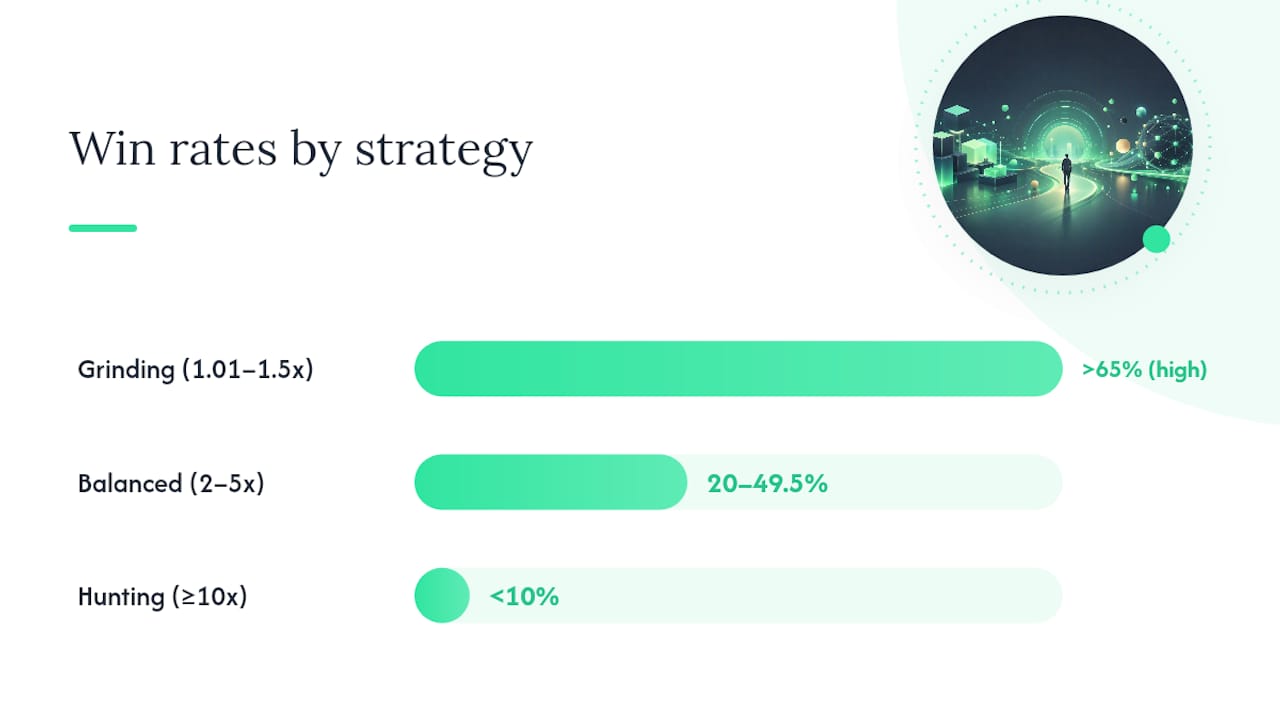
- Grinding. Targets between 1.01x and 1.5x, fixed bet size, no adjustments round to round. Win rates land north of 65%, which keeps your balance stable and your wagered volume climbing fast. That volume matters if you're chasing VIP tiers, rakeback, or rebate stacking, since Stake's bonus and VIP structures reward turnover more than any single win.
- Balanced play. Targets in the 2x to 5x range trade some win frequency (20% to 49.5%) for bigger swings and more engagement per session. This is the template for someone who wants Limbo to feel like a game, not a spreadsheet.
- Hunting. Targets at 10x or higher. Win probability drops under 10%, so you need a bankroll that survives long losing streaks, sometimes 20 or more rounds without a hit, before patience pays off.
None of these templates beat the house. They just decide what kind of ride you're on while losing 1% on average.
Pro Tip: Skip the Martingale-style doubling systems entirely. Because every round is independent, a loss doesn't make the next round more likely to win, so doubling your bet after a loss only accelerates how fast you can bust your session bankroll.
Progressive systems fail for a simple reason: EV independence. Each round starts fresh. The house edge doesn't care about your bet history, and no sequencing trick around bet size changes that.
Session Rules: Bankroll, Bet Sizing, Stops, and Time Limits
Treat your session bankroll as a slice of your total bankroll, not the whole thing. A workable range is 2% to 4% of total bankroll per session, with individual bets sized at 0.5% to 1% of that session amount. On a $1,000 total bankroll, that puts a session at $20 to $40, with bets running $0.10 to $0.40 each.
Stops matter more here than in almost any other casino game because Limbo moves fast:
- Stop-loss at a moderate threshold. If your session losses reach a certain portion of your session bankroll, walk away. This threshold helps prevent a bad run from becoming a bankroll-ending one.
- Stop-profit at a reasonable level. If your session profits reach a set percentage, lock it in and quit. Giving back gains chasing a bigger number is how winning sessions turn into losing ones.
- Time limits. Set a round count or clock limit before you start, not after you're already tilted.
Here's the number that changes everything about bet sizing: Limbo resolves rounds roughly 15 times faster than Crash. If you're used to Crash-sized bets and you bring that same stake size into Limbo, your hourly expected loss balloons because you're placing far more bets per hour at the same edge. The fix is straightforward: shrink your per-bet stake proportionally when you switch games, so your hourly variance and expected loss stay roughly where you want them. A bankroll analyzer does this math for you instead of leaving it to guesswork mid-session.
Step-by-Step Provably-Fair Verification and Tools Checklist
Verification doesn't change your odds. It confirms the odds you already had were applied honestly, and it's the single habit that separates informed players from everyone else clicking the button blind.
Before you start a session, capture three things: the server seed hash shown by the casino, your active client seed, and the nonce counter at the start of play. Every bet increments that nonce, so a clean log lets you match each round to its exact inputs later.
Once the operator rotates the server seed and reveals the old one, the real audit begins. Run an HMAC-SHA256 recomputation using the revealed server seed, your client seed, and each bet's nonce, then compare the recomputed result against what the game displayed. A practical audit covers a sample of 50 to 200 bets, enough to catch a pattern without manually checking thousands of rounds. Reverse-engineered implementations have exposed rounding edge cases that only show up under full decimal verification, which is why spot-checking a handful of rounds isn't enough.
A short toolkit covers the whole workflow:
- The provably fair explanation walks through the commit-reveal process step by step.
- The Stake Originals Analyzer breaks down RTP and volatility patterns across Stake's original games, Limbo included.
- Bet archive analysis lets you pull historical rounds and run a verification sample without manually logging every bet yourself.
| Task | What it confirms | Tool |
|---|---|---|
| Pre-session seed capture | You have the inputs needed to verify later | Manual log or bet archive |
| HMAC recomputation | The displayed result matches the committed hash | Provably fair explainer |
| Sample audit (50 to 200 bets) | No systematic rounding or skimming issue | Stake Originals Analyzer |
| Session sizing | Bets and stops match your bankroll plan | Bankroll analyzer |
Behavioral Traps and What to Avoid
The math stays constant. Your discipline doesn't, and that gap is where most bankrolls actually die.
- Chasing losses by raising your target mid-session. Switching from a 1.5x grind to a 10x hunt after a bad streak doesn't recover anything, it just changes your variance at the worst possible moment.
- Running progressive betting instead of fixed stakes. Doubling down after losses feels logical in the moment. It isn't, since each round is independent of the last.
- Leaving auto-mode running without a stop condition. Auto-bet is a convenience feature, not a substitute for the stop-loss and stop-profit limits you set before you started.
Pro Tip: Write your session limits down before you place a single bet, not while you're already thirty rounds deep and tilted. A rule you set in advance is a rule you'll actually follow.
Verification Versus Math: What Actually Moves the Needle
Provably fair verification confirms your rounds weren't manipulated after the fact. It does not, and never will, predict the next result or shift your edge. Anyone selling a Limbo "predictor" is either running a scam or leaning on unverified pattern chasing that HMAC commitment makes mathematically impossible.
What verification actually buys you is confidence during a losing streak, the kind of streak that makes players second-guess a fair game and start hunting for phantom patterns. Keep your verification logs. Share your audit summaries if you're active in a community. Transparency compounds the same way disciplined bankroll management does, quietly, and only if you keep doing it.
— Ian
Where StakeStats Fits Into Your Limbo Workflow
Stakestats builds the exact toolkit this guide describes, so you're not stitching together spreadsheets and manual HMAC calculations every session. The provably fair explanation tool walks you through commit-reveal verification without needing a cryptography background. Session math, the 2% to 4% bankroll sizing, the 0.5% to 1% per-bet stakes, runs through the bankroll analyzer instead of a notepad. When you want to audit a real sample of your own rounds, bet archive analysis pulls your history and checks it for you.

Log in, connect your account, and run a 50 to 200 bet audit on your last Limbo session before you place another wager. It takes less time than one grinding session, and you'll know exactly where your bankroll stands and whether every round checked out. Start with the bankroll analyzer to set your session limits, then move to verification once your numbers are locked in.