
Stretch a $50 Bankroll: Verified Low Volatility Stake Games

These options work because they spread payouts across more frequent, smaller hits instead of chasing rare jackpots, and most carry either a fixed low house edge or settings you can adjust yourself. Drop your per-spin bet to a small slice of your session bankroll and set a stop point before you start.
TL;DR:
- Low volatility games pay smaller amounts more often, helping to smooth your bankroll and extend session duration.
- Stake Originals like Plinko, Mines, and Dice offer adjustable settings to manually control risk and keep payouts steady.
- Always verify a game's actual RTP and volatility through provably fair checks or data analysis before trusting its label.
- Set fixed session limits and avoid increasing bets to manage risk effectively during long low-volatility play.
- Do not rely on bonus buy-ins for low-volatility games, as they bypass the frequent small wins that support steady bankrolls.
Table of Contents
- What Are Low Volatility Stake Games and Why Do They Matter?
- Curated Shortlist: Best Low Volatility Games to Try
- How Does Low Volatility Actually Work?
- How to Choose a Low Volatility Stake Game for Your Bankroll
- Stake Originals and Adjustable Risk: The Data Behind Low Volatility Play
- Building Session Rules That Actually Protect Your Bankroll
- An Editorial Note on Verifying Games Before You Trust Them
- Verify Before You Bet: Stakestats Tools for Low Volatility Play
- Trusted Resources for Safer Play
- Sources
- FAQ
What Are Low Volatility Stake Games and Why Do They Matter?
Low volatility (also called low variance) describes how often a game pays versus how big those payouts run. A low-volatility game hands back smaller amounts more often, which smooths out your bankroll curve and keeps you in action longer. High volatility flips that script: long dry stretches punctuated by rare, much bigger hits.
This distinction matters more on some platforms than others, as some games let you adjust volatility settings manually. That's a mechanical feature, not a marketing claim. Plinko's row count and risk setting, Mines' tile count, and Dice's win chance slider all directly change how often you win and by how much. Nowhere else in online gambling do you get that level of direct control over your own variance.
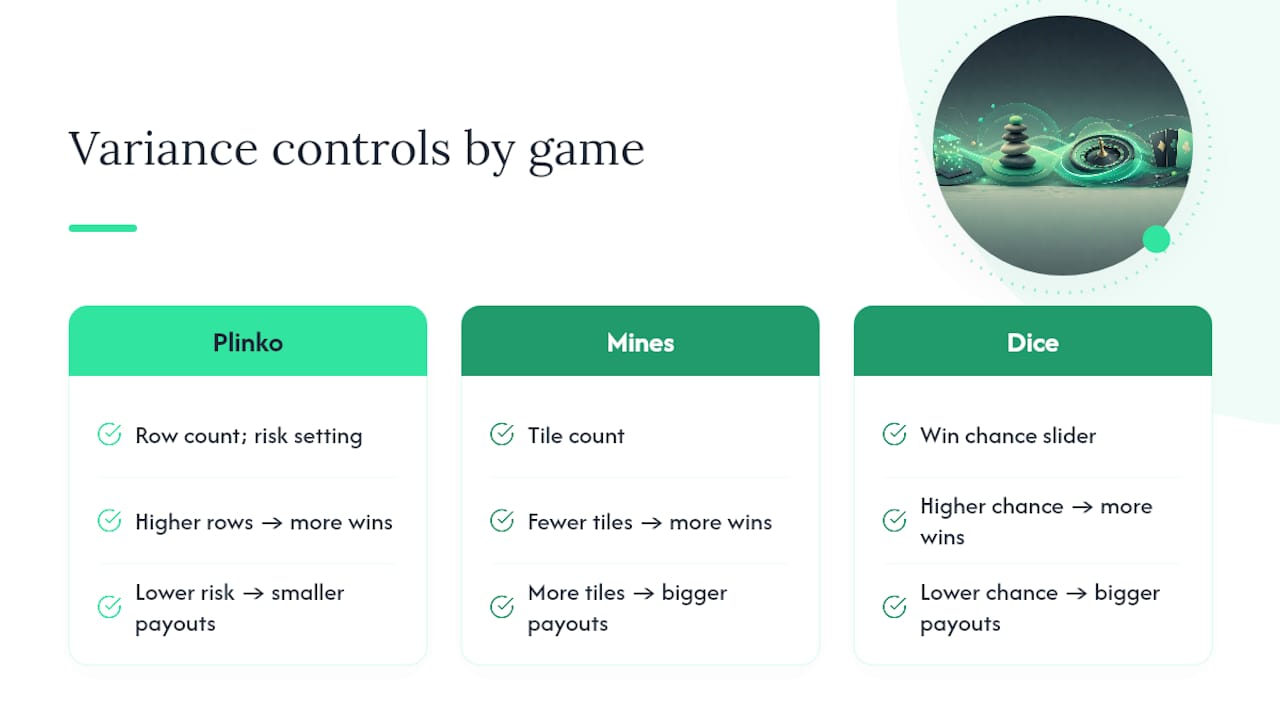
The industry term you'll see in reviews and paytables is "variance" or "volatility rating," usually shown as low, medium, or high, sometimes with a star scale. Stake's provably fair system adds another layer: every round is verifiable against a server seed and nonce, so you can confirm the game behaved the way its published RTP says it should, rather than trusting a marketing page.
Curated Shortlist: Best Low Volatility Games to Try
Here's a ranked shortlist mixing Stake Originals with widely available slots, chosen for session stability rather than jackpot chasing.
- Stake Plinko (low risk, 16 rows) — Best for adjustable low volatility. Plinko carries a headline 99% RTP like most Stake Originals, and setting rows to 16 with low risk clusters payouts tightly around 1x, which is about as steady as a drop-ball game gets. Try $0.10 to $0.50 per drop if you're playing a long session.
- Mines (3 to 5 mines) — Best for strategic base-game play. Fewer mines means more safe tiles to reveal before you cash out, so wins come frequently even if each one is modest. Keep mine count low and bet small if the goal is duration over drama.
- Dice (win chance 75% to 90%) — Best for controlled win-chance. You set the odds directly, so pushing win chance above 75% guarantees frequent hits at a correspondingly lower multiplier. This is the most transparent volatility control on the platform, full stop.
- Starburst — Best known low-volatility slot for beginners. Small, frequent wins on both sides of the reels thanks to its win-both-ways mechanic, and it's one of the most recognized low-variance titles in the industry.
- Blood Suckers — Best for players who want bonus features without big swings. Frequent small-to-medium hits and a well-regarded RTP make it a steady pick for extended play.
- Sweet Bonanza — Best for players who want occasional bigger hits without abandoning frequency. It sits closer to medium volatility than the others here, so treat it as a step up once you're comfortable.
Plinko, Mines, and Dice are original games running on a provably fair engine with adjustable settings baked in. Starburst, Blood Suckers, and Sweet Bonanza are third-party slots you'll find across many licensed platforms, including Stake's slot library, but their volatility is fixed by the developer rather than adjustable by you.
How Does Low Volatility Actually Work?
RTP and volatility are two different numbers answering two different questions. RTP tells you what percentage of wagered money a game returns over millions of rounds. Volatility tells you how that return gets distributed across individual spins. A slot can carry a 96% RTP with either low volatility (steady trickle) or high volatility (long droughts, occasional floods) — the RTP alone won't tell you which.
A few mechanical signals separate genuinely low-volatility games from ones just labeled that way:
- High payline or "ways to win" counts (243, 1,024, or more) that increase the odds of some line hitting each spin
- Bonus rounds triggered by a filling meter or counter rather than a rare random scatter combination
- Frequent free-spin retriggers that keep small wins compounding instead of resetting to zero
- An explicit volatility switch or slider, which Stake Originals like Plinko and Dice both offer
Low-volatility slots in published roundups often carry RTPs in the 94% to 97% range, and many pair that RTP with high paylines or meter-fill bonuses as their defining low-variance trait.
Pro Tip: Don't take a "low volatility" label at face value. Check the game's info screen for the actual RTP and volatility rating, then verify a sample of rounds through a tool like the Stakestats bonus and volatility analyzer before committing real bankroll to it.
How to Choose a Low Volatility Stake Game for Your Bankroll
Picking the right game for a long session comes down to matching mechanics to your bankroll and time budget, not chasing whatever's trending.
- Define your session first. Decide how long you want to play and what "success" looks like: more spins, not a specific cash target.
- Set your bankroll and bet size. A common rule for extended low-volatility play is betting 0.5% to 1% of your session bankroll per spin or round, which stretches a $50 bankroll across 100 to 200 bets.
- Filter by RTP and paylines. Favor games publishing RTP above 94% with high payline counts or ways-to-win mechanics.
- Prefer meter-fill and auto-bonus triggers over random scatters. These mechanics pay more consistently across a session.
- Skip bonus buys on low-volatility titles. Buying straight into a feature defeats the point of steady, low-variance play and usually costs more than letting the meter fill naturally.
Watch for red flags before you load a game: no visible RTP anywhere in the info screen, a tiny max win paired with a low payline count (a mismatch that suggests hidden higher variance), or a "low volatility" label with no supporting detail on hit frequency.
Pro Tip: Run your target bankroll through the Stakestats bankroll analyzer before you sit down. It's faster than doing the math on a scratch pad, and it keeps your per-bet sizing honest once you're a dozen rounds deep and tempted to raise stakes.
Stake Originals and Adjustable Risk: The Data Behind Low Volatility Play
Most Stake Originals share a headline 99% RTP, which means the identical long-run edge sits behind Plinko, Dice, and Mines alike. Since RTP doesn't move much between them, volatility control is what actually separates a steady session from a rollercoaster one, and that control lives entirely in the settings you choose before each bet.
| Game | Adjustable control | Low-volatility setting | Effect on hit frequency |
|---|---|---|---|
| Plinko | Rows (8 to 16) and risk level | 16 rows, Low risk | Payouts cluster near 1x; frequent, modest hits |
| Mines | Number of mines (3 to 5) | 3 to 5 mines | More safe tiles revealed before a bust |
| Dice | Win chance (75% to 90%) | 75% to 90% win chance | Frequent wins at lower payout multiples |
| Chicken (Chicken Chase style) | Difficulty tier | Easy/Medium difficulty | Steadier cash-out points, smaller multipliers |
Plinko specifically offers 8 to 16 rows and Low, Medium, or High risk levels, and setting Low risk with more rows clusters payouts tightly near 1x, which is the clearest example of a Stake Original letting you manually flatten its own variance.
Pro Tip: Before increasing your bet size on any Original, run a batch of rounds through the Stakestats Originals Analyzer and check the actual hit rate against the theoretical one. If the sample looks off, verify the server seed and nonce yourself rather than assuming the discrepancy is just variance.
Building Session Rules That Actually Protect Your Bankroll
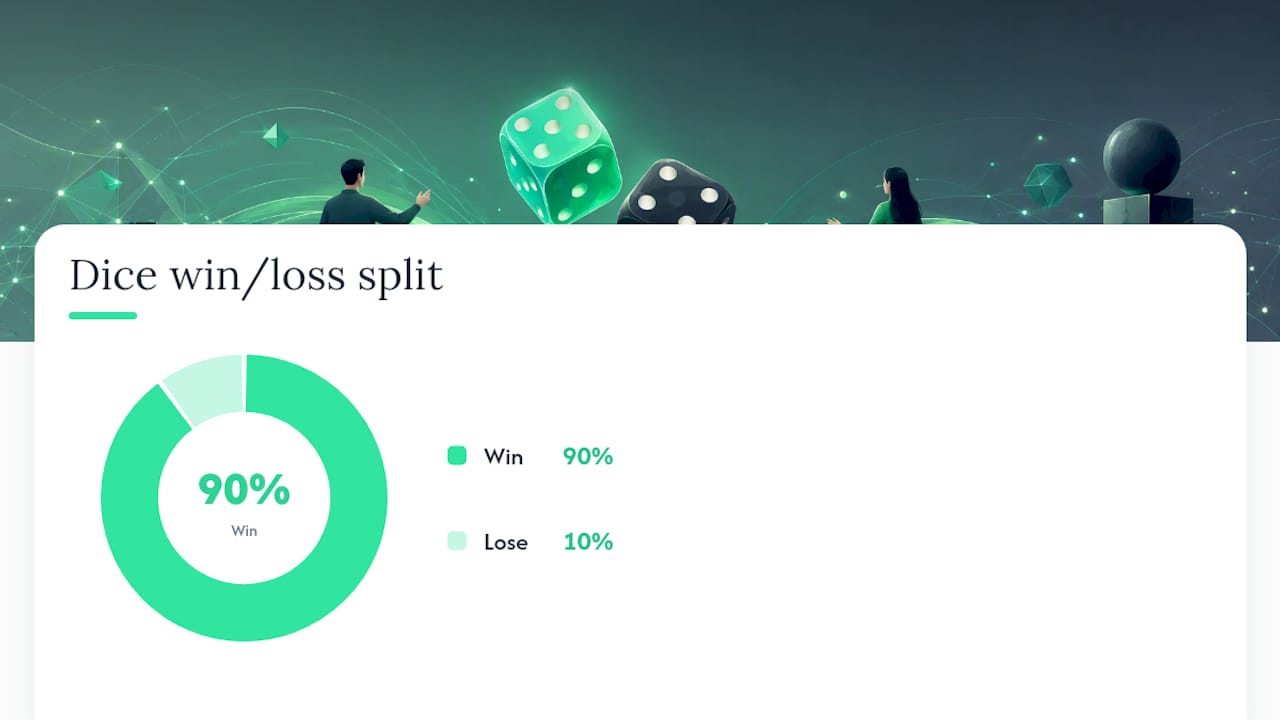
Adjustable volatility reduces swing, but it doesn't remove risk. A low mine count still busts sometimes, and a 90% win chance on Dice still loses one time in ten. Treat every low-volatility setting as risk reduction, not risk elimination.
Before you start a session, lock in three numbers: a time limit, a loss limit, and a target where you stop and walk away regardless of how you feel in the moment. Pre-commit to your bet size rather than deciding spin by spin.
- Set a hard time limit and a hard loss limit before your first bet, not after a losing streak starts
- Decide your stop-loss and take-profit points in advance and treat both as non-negotiable
- If you notice yourself raising bets to "catch up," that's the signal to stop, not push through
- Organizations like GambleAware offer self-exclusion tools and support if session limits stop working on their own
An Editorial Note on Verifying Games Before You Trust Them
Spend enough time comparing published RTPs against actual round outcomes and you notice how often the two drift apart, especially on newer or less-reviewed titles. My working rule: never trust a volatility label without checking a sample of rounds against the server seed and nonce yourself. It takes a few minutes and it settles the question completely. For readers who want to go deeper into how that verification actually works, the Stakestats blog breaks down the process game by game.
— Ian
Verify Before You Bet: Stakestats Tools for Low Volatility Play
Stakestats gives you the one thing volatility labels and forum lists can't: proof. Instead of guessing whether a game's "low volatility" tag matches reality, you can pull real RTP, hit rate, and volatility data across more than 2,500 Stake Engine games and check it against the actual math behind your session.
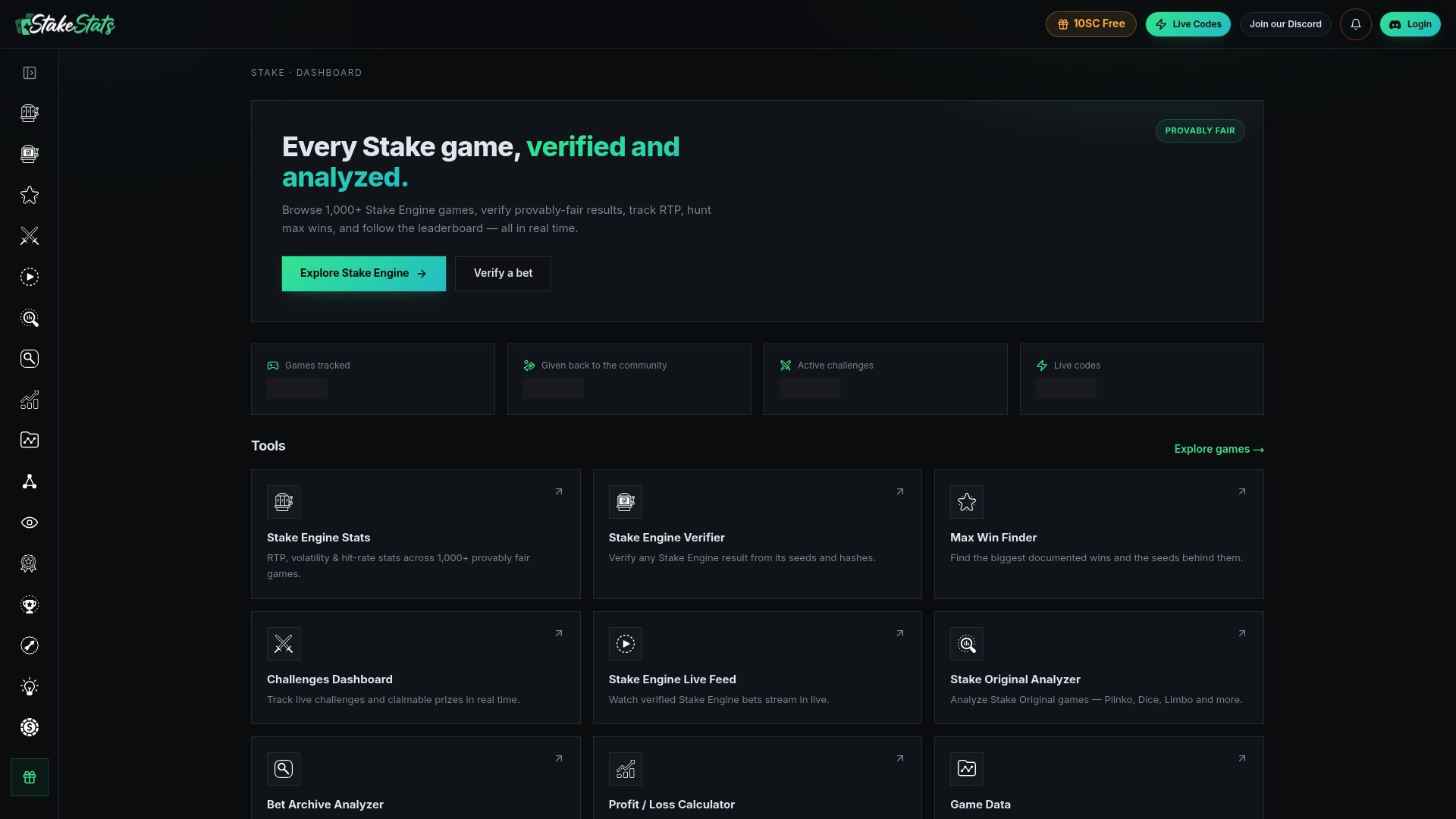
Start with the Stake Originals Analyzer to check Plinko, Mines, or Dice settings against real round data before you commit bankroll. Then run your numbers through the bankroll analyzer to set a per-bet size that actually matches your session goals, and use the provably fair verification tools to confirm any round you're unsure about. If you're ready to plan your next low-volatility session with real data instead of a paytable guess, start with the Stakestats Stake toolkit now.
Trusted Resources for Safer Play
- GambleAware offers free information, advice, and self-exclusion tools for anyone concerned about their gambling.
- Gambling Therapy provides international counseling and moderated forum support for players and families.
- The National Council on Problem Gambling runs the U.S. national helpline and referral network for problem gambling support.
Sources
FAQ
What Does Low Volatility Mean in Stake Games?
It means a game pays out smaller amounts more frequently instead of rare, large jackpots, which keeps your bankroll steadier across a longer session.
Which Stake Originals Count as Low Volatility?
Plinko on low risk, Mines with a low mine count, and Dice with a win chance above 75% all qualify, since each lets you manually reduce swing through adjustable settings.
Is RTP the Same as Volatility?
No. RTP measures the long-run average return of a game, while volatility measures how that return is distributed across individual bets. A game can carry a high RTP and still be high volatility.
How Do I Verify a Game's Actual Volatility?
Check the in-game info screen for its published RTP and volatility rating, then confirm real outcomes using provably fair seed checks or a tool like the Stakestats analyzer.
What's a Safe Bet Size for a Long Low Volatility Session?
A common guideline is 0.5% to 1% of your session bankroll per spin or round, which lets a modest bankroll stretch across 100 or more bets.
Are Bonus Buys Worth It on Low Volatility Slots?
Generally not. Buying into a feature directly skips the frequent small-win mechanic that makes low-volatility games worth playing in the first place, and it typically costs more than letting the bonus trigger naturally.