
Verify Max Win Before You Bet: 10,000× vs 50,000× Can Mislead Players

Max win is the highest payout a slot game can mathematically produce on a single spin, typically expressed as a multiple of your stake. It's a theoretical ceiling, not a guarantee, and the odds of reaching it are extremely low. Before trusting a headline multiplier, check it against the provider's own game page and the in-game help screen, not the marketing banner.
TL;DR:
- Verify max win claims on the provider’s official game page and in-game help screens, not solely on operator promotional sites, as figures often differ.
- Recognize that max win is built from multiple bonus mechanics, stacking multipliers and trigger conditions, often resulting in a payout that may rarely be achieved in practice.
- Understand that high max-win multipliers usually indicate high volatility, meaning the chance of hitting such payouts is extremely low and often in the millions to one odds.
- Remember that a higher max win does not improve your odds of winning, as it only represents the payout ceiling, not the probability of reaching it during normal play.
- Cross-check posted max-win figures with actual game features, version updates, and bonus terms to ensure the information is current and applicable to your specific game setup.
Table of Contents
- Max Win Explained: Multipliers, Payouts, and Where the Number Lives
- How Max Win Gets Calculated: Paytables, Multipliers, and Bonus Rounds
- Max Win vs. RTP vs. Volatility: Which One Actually Affects Your Session
- How to Verify a Published Max-Win Claim Before You Trust It
- Published Max Win Examples and What They Mean at Real Bet Sizes
- What Players Get Wrong About Max Win (and How to Play Smarter)
- Using Provably Fair Verification and Stakestats Tools to Check Max-Win Claims
- Why Verification Beats the Headline Number
- Sources
Max Win Explained: Multipliers, Payouts, and Where the Number Lives
Max win shows up in two formats, and mixing them up leads to bad math. Some providers publish it as a multiplier, like 10,000× your stake. Others publish an absolute dollar figure tied to a specific bet size, which only holds true at that exact bet. A 500× multiplier on a $1 bet pays out very differently than the same multiplier on a $0.10 bet, so the number alone tells you nothing without the stake attached.
You'll typically find max-win claims in three places, and they don't always agree with each other:
- The paytable inside the game, usually under a help or info icon.
- Provider release notes, published when the game first launches.
- Operator promotional pages, which sometimes round up or use an older version's figures.
When a label says "up to," that's your cue to verify before you calculate anything off it.
How Max Win Gets Calculated: Paytables, Multipliers, and Bonus Rounds
A max win almost never comes from a single symbol combination. It's built from several mechanics stacking on top of each other during one bonus round.
- Base paytable value. The highest-paying symbol combination sets a floor multiplier.
- Stacked or accumulating multipliers. Bonus features often multiply wins across free spins, sometimes increasing with each successive win.
- Bonus feature triggers. Scatter symbols or specific reel landings unlock the free spins or bonus round where the big multipliers live.
- Cap enforcement. The game either hard-stops at a fixed multiplier or, in progressive setups, pays out whatever the jackpot pool holds at that moment.
Fixed-cap games are predictable once you know the number. Progressive pools move constantly, so the max win figure you saw yesterday might be different today. Bonus-buy features complicate this further: paying to enter a bonus round skips the base game grind but doesn't change the payout ceiling, it just changes your odds of getting a shot at it. Hacksaw Gaming's Power of Ten uses a Power Wheel mechanic where landing a MAX WIN segment ends the round immediately and pays the full cap in one move, a deliberate design choice rather than an accident of math.
Max Win vs. RTP vs. Volatility: Which One Actually Affects Your Session
These three terms get lumped together constantly, but they answer completely different questions. RTP (return to player) is the percentage of all wagered money a game pays back over millions of spins. Volatility describes how that payback is distributed, in frequent small wins or rare massive ones. Max win is simply the extreme edge of that distribution, the biggest single outcome the math allows.
Here's the distinction that actually matters for your bankroll:
- RTP predicts your long-run session experience.
- Volatility predicts how bumpy the ride to get there will be.
- Max win predicts almost nothing about your actual results, because you're statistically unlikely to see it.
A max win expressed as a multiple of your bet equals that multiple times your stake, but actual payouts depend on the specific bet size. That sounds achievable until you look at the odds behind it. Extreme payouts on high-volatility slots are often quoted at odds in the millions to one, meaning the multiplier is real but functionally reserved for a tiny fraction of a game's total spins across every player who's ever touched it. High max-win numbers usually signal high volatility, which concentrates the RTP into those rare spikes instead of steady, frequent returns.
How to Verify a Published Max-Win Claim Before You Trust It
Treat any max-win figure you read online as a claim, not a fact, until you've checked it yourself. Here's the order that actually works:
- Start at the provider's own game page. This is the primary source, not a casino's marketing copy or a review site's summary.
- Open the in-game help screen. The paytable inside the actual game you're playing should match the provider's published number. If it doesn't, you're likely on an older or region-locked version.
- Check the operator's version. Some operators run modified builds with different RTP settings or feature availability, which can shift the effective max win even when the base game is identical.
- Look for bonus-buy and jackpot eligibility rules. Progressive pools and bonus-buy restrictions can exclude certain max-win paths depending on how you entered the round.
- Note the date the claim was checked. Version and operator differences mean a number verified a year ago may no longer apply.
Pro Tip: If a casino's promo page and the provider's own site disagree on the max win, the provider's figure wins every time. Casino pages get outdated far more often than the source.
Published Max Win Examples and What They Mean at Real Bet Sizes
A few well-known titles illustrate how wildly max-win figures vary, and why the multiplier alone doesn't tell the whole story.
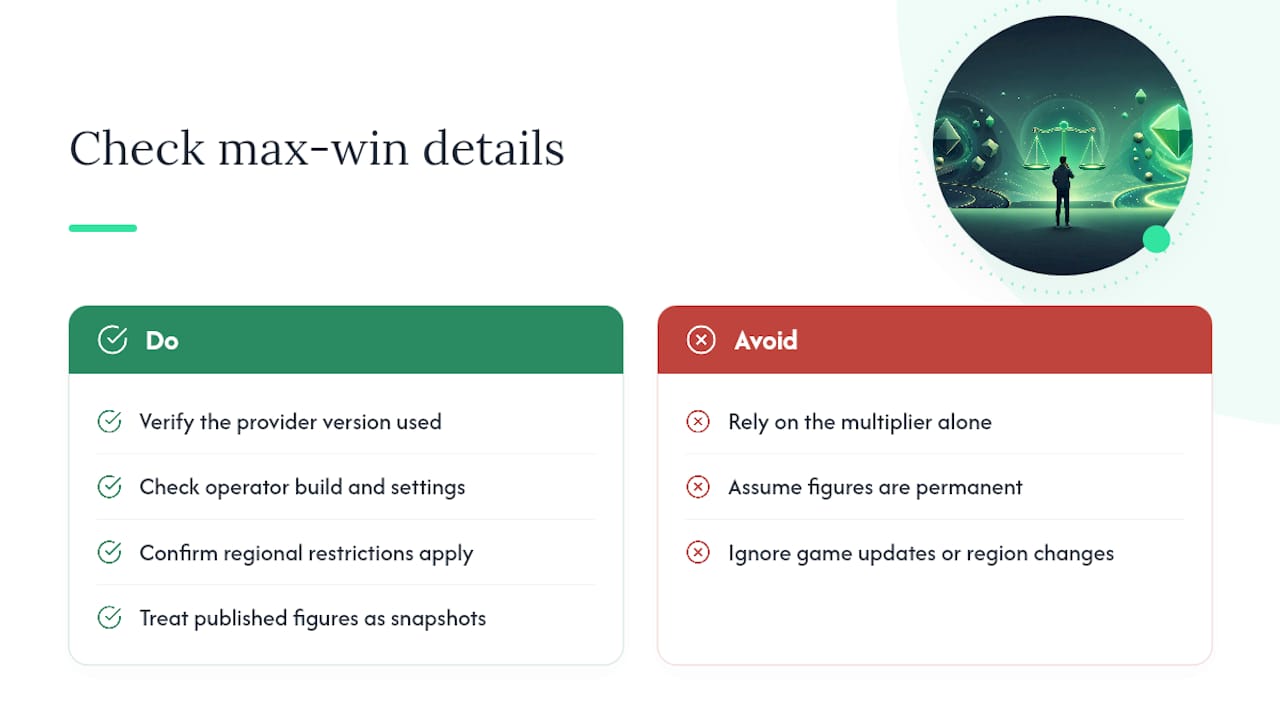
These figures come from the specific provider version tested at the time of publication. Operator builds, regional restrictions, and game updates can all shift these numbers, so treat the table as a snapshot, not a permanent guarantee.
What Players Get Wrong About Max Win (and How to Play Smarter)
The biggest myth: a higher max win means better odds of winning something. It doesn't. Max win describes the ceiling, not your chances of reaching any particular floor. A game with a lower max win can easily have better real-world payback if its RTP and volatility are more favorable for regular sessions.
A few other traps worth knowing:
- Casino-imposed win caps can override a game's own max win, silently limiting bonus payouts regardless of what the paytable says.
- Bonus terms tied to deposit promos sometimes exclude max-win jackpots entirely, buried in fine print most players never read.
- Chasing a specific multiplier with escalating bets is how bankrolls disappear fastest.
Keep stakes small relative to your bankroll, set a stop-loss before you start, and never increase bet size specifically to "catch up" to a max win you haven't hit. Resources like GambleAware offer practical guidance if chasing losses starts to feel like a habit rather than a hobby.
Using Provably Fair Verification and Stakestats Tools to Check Max-Win Claims
Provably fair systems let you verify that a game's outcome, including any max-win event, was generated fairly using a server seed and nonce combination you can independently check after the fact. That's different from simply trusting a paytable number on faith.
Stakestats builds tools around exactly this problem:
- Use the IOU calculator to model how stacked multipliers and bet sizes combine toward a theoretical max payout.
- Check bonus feature terms and eligibility through the bonus tools page before assuming a jackpot applies to your bet type.
- Cross-reference the game's real-time RTP and hit-rate stats against the provider's published figures to spot outdated or region-specific versions.
Pro Tip: Before you trust any max-win claim you see repeated across review sites, run the multiplier through a calculator yourself. If the math doesn't line up with the stated bet size, the claim is probably stale or misquoted.
Why Verification Beats the Headline Number
Most coverage of max win treats the multiplier as the whole story, when it's really just the last digit in a much longer verification chain. The number itself is almost decorative. What matters is whether the version you're actually playing still supports it, whether your operator's build matches the provider's, and whether bonus terms quietly exclude you from ever reaching it.
The conventional advice, "look for games with the biggest max win," gets the priority backwards. RTP and volatility shape every session you'll actually play. Max win shapes a statistical tail event most players will never touch. If you're choosing a game based on marketing multipliers alone, you're optimizing for the wrong variable.
What I'd tell any player: verify before you calculate, and calculate before you bet. Check the provider's own page, confirm the in-game paytable matches, and note the date you checked it. That habit protects you far more than knowing whether a game caps at 10,000× or 50,000×, because neither number matters until you know it's still accurate for the version in front of you.
— Ian
Sources
- Slot Maximum Win Explained: Source Checks, Multiplier Limits, Volatility and Risk Boundaries | The Playbook USA
- Max Win Slots Explained — What Does Max Win Mean?
- Power of Ten — Hacksaw Gaming
- GambleAware