
Minesweeper Gambling Strategy: Control Variance, Not Luck

The most effective minesweeper gambling strategy is not a betting system. It is conservative mine-count selection, strict unit sizing, a cashout rule you set before you click a single tile, and confirming the game is provably fair before you deposit a dollar. Cashout timing and tile guesses change how bumpy your session feels, not how much you win over the long run.
Three things to do right now:
- Pick a mine count that matches your bankroll and patience: 1 to 3 mines for long, grindy sessions; 10 or more only if you're comfortable losing fast for a shot at a big multiplier.
- Set your unit size at 0.5% to 1% of your bankroll per round, and decide your stop loss before you start.
- Choose your cashout multiplier in advance and don't renegotiate with yourself mid round.
Every one of those choices is about managing variance. None of them beats the math built into the game.
Key Takeaways
Variance control through mine-count selection, unit sizing, and predeclared cashout rules determines session outcomes far more than any tile-picking trick or betting progression.
| Point | Details |
|---|---|
| Mine count sets your variance | Fewer mines mean steadier, longer sessions; more mines mean rare but bigger swings. |
| Cashout timing doesn't change EV | Every cashout point pays the same expected value; it only shifts how bumpy the session feels. |
| Progressions fail over time | Martingale-style doubling collapses against finite bankrolls after a handful of losses. |
| Fringe tiles often carry more risk | Interior background tiles can be safer than tiles adjacent to tight numeric constraints. |
| Verify fairness before depositing | Use tools like Stakestats' provably fair explanation and bankroll analyzer to confirm game integrity and size your bets responsibly. |
Table of Contents
- What A Minesweeper Gambling Strategy Can And Can't Do
- How To Judge The Safest Tile Without Doing Algebra
- Why Betting Systems Fail And What Bankroll Rules Actually Work
- When To Cash Out And When To Push One More Tile
- Mistakes And Red Flags That Wreck Sessions
- Practicing Without Risking Your Bankroll
- Verifying Fairness Before You Trust The Numbers
- Why Variance Control Beats Every System I've Seen Players Try
- Track Every Round Instead Of Guessing How You're Doing
- Frequently Asked Questions
- Sources
What A Minesweeper Gambling Strategy Can And Can't Do
Mines is played on a grid, usually 5×5, where you pick a number of hidden mines and then reveal tiles one at a time. Each safe reveal bumps your multiplier higher, and you can cash out whenever you want, or keep pushing until you either hit a mine or run out of tiles. That's the entire game, according to Wizard of Odds' breakdown of the mechanics.
Here's the part most players get wrong: the multiplier ladder is calibrated so the payout at any given reveal equals the site's return to player divided by your probability of reaching that reveal. That means every cashout point, at every mine count, returns the same expected value over enough rounds. A 2026 analysis testing EV across mine counts confirmed this directly: no combination of settings beats the built-in edge. A separate 10,000 game simulation across mine counts and cashout points found the same thing. Every strategy tested lost the same amount relative to stake, on average.
So why does mine count matter at all? Because it controls how your losses and wins get distributed, not how big they are on average. Fewer mines means more frequent small wins and long sessions with shallow drawdowns. More mines means rare, steep multipliers and a real chance of busting out in three clicks.
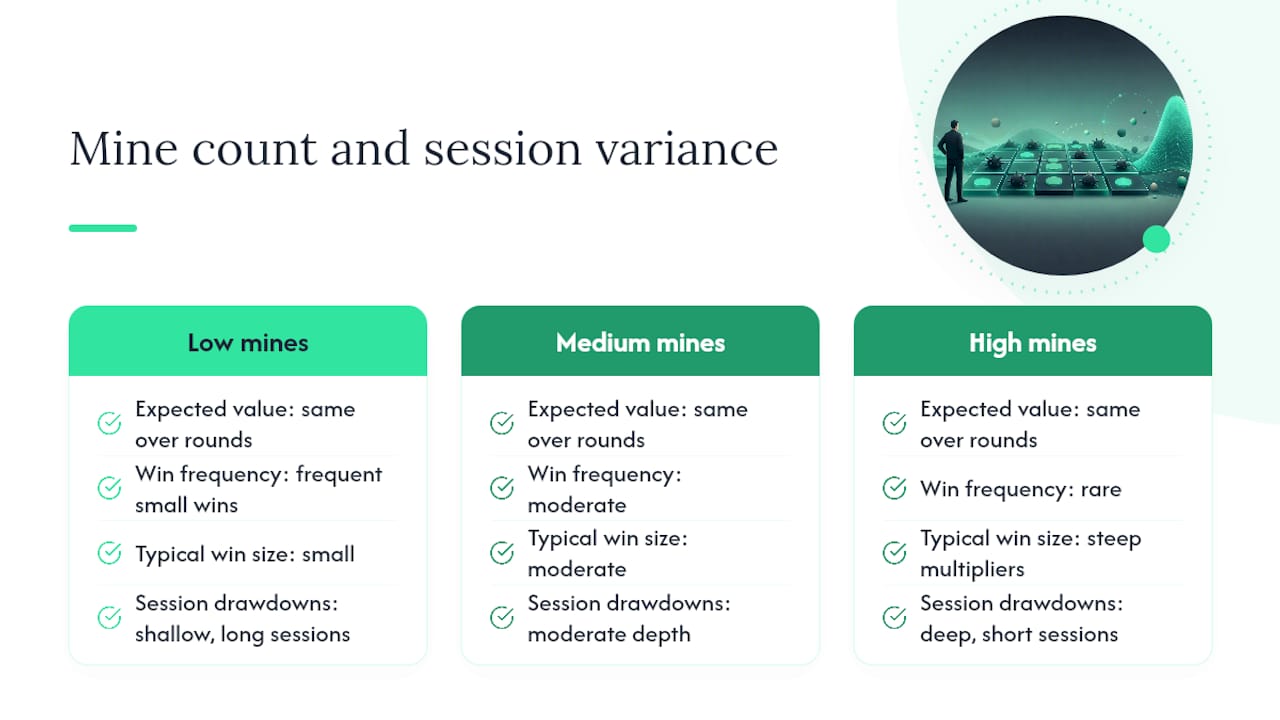
Matching mine count to what you actually want from a session
Think about what you're trying to get out of tonight. If you want two hours of entertainment on a modest bankroll, pick 1 to 3 mines. You'll survive far more rounds, hit cashouts more often, and the swings will stay manageable. If you're chasing a specific multiplier for a specific reason (a lottery ticket play, essentially), a higher mine count with a modest bet size makes more sense, because you're accepting a low hit rate in exchange for a shot at a big number.
Two example plays show the contrast clearly:
- Low mine scalping: 1 mine on a 5×5 board gives you a very high chance of a safe first reveal. Cash out after 3 to 5 safe tiles for modest but frequent gains, and repeat. This is the play style community testers found most stable across 1,000+ rounds.
- High variance swing: 10+ mines drops your odds of a safe first reveal substantially below even odds. Multipliers climb fast per reveal, but your bust rate climbs faster. This only makes sense with a small stake you've already mentally written off.
Pro Tip: *Size your mine count to a drawdown you can actually stomach.
How To Judge The Safest Tile Without Doing Algebra
You don't need to run a probability model in your head to play smart. You need two habits: know your starting odds, and understand how revealed numbers change what's left.

Start with the baseline. If you set 5 mines on a 25 tile board, your prior probability that any single unrevealed tile is a mine is 5 divided by 25, or 20%. Every time you reveal a safe tile, that probability recalculates across the tiles that remain, since there are now fewer squares sharing the same mine count.
Classic Minesweeper analysis splits the board into two zones once numbers start appearing: fringe tiles (squares directly adjacent to a revealed number) and background tiles (everything else, with no direct constraint on them). Formal work on this, including Berkeley's CS70 lecture notes on Minesweeper probabilistic inference, shows the correct way to estimate risk is to compute probability across the fringe using the constraints from adjacent numbers, then treat the background as sharing the leftover mine density evenly.
Here's the part that surprises most players: the fringe is usually riskier, not safer. When a number forces a cluster of mines into a small set of adjacent tiles, that concentrates risk right there. Meanwhile, background tiles just inherit whatever mine density is left over, which is often lower. A mathematical probability guide for Minesweeper makes this explicit: interior squares can carry a lower mine probability than border squares specifically because the border is where local constraints stack up.
A simplified walk-through: say a revealed "1" touches three unrevealed tiles, and you can tell from the board that exactly one mine sits among them.
- Solve every deterministic move first. If a number's constraint math guarantees a tile is safe or guarantees it's a mine, that's not a guess, it's logic.
- Only apply probability once the deterministic moves run out, a sequencing rule that general Minesweeper probability guides also recommend for the traditional puzzle version of the game.
- In an ambiguous 50/50 spot, check whether one of the two tiles is also constrained by a second number elsewhere on the board. That second constraint sometimes tips the odds even when it looks even at a glance.
Casino Mines strips out the deterministic logic layer since there are no visible numbers guiding you, which means every reveal is closer to a pure probability draw based on remaining mine density. That's exactly why mine count, not tile-picking cleverness, is your actual lever.
Pro Tip: When a casino Mines round feels like a coin flip, it usually is one. The house edge is baked into the payout table regardless of which tile you pick, so don't burn mental energy hunting for patterns that aren't there.
The math behind this decomposition, fringe versus background, isn't a casino gimmick. It's the same probabilistic inference framework used to analyze the original puzzle game, and it's the clearest way to think about relative tile risk even when you can't see numbers on the board.
Why Betting Systems Fail And What Bankroll Rules Actually Work
Martingale, the doubling-after-a-loss system, feels logical until you run the numbers on a long losing streak. Multiple consecutive losses cause the wager to escalate rapidly. Bankrolls are finite, table or site limits exist, and one string of bad luck (which happens more often than intuition suggests) ends the run. Community testing of over 1,000 rounds per strategy confirmed that Martingale and similar progressions eventually fail, while flat betting with disciplined mine-count choice held up as the more stable approach.
Here's the bankroll math that actually protects you:
- Unit size: bet 0.5% to 1% of your total bankroll per round. A $500 bankroll means $2.50 to $5.00 per bet, not $25.
- Stop loss: quit the session once you're down 15% to 20% of your starting bankroll for that sitting.
- Target profit: set a win goal, commonly 20% to 30% above your starting stake, and walk away when you hit it.
The logic borrows loosely from Kelly-style risk sizing used in betting and investing: bet in proportion to your edge and your bankroll, never as a fixed dollar amount regardless of your balance. In a negative-expectation game like Mines, that means keeping units small enough that a losing streak doesn't force a bad decision.
A quick math callout shows why flat betting survives what progressions can't. A run of eight consecutive losses at a flat $5 bet costs you $40, uncomfortable but survivable on most bankrolls. That same eight loss run under Martingale doubling, starting at $5, requires a ninth bet of $1,280, and your cumulative loss if you stop there already exceeds $1,275. Simulation data across 10,000 games backs this up: every betting pattern tested landed at the same average loss relative to total stake, but progressions produced far more account-ending swings along the way.
Before any session, check off:
- Your unit size is set as a percentage, not a flat dollar figure that ignores your current balance.
- You know your maximum consecutive losses before you'd hit your stop loss.
- Your target profit percentage is written down, not decided in the moment.
A bankroll analyzer can run these numbers for you against your actual balance instead of leaving you to eyeball it.
When To Cash Out And When To Push One More Tile
Every cashout point along the multiplier ladder pays out the same expected value relative to your stake, a finding both the 2026 EV analysis and the large-sample simulation confirm independently. Cashing out early doesn't cost you value compared to pushing deeper. It just trades a smaller, more frequent win for less variance.
That reframes the decision entirely. You're not looking for the "right" cashout point mathematically, because there isn't one. You're picking the cashout that matches how much swing you want in your session.
- Early cashout (2 to 4 safe reveals): keeps sessions long, smooths out your bankroll curve, and suits low mine counts where hit rates are already high.
- Deep cashout (6+ reveals): only makes sense with a small stake you're fine losing, since your odds of reaching that point shrink fast as mine count rises.
- Mid-range settings (4 to 6 mines): split the difference, moderate hit rate with a meaningfully bigger multiplier than the safest plays.
| Mine count | Reasonable cashout point | Why |
|---|---|---|
| 1 to 3 mines | 3 to 6 safe reveals | High hit rate supports longer, steadier sessions |
| 4 to 6 mines | 2 to 4 safe reveals | Balances multiplier growth against rising bust risk |
| 10+ mines | 1 to 2 safe reveals | Odds of reaching deeper reveals fall sharply |
Pro Tip: Most Mines interfaces show a live multiplier table as you play. Use it to see the actual survival probability tied to your next reveal before you click, rather than guessing how risky the next tile feels.

Mistakes And Red Flags That Wreck Sessions
Chasing losses is the single fastest way to blow a bankroll in Mines. A losing streak feels like it's "due" to turn around, but each round is independent, and no amount of Martingale-style doubling changes that math in your favor over time.
Common player mistakes to cut immediately:
- Increasing bet size after a loss instead of sticking to your predetermined unit.
- Betting more than 1 to 2% of your bankroll on any single round.
- Believing a mine count or tile pattern is "hot" or "cold" based on recent rounds.
- Ignoring a preset stop loss because "one more round" feels justified.
Operator red flags deserve equal attention:
- No provably fair verification available, or a seed reveal process that's vague or missing.
- RTP figures that aren't published or don't match what the game actually pays out over many rounds.
- Withdrawal terms that change after you've deposited, or unusually slow payout processing.
- Support resources like GambleAware or Gambling Therapy are worth bookmarking if a session ever stops feeling recreational.
Practicing Without Risking Your Bankroll
You don't need real money to test whether a mine-count or cashout adjustment actually helps.
- Run demo mode sessions first, and log the mine count, cashout point, and outcome for every round.
- Move to small-stake real rounds once your demo numbers look stable, keeping units at your planned 0.5 to 1%.
- Compare at least 100 to 200 rounds per setting before drawing any conclusion, since small samples hide the underlying variance.
A basic spreadsheet log beats memory every time. Track session length, settings, and results, then run a simple Monte Carlo simulation if you want to sanity check whether your recent run was normal variance or a real signal. The Stake Originals Analyzer lets you replay past rounds to see exactly how a setting change would have played out.
Verifying Fairness Before You Trust The Numbers
Provably fair systems work on a commitment-reveal model, and understanding the flow takes about five minutes.
- Before you play, the server generates a seed and shows you its cryptographic hash, a commitment it can't change later without the hash breaking.
- You pair that with your own client seed, which you can set yourself on most platforms.
- After the round, the server reveals the original seed. You can hash it yourself and confirm it matches the commitment shown before you played.
- Combining both seeds through the disclosed algorithm should reproduce the exact mine layout you saw in the round.
If any step in that chain doesn't check out, that's a legitimate red flag, not a technicality. Stakestats' provably fair explanation walks through the verification steps in more detail if you want to replay a round yourself rather than take an operator's word for it.
Trust signals worth checking before you commit real money: published RTP by game, an accessible seed verification tool, and consistent payout statistics that don't drift from the advertised numbers over hundreds of rounds. An operator that makes verification easy is telling you something about how it operates everywhere else too.
Pro Tip: Run a handful of seed verifications on any new site before depositing more than a small test amount. It takes minutes and tells you more about an operator's honesty than any review ever will.
Why Variance Control Beats Every System I've Seen Players Try
Every version of "the secret Mines strategy" I've come across reduces to the same thing: someone found a pattern in a small sample and mistook noise for a system. The math doesn't support any of it. What separates players who last from players who don't isn't a smarter tile pick, it's whether they treat mine count and unit size as the only levers that matter.
, and. If you want to go past the theory here, Stakestats' verification and analytics tools let you check the actual numbers behind any session instead of relying on gut feel.
Track Every Round Instead Of Guessing How You're Doing
Most players never actually know if their mine-count and cashout choices are working, because they're going on memory instead of numbers.
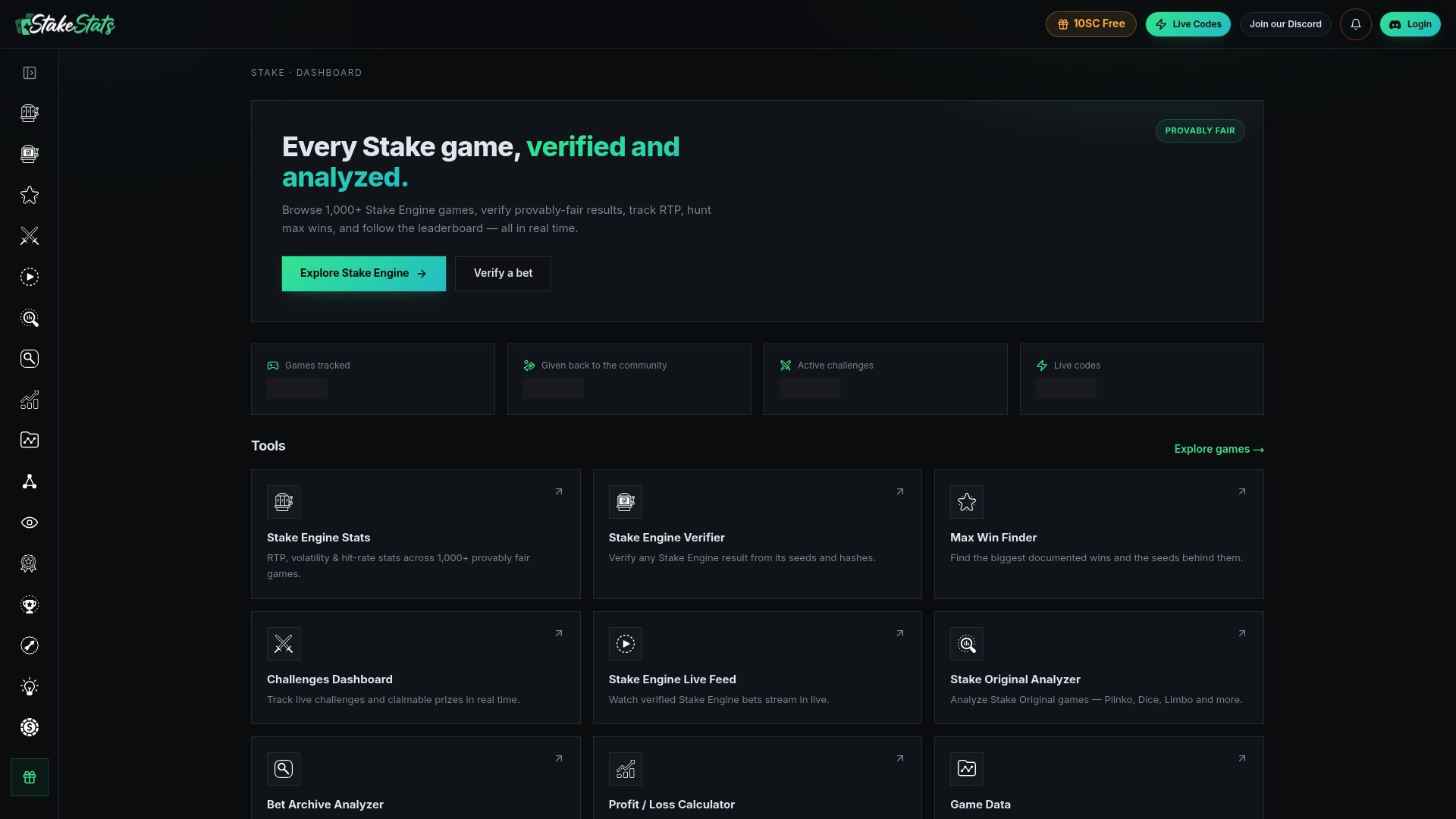
The Stake Originals Analyzer shows you a dashboard view of past rounds and seed verification results, so you can spot whether a losing streak was normal variance or something worth questioning. Pair it with the bankroll analyzer to set your unit size and stop loss against your real balance before your next session, not after it's already gone sideways. Start by running a seed check on your last few rounds and see what the numbers actually show.
Frequently Asked Questions
Is there a minesweeper gambling strategy that beats the house edge? No. Every tested combination of mine count and cashout point returns the same expected value relative to stake, according to both a 2026 EV analysis and a 10,000 game simulation. Strategy shapes variance, not long-run outcome.
What's the best mine count for beginners? Start with 1 to 3 mines. You'll see safe reveals more often, sessions last longer, and losses stay smaller while you learn how the multiplier ladder behaves.
Does Martingale work in Mines? Not over any meaningful sample. Doubling after losses requires an exponentially growing bet, and a realistic losing streak will outpace most bankrolls within eight to ten rounds.
How do I know if a Mines game is fair? Check for a published seed hash before the round, a revealed seed after, and the ability to independently verify the two match. Stakestats' transparency tools walk through this process for Stake engine games.
Should I always cash out early? Only if you're optimizing for session length and smaller swings. Cashing out early doesn't improve your expected value, it just reduces variance, so the right choice depends on what kind of session you want.
Sources
- We Ran 10,000 Games of Mines. Every Strategy Lost the Same Amount
- We tried the best community Mines strategies (1,000+ rounds)
- Lecture notes: Mines optimal strategy and probabilistic inference (Berkeley CS70 lecture notes)