
How to Verify Multi Nonce Bets in Provably Fair Games

Multi nonce bets are sequential wagers tied to a single server seed, each identified by an incrementing nonce, and you verify a whole sequence the same way you'd verify one bet, just repeated. First, confirm the revealed server seed's SHA-256 hash matches the pre-play commitment your casino published before you started playing. Then, for each nonce in the sequence, run HMAC using the server seed as the key and client_seed:nonce as the message to reproduce the outcome the game engine actually generated.
Here's what you need in hand before you compute anything:
- The pre-play server seed hash (shown before you placed any bets)
- The revealed server seed (unlocked after you rotate or the operator discloses it)
- Your client seed (often editable in account settings)
- The nonce or nonce range you want to check
One thing trips up almost everyone: casinos don't all use the same HMAC variant. Some run HMAC-SHA256, others HMAC-SHA512, and running the wrong one will produce a mismatch that looks like fraud but is actually just a formatting error. Check which variant your operator publishes before you compute a single hash.
Key Takeaways
Verifying a multi nonce sequence requires confirming the seed commitment once and then reproducing every individual outcome through HMAC, not just checking the final displayed result.
| Point | Details |
|---|---|
| Confirm the commitment first | Run SHA-256 on the revealed server seed and match it to the pre-play hash before trusting any results. |
| Loop HMAC across the full nonce range | Recompute each outcome individually since single-bet checks miss reuse or sequencing bugs. |
| Clean your copied values | Strip whitespace, normalize hex case, and decode URL encoding before hashing to avoid false mismatches. |
| Reconstruct full float streams for complex games | Plinko, Mines, and shuffles consume multiple values per digest, so check internal state, not just the final number. |
| Use Stakestats for in-browser, no-leak verification | Stakestats' provably fair explanation and Stake Originals Analyzer run HMAC checks locally so seed data stays on your device. |
Table of Contents
- What Counts as a Multi Nonce Bet and Why It Matters
- Checklist: What To Copy From the Fairness Panel
- How to Verify and Replay a Sequence of Nonces
- Choosing Between Built-In, Third-Party, and Local Verification
- Verifying Games That Consume Multiple Random Values Per Round
- Best Practices for Staying Ahead of Fairness Issues
- What a Nonce Actually Does in Provably Fair Systems
- Common Attack Vectors Against Nonce Implementations
- Real-World Consequences When Nonces Get Reused
- Why Verifying a Full Sequence Beats Checking One Bet
- Multi Nonce Bets vs. Single Nonce Checks: Security Tradeoffs
- What Actually Matters When You Verify Nonces
- Verify Nonce Sequences Directly With Stakestats' Tools
- Sources
What Counts as a Multi Nonce Bet and Why It Matters
A single provably fair round uses one server seed, one client seed, and one nonce value plugged into an HMAC function to generate a result. A multi nonce bet sequence is just that same process repeated dozens or hundreds of times, with the nonce ticking up by one for every wager while the server seed and client seed stay fixed. Nonce 1 might be your first dice roll after a seed rotation; the nonce might be your latest crash round in the same session.
The nonce exists to guarantee that identical seed pairs never produce identical results twice in a row. Without it, replaying the same server seed and client seed combination would generate the exact same outcome every time, which would let a player (or an operator) predict or manipulate results. Provably fair systems increment the nonce for every bet specifically so the same seed pair produces a fresh, unpredictable outcome each round while still remaining fully reproducible after the fact.
That reproducibility is the entire point. Anyone, including you, should be able to take the revealed server seed, your client seed, and a nonce value, run the math, and land on the exact same result the casino displayed. If you can't reproduce it, something's wrong with either your inputs or the operator's process.
Checklist: What To Copy From the Fairness Panel
Most fairness mismatches aren't fraud. They're copy-paste errors. Here's the exact order to pull your data:
- Open your account's fairness or "provably fair" panel and copy the pre-play server seed hash before you place any bets in that session.
- After you rotate seeds (or the session ends), copy the revealed server seed exactly as displayed, including full-length hex.
- Copy your client seed. If you never set one, note the default value the casino auto-generated for you.
- Record the nonce or nonce range for the bets you want to verify, without specifying exact numbers.
- Confirm the operator's published message format, whether it's
client_seed:nonceor the less commonclient_seed:nonce:cursor, along with the HMAC variant (SHA256 vs SHA512).
Formatting is where verification quietly breaks. A trailing space at the end of a copied server seed, a stray newline character from pasting out of a chat window, mismatched hex case, or a URL-encoded colon in the client seed will all produce a hash that looks wrong even when the underlying data is correct. Strip whitespace, normalize to lowercase hex, and decode any percent-encoded characters before you run the calculation.
Pro Tip: Paste your copied values into a plain text editor first, not directly into a script. It's the fastest way to spot an invisible trailing space or line break before it wastes twenty minutes of debugging.
How to Verify and Replay a Sequence of Nonces
Verifying one bet and verifying fifty follow the identical logic, just looped. Here's the sequence:
- Capture the pre-play hash before betting starts, and note every nonce as you play.
- Rotate the seed once you're done with that server seed, which reveals the actual server seed string.
- Confirm the commitment. Run SHA-256 on the revealed server seed and check it matches the pre-play hash exactly.
- Loop the nonce range. For each nonce in the sequence, compute
HMAC(server_seed, client_seed:nonce). - Map the digest to a result using the specific game's published formula, since dice, crash, and card games each convert the HMAC output differently.
A Python skeleton makes the looping concrete without needing a full production implementation:
import hashlib, hmac

server_seed = "revealed_seed_here"
client_seed = "your_client_seed"

for nonce in a specified range:
    message = f"{client_seed}:{nonce}"
    digest = hmac.new(server_seed.encode(), message.encode(), hashlib.sha256).hexdigest()
    # convert digest to the game's outcome format here
    print(nonce, digest)
The loop itself never changes much. What changes, game to game, is the small conversion step after the digest, turning hex into a dice roll, a crash multiplier, or a card order. That's the part you have to adjust per title.
Which method should you actually use? It depends on the stakes involved:
| Method | Speed | Assurance level | Best for |
|---|---|---|---|
| Casino's built-in verifier | Fastest | Moderate, operator-supplied | Quick spot checks during play |
| Third-party web verifier | Fast | Higher, runs outside casino domain | Independent confirmation without coding |
| Local script | Slowest to set up | Highest | Disputes, high-value sequences, audit trail |
Pro Tip: If you're checking a single suspicious round, the built-in verifier is fine. If you're auditing a fifty-bet losing streak before filing a support ticket, run it locally so you have your own record independent of the casino's tools.
Choosing Between Built-In, Third-Party, and Local Verification
Each verification method trades speed for independence, and picking the wrong one for the stakes involved is a common mistake.
- Built-in casino verifiers are the fastest option and require no setup, since the operator already has the seed data loaded. Their limitation is obvious: you're trusting the same party whose fairness you're trying to confirm to also grade its own homework.
- Third-party web verifiers run the HMAC calculation outside the casino's own domain, which adds a layer of independence. Reproducing outputs on infrastructure the casino doesn't control is genuinely useful, but you're now trusting a different third party with your seed data, so check what that site's privacy policy says about logging or storing what you paste in.
- Local script verification keeps every input on your own machine. Nothing gets transmitted anywhere, which makes it the right call for disputes or high-value sequences where you want a verification record nobody can dispute you generated independently.
Stakestats' provably fair explanation page runs its HMAC and SHA checks directly in your browser, which means the calculation happens on your side without sending seed data to a server. For sequences that span dozens of nonces, that in-browser approach lets you batch-check a range instead of running one calculation at a time, without the setup overhead of writing and running your own script.
Verifying Games That Consume Multiple Random Values Per Round
Dice and simple crash games map one HMAC digest to one outcome, which makes final-result verification straightforward. Games like Plinko, Mines, and anything involving a shuffle work differently: they pull several random values out of a single digest, or chain multiple digests together, to determine peg bounces, mine placements, or card order.
A Fisher-Yates shuffle, for instance, needs one random value per card position to fully randomize a deck, not just one value for the whole deck. Plinko needs a value for every peg row the ball passes. Mines needs enough values to place every mine on the board. Expert auditors handle this by regenerating the entire float stream: they group the HMAC digest's bytes, convert each group into a 32-bit integer, normalize it into a float between 0 and 1, and check that full sequence against the game's actual internal state.
- Parse the hex digest into byte groups per the game's published spec
- Convert each group to an integer, then normalize to a float
- Compare your reconstructed sequence against the displayed board or shuffle order
When a single final number doesn't match your expectation, the fix usually isn't more suspicion. It's checking whether the game consumed more than one value from that digest and whether you reconstructed the whole stream, not just the last piece of it.
Save full-stream reconstruction for disputes or research. For routine play, checking that the final displayed outcome matches your recomputed result is usually sufficient.
Best Practices for Staying Ahead of Fairness Issues
Rotate your seed pair after long sessions or right after a big win, since experts recommend rotation specifically to prevent a revealed seed from being reused for new bets. Never keep playing on a server seed that's already been revealed to you.
Keep a running audit log as you go, not after the fact:
- Screenshot the pre-play hash the moment a new seed activates.
- Record the revealed server seed immediately after rotation.
- Log your client seed and the full nonce range for that seed's lifespan.
- Note any anomaly, even a minor one, with a timestamp.
Watch for these red flags: a pre-play hash that doesn't match after rotation, a casino that won't let you change your client seed, a seed hash that changes mid-session without your input, or any verifier that never actually reveals the underlying server seed. If you hit a genuine mismatch, capture every screenshot before doing anything else, then contact support with your full audit trail attached.
Pro Tip: Screenshot the pre-play hash the second a new seed goes live. It's the one piece of evidence you can't recover later if you forget.
What a Nonce Actually Does in Provably Fair Systems
A nonce is a number that increments by one with every single bet placed under a given server seed and client seed pair. It's the variable that keeps otherwise-identical inputs from producing identical outputs bet after bet.
Think of the server seed and client seed as two fixed ingredients, and the nonce as the one ingredient that changes every round. Feed HMAC the same server seed and client seed but a different nonce, and you get a completely different digest, and therefore a different game outcome, every single time. That's what makes a hundred-bet session genuinely unpredictable while still letting every one of those hundred results be independently reproduced afterward.
The nonce also acts as a sequence marker. If you know nonce 1 through 40 happened under one seed pair, you know exactly which digest corresponds to which historical bet, which is what makes replaying "bet number 23 from last Tuesday" possible months later. Strip the nonce out of the system and you'd either get repeating outcomes or lose the ability to trace any individual bet back to a verifiable calculation. It's a small piece of the formula, but it's the piece doing the heavy lifting for both fairness and auditability.
Common Attack Vectors Against Nonce Implementations
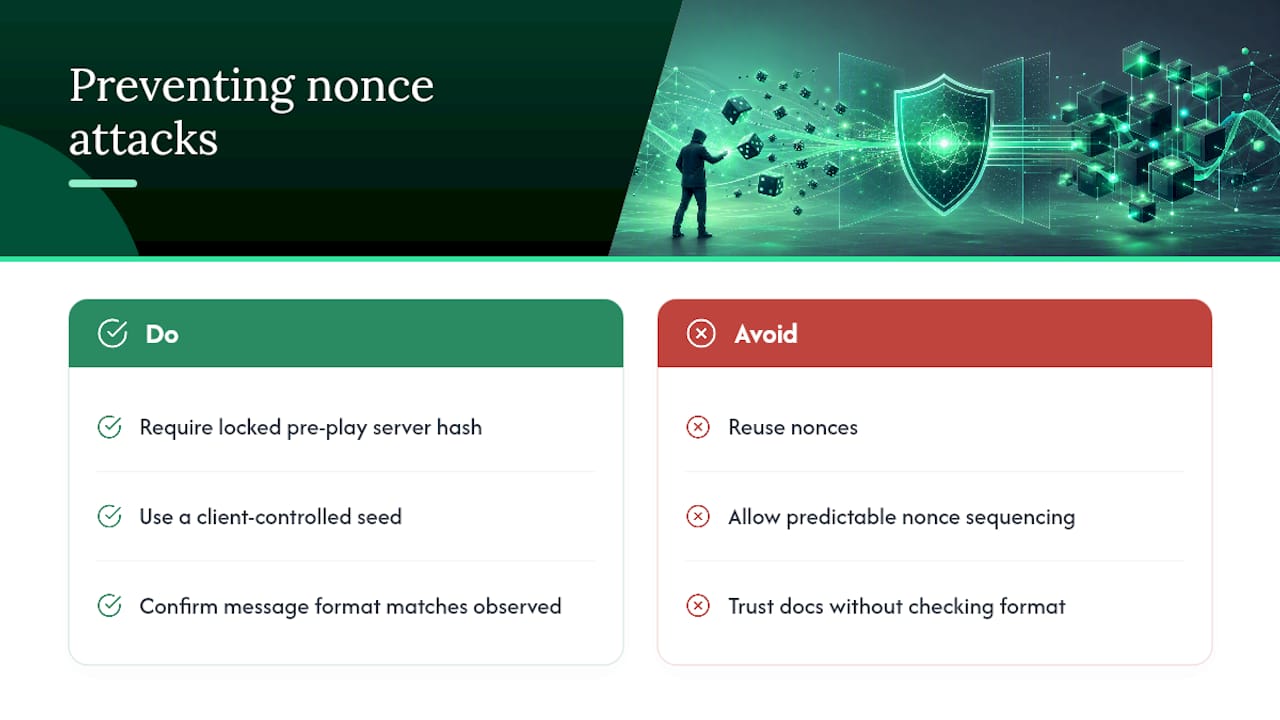
The nonce mechanism is simple, which is exactly why sloppy implementations create openings. The most common weakness is nonce reuse: if an operator's backend ever recomputes a result using a nonce value that's already been consumed, it produces a duplicate outcome that a careful player, or an attacker, can detect and potentially exploit if the pattern repeats.
A second vector involves predictable nonce sequencing combined with a leaked or guessed server seed. If a bad actor gains early access to a server seed before it's officially revealed, and can predict the next nonce in line, they can precompute outcomes ahead of time. This is why the commit-reveal pattern locks the server seed hash before any bets are placed: it prevents anyone, including the operator, from changing the seed retroactively to fit results that already happened.
A third, more subtle issue is message-format tampering. If an operator's message format deviates from what's published, whether that's silently switching from client_seed:nonce to client_seed:nonce:cursor without updating documentation, players verifying independently will get mismatches that look like fraud but are actually just undocumented format drift. Always confirm the current published format rather than assuming it's static across a platform's lifetime.
Guard against all three by insisting on a locked pre-play hash, a client seed you control, and documentation that matches what you observe when you run the calculation yourself.
Real-World Consequences When Nonces Get Reused
Nonce reuse isn't a theoretical risk. It's a concrete implementation bug that undermines the entire fairness guarantee the moment it happens. If a backend system ever generates two different bets using the same server seed, client seed, and nonce combination, both bets produce the exact same HMAC digest and therefore the exact same outcome.

That matters most in games with high per-round stakes. If a coding error causes the backend to reprocess a later bet under that same nonce, the result is deterministically identical, not independently random, breaking the core promise that every bet is a fresh, unpredictable draw.
This kind of bug typically surfaces through session logging errors, race conditions in high-traffic betting queues, or seed rotation logic that fails to increment the nonce counter correctly after a rapid string of bets. It's rarely intentional manipulation. It's far more often a software bug in nonce-tracking logic that nobody caught until a player ran an independent verification and found two "different" bets producing identical digests.
That's precisely why running your own verification across a nonce range, rather than trusting the operator's displayed results in isolation, matters. A single-bet check would never catch a reuse pattern. Only a sequence-level audit across multiple nonces reveals it, which is the whole argument for verifying in batches rather than one bet at a time.
Why Verifying a Full Sequence Beats Checking One Bet
Checking one bet tells you that one result was computed correctly. Checking a full nonce sequence tells you the entire betting session was generated by a consistent, untampered process, which is a fundamentally stronger guarantee.
Sequence-level verification catches things single-bet checks miss entirely: nonce gaps (where a number in the sequence is skipped, which shouldn't happen under normal operation), reused nonces producing duplicate digests, and hash commitments that quietly shift mid-session. None of those problems show up if you only spot-check a bet here and there. They only surface when you line up every nonce from 1 through N and confirm each one produces a distinct, independently reproducible result.
The tradeoff is computational, not conceptual. Verifying fifty nonces takes fifty HMAC calculations instead of one, which is why a local script or a batch-capable browser verifier matters more as your sequence grows. Manually recomputing fifty hashes by hand isn't realistic, but looping through them programmatically takes seconds regardless of how long the sequence runs.
For high-value sessions or anything you might need to dispute later, sequence verification is the standard worth holding yourself to. Single-bet checks are fine for quick reassurance mid-session, but they were never designed to catch the kind of systemic issue that only shows up across a run of consecutive nonces.
Multi Nonce Bets vs. Single Nonce Checks: Security Tradeoffs
Verifying a single nonce is quick and requires almost no setup: grab the seed data, run one HMAC calculation, compare it to the displayed result. It's the right tool for a fast sanity check on one round you're curious about.
Verifying a multi nonce sequence trades that simplicity for a much stronger security posture. Instead of confirming one isolated calculation, you're confirming that an entire chain of results, potentially hundreds of bets deep, was generated consistently from the same locked commitment without gaps, reuse, or silent format changes along the way. That's a categorically different level of assurance, and it comes at the cost of needing either a script or a batch-capable verifier rather than a single manual calculation.
The complexity difference is real but manageable. A single nonce check is one HMAC operation. A fifty-nonce check is the same operation looped fifty times, which is trivial for a script but tedious by hand. The security payoff scales with that complexity too: a single check can confirm one result is legitimate, but only a full-sequence check can confirm the underlying generation process itself hasn't been tampered with or buggy across an extended session.
For casual curiosity, check one nonce. For anything you're staking real money on across an extended session, or anything you might need to escalate to support with evidence, verify the whole sequence.
What Actually Matters When You Verify Nonces
Most guides treat provably fair verification as a one-time checkbox: confirm the hash once, feel satisfied, move on. That's backwards. The hash check confirms the operator didn't change the seed after the fact. It says nothing about whether every individual bet in your session was generated correctly, and that second question is the one that actually protects your money.
The conventional advice to "just use the built-in verifier" undersells how much sequence-level checking catches that single-bet spot checks never will. Nonce reuse bugs, gaps in the sequence, silent format drift, none of that surfaces unless you're running the calculation across a full range, not eyeballing one result that looks plausible.
If you're serious about verification, prioritize building the habit of logging your seed data every session, before you need it, not after a suspicious loss. A local script or a batch-capable in-browser tool costs you a few minutes of setup and gives you an independent record nobody can dispute later. That habit matters more than which specific verifier you use.
Verify Nonce Sequences Directly With Stakestats' Tools
Running fifty HMAC calculations by hand isn't realistic, and pasting seed data into an unfamiliar third-party site means trusting a stranger with information tied to your account. Stakestats built its verification tools specifically to close that gap: they run entirely in your browser, so your server seed, client seed, and nonce values never leave your machine while you check a sequence.
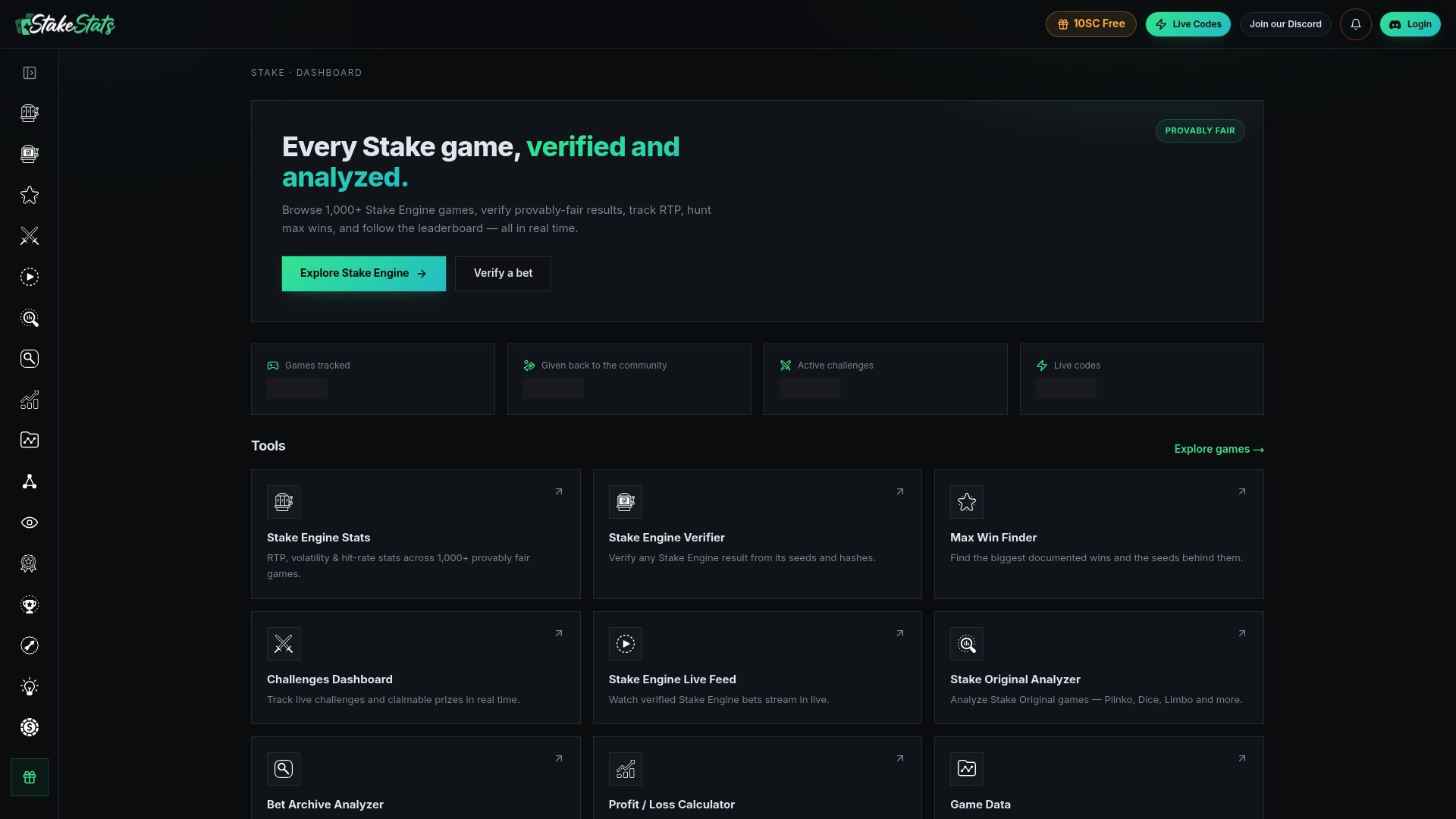
The provably fair explanation page walks through the HMAC and SHA-256 checks in plain terms and lets you run them directly against your own seed data. If you're auditing a complex game like Mines or a card shuffle, the Stake Originals Analyzer replays full game rounds so you can compare reconstructed float streams against actual game state instead of just the final number. And once you've confirmed a session was fair, the bankroll analyzer helps you decide when a rotation or a pause makes sense based on how that session actually played out.
Start with the provably fair explanation page, paste in your pre-play hash and revealed seed, and run your first nonce range through it. It takes less time than writing the script yourself.