
When '5x' Means $50: How Slot Players Verify Multiplier Slots

A slot multiplier multiplies an existing win by a stated factor. Land a $10 win with a 5x multiplier active and the payout becomes $50, not a penny more unless the game says otherwise. That's the whole mechanic in one sentence. The catch is that the multiplier only fires under specific trigger conditions the paytable spells out, and those conditions vary wildly from one game to the next.
TL;DR:
- Multiplier stacking rules vary widely, with some games adding multipliers and others multiplying them; always check the paytable for specifics.
- Free spins and bonus rounds generally feature the highest multipliers, often reaching into the hundreds or thousands, while base-game multipliers are smaller and more frequent.
- The scope of the multiplier—whether it applies to a line, total spin, or bet—significantly affects potential payouts, making paytable verification crucial before playing.
- Combining multiple multipliers can be additive or multiplicative, but players should confirm stacking behavior, as it impacts overall expected returns.
- Multiplier size does not influence the game's RTP, which remains fixed; larger multipliers introduce higher volatility and bigger swings in outcomes.
Table of Contents
- Multiplier Slots Explained: The Basic Math
- Common Types of Multiplier Slots and Their Typical Ranges
- How Multiplier Stacking Actually Works
- Where Multipliers Show Up in a Slot
- How to Read a Paytable for Multiplier Rules
- Multipliers, Volatility, and RTP: Three Different Things
- Bankroll Rules for Playing Multiplier Slots
- Real Slot Examples That Show Multipliers in Action
- How Stakestats Helps You Verify Multiplier Claims
- Common Myths About Slot Multipliers
- Fixed Multipliers vs. Random Multipliers
- How Slot Software Actually Implements a Multiplier
- Multipliers Alongside Jackpots and Bonus Buy Features
- What Actually Matters When You're Chasing Multipliers
- Sources
- FAQ
Multiplier Slots Explained: The Basic Math
Every multiplier follows the same formula: final win = base win × multiplier. No exceptions, no hidden steps. The multiplier only ever scales a win that already exists — it does nothing to a losing spin, no matter how big the number attached to it looks.
Where it gets confusing is what counts as the base win. Some games apply the multiplier to a single payline. Others apply it to your total win across the whole spin. A few apply it directly to your bet amount instead of a win at all.
- Line multiplier: A winning line pays $2, a 3x multiplier hits that line, you get $6.
- Total-spin multiplier: Three separate lines pay $8 combined, a 4x multiplier applies to the whole spin total, you get $32.
- Bet multiplier: Rare, but some bonus mechanics pay out as a straight multiple of your stake (a $1 bet × 500x = $500) regardless of the base game's line structure.
Read the fine print before you assume which version you're playing. The difference between "per line" and "per spin" can change your expected payout by a factor of three or four on the exact same reel outcome.
Common Types of Multiplier Slots and Their Typical Ranges
Multipliers show up in more forms than most players realize, and each type behaves differently:
- Wild multipliers: A wild symbol that carries its own multiplier value, often 2x to 3x, applied when it completes a winning combination.
- Scatter multipliers: Triggered by scatter symbol counts rather than paylines, often used to unlock bonus multiplier values.
- Free-spins multipliers: A multiplier that applies to some or all wins during a bonus round, frequently the largest values in the game.
- Progressive or accumulating multipliers: The value climbs with each consecutive win or cascade, resetting when the streak breaks.
- Reel or symbol multipliers: Fixed values printed directly on specific symbols or positions on the reels.
- Random multipliers: Applied by the game engine at random, unconnected to any specific symbol landing.
Ranges vary enormously by design. PokerNews' breakdown of multiplier types notes that free spins routinely carry heavier multipliers than the base game, and that pattern holds across most modern titles. Base-game multipliers typically sit in the 2x to 5x range since they trigger often. Bonus features push into 10x to 100x territory. A handful of high-volatility slots advertise multipliers north of 1, 000x in rare, specific scenarios. Those numbers are always designer-specific. The only way to know what a given game actually offers is to open its paytable.
How Multiplier Stacking Actually Works
When two or more multipliers land on the same spin, the game has to decide how to combine them, and there's no universal rule. Stacking behavior differs by title: some games add multiplier values together, some multiply them, some only count the highest one active, and some apply a separate multiplier per winning line.
Two quick examples show how much this changes your payout:
- Additive stacking: Two 3x multipliers land on the same spin. Added together, that's a 6x total applied to the base win.
- Multiplicative stacking: The same two 3x multipliers, but the game multiplies them instead. That's 3 × 3 = 9x, a 50% bigger payout than the additive version on identical symbols.
Before you assume either scenario, check the rules for these four things: whether multipliers add or multiply, whether only the highest value counts, whether stacking is per line or per total spin, and whether the mode (base game versus free spins) changes the stacking behavior.
Pro Tip: Don't guess based on how a similar-looking game worked. Two slots from the same studio can use completely different stacking logic under the hood.
Where Multipliers Show Up in a Slot
Multiplier placement follows a fairly predictable pattern across the industry, though the specifics differ game to game.
Base-game multipliers tend to be smaller in value but far easier to trigger, since they need to keep the reels feeling active on every spin. Free spins and bonus rounds are where the bigger numbers live. Push Gaming's design notes on multiplier mechanics confirm that developers deliberately reserve their strongest multiplier values for bonus modes, since those rounds happen rarely enough to absorb a much larger swing in payout size.
Cascading and respin mechanics add another layer. Games that clear winning symbols and drop new ones into place often pair that mechanic with an accumulating multiplier, one that climbs a step with every consecutive cascade and resets once the chain breaks. That's a different animal from a flat, one-time multiplier and worth spotting in the rules before you play.
How to Read a Paytable for Multiplier Rules
The paytable is the only place that tells you the truth about how a multiplier behaves. Everything else, including forum posts and secondhand summaries, is a guess.
- Open the paytable or help screen (usually an "i" icon or menu labeled "Info" or "Rules").
- Find the multiplier entry, usually listed under special symbols or bonus features.
- Note the scope: does it say "per line," "total win," or "bet"?
- Check whether it specifies stacking behavior, or search separately for a "multiple multipliers" clause.
- Confirm which mode it applies to, base game, free spins, or both.
- Run a few spins in demo mode to see the mechanic trigger before risking real money.
Watch for vague phrasing. "Up to 500x" tells you the ceiling, not how often that number actually shows up. Slots.Rodeo's explainer on multiplier wording points out that "up to" claims describe the maximum possible value, which in practice might trigger once in tens of thousands of spins.
Pro Tip: Spend five minutes in demo mode on a new title before betting real money. Watching one multiplier trigger firsthand clears up more confusion than reading the rules text twice.
Multipliers, Volatility, and RTP: Three Different Things
A bigger multiplier usually means bigger swings, not bigger long-term returns. That's the distinction most players miss. Volatility describes how spread out your outcomes are: high-volatility multiplier slots pay less often but hit harder when they do, while low-volatility versions pay smaller amounts more consistently.
Return to Player (RTP) is a separate, independent figure that estimates the percentage of wagered money a game returns over millions of spins. A multiplier changes how that return gets distributed across sessions. It doesn't change the RTP itself. It just gets there through rare, massive spikes instead of steady, small wins. Match the multiplier size to your own risk tolerance, not to the flashiest number on the box.
Bankroll Rules for Playing Multiplier Slots
Chasing a rare multiplier feature without a plan is how bankrolls disappear fast. A few rules keep the math on your side:
- Match the game to your bankroll: a slot with rare 500x bonus multipliers needs a deeper session budget than one with frequent, modest 2x to 5x wilds.
- Set a session limit before you start, and stick to it regardless of how close a bonus feels.
- Size your bets so a losing streak while chasing a bonus trigger doesn't wipe out your budget in one sitting.
- Favor free-spins multiplier features over rare base-game ones when you can. PokerNews notes that free spins paired with multipliers often deliver a better balance of expected value against variance than chasing a base-game jackpot multiplier that almost never lands.
- Test unfamiliar mechanics in demo mode first, always.
Pro Tip: Following bankroll guidance from resources like BeGambleAware matters more on high-multiplier titles than on flat-payout games, since variance stretches both your wins and your losing streaks further in both directions.
Real Slot Examples That Show Multipliers in Action
Naming actual games makes the mechanics click faster than abstract rules ever will.
- Gonzo's Quest uses avalanche multipliers that step up with each consecutive win, capping at 5x in the base game and 15x during free spins, a clean example of accumulating multipliers tied to a cascading reel structure.
- Bonanza, and the broader Megaways format it popularized, pairs cascading wins with multipliers that climb through free spins, sometimes reaching very large totals as cascades chain together.
- Sweet Bonanza drops "multiplier bombs" during its free-spins round, with advertised values ranging from small multipliers up to four-figure numbers in rare feature hits.
- Mega Moolah ties its free-spins multiplier context to a progressive jackpot structure, showing how multiplier mechanics and jackpot pools can run side by side in the same title.
How Stakestats Helps You Verify Multiplier Claims
Reading a paytable tells you the stated rule. Verifying it in practice is a different job, and that's where Stakestats' provably fair verification tools come in, alongside its real-time RTP and volatility dashboards for Stake Engine titles. Pair those with the bankroll analyzer to size your bets before chasing a bonus multiplier. Always confirm paytable wording and run a demo session first. Numbers on a screen mean little until you've watched the math play out for yourself.
Common Myths About Slot Multipliers
It's a ceiling, not an average. Most spins that trigger a multiplier feature land somewhere near the low end of the advertised range, and the eye-catching top figure might appear once in a very long run of play.
Another common misread: assuming every multiplier applies to your total win.
Some players also believe multipliers "get you closer" to a big win over time, as if the game is building toward something after a dry stretch. Slot outcomes are independent events determined spin by spin. A multiplier feature that hasn't triggered in fifty spins has no more or less chance of triggering on the fifty-first.
There's also a persistent idea that higher multipliers always mean a better game. The multiplier size on a game's marketing art tells you almost nothing about how it actually feels to play for an hour.
Finally, some players assume a multiplier changes the odds of winning. It doesn't. It changes the size of a win after the outcome is already determined. The two are separate mechanics entirely.
Fixed Multipliers vs. Random Multipliers
A fixed multiplier is printed on a symbol or tied to a specific, predictable trigger. Fixed multipliers give you predictability: you can look at the paytable and know precisely what value applies once the trigger condition is met.
A random multiplier works differently. The game engine assigns a value on the fly, often from a defined range, without any symbol on the reels announcing it in advance. A random multiplier might apply to any winning spin, chosen by a separate random process that runs alongside the main reel outcome. You might see a multiplier value flash onto the screen after the win is already calculated, applied retroactively to that result.
The practical difference matters for how you read a paytable. Fixed multipliers usually list a specific value or small set of values tied to a specific symbol or position. That range is your best guide to what to expect, but individual outcomes within it are unpredictable by design.
Neither structure is inherently better for the player. Fixed multipliers offer certainty and are easier to plan around. Random multipliers add unpredictability that can work in your favor on a lucky trigger, but also means you can't count on hitting the top of the range just because the feature activated. Check which structure a specific game uses before assuming how its multiplier feature will behave across a session.
How Slot Software Actually Implements a Multiplier
Under the hood, a multiplier isn't a separate game running alongside the main one. It's a value stored and applied within the same math model that calculates every other part of the spin. The game's random number generator determines the reel outcome first. Separately, depending on the mechanic, the software either reads a fixed multiplier value tied to a landed symbol or runs a second random draw to select a multiplier value from a predefined table of possible outcomes and their weighted probabilities.
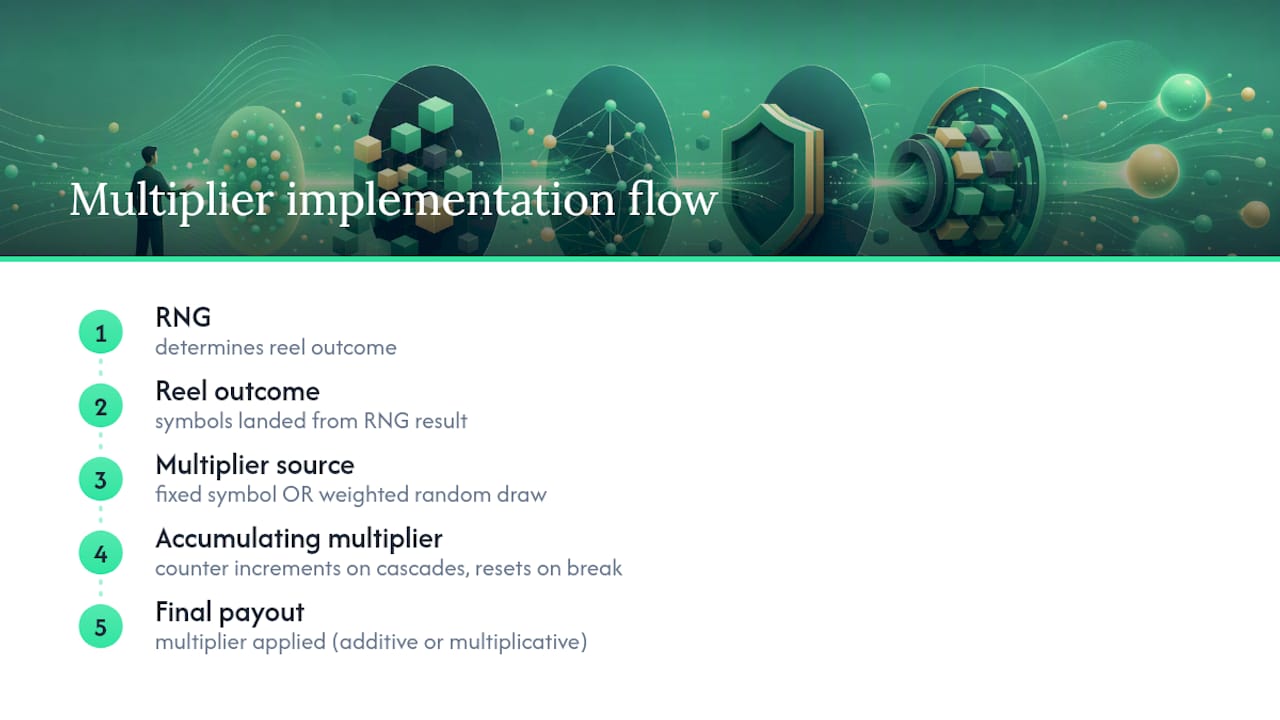
That weighting is the part players never see. Lower values get pulled far more often than the eye-catching top number, which is why the maximum advertised multiplier feels rare even when it's technically always possible.
Developers build and test these math models through large-scale simulation before a game ever launches, running millions of simulated spins to confirm the multiplier frequency and size land where the target RTP and volatility profile require. That simulation process is also how a studio decides whether a multiplier stacks additively or multiplicatively, since that choice has to be baked into the math model from the start, not adjusted after launch.
Accumulating multipliers work through a slightly different mechanism: the software tracks a counter tied to consecutive wins or cascades, incrementing a stored value each time the trigger condition repeats, then resetting that counter to its starting point once the streak breaks. All of this runs invisibly behind the paytable's plain-language summary, which is exactly why the paytable, not intuition, remains the only reliable source for how a specific game's multiplier actually behaves.
Multipliers Alongside Jackpots and Bonus Buy Features
Multipliers rarely operate in isolation. Most modern slots layer them against other mechanics, and the interactions aren't always obvious from the lobby screen.
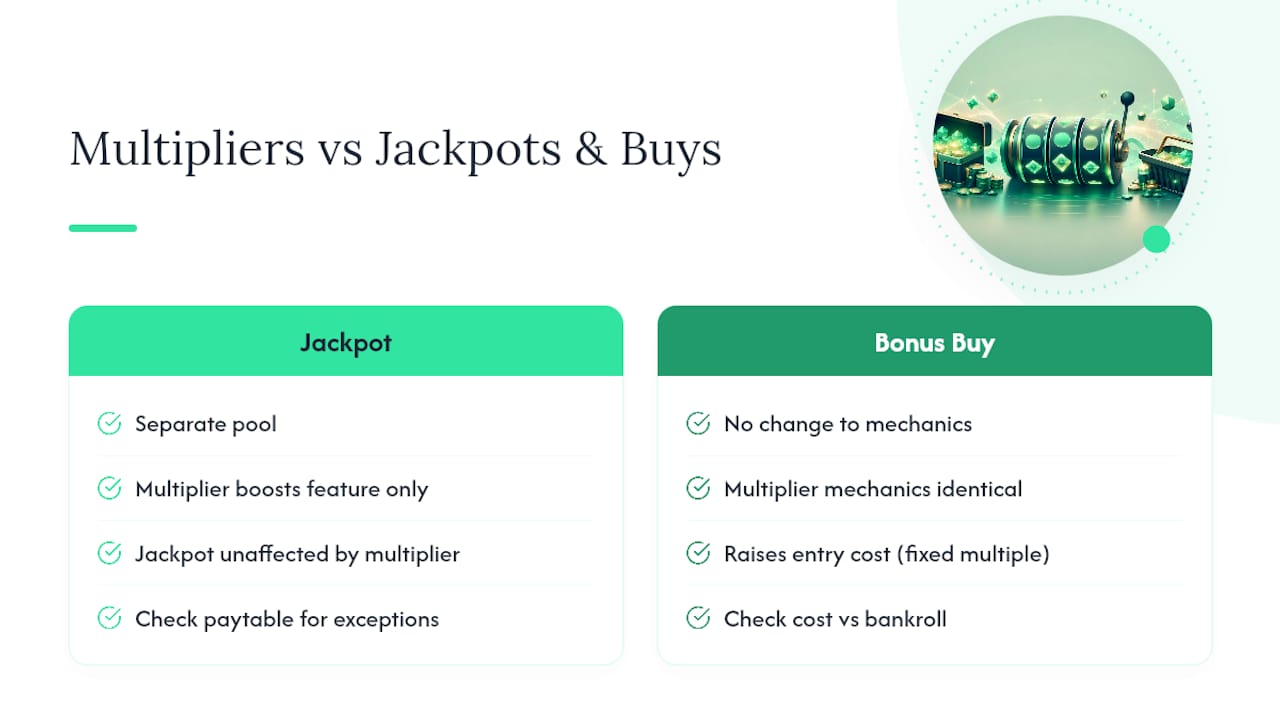
Progressive jackpots and multipliers typically run as separate systems within the same game. A title like Mega Moolah keeps its progressive jackpot pool distinct from its free-spins multiplier feature. Landing a multiplier during free spins boosts your feature payout, but it doesn't feed into or draw from the separate jackpot pool, and winning the jackpot itself usually isn't affected by whatever multiplier value happened to be active. Always check the paytable to confirm whether a specific title's jackpot and multiplier features are linked or fully separate, since a handful of games do build connections between the two.
Bonus buy options add a different wrinkle. Paying to skip straight into a free-spins round doesn't change the multiplier mechanics themselves. It just guarantees you reach the feature where those multipliers live, without needing to trigger it through normal scatter combinations. The multiplier ranges, stacking rules, and probability weighting inside that bonus round stay identical whether you bought your way in or landed it naturally. What changes is your cost basis for reaching that round, which matters for bankroll math since a bought bonus round costs a fixed, often steep multiple of your normal bet upfront.
The practical takeaway is that a multiplier's behavior stays consistent regardless of which other feature triggered it. What changes is your entry cost or your exposure to a separate prize pool, not the multiplier math itself.
What Actually Matters When You're Chasing Multipliers
Most guides to multiplier slots spend their energy hyping the biggest numbers a game advertises, and that's backwards. The multiplier ceiling on a loading screen tells you almost nothing about how a game plays over a real session. What matters is the stacking rule, the trigger frequency, and whether the multiplier applies to a line, a spin, or your bet, because those three details determine your actual outcome far more than whatever four-digit number is printed on the splash art.
The conventional advice to "look for high multiplier games" skips the harder, more useful step: reading the paytable closely enough to know what you're actually being offered.
If you take one thing from this, prioritize verification over excitement. Confirm the stacking rule, confirm the scope, and run a demo session before committing real money to a title you don't fully understand yet. Tools that verify RTP, volatility, and fairness directly exist for exactly this reason, and using them beats trusting a badge on a loading screen every time.
— Ian
Sources
- What Is a Multiplier in Slots? How It Works, Where It Appears, and What It Can Change
- Guide to Online Slots: How Multipliers Work
- How online slot multipliers work | Push Gaming
- BeGambleAware
FAQ
What Is the $20 Method on Slots?
A common bankroll method is setting a fixed budget for a single session and stopping once it's gone, rather than reloading funds mid-session. It's a discipline tactic more than a mathematical strategy, and it works especially well on higher-volatility multiplier slots where losing streaks between bonus triggers can run long.
Is Higher Volatility Better?
Higher volatility isn't inherently better or worse, it's a fit question. High-volatility multiplier slots pay less often but can produce much larger wins when a feature triggers, while low-volatility games pay smaller amounts more consistently. Choose based on your bankroll and how much variance you can tolerate in a single session, not based on which option sounds more exciting.
Do All Multipliers Stack the Same Way?
No. Some games add multiple active multipliers together, some multiply them, and some only count the single highest value in play. The only reliable way to know is checking that specific game's paytable, since stacking rules vary title to title even within the same studio's catalog.
Does a Multiplier Change a Game's RTP?
No. RTP is a fixed, independent long-term average built into the game's math model, and a multiplier feature doesn't raise or lower that number. What a multiplier changes is how your outcomes are distributed across a session, trading frequent small wins for rarer, larger ones without altering the game's overall return percentage.
Where Do the Biggest Multipliers Usually Show Up?
Bonus rounds and free spins typically carry the largest multiplier values, since developers reserve their strongest multipliers for features that trigger less often. Base-game multipliers tend to be smaller because they need to appear frequently enough to keep regular spins engaging.