
Stake Players: Verify Any Bet With the Nonce in Five Minutes

The nonce on Stake is a simple counter, a number used once, that ticks up by one with every bet you place under a given seed pair. It exists so that no two bets, even identical ones, ever run through the exact same input when generating a result. Combined with the server seed and client seed, the nonce is what turns a random-looking spin into something you can mathematically check afterward.
TL;DR:
- The nonce on Stake is a public sequential counter that increases by one with each bet, ensuring each input is unique for outcome generation.
- Outcomes are generated using HMAC-SHA256 with the server seed, client seed, and nonce, allowing anyone to verify fairness after the seed is revealed.
- A server seed hash is published before betting begins, and its rotation prevents future outcome prediction, limiting the nonce's role to enforcing order.
- Common misconceptions include believing the nonce is secret or can be used to predict results, but outcomes depend on the hidden server seed, not the visible nonce.
- Routine verification of bets using provided seed and nonce data is quick, reduces errors, and increases transparency without implying any house foul play.
Table of Contents
- Nonce Explained: Stake's Cryptographic Definition and Why It Matters
- How Stake Turns a Seed Pair and a Nonce Into a Game Outcome
- The Nonce Myths That Trip Up Even Experienced Players
- Verifying a Bet Yourself: A Practical Nonce Walkthrough
- Why Routine Nonce Checks Are Worth the Five Minutes
- Check Your Own Bets With the Stakestats Verifier
- Where These Definitions Come From
- Sources
- FAQ
Nonce Explained: Stake's Cryptographic Definition and Why It Matters
The word itself comes straight from cryptography, where a nonce is defined as a value used only once inside a cryptographic operation to stop old messages or transactions from being replayed. The National Institute of Standards and Technology describes it as a time-varying value with, at most, a negligible chance of repeating. That single sentence covers a wide range of real-world uses, and gambling only needs one narrow slice of it.
Cryptographers generally split nonces into two families:
- Unpredictable nonces, used in login systems and authentication protocols, where the whole point is that an attacker cannot guess the next value. Okta's identity documentation covers this use case in detail, explaining how these nonces block replay attacks in web and API security.
- Sequential or monotonic nonces, which simply count upward, one at a time, with no attempt to hide the pattern. This is the type gambling platforms use.
That distinction matters because a lot of confusion online treats "nonce" as if it must be some hidden, unguessable value. In authentication, sure. In betting, the nonce's job isn't secrecy at all. Its job is uniqueness. The IEEE Technology Navigator notes that nonces are frequently transmitted in the clear right alongside the data they protect, since their security comes from freshness, not concealment. A blockchain miner's nonce works differently again. Chainlink's explainer on blockchain nonces separates mining nonces, which are search variables miners brute force to find a valid block, from account nonces, which are ordinary sequential counters that stop the same transaction from being processed twice. Betting nonces are closer to that second kind: dumb, sequential, and entirely public.
How Stake Turns a Seed Pair and a Nonce Into a Game Outcome
Before you place a single bet, Stake commits to a server seed by publishing its cryptographic hash. You never see the raw server seed at that point, only its hash, which locks the casino into a value it cannot quietly change later. You pick or generate your own client seed, and that seed pairs with the current server seed for as long as it stays active.
Every bet you make under that seed pair increases the nonce by exactly one, starting from 0 or 1 depending on the game. The actual outcome generation follows a repeatable sequence:
- The system takes the server seed, your client seed, the current nonce, and often a game identifier as inputs.
- Those inputs run through HMAC-SHA256, producing a long hexadecimal digest.
- That digest gets mapped into a game-specific outcome, a dice roll, a crash multiplier, a card draw, depending on the title.
- The nonce increments for the next bet, and the process repeats with the same server and client seed.
- When the server seed eventually rotates, the casino reveals the original raw seed so you can check every bet that used it.
Once a server seed is revealed, anyone can recompute every outcome tied to it using the same HMAC-SHA256 process, which is the entire basis of provably fair gaming. That's not a trust exercise. It's math you can rerun yourself.
Seed rotation matters for security. Once a seed retires, nobody can precompute future outcomes against it, because a brand-new server seed (with a brand-new hash) takes over and the nonce resets to the start of that new sequence. You can find the server seed hash, the revealed seed once rotated, your client seed, and the exact nonce for any wager in the bet detail view on Stake, usually accessible from your bet history.
The Nonce Myths That Trip Up Even Experienced Players
The biggest misconception is that the nonce is some secret variable the house hides from you. It usually isn't. Public nonce values are the point, not a leak. What actually protects the fairness of the system is that outcomes depend on the unrevealed server seed, not the nonce, which sits in plain view the entire time you're playing.
A related myth: some players believe you can spot patterns in nonce sequences and predict upcoming results. You can't, and here's the practical reason why. Without the raw server seed, the HMAC-SHA256 digest for nonce 4,502 is unrelated in any exploitable way to the digest for nonce 4,501. SSPilot's breakdown of Stake's verification process makes the same point: pattern analysis on nonces alone, without the seed, tells you nothing useful about what's coming next.
Here's a short checklist worth running periodically:
- Confirm the server seed hash was published before your session started.
- Once the seed rotates, verify the revealed seed actually hashes to the value you saw earlier.
- Check that your nonce sequence increments cleanly, with no unexplained gaps or repeats.
- Make sure the client seed shown in your bet details matches what you set.
Pro Tip: If a verifier gives you a mismatch, check the nonce first. Off-by-one errors, where you accidentally verify bet number 240 using the nonce for bet 239, cause more false "failures" than actual fairness problems.
Verifying a Bet Yourself: A Practical Nonce Walkthrough
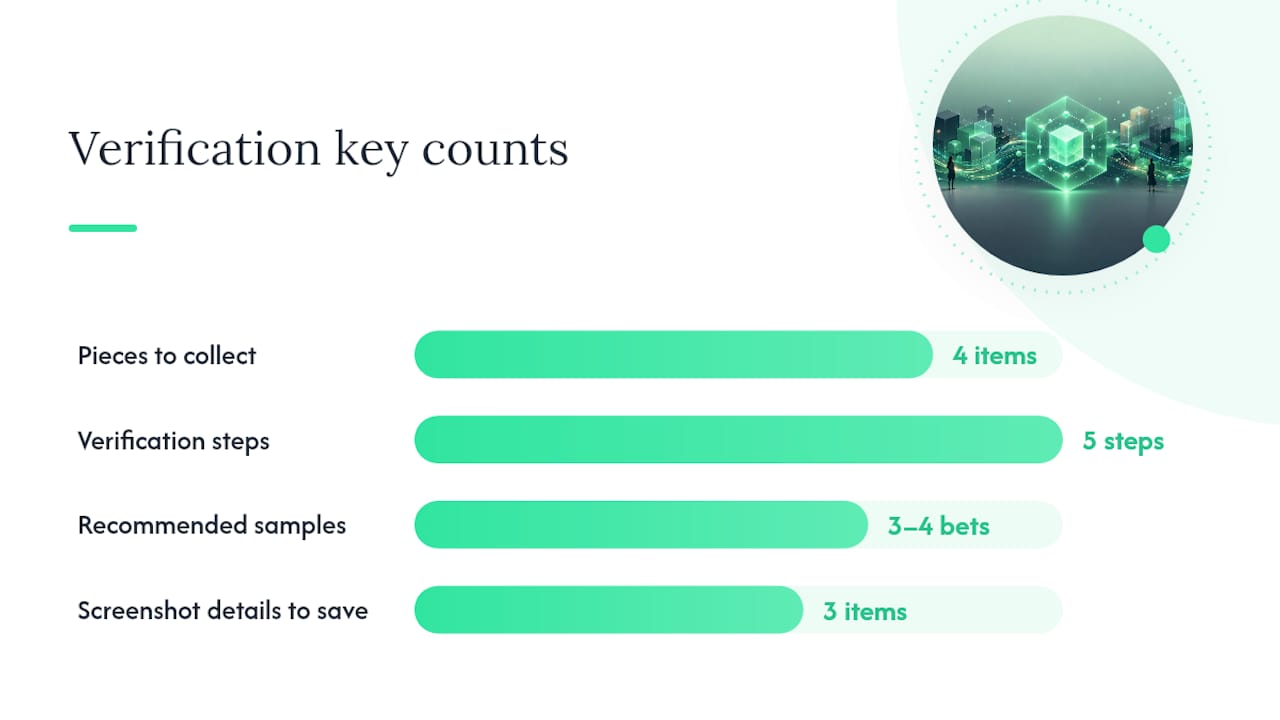
You need exactly four pieces of information to check any bet: the revealed server seed, your client seed, the nonce for that specific bet, and the game type. All four live in the bet detail screen on Stake, typically reachable by clicking into an individual wager from your history.
Once you have them, verification runs in five steps:
- Pull the revealed server seed, client seed, nonce, and game type from the bet you want to check.
- Feed those four inputs into an HMAC-SHA256 verifier, either an open-source script or a dedicated tool.
- Let the tool generate the hex digest from those inputs.
- Compare the digest-derived result against the actual outcome shown on your bet history.
- A match confirms the bet was generated fairly under that seed pair. A mismatch means something needs a closer look, usually a data entry mistake rather than actual foul play.
A practical verification pass should sample bets from the start, middle, and end of a session, since that gives you a fast read on whether the entire nonce sequence stayed consistent across the full seed lifecycle. Checking three or four scattered bets tells you far more than obsessively checking one.
If a verification fails, don't panic. Screenshot the bet ID, the seed values, and the nonce before you do anything else, then double check you copied the exact revealed server seed and not a truncated version. Manually copying long hex strings is where most "failures" actually originate. A dedicated Stakestats verifier removes that step entirely and cuts down on the off-by-one mistakes that trip up manual checks.
Why Routine Nonce Checks Are Worth the Five Minutes
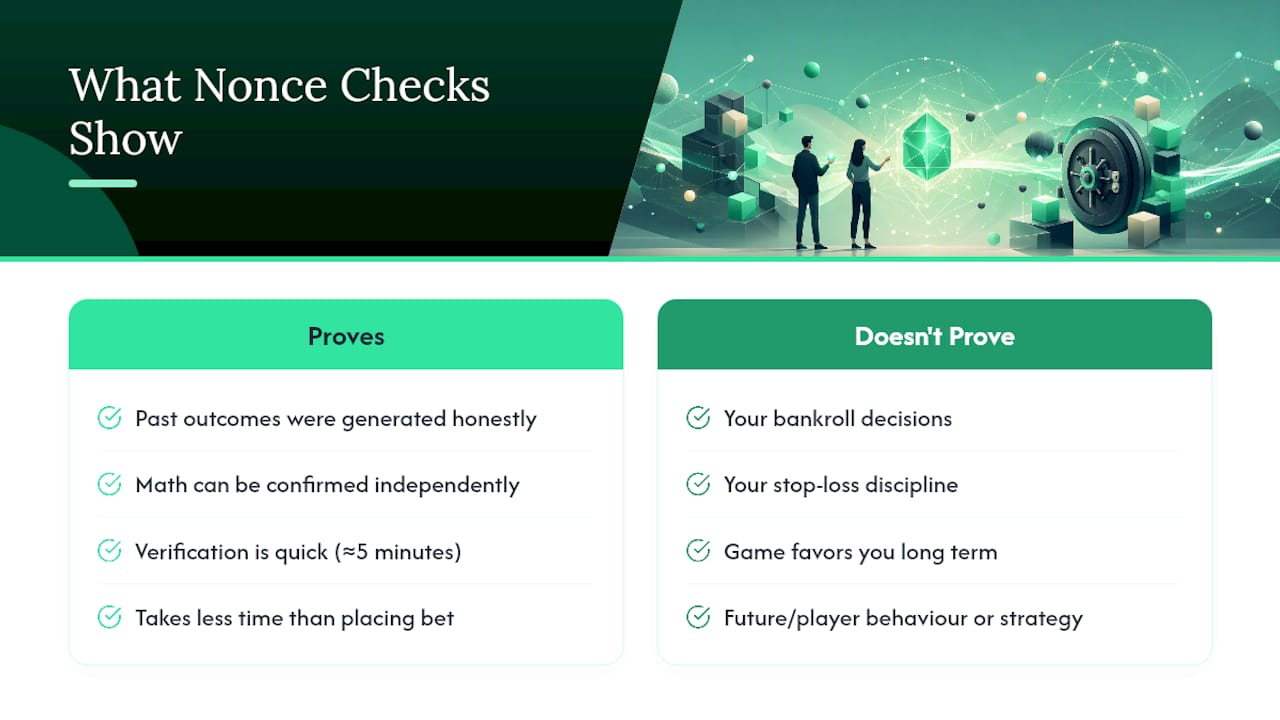
Verification isn't about catching a casino cheating you on any single spin. It's about building a habit of checking your own game data the same way you'd check a receipt. Most players never run a single verification in their entire time on a platform, which is a shame, because the tools to do it take less time than placing the bet itself.
Transparency tools work because they let you confirm the math independently of anyone's word, including ours. That said, a clean verification only proves past outcomes were generated honestly. It says nothing about your bankroll decisions, your stop-loss discipline, or whether the game you're playing has odds that favor you long term. Fairness and good bankroll management are two separate problems, and provably fair math only solves one of them.
— Ian
Check Your Own Bets With the Stakestats Verifier
Stakestats gives you a direct way to run the nonce and seed check described above without touching a command line or writing your own script. Paste in the revealed server seed, your client seed, the nonce, and the game type, and the provably fair verification tool recomputes the outcome for you and flags a match or mismatch instantly.
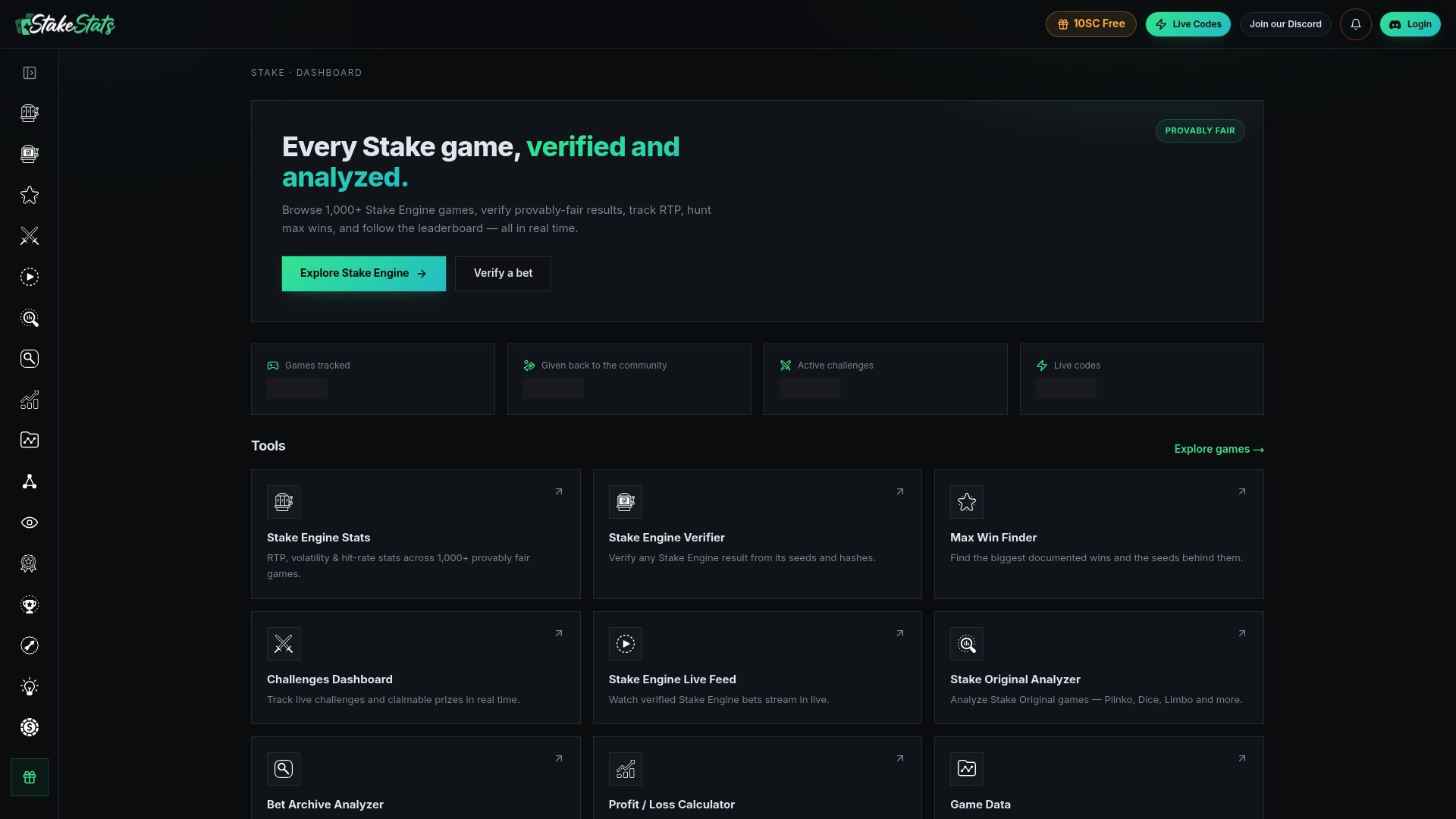
That automation matters because manual HMAC verification is exactly where off-by-one nonce errors and copy-paste mistakes creep in. Stakestats also covers session-level analytics across Stake Engine games, so you're not limited to checking one bet at a time. If you've never verified a single wager, pick one recent bet from your history right now, grab its four inputs, and run it through the verifier to see the process firsthand.
Where These Definitions Come From
- NIST's glossary entry on nonce gives the formal cryptographic definition and covers both uniqueness and unpredictability variants.
- Okta's explainer is a solid resource if you want the authentication side of nonces, separate from gambling.
- SSPilot's breakdown of Stake's provably fair system walks through the exact HMAC-SHA256 mechanics behind seed and nonce verification.
Sources
- Nonce — NIST Glossary
- What Is a Cryptographic Nonce? Definition & Meaning | Okta
- Provably Fair on Stake: How Cryptographic Bet Verification Actually Works | SSPilot
FAQ
What Is the Definition of a Nonce?
A nonce is a number used only once inside a cryptographic operation, most often to prevent old data from being reused or replayed. NIST defines it as a time-varying value with a negligible chance of repeating, and on Stake it specifically takes the form of a counter that increases by one with each bet.
Is a Nonce the Same as a Salt?
No. A salt is random data mixed into a password or hash to make precomputed attacks harder, and it's typically stored alongside the hash it protects. A nonce, especially the sequential kind used in betting, is a simple counter with no randomization requirement, and its purpose is uniqueness across a sequence rather than defense against password cracking. A nonce also differs from an initialization vector, which sets the starting state for an encryption cipher rather than counting discrete events.
How Do I Fix a Nonce Verification Error?
Most nonce errors trace back to copying the wrong bet's nonce or grabbing a truncated server seed string, so recheck those two fields first. If the numbers still don't line up, confirm the server seed you're using was actually revealed for that seed pair and not still hashed, since seed rotation confuses this constantly. Running the check through an automated tool like the Stakestats verifier removes most of the manual copy errors that cause false mismatches.
Can Players Predict Outcomes Using the Nonce Pattern?
No. The nonce is public and sequential by design, but the outcome depends on the server seed, which stays hidden until it rotates and gets revealed. Without that raw server seed, nonce patterns carry no predictive value, since each nonce produces an unrelated HMAC-SHA256 digest.
Why Does the Nonce Increase by Exactly One Each Bet?
The increment enforces strict ordering and guarantees no two bets under the same seed pair ever generate an identical input to the outcome hash. It also makes gaps easy to spot. If your nonce sequence jumps or repeats, that's usually the first sign of a data entry mistake rather than an actual fairness issue.