
1 in 32,768: Stake Plinko Odds, RTP & Provably Fair Checks

Stake Plinko runs at a published RTP near 100% with a small house edge, and that number holds regardless of which row count or risk mode you pick. Rows and risk settings reshape the payout curve, spreading or concentrating variance across slots, but they don't touch the long-run return. Because extreme edge multipliers land with one-in-thousands or one-in-tens-of-thousands odds, a single session can look nothing like the math promises.
TL;DR:
- The probability of landing on the edges of a 16-row Plinko board is approximately 1 in 65,536, making extreme multipliers genuinely rare.
- Higher row counts increase the variance and the difficulty of hitting large multipliers, but do not improve the long-term RTP, which remains near 99%.
- Stake's risk modes only alter the multiplier map, not the slot probabilities, concentrating potential big wins into very rare outcomes.
- Most drops on high-risk configurations produce low multipliers below your stake, with big wins occurring so infrequently they can't be relied upon in short sessions.
- Verifying results through provably fair methods confirms outcome integrity but does not influence your expected long-term return or the likelihood of hitting high multipliers.
Table of Contents
- What Are Plinko Odds and How Does the Board Work?
- How Do You Calculate Plinko Odds for Each Slot?
- What Do Stake's Row and Risk Settings Actually Change?
- How Rare Are Big Plinko Multipliers, Really?
- How Should You Manage Bankroll and Strategy for Plinko?
- How Do You Verify Plinko Results Are Provably Fair?
- What Players Get Wrong About Plinko Odds
- Plan Smarter Plinko Sessions With Stakestats
- Where to Check Live Plinko Odds and Math Yourself
- Sources
What Are Plinko Odds and How Does the Board Work?
A Plinko drop is a physics-flavored version of a coin flip repeated over and over. Every ball starts dead center at the top and hits a peg. It bounces left or right, then hits another peg, then another, all the way down through however many rows you've chosen. That's the entire mechanism generating the odds behind Stake Plinko.
If you set the board to 12 rows, the ball makes 12 independent left-or-right decisions before it lands. That produces exactly 13 possible landing slots, because n rows always create n+1 slots. Choose 16 rows and you get 17 slots. This isn't a design choice Stake made arbitrarily. It's the only way a symmetric physical (or simulated) board can behave.
Here's the part that trips people up: each bounce is independent, but the slots are not equally likely. A ball that bounces right every single time, or left every single time, follows just one specific path out of thousands of possible ones. A ball that lands in the dead center slot can arrive there through dozens of different bounce sequences. More paths lead to the middle, so the middle fills up more often. That's why Plinko payout curves always look like a valley: low multipliers stacked in the center, big multipliers stranded at the edges where almost no path leads.

This pattern has a name. It's a binomial distribution, the same math that governs coin-flip streaks, and it's why the center of every Plinko board pays out the least.
A few terms come up constantly when people research Stake Plinko odds, and it's worth locking them down before the math gets specific:
- RTP (Return to Player): the theoretical percentage of wagered money returned to players over a very large number of drops, factoring in every slot's probability and multiplier together.
- House edge: the inverse of RTP. A 99% RTP means a 1% house edge, the built-in margin that funds the platform.
- Variance (volatility): how spread out the possible outcomes are. High variance means rare huge wins and frequent small losses; low variance means steadier, smaller swings.
- Slot probability: the chance a single drop lands in a specific bucket, driven entirely by row count and binomial math, independent of what multiplier sits in that bucket.
Notice that RTP and slot probability are two separate calculations that only combine once you multiply every slot's odds by its multiplier. That distinction matters more than almost anything else in this article, and it's the reason two boards with identical row counts can have wildly different payout behavior depending on risk mode.
How Do You Calculate Plinko Odds for Each Slot?
The formula behind every Stake Plinko slot is straightforward once you see it written out: P(slot k) = C(n, k) ÷ 2^n.
Here, n is the number of rows, k is which slot you're calculating (counted from one edge), C(n, k) is the binomial coefficient (the count of distinct bounce paths that land in that slot), and 2^n is the total number of possible bounce sequences. Divide the paths that reach a slot by the total paths possible, and you get that slot's exact probability.
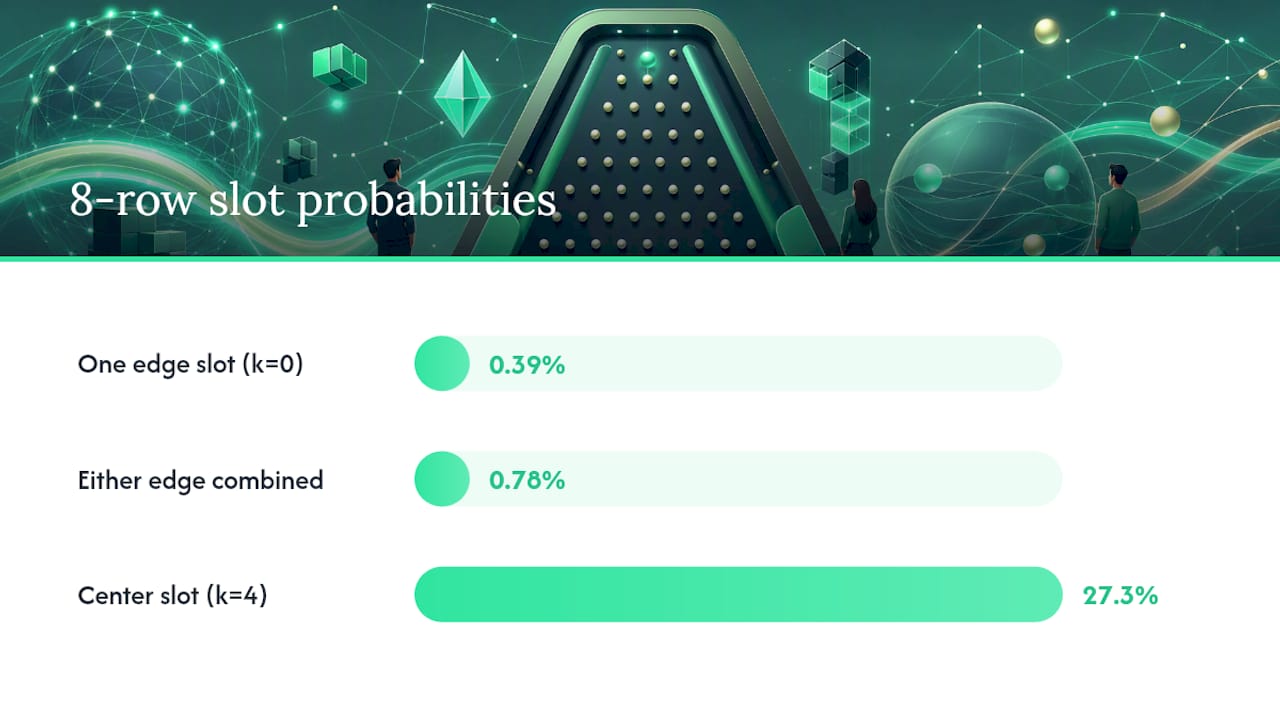
A quick worked example makes this concrete. On an 8-row board, there are 2^8 = 256 total possible paths. The exact center slot (k=4) has C(8,4) = 70 paths leading to it, giving a probability of 70 ÷ 256, or about 27.3%. Compare that to either outer edge slot, where C(8,0) = 1, giving just 1 ÷ 256, or roughly 0.39%. The center is 70 times more likely to catch a ball than the edge on an 8-row board.
Here's how that scales as you add rows, using the binomial derivations Stake itself publishes:
- 8 rows: one specific edge lands at 1 in 256; hitting either edge (left or right) comes to roughly 1 in 128.
- 12 rows: one specific edge lands at 1 in 4,096; either edge combined is about 1 in 2,048.
- 16 rows: one specific edge lands at 1 in 65,536; either edge combined comes out to 1 in 32,768.
One in 32,768. That's the combined odds of landing on either far edge on a 16-row board, the configuration where Stake's headline multipliers live. To put that in perspective, you're roughly as likely to flip 15 consecutive coin heads as you are to catch either extreme slot on a single 16-row drop.
Every row you add roughly doubles the rarity of the edge slots while making the middle even more crowded. That tradeoff, tighter edges against a fatter center, is the entire engine behind how Plinko risk and variance scale with row count.
What Do Stake's Row and Risk Settings Actually Change?
Stake Plinko lets you pick row counts from 8 through 16, along with four risk modes: Easy, Medium, Hard, and Expert. None of these settings touch the binomial slot probabilities calculated above. What they change is the multiplier map laid over those slots.
Think of it this way: the slot probabilities are baked into the board's geometry and can't be altered. What Stake adjusts between risk modes is which number gets printed above each slot. Easy mode spreads modest multipliers fairly evenly, so even a near-center landing pays something reasonable. Expert mode does the opposite: it crushes most of the middle slots down toward 0.2x or 0.3x and reserves the enormous multipliers, sometimes up to 1,000x, occasionally higher depending on row count, for those one-in-tens-of-thousands edge hits.
This is where a lot of players misread the odds. A higher max multiplier does not mean better long-run odds. It means the same 99% RTP is redistributed more dramatically, concentrated into rarer outcomes rather than spread across common ones.
A few practical points worth knowing before you drop a ball:
- Higher row counts (14 to 16) create more slots and lower per-slot probabilities, which pushes variance up regardless of risk mode.
- Expert risk on 16 rows produces the widest gap between typical outcomes (frequent sub-1x multipliers) and rare outcomes (the flashy four- and five-digit multipliers).
- Easy risk on 8 rows is the lowest-variance combination available, useful if you want longer sessions with smaller swings.
- Multiplier tables update from time to time, so always check the live paytable before you plan a session around a specific maximum multiplier.
Running the exact multiplier list through a calculator alongside the slot probabilities is the only way to know a configuration's true expected value, since RTP requires summing every slot's probability times its multiplier, not just eyeballing the biggest number on the board.
How Rare Are Big Plinko Multipliers, Really?
The math from the previous section gets a lot more visceral once you attach dollar signs to it. On 16 rows, hitting one specific extreme edge sits at 1 in 65,536, and Stake's published paytables have listed multipliers reaching into the thousands on that exact slot, with some high-risk configurations advertising figures as high as 10,000x, according to Stake's own game page. Landing that top prize on a single drop is a genuinely rare event, not a realistic session expectation.
Run the numbers on cost. If you're dropping $1 per ball on 16 rows Expert risk, hitting that one rare edge slot would, on average, require tens of thousands of drops before you'd expect to see it once. That's $65,536 wagered to see one hit on average, and averages hide enormous swings. You might hit it on drop 200, or you might never hit it across 100,000 drops. Either result is consistent with the math; neither tells you anything about whether the game is rigged.
The math behind the headline number: independent probability breakdowns of Stake's high-risk 16-row paytable find that roughly A large majority of drops land in a very low multiplier slot in some classic configurations. That single low-paying bucket, hit constantly, is what funds the rare edge multipliers that make the 99% RTP hold true over the long run.
That statistic explains something a lot of players find counterintuitive: most of your drops on a high-risk board will lose money, sometimes the large majority of them, and that's not a sign of a broken game. It's the mechanism by which the big multipliers get funded at all. A few things follow directly from this:
- The overwhelming majority of drops on high-risk paytables return less than your stake, often landing in a 0.2x to 0.5x range.
- The rare high-multiplier hits are what pull the average back up to the published RTP.
- Because those hits are so infrequent, a losing streak of hundreds of drops is entirely normal and doesn't indicate a fault or a "cold" board.
- No amount of watching previous drops tells you anything about the next one, since each bounce sequence is independent.
Long-run RTP is a statement about very large numbers of drops, not about your Tuesday night session. Treating a rare multiplier as something you can "work toward" with volume is where most bankroll damage happens.
How Should You Manage Bankroll and Strategy for Plinko?
Start by matching your settings to your patience. If you want a session that lasts a while without wild swings, 8 or 10 rows on Easy or Medium risk keeps outcomes clustered tighter around your stake.
Pro Tip: Before you commit to a session, run your planned row count and risk mode through a bankroll analyzer using your actual stake size. Watching the simulated drawdown curve for 200 or 500 drops tells you more about what to expect than any amount of intuition.
A workable session framework looks like this:
- Pick a flat stake size you're comfortable repeating for 100 to 300 drops without adjusting it up after losses.
- Set a stop-loss before you start, a fixed dollar amount or percentage of bankroll you won't exceed regardless of how the session feels.
- Set a time or drop-count limit independent of the stop-loss, since variance can keep you "even" for a long stretch before a swing either way.
- Avoid staking progressions like Martingale-style doubling after losses. Plinko complicates this further than a simple coin flip because many slots return partial multipliers (0.3x, 0.5x) rather than a clean win or loss, so a doubling scheme doesn't recover cleanly even when it eventually lands a decent slot.
- Reassess after your limit, not during it. Decide before the session whether you'll walk away or continue, so the decision isn't made mid-swing.
For the bankroll math itself, a simple template works: divide your total session bankroll by your planned number of drops to get your flat stake, then check that stake against the board's worst realistic drawdown scenario using a calculator rather than a gut estimate. Rows and risk change how bumpy that curve looks, not whether the curve trends downward over enough drops.
How Do You Verify Plinko Results Are Provably Fair?
Every Stake Plinko outcome can be checked independently through provably fair verification, which relies on HMAC-SHA256 hashing to prove a result wasn't altered after you placed your bet. The system combines a server seed, a client seed, and a nonce, then hashes them together. Because the server seed's hash is published before you play, you can confirm afterward that the outcome matches what the hash predicted.
Verifying a single drop takes a few steps:
- Locate your active server seed, client seed, and nonce from your bet history.
- Run those three inputs through an HMAC-SHA256 calculator to reproduce the outcome hash.
- Compare your calculated result against the drop Stake recorded.
- Use a guided verifier like Stakestats's provably fair explanation tool if you'd rather not compute the hash by hand.
Verification proves one thing only: that the outcome wasn't manipulated after the bet was placed.
| What verification confirms | What verification doesn't confirm |
|---|---|
| The seed and nonce weren't altered after your bet | Whether you'll win a given session |
| The outcome matches the published hash | Which slot a future drop will land in |
| The RNG process follows HMAC-SHA256 standards | Your personal RTP over a small sample |
What Players Get Wrong About Plinko Odds
Most players don't misunderstand the RTP number. They misunderstand what it takes to see it. Chasing a specific multiplier by increasing stakes after losses doesn't fix that. It just accelerates how fast you can lose. The players who do best treat verification and calculators as planning tools, not lucky charms, and size their bankroll for the variance they're actually choosing.
— Ian
Plan Smarter Plinko Sessions With Stakestats
Knowing the math is one thing. Applying it to your actual bankroll before you drop a single ball is what separates an entertaining session from an expensive one. Stakestats builds the tools to close that gap: independent HMAC-SHA256 verification so you can confirm a drop wasn't tampered with, a bankroll analyzer that simulates drawdown across hundreds of drops before you commit real money, and the Stake Originals Analyzer for pulling live multiplier tables so you can calculate real expected value instead of guessing from the max multiplier alone.

Run your planned rows and risk mode through the Stake Originals Analyzer before your next session to see the current paytable and calculate your realistic odds, or head to Stakestats to explore the full toolset built for provably fair players.
Where to Check Live Plinko Odds and Math Yourself
For readers who want to run these numbers independently, a few sources are worth bookmarking:
- Stake's Plinko game page lists the live RTP, house edge, and current multiplier tables for every row and risk combination.
- Stake's probability and distribution guide walks through the binomial derivations behind slot odds.
- Independent Plinko odds analysis breaks down multiplier frequency for high-risk paytables specifically.
- A Plinko calculator and simulator lets you paste a live paytable and compute exact EV for your planned drop count.
Sources
- Stake
- Guide to Plinko Board Probability & Game Odds!
- Plinko Odds: The Real Probability of Every Multiplier
- Plinko Calculator: Odds, RTP & Simulator