
Pragmatic Play RTP: Highest Slots and How to Verify

The highest reported theoretical RTPs in Pragmatic Play's catalog belong to titles like Big Bass Bonanza (96.71%) and several other fishing and mythology-themed slots that cluster in the 96.5–96.7% range, according to SlotArk's verified database. Before you spin, though, that number on a review site may not be the RTP your casino actually deployed. Operators can legally configure lower tiers, so the only figure that matters is the one active in your session.
Here's what you need to know right now:
- Highest reported theoretical RTP: Big Bass Bonanza and similar Big Bass series titles at 96.71%
- Portfolio average: around 96.47% across tracked titles
- Verification step: open the game, tap the ⓘ or paytable icon, and read the RTP listed there — that is the live-configured value for your session
- Cross-check tool: Stakestats provides live RTP, volatility, and provably-fair verification for Stake Engine titles
Quick action: Open any Pragmatic Play game right now, find the ⓘ info panel, and compare the displayed RTP against the theoretical default. If it reads lower than 96.5%, your casino is running a reduced tier.
Table of Contents
- Which Pragmatic Play slots have the highest reported RTPs?
- What's the difference between theoretical RTP and live tracker data?
- How do operator-configured RTP tiers work, and how do you verify yours?
- Does a higher RTP always mean a better game for your bankroll?
- What do U.S. players need to check before playing Pragmatic Play slots?
- Key Takeaways
- The verification gap most players never close
- Stakestats gives you the verification layer casinos don't
- Useful sources for verifying Pragmatic Play RTP
Which Pragmatic Play slots have the highest reported RTPs?
SlotArk's database reports the portfolio average around 96.47%, with the top titles sitting at 96.71%. The figures below are reported theoretical defaults — the maximum tier Pragmatic Play makes available. Your casino may deploy a lower configuration, so treat these as ceilings, not guarantees.
| Game | Reported Theoretical RTP | Volatility | Notes |
|---|---|---|---|
| Big Bass Bonanza | 96.71% | High | Widely cited as the portfolio leader |
| Big Bass Splash | 96.71% | High | Shares the same top-tier RTP |
| Big Bass Day at the Races | 96.71% | High | Part of the Big Bass series |
| Gates of Olympus | 96.50% | High | One of the most-played titles globally |
| Sweet Bonanza | 96.51% | High | Candy-themed; popular for bonus buys |
| The Dog House | 96.51% | High | Consistently featured in high-RTP lists |
A few older or variant titles fall outside this window. Compare.bet's provider overview notes that some classic Pragmatic Play games default below 96.1%, so the portfolio is not uniformly generous.
One critical caveat: PPSlotGuide's RTP database explicitly advises clicking the game's ⓘ icon before playing, because the value on a review site reflects the highest available tier, not necessarily the one your operator selected. The verification workflow in the next section walks you through exactly how to confirm what you're actually playing.
What's the difference between theoretical RTP and live tracker data?
Theoretical RTP is a mathematical long-run expectation calculated over millions of spins. A game labeled 96.71% will, across a statistically sufficient sample, return that proportion of all wagered money to players. Live or observed RTP is something different: it is the measured return across a specific window of actual play, typically 24 hours, 7 days, or 30 days.

DemoSlot's live tracker demonstrates how dramatically short windows can swing. A 24-hour window might cover only a few thousand spins on a given title, which is nowhere near enough to smooth out variance. One large jackpot hit or a cold streak can push the 24h figure above 100% or below 90% without telling you anything meaningful about the game's long-term behavior.
Here's a simplified example of how the same game can look across different windows:
| Tracking Window | Observed RTP | Interpretation |
|---|---|---|
| 24 hours | — | Variance artifact — a big win skewed the sample |
| 7 days | 95.91% | Still within normal variance range |
| 30 days | 96.47% | Approaching the theoretical default |
| Theoretical | 96.71% | Long-run mathematical expectation |
SlotStat's tracked data shows average live RTP across its Pragmatic Play sample sitting at 95.91%, below the portfolio theoretical default — a normal outcome given the sample sizes involved.
Practical takeaways for reading tracker data:
- A 24h spike above 100% is variance, not a hot streak to chase
- The 30-day window is the most reliable short-term proxy for theoretical performance
- Live RTP tells you what happened; it does not predict what happens next
- Pair any live RTP reading with volatility and hit-rate data before drawing conclusions
Pro Tip: When using a live tracker, ignore the 24h column entirely for decision-making. The 30-day figure, combined with the game's hit rate, gives you a far more honest picture of what to expect from your bankroll.
How do operator-configured RTP tiers work, and how do you verify yours?
Pragmatic Play's multi-tier system is the single most important thing most players don't know. RTPTrack documents a three-tier configuration for Pragmatic Play titles, with the highest tier near 97% and the lowest tier on some titles dropping to a low-94% figure. The same game, at two different casinos, can have a nearly 3-percentage-point gap in RTP — and both are operating within Pragmatic Play's licensed framework.

That gap compounds over time. On a $5 spin, the difference between a 96.71% and a 94.02% RTP is about $0.13 per spin. Over 500 spins in a session, that's roughly $67 in expected value you didn't have to give up.
Step-by-step verification workflow
- Open the game at your casino and locate the ⓘ, paytable, or "Game Info" button — usually in the top corner of the game window.
- Read the displayed RTP. This is the operator-configured value for your session, not a generic default.
- Cross-check with the casino's help file or terms. Search the casino's help center for the game name; some operators publish their configured RTP tiers there.
- Consult a live tracker. Sites like DemoSlot or SlotStat show observed performance across tracked operators.
- Use Stakestats for Stake Engine titles. The Stake Engine tools provide live RTP, volatility, hit rate, and provably-fair verification — the most complete verification stack available for those games.
- Screenshot and save. Capture the in-game RTP screen and any tracker data you consult. If a dispute arises later, that evidence is your only leverage.
What each verification layer confirms:
- In-game ⓘ panel: the operator-deployed RTP for your session
- Casino help file: the operator's stated configuration policy
- Live trackers: observed performance across a sample of real play
- Stakestats provably-fair tools: cryptographic verification of individual bet outcomes on Stake Engine titles
Pro Tip: Screenshot the in-game paytable RTP before your first spin, not after. Once you've played, you can't prove what the configured value was at session start — and some casinos update configurations between sessions.
Does a higher RTP always mean a better game for your bankroll?
Not automatically. RTP and volatility pull in opposite directions depending on what you're trying to do with your session.
A game with 96.71% RTP and high volatility — like Big Bass Bonanza — will return that percentage over millions of spins, but your individual session could look nothing like that average. High-volatility games pay infrequently and in larger amounts, which means a 100-spin session might return 60% of your stake or 200%, with the long-run average only emerging across thousands of sessions.
Strategy rules that actually hold up:
- Low volatility + higher RTP suits longer sessions on a fixed bankroll. You'll see more frequent, smaller wins that extend play time and keep variance manageable.
- High volatility + similar RTP makes sense when you're targeting a large win or bonus round, and you're prepared to absorb a cold streak to get there.
- Bet sizing matters more than most players admit. On a high-volatility title, betting 1–2% of your session bankroll per spin gives you enough spins to hit the variance range where the game's mechanics can actually pay out.
A quick bankroll example: if you sit down with $200 on a high-volatility slot, a $4 bet per spin gives you 50 spins — not enough to smooth variance. Drop to $2 per spin and you get 100 spins, which is still a short sample but meaningfully better. The Stakestats bankroll analyzer lets you model exactly this: input your stake, volatility tier, and session length to see the probability distribution of outcomes before you commit.
A slightly lower RTP title can still be the right call if its bonus mechanics or max-win profile match what you're after. Gates of Olympus at 96.50% with its multiplier mechanic offers a different risk-reward profile than a 96.71% low-volatility game, and for players targeting a large payout, that difference in mechanics matters more than the 0.21% RTP gap.
What do U.S. players need to check before playing Pragmatic Play slots?
Availability of Pragmatic Play titles in the United States is not uniform. Legal online casino gambling operates in a limited number of states — including New Jersey, Michigan, Pennsylvania, Connecticut, and West Virginia — and the specific titles available, along with their configured RTP tiers, vary by licensed operator within each state.
Before you play, confirm all of the following:
- In-game RTP: — Open the paytable and confirm the displayed RTP before your first spin. Do not rely on a review site's listed default.
For players on crypto-native platforms using Stake Engine games, Stakestats's transparency tools provide an additional verification layer that licensed U.S. casino platforms typically don't offer.
This article is general information, not legal or gambling advice. Confirm current licensing and availability rules with your state's gaming commission or a qualified professional before playing.
Key Takeaways
Pragmatic Play's highest reported theoretical RTPs top out at 96.71%, but the RTP active in your session depends entirely on which tier your operator deployed — always verify in-game before you play.
| Point | Details |
|---|---|
| Top reported RTP | Big Bass Bonanza, Big Bass Splash, and Big Bass Day at the Races all report 96.71% as their highest theoretical tier. |
| Operator tiers matter | RTPTrack documents a three-tier system; the lowest tier on some titles drops to around 94.02% — nearly 3 points below the default. |
| Live trackers have limits | The 30-day window is the most reliable short-term proxy; 24h figures are variance artifacts and should not drive decisions. |
| RTP alone isn't the full picture | Pair RTP with volatility and hit rate; a high-volatility 96.71% game plays very differently from a low-volatility one at the same percentage. |
| Stakestats for verification | Stakestats provides live RTP, volatility, hit-rate stats, and provably-fair verification for Stake Engine titles — the most complete verification stack for crypto casino players. |
The verification gap most players never close
The conventional wisdom on RTP is that you find the highest number and play that game. That framing misses the actual problem: the number you find is almost never the number you're playing.
Review sites, aggregators, and even well-meaning guides almost universally list the highest available RTP tier. That's the number Pragmatic Play publishes as the ceiling. What your casino actually deployed is a separate question, and most players never ask it. The three-tier system RTPTrack documents isn't a loophole — it's a standard industry practice, and operators are under no obligation to advertise which tier they've selected.
The players who consistently make better decisions aren't the ones who memorize the highest-RTP list. They're the ones who open the paytable before every session, screenshot it, and cross-reference it against a live tracker. That takes about 90 seconds. The expected-value difference over a year of regular play is not trivial.
Live trackers add another layer of nuance that most guides flatten. A 24h RTP of 103% on Gates of Olympus doesn't mean the game is running hot — it means someone hit a big multiplier in a small sample. The 30-day figure is the one worth watching, and even that should be paired with hit-rate data before you draw any conclusions about session strategy.
The tools exist to do this properly. The gap is almost always in whether players bother to use them.
Stakestats gives you the verification layer casinos don't
Most RTP guides stop at the list. Stakestats goes further: live RTP, volatility, hit-rate stats, and provably-fair verification for 2,500+ Stake Engine games, all in one place.
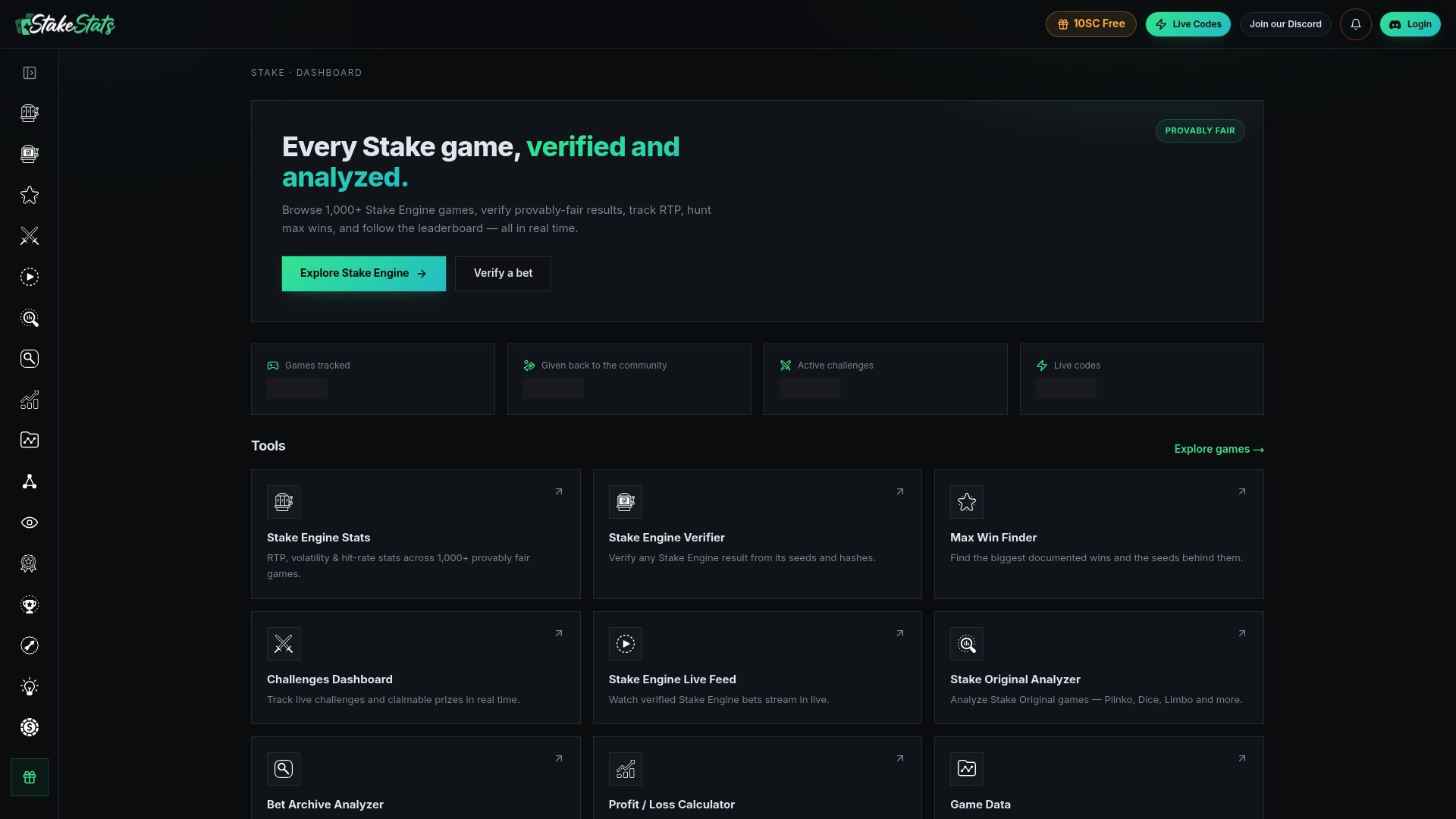
Here's how to use it for a Pragmatic Play session:
- Find your game on Stakestats. Search by title and pull up the live metrics panel — RTP, volatility tier, and hit rate are all displayed.
- Compare the in-game ⓘ RTP to the Stakestats live data. A significant gap between the theoretical default and observed performance is worth noting before you increase your stake.
- Run a provably-fair check or bankroll model if needed. For Stake Engine titles, the provably-fair tools let you verify individual bet outcomes cryptographically. For session planning, the bankroll analyzer models your stake against volatility before you commit.
Save your screenshots. Stakestats gives you the data; your screenshots give you the evidence trail. Together, they're the closest thing to a complete verification workflow available to a crypto casino player today.
Useful sources for verifying Pragmatic Play RTP
| Source | Best used for | Coverage notes |
|---|---|---|
| SlotArk | Theoretical RTP list and portfolio averages | Broad catalog coverage; reflects highest available tier |
| PPSlotGuide | Multi-tier RTP documentation and in-game verification advice | Documents operator configuration practices |
| RTPTrack | Three-tier RTP spreads and lowest-tier values | Shows the full tier range, not just the default |
| DemoSlot | Live 24h/7d/30d RTP tracking | Explains variance effects on short windows |
| SlotStat | Live RTP averages across a tracked game sample | Average live RTP may differ from theoretical defaults |
| Stakestats | Live RTP, volatility, hit rate, provably-fair verification | Deepest verification stack for Stake Engine titles |
A note on source limits: Every tracker above reflects the games and operators it has access to — none covers every casino or every RTP tier in use. SlotArk and PPSlotGuide list theoretical defaults, not operator-deployed values. Live trackers like DemoSlot and SlotStat show observed performance across their tracked sample, which may not include your specific casino. For Stake Engine titles, Stakestats's provably-fair verification is the only tool that lets you verify outcomes at the cryptographic level rather than relying on aggregated performance data.