
Stop Chasing Predictable Seeds: 3 Steps to Verify for Provably Fair Players

No. On a properly implemented provably fair system, server seeds, client seeds, and nonces cannot be predicted before a round resolves. The cryptographic commitment locks the outcome in before you bet, and breaking it would require either stealing the operator's secret seed or breaking SHA-256 itself. Your move: log the serverHash and clientSeed before you play, then verify the result the moment the server seed gets revealed.
TL;DR:
- Properly implemented provably fair systems use cryptographic commitments that prevent seed prediction unless the operator's infrastructure is compromised.
- Verifying fairness involves recording hashes and seeds before betting, then confirming the seed reveal matches the initial commitment and recomputing the outcome independently.
- Predictors claiming to forecast game results rely on fake visuals or malware, as cracking SHA-256 or predicting seeds beforehand is technically impossible.
- Implementation flaws such as seed leakage, seed grinding, or weak hashing practices create real risks, but these are unrelated to the cryptography's mathematical strength.
- Regularly verifying results is vital for transparency, especially if the platform lacks visible seed rotation, consistent fairness tools, or promotes third-party prediction apps.
Table of Contents
- What Makes Predictable Seeds a Myth in Provably Fair Games?
- Why Do Predictor Apps and Seed Theories Keep Spreading?
- What Real Risks Exist Beyond the Predictable Seeds Myth?
- How Do You Verify a Provably Fair Outcome Yourself?
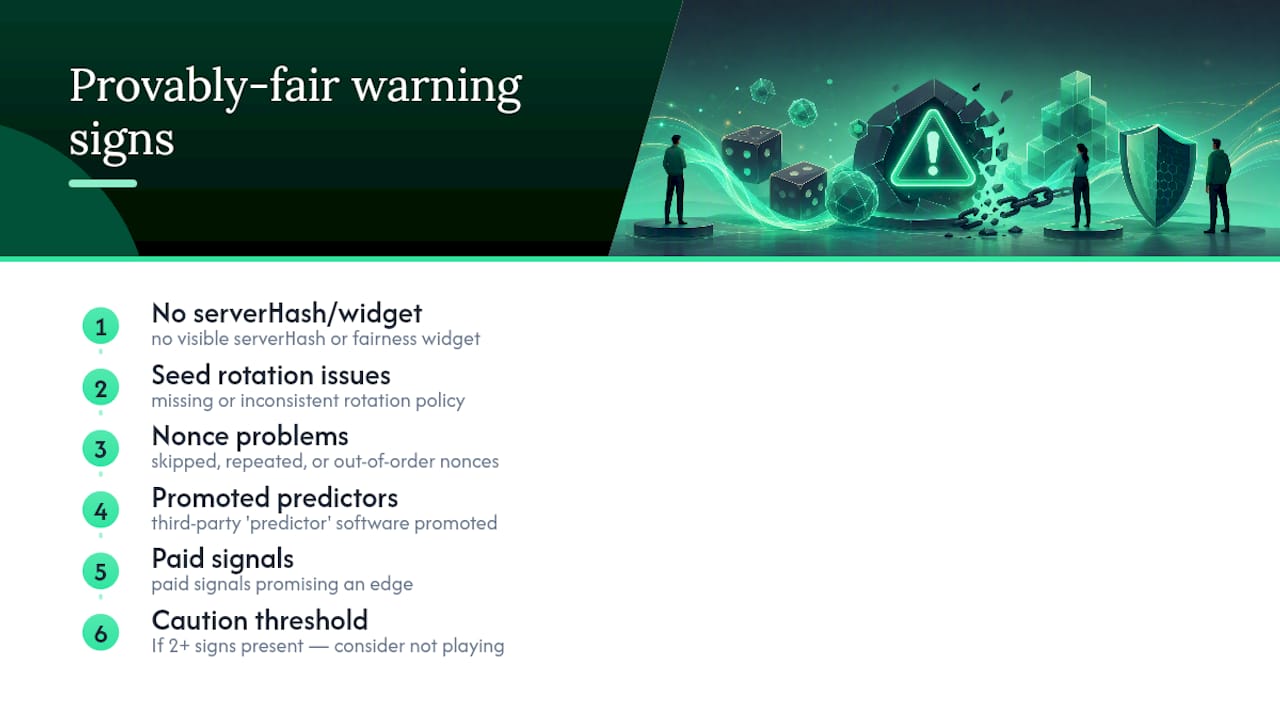
- A few quick checks can reveal risky provably fair setups. Look for absence of a visible serverHash or fairness widget, missing or inconsistent seed rotation policies, nonces that skip, repeat, or are out of order in bet histories, and any promotion of third-party 'predictor' software or paid signals promising an edge. If you notice one of these issues, proceed cautiously; with two or more, consider not playing there.
- Why Verification Should Be a Habit, Not a One-Time Check
- Verify Every Bet With Stake Stats in Three Steps
- Where to Learn More About Seed Verification
- Sources
What Makes Predictable Seeds a Myth in Provably Fair Games?
The math behind provably fair gaming is built specifically to kill prediction, not enable it. Every round rests on three inputs: a server seed (a secret string the casino generates and holds), a client seed (something you supply or that gets assigned to you), and a nonce (a counter that increases with every bet you place). None of these alone determines anything. Combined through a keyed hash function, they do.
Before the round starts, the operator publishes a serverHash, which is a SHA-256 digest of the still-secret server seed. That's the commit. The reveal comes later, when the operator discloses the actual server seed and you can hash it yourself to confirm it matches the hash you saw beforehand. This commit-reveal structure is the backbone of the entire system.
The outcome itself typically comes from an HMAC (a keyed cryptographic hash) using the server seed as the key and the client seed plus nonce as the message. That digest gets converted into a number, which maps to a game result, such as a dice roll, a crash multiplier, or a mine location.
- Server seed: secret until reveal, hashed and published in advance as the serverHash
- Client seed: visible to you the entire time, sometimes editable
- Nonce: increments with each bet, so no two rounds share the same combination of inputs
- HMAC output: deterministic, meaning identical inputs always produce identical outputs
That determinism is exactly why provably fair randomness works as a verification tool: you can reproduce the exact math after the fact, but you can't run it forward before the server seed exists in the open.
Why Do Predictor Apps and Seed Theories Keep Spreading?
Search "provably fair predictor" and you'll find no shortage of apps and Telegram channels claiming to forecast your next crash multiplier or dice roll. They don't work, and the reason is straightforward math rather than opinion.
To predict an outcome before reveal, a tool would need one of two things: live access to the operator's still-secret server seed, or the ability to break SHA-256. Getting the seed means the casino's infrastructure has already been compromised, which is a security failure, not a predictive skill. Breaking SHA-256 would mean cracking a hash function that underpins a huge share of global digital security, something no consumer app is remotely capable of.
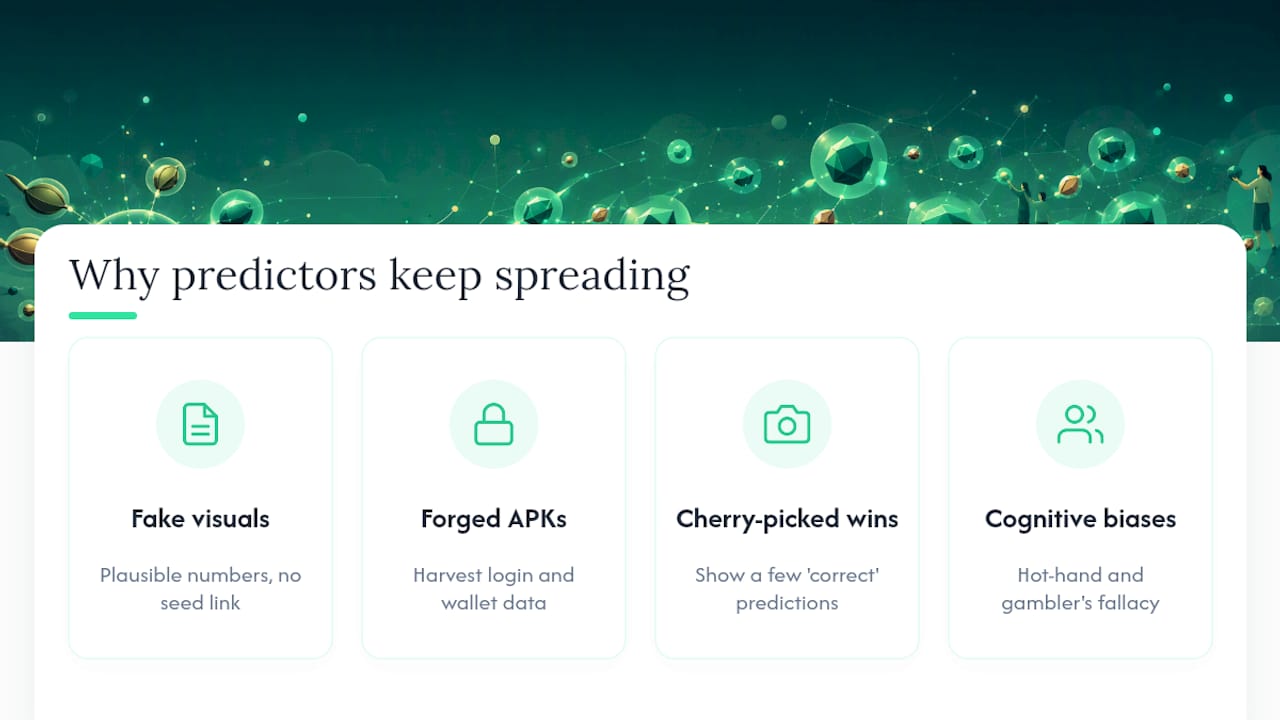
So why do these tools have paying users? A few overlapping reasons include fake visual predictors that display plausible-looking numbers with zero connection to the actual seed math, forged APKs distributed outside official app stores that harvest login credentials or wallet data instead of predicting anything, cherry-picked screenshots showing a handful of "correct" predictions while hiding many misses, and cognitive shortcuts like the hot-hand fallacy and gambler's fallacy that make short winning streaks feel like proof of a working system.
Pro Tip: If a predictor app asks you to disable app-store safety checks or grant it screen-reading permissions, treat that as a data-theft attempt, not a betting edge.
The pattern repeats across every casino vertical: sell certainty to people who want it, deliver noise, and let confirmation bias do the rest.
What Real Risks Exist Beyond the Predictable Seeds Myth?
The seed math is sound, but implementation is where things actually break down, and that gap is worth understanding.
- Seed leakage. If an insider or a compromised server exposes the live server seed before reveal, an attacker with that seed genuinely could predict outcomes. That's an infrastructure failure, not a flaw in the cryptography.
- Seed grinding, or last-look. A dishonest operator could generate many candidate server seeds, quietly test which one produces favorable outcomes, and only then commit to that one. Committing to the hash before the round, and ideally before the client seed is even known, closes this door.
- Weak implementation choices. Using a non-cryptographic hash, reusing seeds across rounds, or mishandling the nonce counter all create exploitable gaps that have nothing to do with HMAC or SHA-256 being weak.
- Mitigations that matter. Daily Merkle roots, idempotency keys, and one-shot commit flows raise the cost of tampering and make manipulation detectable rather than invisible.
How Do You Verify a Provably Fair Outcome Yourself?
Verification isn't optional homework. It's the entire point of the system, and it takes about two minutes once you've done it a couple of times.
- Before you bet: record the serverHash shown on screen and note your current clientSeed and nonce.
- After the round resolves: confirm that hashing the revealed server seed produces the exact serverHash you recorded earlier. If it doesn't match, something is wrong.
- Recompute the outcome: run HMAC using the revealed server seed as the key and your clientSeed plus nonce as the message, then map that digest the same way the game does, to confirm it lands on the result you actually got.
- Use an independent verifier, not just the operator's built-in widget. A browser-based verifier or a dedicated analyzer recomputes the math outside the casino's own environment, which matters if you're worried about a manipulated front end.
- If verification fails: stop playing that game immediately, screenshot or export your bet history, and report the discrepancy to the operator with your logged serverHash, clientSeed, and nonce attached.
Most verification failures aren't fraud. They're implementation mismatches, a wrong nonce format, a different digest-to-outcome mapping, or an unkeyed hash used where an HMAC was required. Match the operator's published algorithm spec exactly before assuming foul play.
One more thing worth separating in your head: verifying fairness confirms nobody altered your result after the bet was placed. It says nothing about the house edge, which is baked into the payout table regardless of how clean the seed math is.
A few quick checks can reveal risky provably fair setups. Look for absence of a visible serverHash or fairness widget, missing or inconsistent seed rotation policies, nonces that skip, repeat, or are out of order in bet histories, and any promotion of third-party 'predictor' software or paid signals promising an edge. If you notice one of these issues, proceed cautiously; with two or more, consider not playing there.
Why Verification Should Be a Habit, Not a One-Time Check
Reputable platforms rarely need to be caught cheating for verification to matter. The value is in the habit itself: checking after every session, or at minimum after every big swing, keeps you from ever wondering later whether something looked off.
Some platforms expose seed reveals, bet replays, and game-level statistics across numerous Stake Engine titles to enhance transparency and trust. Independent verifiers and published proofs raise the cost of covert tampering to the point where cheating quietly stops being worth the risk for any operator. Save your logs. Check your hashes. It costs you nothing and it's the only real insurance you have.
— Ian
Verify Every Bet With Stake Stats in Three Steps
Stakestats gives you the tools to check your own math instead of trusting a widget you can't audit. The Stake Originals Analyzer replays and inspects outcomes across Stake Engine games, so you can confirm a result independent of the casino's own interface.

Getting started takes three steps. Copy your serverSeed (once revealed), serverHash, clientSeed, and nonce from your bet history. Paste them into the verifier. Confirm the recomputed digest matches your actual result. If you want the full breakdown of how commit-reveal and hashing work before you dive in, the provably fair explanation page walks through each step in plain language. Run your next bet through it and see the match for yourself.
Where to Learn More About Seed Verification
For readers who want the code-level detail behind everything covered here:
- Provably fair randomness: A technical guide — Chainlink's breakdown of commit-reveal and HMAC-based generation
- Introduction to provably fair algorithms — the whitepaper defining seed roles and required criteria
- Provably Fair Predictors: Do They Work? — the math showing why predictor apps fail
- Stake Stats blog — longer explainers and verification tutorials