
Provably Fair Explained: How Crypto Casino Verification Works

Provably fair is a cryptographic commitment system that lets any player verify that a single game outcome was not changed after they placed their bet. Here is the three-step check you can run on any round right now:
- Step 1: Before you bet, copy the server hash the casino publishes. This is the SHA-256 fingerprint of the server seed, and it locks the casino into a specific outcome before you wager a single cent.
- Step 2: Play the round. Note your client seed and the nonce (the round counter for that seed pair).
- Step 3: After settlement, the casino reveals the server seed. Paste it into any verifier, re-hash it with SHA-256, and confirm it matches the hash from Step 1. Then recompute the outcome using HMAC-SHA256 with those three inputs. If the numbers match, the round was clean.
One caveat worth stating upfront: provably fair proves only that a specific round's result was not altered after your bet. As European Gaming notes, it does not prove long-run statistical randomness, it does not replace third-party RNG certification, and it says nothing about whether the site holds a license.
Key Takeaways
Provably fair proves a single round was not tampered with after your bet, using HMAC-SHA256 across three inputs: server seed, client seed, and nonce.
| Point | Details |
|---|---|
| What provably fair proves | A single round's outcome was cryptographically locked before your bet; the math is verifiable by anyone. |
| How to verify a round | Confirm the server hash matches the revealed seed via SHA-256, then recompute the outcome with HMAC-SHA256 using server seed, client seed, and nonce. |
| Main limitation | Provably fair does not prove long-run randomness, does not replace licensing, and does not remove the house edge. |
| Nonce tracking matters | The nonce increments per bet; losing track of it makes correct verification impossible for that round. |
| Use multiple verification methods | Run the site's built-in verifier first, then cross-check with a third-party tool or local script for any round in doubt. |
Table of Contents
- What does "provably fair" actually mean?
- How the cryptographic mechanics actually work
- A worked example you can recompute yourself
- How you can actually verify a round
- Where provably fair is used and how the architecture varies
- Provably fair vs. third-party RNG certification
- What provably fair does not do
- Security best practices for operators and players
- Practical verification tools you can use today
- Where to learn more and what to do next
- Why Stakestats publishes this resource
- Sources
What does "provably fair" actually mean?
At its core, provably fair is a cryptographic promise. Before a round starts, the casino commits to a secret value (the server seed) by publishing its hash. You cannot reverse-engineer the seed from the hash, so the casino cannot know what outcome you will get. Once you add your own client seed and the round counter (nonce), the combined inputs produce a deterministic result that neither party could have predicted or manipulated in advance.
The system is most common at crypto-first casinos and in games with simple, auditable outcome spaces: dice, crash titles, mines, and basic card draws. Traditional slot machines at licensed online casinos almost always rely on certified RNG software instead, because the math behind thousands of symbol combinations is harder to expose in a single hash check.
Pro Tip: Provably fair proves the integrity of one round, not the fairness of the house edge, not long-run randomness, and not regulatory compliance. A site can be provably fair and still unlicensed. Treat it as a tamper-proof receipt for a single bet, nothing more.
How the cryptographic mechanics actually work
Three inputs drive every provably fair system. Understanding each one is the difference between trusting a casino's word and actually verifying it yourself.
Server seed: A random string the casino generates before the round. It stays secret until after settlement. The casino's commitment to this seed is what prevents post-bet manipulation.
Server hash: The SHA-256 digest of the server seed, published before any bet is placed. Because SHA-256 is a one-way function, you cannot derive the seed from the hash, but you can confirm the seed matches the hash once it is revealed.
Client seed: A value you supply (or the casino generates for you). Mixing your seed into the calculation means the casino cannot precompute outcomes for your specific session, even if it wanted to.
Nonce: An integer that increments by one for every bet within a server-seed/client-seed pair. It prevents the same seed combination from producing the same result twice and is the input most often mishandled by players.
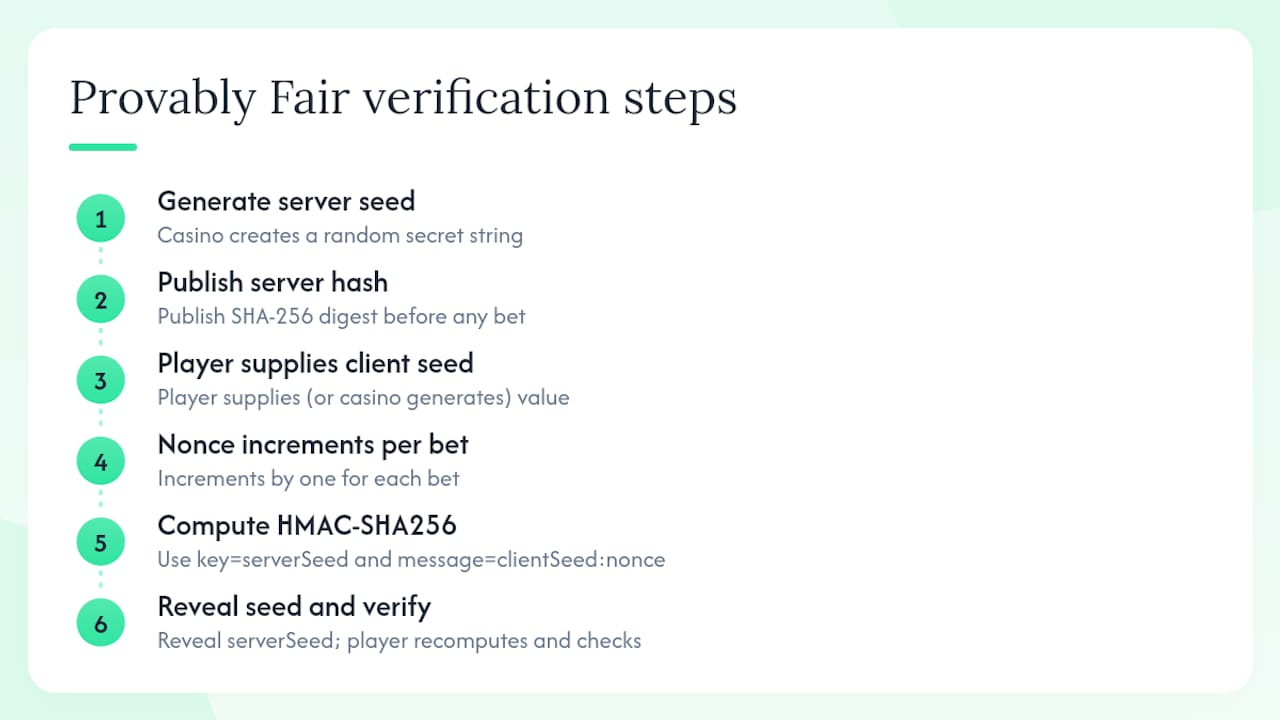
The Chainlink technical guide describes the full order of operations clearly: the casino commits to the server hash first, the player provides a client seed, and then the system combines all three inputs through HMAC-SHA256 to produce a deterministic byte stream. Those bytes convert to floats in the range Provable formalizes this as: generate server seed → publish SHA-256(serverSeed) → player supplies clientSeed → compute HMAC-SHA256(key=serverSeed, message=clientSeed:nonce) → reveal serverSeed after round → player recomputes and checks.
A worked example you can recompute yourself
Dice is the cleanest game to walk through because the outcome space is a single number from 0 to 100.
Inputs for this example:
- Server seed (revealed):
a3f8c2...(truncated for readability) - Server hash (pre-published):
SHA-256(serverSeed)=d7e9b1... - Client seed:
myClientSeed123 - Nonce:
42
Step-by-step recreation:
- Verify the commitment: Run
SHA-256("a3f8c2...")and confirm it equalsd7e9b1.... If it does not match, stop. The casino tampered with the seed. - Compute the HMAC: Run
HMAC-SHA256(key="a3f8c2...", message="myClientSeed123:42"). This produces a 32-byte hex string. - Convert to a float: Take the first 4 bytes of the output as a big-endian unsigned integer. Divide by 2^32 (4,294,967,296) to get a float in [0, 1).
- Scale to the game range: Multiply the float by 10,001 and floor the result to get a dice roll from 0 to 10,000 (representing 0.00 to 100.00).
The fairseed library on GitHub implements exactly this pattern. Its verification function signature looks like this in pseudocode:
function verifyResult(serverSeed, clientSeed, nonce, gameRange):
    hmac = HMAC_SHA256(key=serverSeed, message=clientSeed + ":" + nonce)
    bytes = hexToBytes(hmac)
    float = bytesToUint32(bytes[0:4]) / 4294967296
    return floor(float * gameRange)
Pro Tip: When testing verification, copy seeds from the casino's own history page rather than typing them by hand. A single character error in a 64-character hex string produces a completely different hash. Screenshot the server hash before you bet and the revealed seed after settlement so you have both values side by side.
How you can actually verify a round
Three paths exist, and they are not equally reliable.
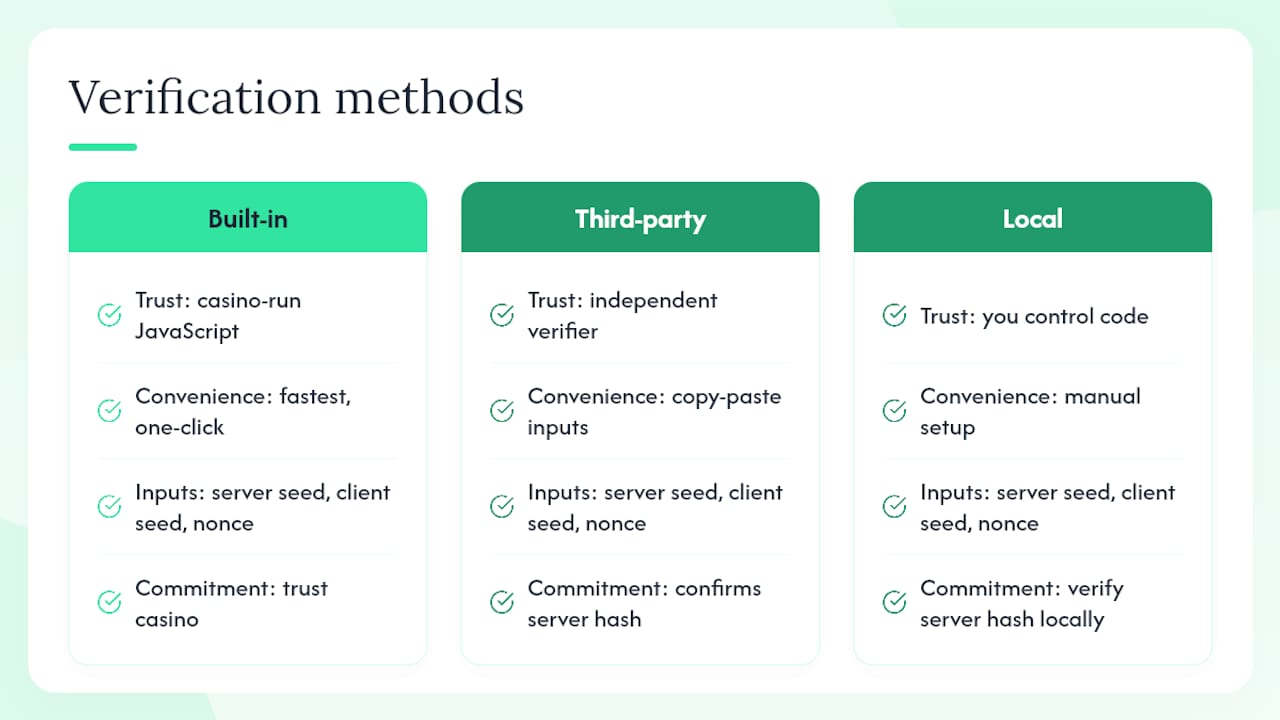
Built-in site verifier: Most provably fair casinos embed a verification widget in the bet history. You click a round, the widget pre-fills server seed, client seed, and nonce, and it recomputes the result. Fast and convenient, but you are trusting the casino's own JavaScript to run the math honestly. Use it as a first pass.
Third-party verifiers: Independent pages and tools accept the same three inputs and run the computation outside the casino's environment. This removes the conflict of interest. The fields you need to supply are always the same: revealed server seed, server hash (to confirm the commitment), client seed, and nonce. Cross-check the displayed result against what the casino showed you.
Manual local recomputation: Download a library like fairseed and run the HMAC locally in Node.js or Python. This is the most trustworthy path because you control every line of code. It takes five minutes to set up and gives you a permanent, reusable script.
A security note: once the casino reveals the server seed, that seed-pair is burned. Any future bets under the same server seed would be predictable, which is why reputable casinos rotate seeds after every session or on player request. If you see the same server hash appear across multiple sessions, that is a red flag worth escalating.
The Webopedia guide on provably fair flags incorrect nonce tracking as the most common beginner error. The nonce starts at 0 (or 1, depending on the casino) and increments by one per bet. If you lose track of it, you cannot reproduce the correct outcome even with the right seeds.
Pro Tip: Run the built-in verifier first. If the result looks off, paste the same inputs into a third-party tool. If those two disagree, that discrepancy is worth a screenshot and a support ticket.
Where provably fair is used and how the architecture varies
CryptoSlate's overview of crypto casinos documents that crash and dice games popularized provably fair, with BGaming among the early adopters and Aviator (by Spribe) becoming the canonical crash-game example most players recognize. The mechanic fits naturally: one number determines the multiplier at which the plane crashes, and that number is derived from a single HMAC computation anyone can check.
Beyond single-player games, the architecture splits into three main variants:
- Single-player HMAC scheme: The standard server seed + client seed + nonce model described above. Each player's outcome is independent.
- Hash-chain for shared-result games: When all players in a round share the same outcome (a community crash multiplier, for example), the casino publishes a chain commitment and reveals links in reverse order. Each revealed link proves the previous one was not altered. Developers often salt the chain with a later-chosen public value, such as a blockchain block hash, to prevent precomputation attacks.
- On-chain VRF (Chainlink VRF): For fully decentralized applications, Chainlink VRF generates a random value off-chain and delivers a cryptographic proof on-chain, so a smart contract can verify the value without trusting any single oracle. This is the preferred approach when the game logic itself lives on a blockchain and you want the randomness source to be publicly auditable at the protocol level, not just the application level.
The Stake Engine, which powers Stake Originals games, uses the HMAC-based scheme. You can explore the mechanics of those games through the Stake Engine tool on Stakestats.
Provably fair vs. third-party RNG certification
These two systems answer different questions, and confusing them is the most common misunderstanding in provably fair gaming.
| Dimension | Provably fair | Third-party RNG certification |
|---|---|---|
| What it proves | A single round's outcome was not changed after bets | Long-run statistical randomness across millions of rounds |
| How verification works | Player recomputes hash locally or via verifier | External lab (eCOGRA, BMM, iTech Labs) audits the RNG source |
| Typical use cases | Crypto dice, crash, mines, simple card draws | Licensed slots, table games, live dealer |
| Trust model | Cryptographic commitment; math is the proof | Institutional audit; trust the lab's report |
| Player action required | Yes, player must verify | No, audit is done by a third party |
The practical implication: a provably fair game on an unlicensed site gives you mathematical proof that one round was clean, but no protection around dispute resolution, withdrawal limits, or responsible gambling tools. A certified RNG on a licensed site gives you statistical confidence across millions of rounds and regulatory recourse if something goes wrong, but you cannot check a single round yourself.
Pro Tip: If you are playing for significant amounts, prefer a site that offers both: provably fair for round-level verification and a recognized gaming license for player protections. Neither alone is a complete safety net.
What provably fair does not do
The list of misconceptions here is longer than most casino sites admit.
- It does not remove the house edge. The math is transparent, but the house edge is baked into the outcome range. A dice game with a 1% edge is still a 1% edge, verifiably.
- It does not prove long-run randomness. A casino could use a weak or biased server seed that still passes the hash check for every individual round. The commitment proves the seed was not changed post-bet, not that it was generated with strong entropy.
- It does not mean the site is licensed. Provably fair is a technical feature, not a regulatory status. Some of the most prominent provably fair casinos operate without a license recognized in the United States.
- It does not protect you if the server seed entropy is compromised. As CryptoSlate documents, a malicious operator could choose a low-entropy server seed upfront that biases outcomes in their favor. The proof confirms the committed seed was used, not that the seed itself was random.
- Manual verification has real UX friction. Webopedia's analysis points out that most casual players never verify a single round, relying instead on platform reputation. The system only works as a trust mechanism when players actually use it.
- Premature seed reveal breaks the model. If a casino reveals the server seed before a round closes, players could compute the outcome in advance. Reputable implementations never expose the seed until after settlement is final.
Security best practices for operators and players
For operators:
- Generate server seeds from a cryptographically secure RNG, not a predictable source like a timestamp.
- Never expose the server seed before settlement is confirmed and irreversible.
- Rotate server seeds regularly and publish a new hash commitment for each new seed.
- Use HMAC-SHA256 with the server seed as the key; avoid weaker hash functions.
- Provide a built-in verification widget so players do not need to rely on external tools.
For players:
- Change your client seed before each session. The default seed the casino assigns is fine cryptographically, but a custom seed you control adds a layer of personal verification.
- Track your nonce. If you play 50 rounds under one seed pair, the 50th round used nonce 49 (or 50, depending on the casino's starting index). Losing track means you cannot reproduce that round.
- After any session where a result felt wrong, pull the bet history, grab the revealed server seed, and run a spot check on two or three rounds using a third-party tool.
Pro Tip: Spot-check at least one round per session, not just when something feels off. A consistent verification habit catches anomalies early. If a recomputed result ever fails to match the displayed outcome, screenshot everything: the server hash, the revealed seed, the client seed, the nonce, and the displayed result, then contact support with all five values. If the discrepancy is not resolved, post the evidence publicly.
Practical verification tools you can use today
Three tool types cover the full verification workflow:
- Site widget: Pre-filled, fast, zero setup. Use it for routine checks. The limitation is that you are running the casino's own code.
- Third-party verifier: An independent page where you paste the four inputs manually. Removes the casino from the equation. Good for any round where you want a second opinion.
- Local HMAC script: Download the fairseed library and run verification in your own environment. Takes five minutes to set up; gives you a permanent, auditable script you can reuse.
Three-step quickstart with Stakestats:
- Open the Stakestats provably fair verifier. The tool walks you through the exact fields required for Stake Originals games.
- Paste your revealed server seed, client seed, and nonce from your bet history. The tool recomputes the outcome and flags any mismatch.
- For a broader game-level view, the Stake Originals Analyzer lets you replay rounds and cross-reference RTP and hit-rate data alongside individual verification results.
Stakestats covers 2,500+ Stake Engine games and tracks nonces automatically in its verification flow, which addresses the most common manual error Webopedia identifies: losing track of the round counter.
Where to learn more and what to do next
A short, curated list of resources for readers who want to go deeper:
| Resource | What it teaches | Best use |
|---|---|---|
| Chainlink VRF docs | On-chain verifiable randomness and cryptographic proof delivery | Understanding decentralized RNG alternatives |
| Provable | Canonical verification flow and API endpoints | Reference for the standard HMAC-SHA256 protocol |
| fairseed on GitHub | Pseudocode, deterministic APIs, byte-to-float conversion | Building or auditing your own verification script |
| Stakestats provably fair explainer | Step-by-step verifier for Stake Originals games | Immediate practical verification |
Practical next steps:
- Run one manual verification this session using the fairseed pseudocode above and your own bet history.
- Automate verification for a sample of past bets using the Stakestats verifier or a local script.
- Bookmark an independent third-party verifier alongside the site's built-in widget so you always have a second check available.
Why Stakestats publishes this resource
Stakestats exists to give crypto casino players the transparency tools that most platforms bury or omit entirely. The provably fair verifier on this site is built specifically for Stake Originals games, and it handles nonce tracking automatically because that is where most players fall down when trying to verify manually. The broader suite, including the Stake Originals Analyzer and real-time RTP and volatility data for 2,500+ games, is designed around one idea: informed players make better decisions, and better decisions start with being able to check the math.
Pro Tip: Use verification as part of informed play, not just as a trust signal. Pairing round-level provably fair checks with session-level analytics from the bankroll analyzer gives you a complete picture of both outcome integrity and long-run performance.
Sources
- Provably Fair Randomness: A Technical Guide | Chainlink
- Provable
- Provably fair gambling explained: How it works
- Provably Fair | How to Trust Crypto Casinos - Webopedia
- fairseed (GitHub)
- Provably fair — Crypto casinos (CryptoSlate)