
Verify Real Time RTP on Stake in Minutes Without HMAC

Real-time RTP is a live, rolling estimate of a game's return to player built from actual provably-fair spin data as you play, not the static number listed in a paytable. It's useful, but only if you treat it as a short-term signal rather than a guarantee. The right move is to verify the underlying spins yourself using the server seed, client seed, and nonce inputs run through HMAC-SHA256, and lean on a dedicated tool like Stake Stats to do the heavy lifting.
TL;DR:
- Live RTP estimates are highly noisy and require thousands of spins to reliably reflect the game's long-term payout percentage.
- Verifying individual spins relies on rotating server seeds and matching hashes, which many players neglect, causing unverified data to compromise accuracy.
- Short-term fluctuations in RTP are normal, especially on high-variance games, and should not be used to judge whether a game is "hot" or "cold."
- Hit frequency and volatility significantly influence how RTP feels in practice, with high volatility games risking longer dry spells despite the same advertised payout percentage.
- Automated tools like Stake Stats enable seamless verification of spins and help turn raw data into informed bankroll and session management decisions.
Table of Contents
- What Real-Time RTP Actually Measures
- How Real-Time RTP Gets Calculated and Verified
- Reading a Live RTP Display Without Getting Fooled
- Volatility and Hit Frequency Change Everything About RTP
- Step-By-Step: Verifying a Game's Live RTP and Individual Spins
- Turning Live RTP Into Smarter Bankroll Decisions
- Why Real-Time RTP Matters in Gaming and Betting
- The Latency Problem Behind Real-Time RTP Systems
- Real-Time RTP Versus Traditional RTP Calculation
- Who Benefits From Monitoring Real-Time RTP
- Fairness Safeguards That Go Beyond HMAC-SHA256
- Regulatory Views on RTP Disclosure
- Why Verification Habits Separate Casual Players From Sharp Ones
- Verify Every Spin Without Doing the Math Yourself
- Sources
What Real-Time RTP Actually Measures
RTP is a long-run average. A slot advertised at 96% doesn't pay back 96 cents on every dollar wagered. It converges toward that number only after tens or hundreds of thousands of spins. A live RTP feed is trying to estimate that same long-run number from whatever sample size you've actually played, which for most sessions is a few hundred spins at best.
That's a noisy estimate, not a verdict. A slot can run at 80% RTP for an hour and 112% RTP the next hour and still be dead-on 96% over its full lifetime. Short samples swing hard, especially on high-variance titles where a single big hit skews the number for the rest of the session.
Provably-fair mechanics solve a different problem entirely. They prove the outcome of each spin wasn't altered after you placed your bet. They say nothing about whether the game is generous. A game can be perfectly verifiable and still have a rough hour, which is exactly why live RTP needs company:
- Sample size: fewer than a few thousand spins tells you almost nothing about true long-run RTP.
- Hit frequency: how often you win at all, regardless of size.
- Volatility: how wildly individual payouts swing session to session.
Those last two metrics change how an identical RTP feels in practice, which the next sections dig into.
How Real-Time RTP Gets Calculated and Verified
Every provably-fair spin rests on four inputs working together. The server seed is generated by the game server and hashed before you bet, so the operator commits to a value it can't quietly change afterward. The hashed version, the serverHash, is what you see pre-spin. The client seed comes from you (sometimes editable, sometimes auto-generated), and the nonce is a counter that increments with every bet, so the same seed pair never produces the same output twice in a row.
The math behind the outcome is HMAC-SHA256, run against the server seed, client seed, and nonce together. This produces a deterministic hash that maps to the spin's result. Because it's deterministic, the same three inputs will always produce the same output. That's what makes re-verification possible after the fact.
Here's the sequence in order:
- The operator publishes the serverHash before you bet, committing to a hidden serverSeed.
- You bet, and the outcome is generated instantly from the hidden serverSeed, your clientSeed, and the nonce.
- At some point, usually when you rotate seeds, the operator reveals the raw serverSeed.
- You hash that revealed serverSeed and confirm it matches the original serverHash.
- You re-run the HMAC-SHA256 computation yourself and confirm it matches the result you were shown.
A working reference implementation on GitHub shows how this scales: it uses serverHash pre-commitment, HMAC-based entropy per grid cell for multi-line slots, and a Monte Carlo simulator that runs millions of simulated spins to produce RTP, hit frequency, volatility, and a 95% confidence interval. That's how a live RTP tracker knows when a number is statistically meaningful rather than a fluke.
Statistic to know: the same reference implementation treats individual spin verification and aggregate RTP estimation as separate problems entirely, one confirms a single result, the other confirms a pattern across thousands of results.
The most common mistake players make is never rotating or revealing their server seed. Stake's own provably-fair implementation page is direct about this: if you don't rotate the seed, you can't audit anything that already happened, because the raw serverSeed needed to verify past spins is never released. Players who play for months on the same seed pair without ever revealing it have effectively locked themselves out of ever checking their own history.
Reading a Live RTP Display Without Getting Fooled
A live RTP number on screen is only as good as the sample behind it. Under a few hundred spins, that percentage is closer to a coin flip result than a meaningful statistic. It takes real volume, often into the thousands of rounds, before the number starts resembling the game's advertised long-run RTP. Monte Carlo simulation is how developers know where that stabilization point actually sits for a specific title, running the math millions of times to generate a confidence band instead of a single misleading figure.
Watch for a few warning signs:
- No visible serverHash before you spin, which means there's nothing to verify later.
- An RTP number that never moves even after heavy volume, which is statistically implausible for a genuine live feed.
- Vague labeling that doesn't specify whether the RTP shown includes bonus buys, jackpot contributions, or base game only.
- No option to see historical seed reveals or bet archives.
Pro Tip: Don't chase a live RTP number upward or downward mid-session. If a slot's live RTP dips to 70% after 200 spins, that's sample noise, not a sign the game "owes you" a hot streak.
Use live RTP as a rough compass, not a scoreboard. It tells you whether a session has been unusually cold or hot relative to expectations. It should never override your actual stop conditions or your read on hit frequency, which matters more for how a session plays out minute to minute.
Volatility and Hit Frequency Change Everything About RTP
RTP tells you the destination. Hit frequency and volatility tell you the ride. Hit frequency is simply how often a spin returns any win at all, often expressed as a percentage of spins. Volatility measures how much those individual wins vary in size, low volatility means frequent, small payouts; high volatility means long dry spells punctuated by occasionally huge hits.
Two slots can both sit at 96% RTP and play completely differently. One with a 40% hit frequency and low volatility pays back small amounts constantly, letting a bankroll stretch across a long session with minimal drawdown. Another at the same RTP but a lower hit frequency and high volatility will chew through that same bankroll in dry stretches before (maybe) delivering a payout big enough to make up the difference. The math evens out over the long run; your bankroll has to survive long enough to see it.
- If your goal is a long, steady session, prioritize hit frequency over headline RTP.
- If you're chasing a specific big multiplier and can tolerate variance, high volatility with fewer, larger hits fits better, but budget for longer losing streaks.
- Wagering requirements on bonus funds usually favor higher hit frequency, since you need volume of spins to clear them without busting first.
Some providers publish hit frequency or volatility ratings directly, though plenty don't, which is exactly the gap tools built for verification are meant to close.
Step-By-Step: Verifying a Game's Live RTP and Individual Spins
Verification isn't complicated once you know the order of operations. Here's the workflow, start to finish.
- Capture the pre-spin commitment. Before betting, note the serverHash displayed, along with your active clientSeed and the nonce for that specific bet. Skip this step and you have nothing to check later.
- Collect the revealed serverSeed and run the HMAC check. Once you rotate seeds (or the operator reveals the seed at session end), take the raw serverSeed, hash it, and confirm it matches the serverHash you recorded. Then run HMAC-SHA256 against the serverSeed, clientSeed, and nonce to confirm the output matches the spin result you were shown.
- Feed results into a rolling RTP calculator. A single spin check tells you one result was legitimate. To judge live RTP meaningfully, you need dozens or hundreds of verified spins fed into a rolling average or Monte Carlo simulator that can output a confidence interval, not just a raw percentage.
- Archive everything and confirm seed rotation happened correctly. If a seed never gets revealed, that block of betting history becomes permanently unauditable. Keep a bet archive so you can revisit sessions later.
Pro Tip: Doing this by hand for even one gaming session is tedious. Stake Stats automates the entire chain, from bet archive capture to running the Stake Originals Analyzer against per-spin metadata, so you're not manually hashing strings after every rotation.
Turning Live RTP Into Smarter Bankroll Decisions
Verification tells you a game is fair. It doesn't tell you how to size your bets, and that's where hit frequency and volatility earn their keep. A bankroll built for a low-volatility, high-hit-frequency slot can run far smaller stakes relative to total balance and still survive a long session. A high-volatility title demands a bigger buffer, because you're betting on fewer, larger hits arriving before your balance runs dry.
A few working rules:
- Match session length to volatility. If you only have a short window to play, low-volatility games give you a smoother, more predictable ride.
- Set a hard loss limit before you start, and treat it as non-negotiable regardless of what the live RTP display shows mid-session.
- Log anything that looks statistically off, missing serverHash values, RTP numbers that never move, or seeds that never rotate, and stop playing that title until it's resolved.
- Remember that provably-fair verification confirms outcomes weren't manipulated after the fact; it does not change the house edge baked into the advertised RTP.
A bankroll analyzer that converts your hit frequency and volatility observations into concrete stake-sizing suggestions removes a lot of the guesswork here. Responsible limits still matter even when every spin checks out mathematically clean.
Why Real-Time RTP Matters in Gaming and Betting
RTP has always been a backward-looking, static number, calculated by the studio over millions of simulated spins and printed in the paytable. Real-time RTP flips that into something live: a running estimate built from the actual outcomes you're generating as you play, updated spin by spin.
Its significance in the provably-fair space is specific. Traditional online casinos ask players to trust a printed RTP figure with no way to check it against their own experience. Provably-fair systems, by contrast, hand players the raw ingredients, server seed, client seed, nonce, and a deterministic hash function, needed to reconstruct every outcome independently. Real-time RTP is the natural extension of that transparency: instead of trusting a static claim, you're watching a number build from verifiable data in front of you.
For betting contexts specifically, live RTP tracking matters because stakes and session length vary wildly from one player to the next. A recreational player doing 50 spins a night needs a different read on the number than someone running thousands of automated bets. The live figure adapts to actual play volume in a way a printed paytable number never could.
The catch is that "real time" doesn't mean "reliable at any moment." It means the estimate updates continuously, not that it's statistically solid the instant you check it. Significance here comes from combining that live feed with the verification steps and volatility context covered earlier, not from treating the number in isolation.
The Latency Problem Behind Real-Time RTP Systems
Building a live RTP tracker sounds straightforward until you account for the actual data pipeline. Every spin has to be captured, verified, and folded into a running calculation without lag piling up as volume increases, especially for players running high-frequency automated betting where hundreds of rounds fire per minute.
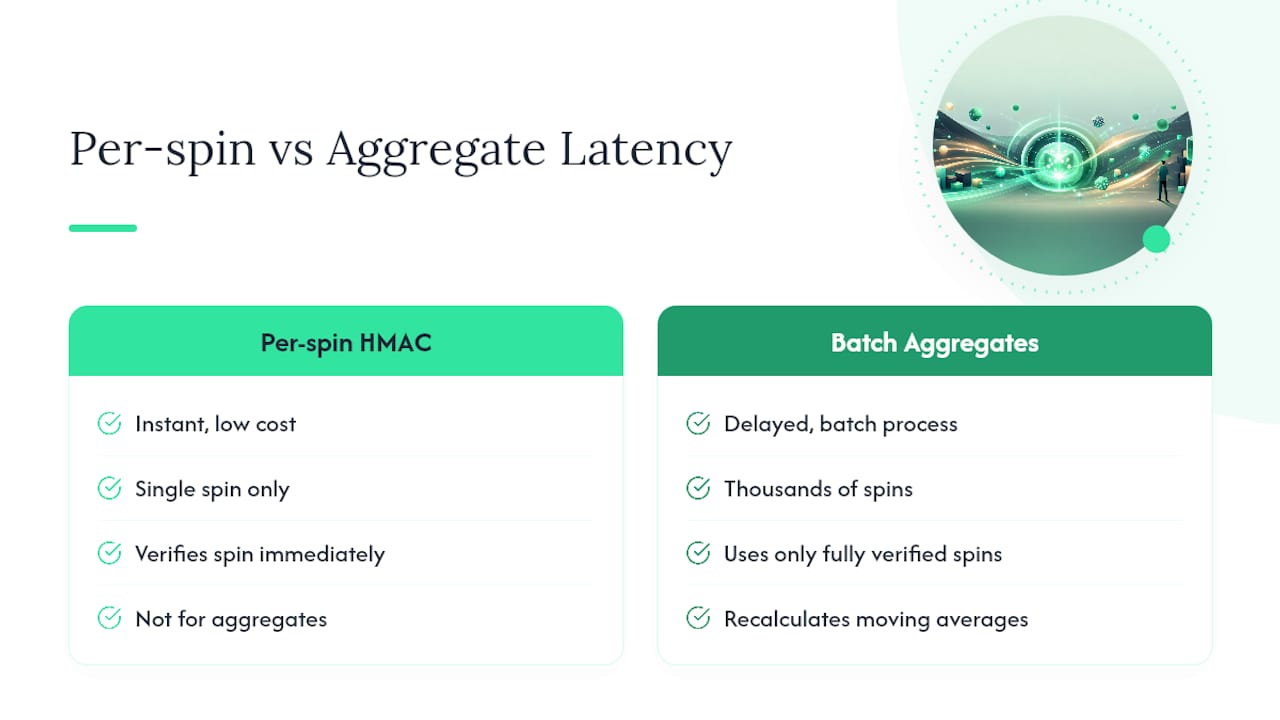
The technical bottleneck usually isn't the HMAC computation itself, that's fast and cheap. It's aggregation. Turning thousands of individual verified spins into a statistically meaningful rolling RTP, hit frequency, and volatility read requires recalculating a moving average or re-running simulation-based confidence intervals continuously, which gets computationally heavier as history grows.
There's also a data integrity challenge specific to provably-fair systems: you can't calculate a trustworthy live RTP from spins you haven't verified. If verification lags behind actual play, either because seed reveals haven't happened yet or because the archive hasn't caught up, the live number is built on an incomplete or stale sample. That's a different kind of latency than network delay. It's verification latency, and it matters more for accuracy than raw processing speed.
This is why serious implementations separate the concerns: a fast per-spin HMAC check confirms individual fairness instantly, while the aggregate RTP, hit frequency, and volatility figures run on a slightly delayed, batch-style process that only includes fully verified spins. Mixing those two timelines, treating unverified recent spins as equal to confirmed historical ones, is a common source of inflated or misleading live RTP readings.
Real-Time RTP Versus Traditional RTP Calculation
Traditional RTP is a lab number. Game studios run millions of simulated spins under controlled conditions long before a title ever reaches a casino floor, and the resulting percentage gets printed in the paytable and stays fixed for the life of that game version. It's accurate over the long run, but it tells you nothing about your specific session.
Real-time RTP inverts the source of the data. Instead of simulated spins, it's built from your actual verified betting history, updated continuously as you play. That makes it more personal and more immediate, but also far noisier, since you're working with a sample size that's a tiny fraction of what studios use to generate the traditional figure.
The two aren't competing claims about the same game; they're answering different questions. They're measuring different things over different scales.
The practical implication: never treat a live RTP reading as a replacement for the advertised figure, and never treat the advertised figure as a promise about your next session. Use the traditional number to judge whether a game is worth playing at all. Use the real-time figure, paired with hit frequency and volatility, to judge how a specific session is actually going.
Who Benefits From Monitoring Real-Time RTP
Players get the most obvious benefit: a live RTP feed, read correctly alongside hit frequency and volatility, turns vague gut feelings about a "cold" or "hot" game into something closer to an informed read. It won't predict the next spin, but it flags when a session's results have drifted far enough from expectation to warrant a second look at your seed verification, or simply a break.
Bankroll planning is the second major use case. Watching how live RTP and hit frequency interact across a session helps you decide whether to keep playing at your current stake or scale down until the numbers normalize.
Operators and game studios have their own reasons to monitor these figures, mainly for quality assurance and catching implementation bugs before they affect large numbers of players. A live RTP tracker that flags a title running persistently and implausibly far from its advertised figure across a large aggregate player base is a useful early warning that something in the math or the random number generation has gone wrong.
For provably-fair platforms specifically, real-time monitoring also supports the broader transparency pitch: it's one thing to say outcomes are verifiable, it's another to give players tools that actually surface the aggregate pattern those verified outcomes produce. That's the gap that dedicated verification and analytics tools are built to close for Stake Engine games specifically.
Fairness Safeguards That Go Beyond HMAC-SHA256
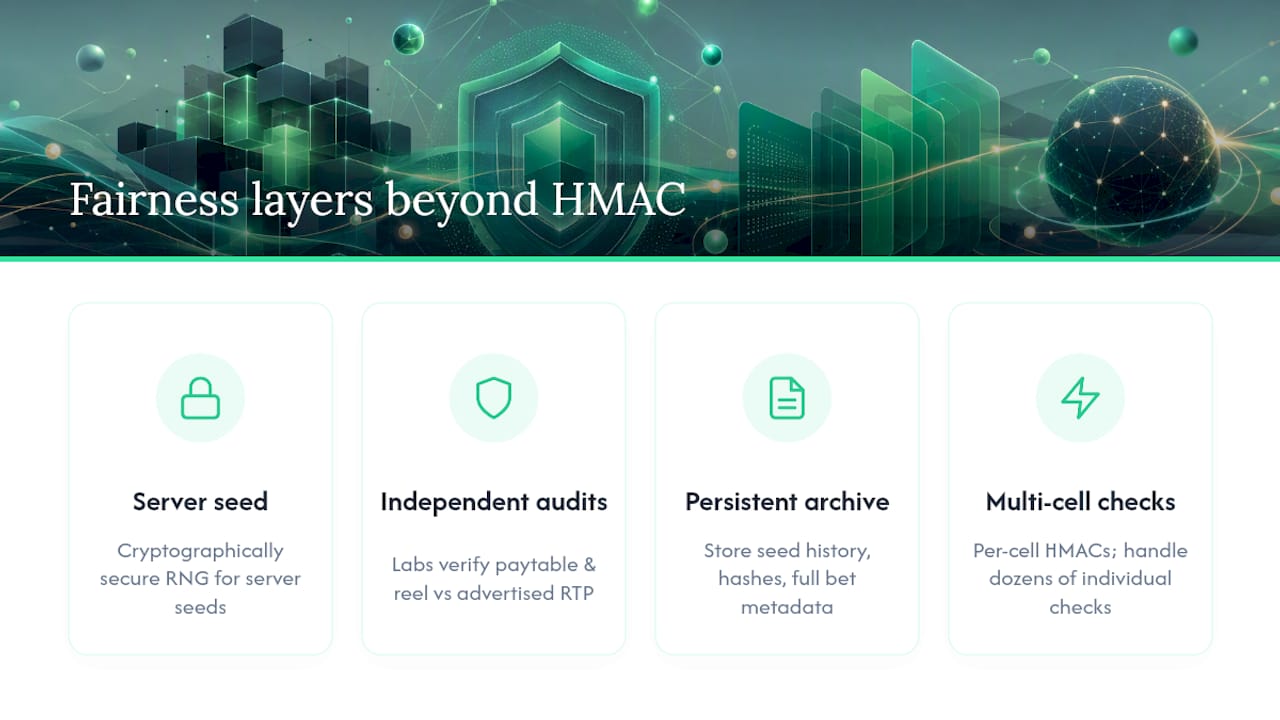
HMAC-SHA256 verification proves one thing well: that a specific spin's outcome wasn't altered after the bet was placed. It doesn't, by itself, prove the underlying random number generation feeding those seeds is statistically sound, or that the game's reel weightings match what's advertised.
A few additional layers matter for genuine fairness beyond the hash check itself. The server seed generation process needs a cryptographically secure random source; a weak or predictable seed generator undermines the entire commitment scheme even if the HMAC math checks out perfectly downstream. Independent testing labs auditing a game's actual paytable and reel configuration against its advertised RTP add a layer that per-spin verification alone can't cover, since HMAC confirms the spin wasn't tampered with, not that the odds behind it are what the operator claims.
Persistent bet archiving matters just as much. A verification system is only as good as its ability to be replayed months later, which means seed history, hash commitments, and full bet metadata need durable storage rather than disappearing once a session ends. The GitHub reference implementation reflects this directly, pairing its HMAC verification with a persistent archive specifically so entire sessions remain auditable long after the fact, not just the most recent spin.
Multi-cell and multi-line slot mechanics add another wrinkle: per-cell HMAC computation means a single spin might involve dozens of individual hash checks rather than one, and a verification tool needs to handle that complexity correctly or risk giving a false pass on a spin that only partially checks out.
Regulatory Views on RTP Disclosure
Regulators generally don't dictate a specific RTP a game must offer. What most licensing frameworks focus on is disclosure and consistency: operators need to make the RTP figure available to players, and the actual game math needs to match whatever figure gets advertised. Independent testing labs typically certify that a submitted paytable produces the claimed RTP before a game goes live in a regulated market.
Where this intersects with real-time RTP and provably-fair systems is mostly around verification claims rather than the percentage itself. Dynamic mechanics, adjustable volatility, bonus-buy features that change the effective RTP, or jackpot contributions that shift the base game figure, still need to disclose what the player is actually getting, and regulators increasingly expect that disclosure to be specific rather than a single blended number covering multiple play modes.
Provably-fair verification sits somewhat outside traditional regulatory RTP certification, since it's a cryptographic proof of outcome integrity rather than a statistical audit of long-run payout math. The two aren't substitutes. A game can be both provably fair and subject to a licensing body's RTP certification, and the strongest platforms lean on both: certified math backing the advertised figure, and cryptographic verification backing each individual result. Players relying on self-verification are effectively doing the transparency work regulators require of licensed operators, just at the individual spin level instead of the aggregate certification level.
Why Verification Habits Separate Casual Players From Sharp Ones
Most players never open a serverHash or run an HMAC check in their life, and that's exactly why live RTP readings get misread so often. The number on screen looks precise, so it gets treated as fact, when it's really a rough signal sitting on top of a small, noisy sample. Verification is what turns that vague feeling of "this game feels cold" into an actual data point you can trust.
What surprises people most isn't the cryptography, it's how often the failure point is procedural rather than technical. Nobody's HMAC math is usually wrong. What goes wrong is players never capturing the serverHash before betting, or never rotating a seed, which means the audit trail simply doesn't exist by the time anyone thinks to check it. That's a habit problem, not a math problem, and it's solvable with better tooling and a bit of discipline.
— Ian
Verify Every Spin Without Doing the Math Yourself
Stake Stats exists so you don't have to run HMAC-SHA256 by hand after every seed rotation. Every workflow covered above, capturing the serverHash, checking the reveal, rolling verified spins into an RTP and volatility read, is exactly what the platform automates for Stake Engine games.

Start with the transparency and verification tools to see per-spin audit data across your bet archive without manually recomputing anything. Pair that with the bankroll analyzer to turn your actual hit frequency and volatility numbers into stake-sizing guidance instead of guessing. None of this changes a game's house edge or promises better outcomes, it simply gives you the same verification power operators already have, applied to your own play. Head to Stake Stats and run your bet archive through the verifier before your next session.