
How to Rotate a Server Seed and Verify Your Bets

Rotating a server seed means retiring the secret seed your current bets were generated from, so the casino reveals it and starts a fresh one. Until you rotate, you only see a hash of the seed. After you rotate, you see the real seed and can check every bet placed under it. The nonce resets to zero, a new hash is committed for future play, and the odds of your next bets stay the same.
This guide covers what rotation does, how to do it, what happens to each value afterward, and how to use the revealed seed to verify results. Examples lean on Stake, since that is where most of our readers play, and the same logic applies to other provably fair sites.
TL;DR
- Rotating reveals the old server seed and commits a new hashed one. It is the only way to verify bets made under the previous seed.
- The nonce restarts at 0 (or 1, depending on the site) after rotation. The client seed may stay or reset, depending on the platform.
- To verify, you need the revealed server seed, the exact client seed, the nonce and the game settings. A wrong value in any field gives a wrong result.
- Rotation does not change your odds. It only opens the commitment on past bets.
- Set your own client seed before you play, then rotate whenever you want to audit a session.
Table of Contents
- What rotating a server seed actually means
- How to rotate your server seed
- What happens to the seeds and the nonce
- Does rotating change your odds or your past bets?
- How to verify bets with a revealed server seed
- A worked routine for a session
- Our perspective
- Check your bets with Stakestats
- Common mistakes to avoid
- FAQ
- Sources
What rotating a server seed actually means
Every provably fair bet comes from three inputs. Stake's Help Center names them: the client seed, the server seed and the nonce. The server seed is hashed with SHA-256 and shown to you, so results cannot be seen in advance. After you rotate the seed pair, the actual server seed is shown, and you can use it to verify results.
The design is a commit and reveal. Stake's implementation page explains that the server seed is a random 64-character hex string, and that you get its SHA-256 hash before any games are played. That hash locks the operator in: it cannot swap the seed later without the hash changing. You also cannot work out results ahead of time, because the hash does not let you recover the seed.
The catch is that a hash alone proves nothing about individual bets. Maktub's documentation describes the server seed as a secret while it is in use, with only the hash visible. If it were shown during play, anyone could predict the next outcomes. CSRAGE's fairness page states the problem the same way: verification needs the plaintext seed, but showing it mid-session would expose future results. Rotation resolves this. The current seed is retired and revealed, and a new one takes over with its own hash.
Think of it as sealing and opening an envelope. The hash is the sealed envelope you were handed before you bet. Rotation opens it. Then you can check that what is inside matches the seal, and that it produces the results you got.

How to rotate your server seed
The exact buttons differ by site, but the pattern is consistent. The steps below follow the Stake flow described in its implementation page, where the seed must be rotated by the customer to trigger replacement with a newly generated one.
- Finish the session you want to audit. Everything you bet under the current seed will become verifiable once you rotate. Bets you place after rotating belong to the next seed.
- Open the fairness menu. On Stake this is the Fairness option in the menu or on a game page. You will see your active client seed and the hashed active server seed.
- Note the hashed server seed. Copy it or screenshot it. The hash you were shown before betting is what you will compare against later.
- Choose a new client seed. On many sites, changing your client seed is what triggers a rotation. Pick any text you like.
- Confirm the change. The old server seed is now unhashed and visible in the same menu, and a new hashed seed is queued for your next bets.
- Compare the hash. Hash the revealed seed with SHA-256 and confirm it matches the hash you copied in step 3.
Some sites use a dedicated button instead. One public help article, for example, tells players to open the Fairness panel and click Rotate, and notes that each game of that type keeps its own separate seed. If you play several games, check whether your seed is shared across them or kept per game, because it decides how many rotations you need.
How often should you rotate?
There is no required schedule. CSRAGE states there is no cooldown, so you can rotate as often as you like. An open standard documented by Galabet sets no rotation interval at all. Its docs also warn that a seed which is never rotated is a commitment that is never opened, and a record under it proves nothing.
The same documentation points out that two costs grow with the age of a seed. You wait longer before you can check anything, and the operator holds a longer run of results it could calculate in advance. A practical habit follows from that: rotate after any session you care about, and certainly after a big win or an unexpected losing run.
What happens to the seeds and the nonce
After a rotation, three values behave differently. Here is the general pattern, with the platform differences that trip people up.
| Value | What happens on rotation | Source |
|---|---|---|
| Old server seed | Revealed in plaintext, so every bet under it becomes checkable | Galabet docs |
| New server seed | Generated fresh, with a new hash committed for future play | CSRAGE |
| Nonce | Resets to zero for the new seed pair | CSRAGE |
| Client seed | Unchanged on some platforms, reset to a default on others | Galabet docs, Lightning Faucet |
| Old records | Kept as they were, under the old commitment | Galabet docs |
The nonce
The nonce is a bet counter. Maktub's docs describe it as starting at 1 for the first bet of a seed pair and never repeating within that pair. Other platforms start at 0. Either way, it climbs by one for each bet and restarts when the seed pair changes.
Restarting is safe because the server seed changed too. Galabet's documentation explains that the nonce can go back to 0 because the HMAC key is different: the same client seed and nonce under seed A and seed B produce unrelated digests. Nothing about your earlier results predicts your later ones.
The client seed
This is where platforms differ most. Under the open standard in the Galabet docs, the client seed stays the same after rotation. Lightning Faucet describes the opposite on its platform: rotation archives the old seed, hash, client seed and game count into seed history, then resets the client seed to default, so you must set a custom one again. After any rotation, look at your client seed before you place the next bet, rather than assuming it carried over.
Does rotating change your odds or your past bets?
No public source we checked says that rotation alters a game's odds or its payout table, and the mechanics point the other way. The result of a bet is a function of the server seed, client seed and nonce. The house edge and the paytable are properties of the game, not of the seed. A new seed gives a new, independent sequence of outcomes drawn from the same game rules.
Past bets are also unaffected. Rotation does not rewrite them. As the Galabet documentation puts it in effect, old records stay unchanged and keep the old commitment. What changes is your ability to check them: the revealed seed turns the hash from a promise into something you can test.
Two cautions follow, because rotation is not a strategy:
- It does not predict anything. Because the new seed is hashed and hidden, you cannot know what the next outcomes will be. Rotating after a loss does not make a win more likely, and rotating after a win does not make a loss more likely.
- It is not a way to change a bet already placed. Once a bet resolves, its result is fixed by the seeds and nonce it used.
If gambling stops being fun or you feel pressure to chase losses, step away. In the US, the National Problem Gambling Helpline is available at 1-800-GAMBLER. You must also be of legal age where you live to gamble.
How to verify bets with a revealed server seed
Once you have rotated, verification is a matter of feeding the right values into a calculator. Maktub's documentation outlines the flow: rotate the pair, choose the game in the Verify tab, and paste the revealed server seed, client seed, nonce and game settings. The browser recomputes the result. The hash of the pasted seed must equal the hash shown before the bet.

On some sites this is even easier. One help article says that after a rotation, the bet detail page shows a Verify This Bet button with the seed, client seed and nonce already filled in.
The verification checklist
- Hash check. Hash the revealed server seed with SHA-256. It must match the hash you saw while the seed was active.
- Exact client seed. Use the client seed that was active for that bet, not what you remember typing.
- Exact nonce. CSRAGE warns that you must supply the exact nonce used, or the verifier reproduces a different, wrong result.
- Correct game and settings. Parameters such as risk level, number of rows or target multiplier feed into the calculation. A mismatch gives a different outcome.
- Compare the outcome. The recomputed result should match what the game showed.
The formula behind the result is HMAC-SHA256 with the server seed as the key, applied to a message built from the client seed, nonce and a cursor. CSRAGE writes it as HMAC(server, client:nonce:0). The resulting bytes are then converted into the game outcome.
The mistake behind most failed checks
If a verification fails, suspect your inputs first. Lightning Faucet reports that client seed sanitization causes more failed verifications than every other cause combined. People verify against the string they typed, get a completely different hash, and conclude something is wrong. The fix is to verify against the client seed the platform returns or lists in your seed history.
This is the most common reason a legitimate result looks wrong. Check spaces, case and special characters before drawing conclusions.
Use an independent verifier too
Stake's Help Center notes that third-party verifiers made independently can also be used for verifying results. It also recommends changing your client seed before you start playing so you have a say in the results. Our own provably fair verification tool takes your server seed, client seed and nonce and recomputes the result, and our explainer on how provably fair works walks through the math step by step.
A worked routine for a session
Here is a routine that keeps everything checkable without adding much effort.
- Before you play: open the fairness menu, set a client seed of your own, and copy the hashed server seed.
- While you play: nothing to do. The nonce counts up with each bet.
- After you play: rotate. Save the revealed server seed, the client seed and the final nonce.
- Verify: hash the revealed seed, compare it with the one you copied, then recompute one or more bets. Start with the biggest win, since it is the one most worth confirming.
- Log it: keep the seed, client seed and nonce range together so you can come back to them later.
Rotating frequently also keeps each seed short-lived. Fewer bets per seed means you can check results sooner, and it matches the point in the Galabet docs that the cost of a long-lived seed grows with its age.
Our perspective
We built Stakestats around one idea: a hash only helps you if you actually check it. Most players never rotate, and so most players never see whether the seed behind their bets matches what they were promised.
Rotation is the moment the system becomes transparent, which is why we treat it as a habit rather than an emergency measure. Rotate after a session, verify a sample of bets, and keep the numbers. It takes a couple of minutes.
We also think verification should not stop at one game. Our tools are designed to bring the same transparency to a wide catalog, with live RTP, volatility and hit rate stats for 2500+ Stake Engine games, plus bet replay and max win lookups. Knowing a bet was fair and knowing what a game really pays are two halves of the same decision.
Pair the audit with a bankroll plan. The numbers are only useful if they change how you size and stop your sessions.
Ian
Check your bets with Stakestats
If you have just rotated a seed, you have everything you need to run the checks. Paste your revealed server seed, client seed and nonce into our verification tools and see the recomputed result in your browser.
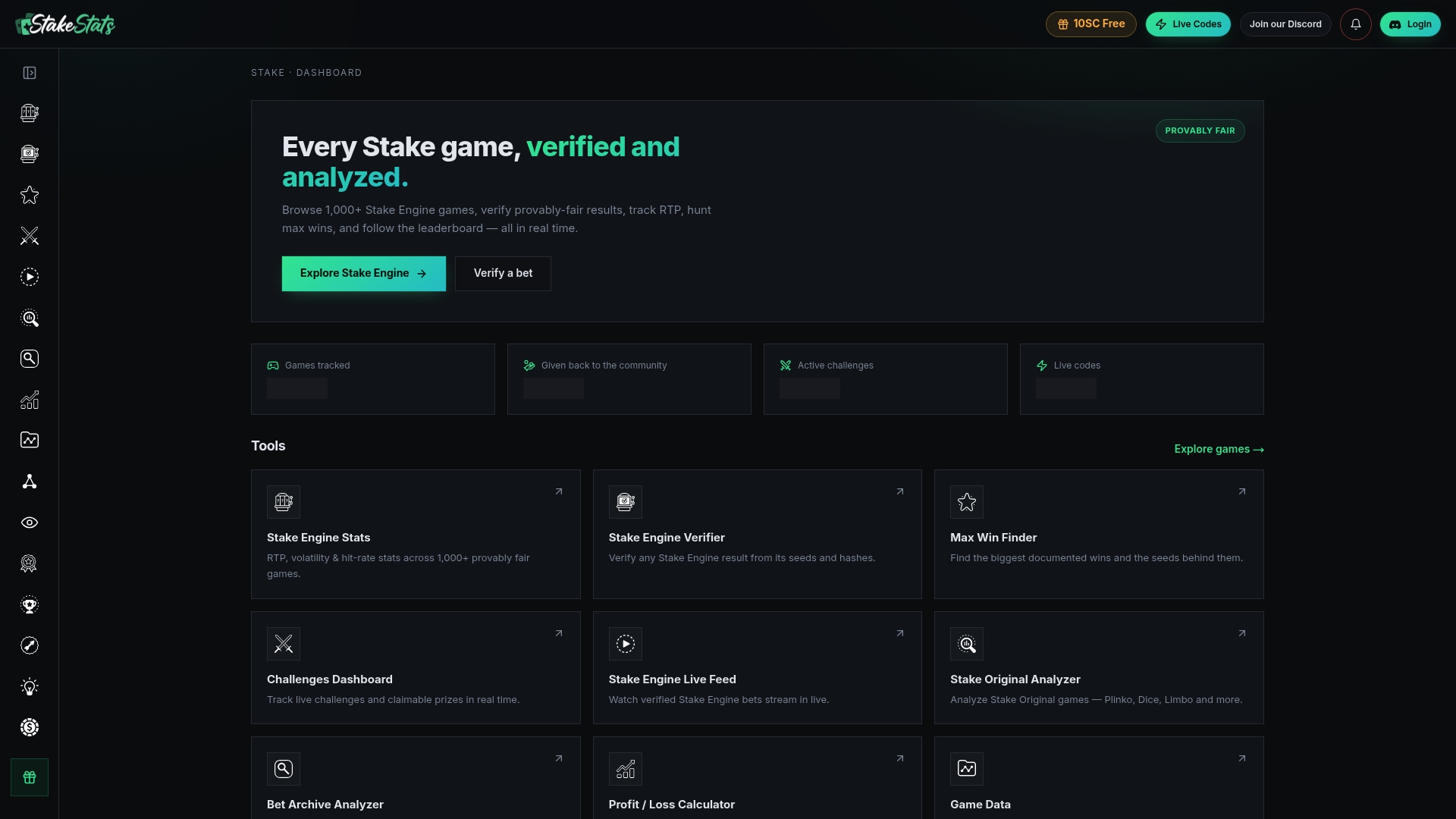
For Stake Originals you can go further with the Stake Originals Analyzer, and our bankroll analyzer helps you size sessions around what the numbers say. Games built on Stake Engine have their own bet verification page. Start from the Stakestats home page to see everything in one place.
Common mistakes to avoid
- Verifying before rotating. While a seed is active, only its hash is available. Gamba's help center says you must rotate first, because the server seed is hashed and hidden while active.
- Losing the hash. Without the hash you saw before betting, you cannot prove the revealed seed is the one that was committed. Copy it at the start of each seed.
- Forgetting the client seed reset. On platforms that reset it, your next bets run under a default seed rather than your own.
- Mixing up games. If seeds are kept per game, rotating on one game does not unlock bets on another.
- Mismatched nonce. Off-by-one errors are common when a platform counts from 0 and your tool counts from 1. Check the site's documentation for where it starts.
FAQ
Does rotating a server seed change my odds?
No. Odds and payouts come from the game's rules, while the seeds only decide which outcome in that game you get. Rotation swaps in a fresh, independent sequence and cannot be used to predict or influence the next result.
Can I verify bets without rotating?
Not fully. While the seed is active you only see its hash, so you can confirm the hash has not changed but cannot recompute any single round. After rotation the plaintext seed is revealed and every bet under it can be checked.
What happens to my nonce after I rotate?
It resets for the new seed pair, to zero on many platforms and to one on others. Your old bets keep their old nonces, so record the range you used for each seed before moving on.
Why does my verification show a different result?
The usual causes are a wrong client seed, a wrong nonce or the wrong game settings. Use the client seed value the platform lists in your seed history rather than the text you remember typing, and recheck the nonce.
How often should I rotate?
There is no fixed rule, and some platforms impose no cooldown. A sensible habit is to rotate after each session you want to audit, so you do not wait long to verify.
Sources
- Provably Fair Implementation, Stake.us
- Provable Fairness, Stake Help Center
- Provably Fair, Maktub documentation
- Provably Fair, Verify Game Results, CSRAGE
- Rotation and Reveal, Galabet documentation
- How provably fair dice verification works, Lightning Faucet
- How to Verify Provably Fair Bets, Help Center
- How to Verify Original Bets, Help Center