
No, RTP Doesn't Owe You Anything This Session

No: RTP is a long-term average across every wager ever placed on a game, and it does not guarantee you'll get back 96% of what you bet tonight, this week, or even this year. A slot advertising 96% RTP can chew through $500 without a meaningful payout and still be operating exactly as designed. The gap between what RTP promises and what a single session delivers comes down to two things: the RNG treats every spin as an independent event, and short-term variance can swing wildly in either direction before the math evens out.
That's the whole "rtp over time myth" in a nutshell. People treat a long-run statistical average as a short-run promise, and then feel cheated when a game doesn't cooperate on their schedule.
Here's what actually holds true:
- RTP describes millions of spins pooled together, not your Tuesday night session.
- Each spin's outcome has zero memory of the spin before it.
- Bankroll planning should assume variance, not the advertised percentage, will decide your night.
Key Takeaways
RTP is a long-run statistical average calculated across millions of independent spins, and no single session is obligated to reflect it.
| Point | Details |
|---|---|
| RTP is long-term only | It describes aggregate returns across a huge sample, never a guarantee for one session. |
| Spins are independent | The RNG has no memory, so no machine is ever "due" for a win. |
| Convergence takes volume | Measured RTP can require millions of spins to approach the theoretical figure. |
| Volatility drives short-term swings | Two games with the same RTP can feel completely different depending on variance. |
| Verification beats guessing | Provably fair tools let you check outcomes instead of relying on marketing claims. |
Table of Contents
- What Does RTP Actually Measure?
- Why Is Every Spin Completely Independent?
- How Much Play Does It Take for RTP to Show Up?
- Are Hot Machines, Cold Machines, and Due Slots Real?
- How Should You Actually Use RTP When You Play?
- Can You Verify RTP and Fairness Yourself?
- Why the RTP Conversation Usually Misses the Point
- Frequently Asked Questions
- Sources
What Does RTP Actually Measure?
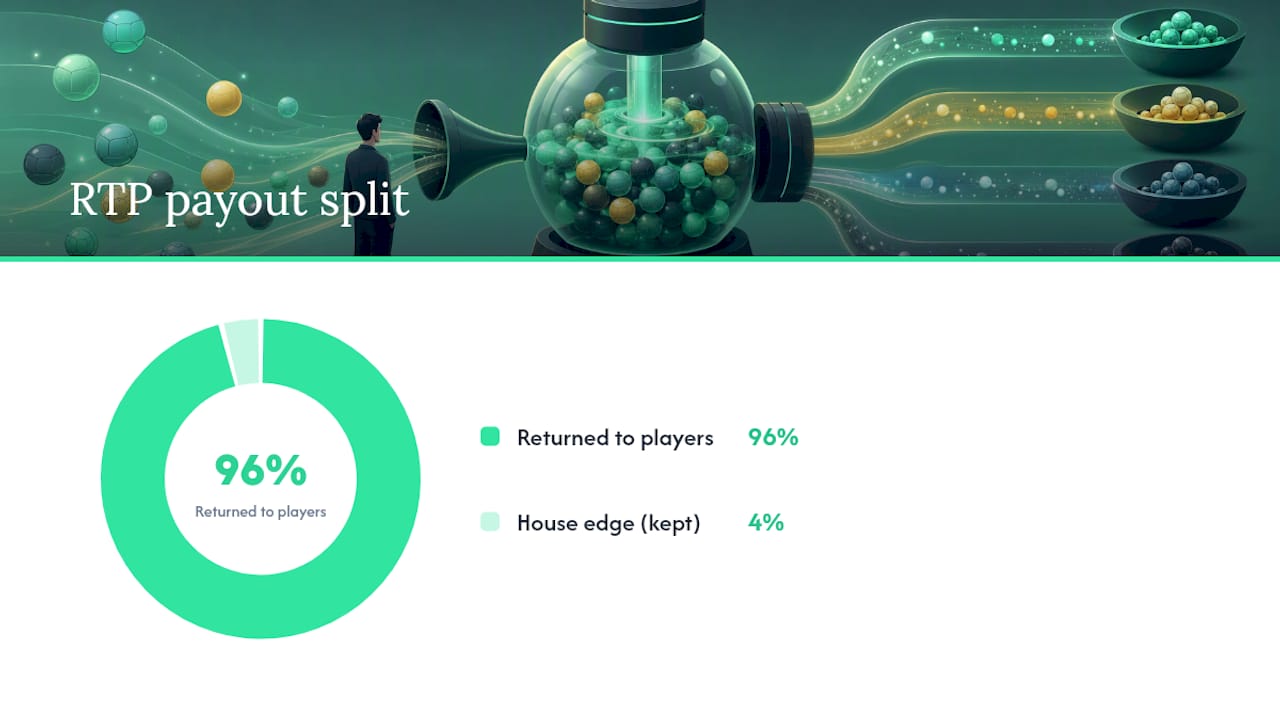
RTP stands for Return to Player, and it's the percentage of total wagers a game pays back over its full theoretical lifespan. If a slot has a 96% RTP, the math says that for every $100 wagered across an enormous number of spins, $96 comes back to players as winnings, and the house keeps $4 as its edge. That $4 is the game's built-in cost of play, spread across every player who has ever touched that machine or that Stake Engine title.
There's a distinction worth nailing down early, because it explains almost every misconception that follows: theoretical RTP versus observed RTP.
- Theoretical RTP is calculated directly from the game's math model, the probability of every symbol combination, paytable value, and bonus trigger baked into the code before a single real spin happens.
- Observed RTP is what actually gets paid out during real play over a given stretch, and it can sit well above or below the theoretical number depending on how much data you're looking at.
QuadCode's glossary explanation of RTP frames this clearly: RTP is a theoretical figure derived from the game's own probability model, and it only converges with observed results once you're looking at a genuinely large sample. Game studios and independent testing labs calculate theoretical RTP before launch and typically disclose it in the game's info screen or paytable, though disclosure thoroughness varies by jurisdiction and operator.
Quick fact: A 96% RTP does not mean you lose exactly 4 cents per dollar wagered. It means the average loss across millions of wagers settles near 4 cents. Your personal average could look nothing like that after 200 spins.
Why Is Every Spin Completely Independent?
Slot outcomes come from a random number generator that produces a new, unpredictable result for every spin, with no awareness of what happened on the spin before it. That's the mechanical reason "due to hit" thinking falls apart. The RNG isn't tracking a debt it owes you. It isn't counting how many spins have passed since the last bonus round. It's generating a fresh outcome from the same fixed probability distribution every single time.
Probability theory backs this up in a way that's almost annoyingly simple once you see it. Independent events don't accumulate pressure toward an outcome. Flip a fair coin nine times and land nine tails in a row. The odds of tails on flip ten are still exactly 50%, not higher, because the coin has no memory and no obligation to "correct" for the streak. Casino.org's breakdown of RTP mechanics makes the same point about slots: because the RNG generates independent events, prior spins carry zero influence over future ones.
Try this thought experiment. Imagine a slot with a 1-in-1,000 chance of triggering a bonus round on any given spin. You play 999 spins with no bonus. Are you "due" on spin 1,000? No. The odds on spin 1,000 are exactly what they were on spin one: 1 in 1,000. The only thing that's changed is your perception, not the math.
Pro Tip: If you catch yourself thinking "it has to hit soon," that's a signal to step away for a few minutes, not a signal to increase your bet size.
A few things worth keeping straight on independence:
- No mechanical or digital memory links one spin's outcome to the next.
- A losing streak doesn't raise your odds on the following spin.
- A hot streak doesn't lower them either. The game isn't "cooling down."
How Much Play Does It Take for RTP to Show Up?
This is where the rtp deviation explained conversation gets genuinely useful, because the numbers involved are bigger than most players assume. Regulatory guidance from the UK Gambling Commission on calculating RTP treats measured RTP as a value that converges toward the theoretical figure only as sample size grows, and it publishes tolerance ranges tied to confidence intervals for exactly this reason. Testing labs don't expect a few hundred spins to match the advertised number. They expect wide swings at low volume and a narrowing band as volume increases.
Volatility (sometimes called variance) measures how bumpy that convergence path is. A low-volatility game pays smaller wins more often, so its observed RTP tracks the theoretical number relatively fast. A high-volatility game, the kind built around rare jackpots, can sit far below its advertised RTP for thousands of spins and then jump dramatically when a big win lands. Both games can carry the same headline RTP and feel completely different to play.
Here's a conceptual picture of how that tolerance band behaves as sample size grows:
| Number of Spins | Expected Deviation From Theoretical RTP |
|---|---|
| 100 | Very wide, plus or minus tens of percentage points |
| — | Still noticeably wide, especially on volatile games |
| millions | Narrower, but jackpot-heavy games can still skew |
| Hundreds of millions | Approaches the published theoretical figure |
This is why RTP profits timeline discussions among testers and analysts routinely reference sample sizes in the millions. Casino.org's deep dive on RTP notes that real convergence can require millions or even billions of spins depending on volatility and jackpot structure, which is a scale no individual player will ever personally reach. That's precisely why nobody, including you, should expect a single evening's play to mirror the number on the paytable.
Statistic to remember: convergence to theoretical RTP isn't a "few thousand spins" phenomenon on volatile titles. It can require a sample size in the millions before the tolerance band narrows meaningfully.
Are Hot Machines, Cold Machines, and Due Slots Real?
Short answer: no, and the reasons are worth knowing individually because each myth gets debunked slightly differently.
- "This machine is due to hit." Independence rules this out entirely. The RNG doesn't track how long it's been since the last payout, so no spin is ever "overdue."
- "Hot and cold machines exist." What players read as heat is variance doing what variance does: clustering wins and losses in ways that look meaningful but aren't. Industry explainers on slot myths attribute this pattern directly to variance and jackpot distribution rather than any real state change in the machine.
- "Time of day changes your odds." RTP is fixed in the game's code and tested against that code. A machine doesn't quietly shift its math because it's 2 a.m.
- "Player loyalty cards affect RTP." Cards track play for comp purposes; they have no connection to the RNG or the paytable math.
- "Casinos can dial RTP up or down whenever they want." In regulated markets, RTP changes require an actual update to the game build and, in most cases, re-certification through a testing lab before that build goes live. Operators can't quietly adjust it mid-session.
Bonus frequency and jackpot size play a bigger role in these illusions than most players realize. A rare, oversized win skews short-term observed returns dramatically, which is exactly why one lucky session can make a "loose" machine look real when it's just a distribution tail doing its job.
How Should You Actually Use RTP When You Play?
Treat RTP as one input among several, not a promise. Here's a practical way to apply everything above:
- Size your bankroll for variance, not RTP. Assume any single session can land well outside the advertised percentage in either direction, and only wager what you're fine losing entirely.
- Set a session loss limit before you start, and treat it as non-negotiable regardless of how the RNG is behaving in the moment.
- Weigh volatility alongside RTP when picking a game. Two titles with identical RTP can produce very different experiences: one grinds out small frequent wins, the other sits flat for long stretches before a rare spike.
- Check hit frequency, when it's published, alongside RTP and volatility. It tells you how often you'll see any win at all, which matters more for session-length enjoyment than the headline percentage.
- Use time limits, not just money limits. Long sessions expose you to more of a volatile game's downside swings without necessarily getting you closer to convergence.
Pro Tip: If a game markets a huge headline RTP but you notice long dry stretches, that's probably a volatility signal, not evidence the RTP figure is fake.
Groups focused on player protection and gambling harm reduction consistently point to expectation-setting, understanding variance rather than chasing an advertised percentage, as one of the more effective ways to keep play from becoming a problem. A bankroll analyzer can help you translate these rules into concrete numbers before you sit down to play, rather than guessing at limits in the moment.
Can You Verify RTP and Fairness Yourself?
You don't have to take a publisher's word for any of this. Provably fair systems let you check outcomes directly. Games built this way generate a server seed, combine it with a client seed you control, and increment a nonce with every bet, then let you verify after the fact that the result wasn't tampered with. Transparency here doesn't reduce variance, it never will, but it does let you confirm the RNG behaved honestly on your own bets.
That's the gap Stakestats exists to close. A few ways to put it to work:
- Run the provably fair explanation tool to understand exactly how server seed, client seed, and nonce combine to produce a verifiable outcome.
- Pull up real-time RTP, volatility, and hit-rate stats across 2,500+ Stake Engine games instead of relying on a single paytable screen.
- Use the Stake Originals Analyzer to inspect a specific title's actual observed performance against its theoretical figure.
- Feed your own play into a bet archive review to see whether your personal variance lines up with what the math predicts.
Worth knowing: transparency tools won't shrink the size of a bad-luck streak, but they will confirm whether the streak came from honest randomness or something worth flagging.
Why the RTP Conversation Usually Misses the Point
The RTP myth debunked here isn't really a math problem, it's an expectations problem. Most explainers stop at "RNGs are random" and call it a day, which is true but unhelpful. The more useful lesson is that volatility, not RTP, decides what your night actually feels like.
Where conventional advice falls short is in stopping at "understand the math" without giving anyone a way to check it themselves. Verification matters more than most guides admit. If you can inspect a server seed and nonce, you're no longer trusting marketing copy, you're confirming behavior directly.
Prioritize this: set your bankroll limits before you consider volatility, and consider volatility before you fixate on RTP. In that order. Anyone who reverses that sequence is optimizing for the wrong variable.
Frequently Asked Questions
Does RTP guarantee I'll win back a percentage of my money? No. RTP is a theoretical average calculated across millions of spins. Any individual session, including a losing one, is entirely consistent with a game's advertised RTP.
Can a casino change a slot's RTP without telling players? In regulated markets, no. Changing RTP requires updating the actual game code, and that new build typically has to pass testing lab certification before it goes live again.
Why do some slots feel "hot" or "cold"? That perception comes from variance and jackpot distribution, not any real change in the machine's behavior. Rare, large wins cluster unpredictably and create patterns that look meaningful but aren't.
How many spins does it take for observed RTP to match theoretical RTP? It depends heavily on volatility, but high-variance games can require millions of spins before observed results reliably approach the published figure.
Does using a player's card or loyalty account change my odds? No. Loyalty tracking exists for comp and rewards purposes and has no connection to the RNG or the game's paytable math.
Sources
- How to calculate return to player (RTP)