
30–60 Second Server Seed Checks for Provably Fair Players
A server seed is the operator's secret value, committed as a SHA-256 hash before you play and revealed only after you rotate it. Verifying a bet comes down to two checks: does the revealed seed hash back to the commitment you were shown, and does recomputing the result with HMAC-SHA256 using the server seed, client seed, and nonce match what the game displayed. Both checks together take about 30 to 60 seconds once you know where to look.
TL;DR:
- Verification errors often stem from user mistakes like incorrect nonces or hashing the seed twice, rather than malicious intent.
- Batch checking saved seed and nonce data after gameplay reduces errors and saves time, instead of verifying each bet live.
- Using trusted third-party verification tools requires matching the casino's input format and cross-referencing results before trusting them.
- Visible server seeds before rotation or mismatched hash commitments indicate possible security issues or failed verification attempts.
- Conducting regular, session-wide verification helps detect tampering and builds confidence, even if individual bets occasionally fail.
Table of Contents
- What Is a Server Seed and Why Casinos Reveal It Later
- How to Verify a Bet in Under a Minute
- How the HMAC-SHA256 Math Actually Works
- Which Verification Tools Are Worth Trusting
- Mistakes That Cause False Mismatches
- How Players Fit Verification Into Real Sessions
- Run the Same Checks With Stakestats
- Sources
What Is a Server Seed and Why Casinos Reveal It Later
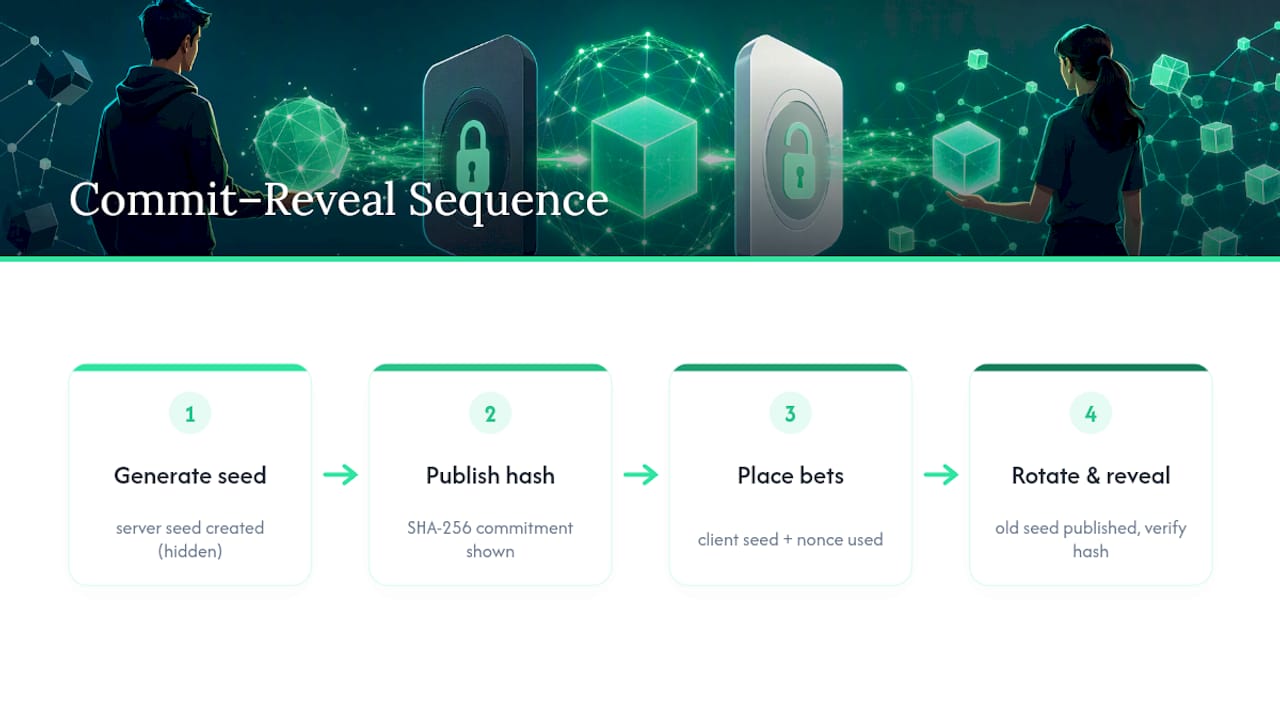
Provably fair platforms use a commit and reveal system. Before you place a bet, the casino generates a server seed and shows you only its SHA-256 hash, a scrambled fingerprint that proves the seed exists without exposing it. That's the "commit." Once you rotate seeds, the site publishes the actual server seed, the "reveal," and you can check that hashing it produces the exact commitment you saw earlier.
This order matters. If the plain server seed were visible while it was still active, anyone could run the numbers ahead of time and predict outcomes before betting, which defeats the entire point of provably fair randomness. Keeping it hidden until rotation is what makes the model tamper-resistant rather than just tamper-labeled.
The client seed and nonce fill the other half of the equation. You (or your browser) supply the client seed, and the nonce ticks up with every bet, so no two rounds ever share the same inputs even when the server seed stays constant across a session. You can expect a fresh server seed hash to appear whenever you manually rotate, and the old one gets unhashed and handed to you at that exact moment, per the commit-reveal model most provably fair sites follow.
How to Verify a Bet in Under a Minute
Running both checks is mechanical once you've done it a couple of times. Here's the order that works:
- Find your inputs. Open the game's fairness or provably fair panel and note the committed server seed hash, your client seed, and the nonce for the specific bet you're checking.
- Rotate to reveal. If the server seed is still active, rotate seeds in your account settings. This unhashes the old server seed and hands you the plain text version.
- Run check one: hash match. Hash the revealed server seed with SHA-256 yourself and compare it to the commitment you saved in step one. They must match character for character.
- Run check two: recompute the outcome. Feed the server seed, client seed, and nonce into HMAC-SHA256, convert the result the way the game specifies, and compare it against the outcome the casino actually displayed.
- If anything mismatches, stop. Screenshot the hash, the seed, the nonce, and the result, then contact support with that evidence before you place another bet.
This sequence mirrors the player workflow outlined by provably fair verification guides: save the commitment first, reveal second, verify twice.
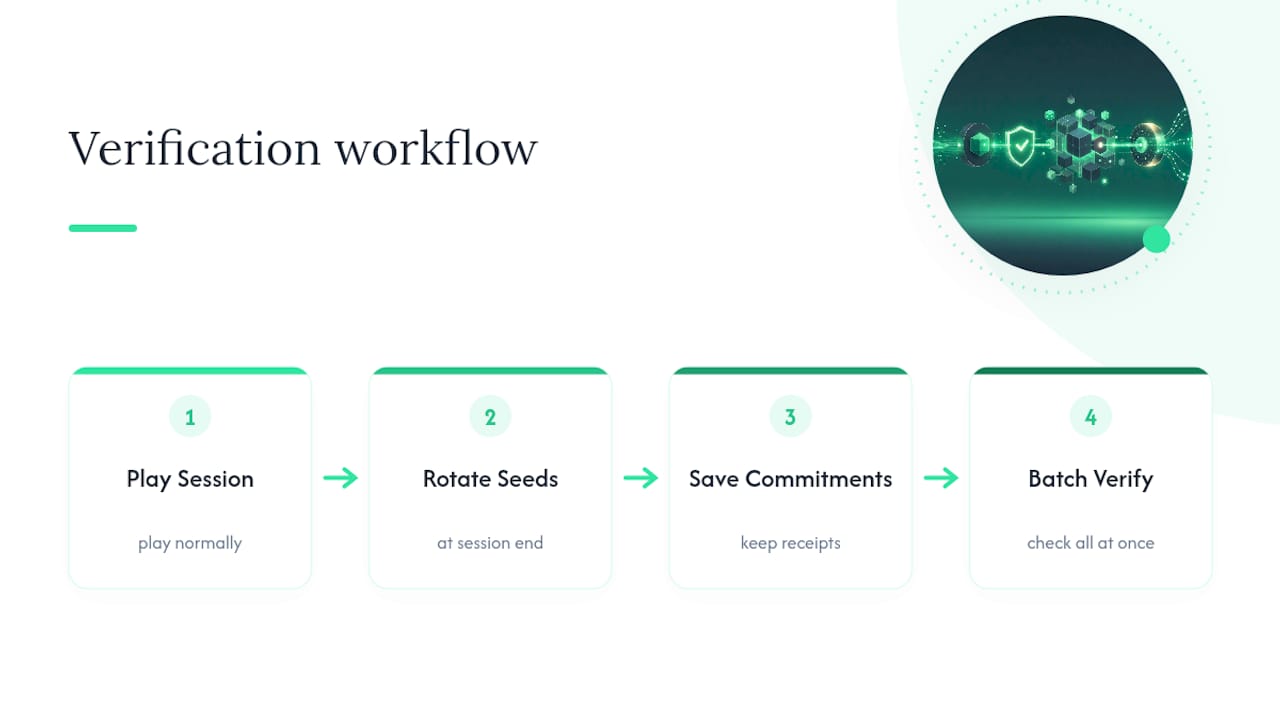
Pro Tip: Batch your verification instead of checking every bet live. Save your seed pairs and nonces during a session, then run all the checks in one sitting after you're done playing. It's faster and you're less likely to fat-finger a nonce while you're mid-session.
How the HMAC-SHA256 Math Actually Works
HMAC-SHA256 takes two inputs, a key and a message, and produces a fixed-length hex digest. In provably fair systems, the server seed acts as the key, and the message is almost always your client seed and nonce joined by a colon, something like clientSeed:nonce. Some sites append a third segment, like clientSeed:nonce:0, so always match the exact format your casino publishes rather than assuming a standard one.
Once you have the hex digest, converting it into a usable game number generally follows this pattern:
- Take a slice of the hex output, often the first 8 characters.
- Parse that slice as an integer.
- Apply a modulo operation against the game's outcome range, then scale to match the display (a percentage, a multiplier, a card value).
A minimal version looks like this in pseudocode:
hash = HMAC_SHA256(serverSeed, clientSeed + ":" + nonce)
slice = hash.substring(0, 8)
number = parseInt(slice, 16) % 10000
result = number / 100
This mirrors the core logic in open-source provably fair verifier projects, though the exact slicing and scaling steps vary by game type. Dice games, crash multipliers, and card draws each map the hex output differently, so check the casino's own published formula before assuming yours matches this example exactly.
Which Verification Tools Are Worth Trusting
You've got two real options: the casino's built-in verifier, or an independent tool you run yourself. The built-in version is convenient but you're trusting the same party whose fairness you're trying to confirm. An independent verifier, one you control or one built by a third party with published logic, removes that conflict of interest.
Whichever you use, check for a few essentials before you rely on it:
- Support for the specific game type you're verifying, since dice, crash, and card games each convert hex output differently.
- A message format field that matches your casino's exact published structure, not a generic default.
- Simple copy and paste inputs for the seed, client seed, and nonce, with no manual retyping that invites errors.
- Clear output mapping so you can see exactly how the raw hash became the displayed result.
Stakestats builds its tools around this exact workflow for Stake engine games specifically. Its provably fair explanation page walks through the commit and reveal steps in plain language, while the Stake engine tools collection handles the seed and nonce math for you. The Stake Originals Analyzer adds replay lookup, so you can pull up a past round and check it without hunting through your own bet history first, and a bankroll analyzer rounds out the session-level side of things once fairness is confirmed.
The safe workflow with any third-party verifier: copy your values directly from the casino's fairness panel, paste them without editing, and cross-check the tool's result against what the game displayed before you trust either one.
Mistakes That Cause False Mismatches
Most "failed" verifications aren't proof of a rigged game. They're user error. The most common mistakes players make include pasting the wrong nonce, using the wrong separator between client seed and nonce, or accidentally hashing an already-hashed value instead of the raw seed.
Watch for these red flags instead, which point to a real problem rather than a typo:
- A server seed that's visible and readable while still marked active, before any rotation.
- A revealed seed that hashes to something different than the commitment you were originally shown.
- A fairness panel that's missing entirely, or one that hides the nonce from your bet history.
Verification generally takes under a minute using two checks: hash confirmation and outcome recomputation. If either one fails after you've triple-checked your inputs, stop betting, screenshot everything, and escalate to support with your evidence attached rather than assuming the worst or dismissing it outright.
How Players Fit Verification Into Real Sessions
Nobody wants to run HMAC calculations mid-hand. The players who actually stick with verification treat it like a receipt, not a ritual: play the session, rotate seeds at the end, then check everything at once against saved commitments.
That habit matters more than doing it perfectly every single time. A missed check on one round costs you nothing if the pattern holds across a hundred rounds. What builds real confidence is consistency, checking often enough that a genuine mismatch would stand out immediately against your own baseline.
Worth remembering: provably fair verification confirms an outcome wasn't altered after the fact, not that the odds favor you. A perfectly verified round can still lose. That distinction is easy to forget when you're focused on the math.
— Ian
Run the Same Checks With Stakestats
Stakestats gives you a faster path to the same two checks this article just walked through, without opening a spreadsheet or writing your own HMAC function. The provably fair explanation and verifier tools handle the hash comparison and outcome recomputation for Stake engine games directly, so you paste in your revealed server seed, client seed, and nonce, and get a clear match or mismatch result back.
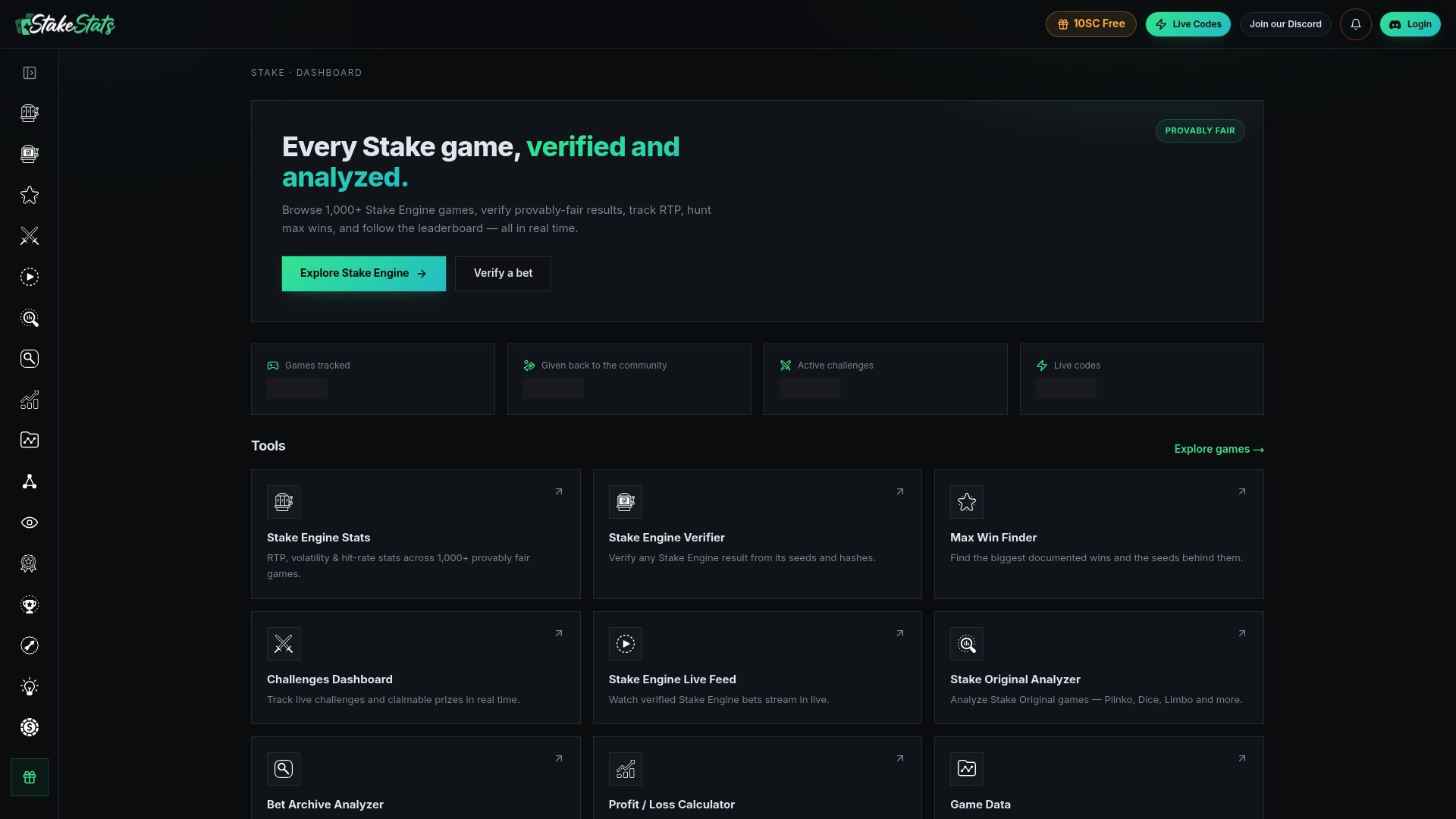
Beyond the verifier, the Stake engine tools collection covers RTP and hit-rate data across thousands of games, and the Stake Originals Analyzer lets you pull up a past round for replay and verification instead of digging through your own bet history. The platform earns referral commissions on some outbound casino links, which costs you nothing and doesn't affect the accuracy of the verification tools. Next time you rotate seeds, paste the values straight into the verifier and see the result for yourself.