
Plan Spins Per Session by Math for Slot Players Using the 250 Bet Rule

No number of spins changes the per-spin odds. Each pull is independent, so plan sessions by bankroll, wager size, RTP and spin rate instead of chasing a hit. Set a session bankroll, a target spins-per-hour pace and a stop-loss before you start. Industry heuristics like the 250-bet rule and simple calculators give a workable starting point for how long your money should last.
TL;DR:
- Spin independence means each outcome is unaffected by previous results, making short sessions highly unpredictable in terms of actual RTP.
- Variance and volatility significantly influence session length and bankroll depletion, with high-volatility games risking faster busts despite similar RTPs.
- Using bankroll calculators based on house edge and wager size provides rough estimates of how many spins and hours a session can support, but all are subject to wide variability.
- Sticking to simple rules like setting stop-loss limits and controlling spin rate is more effective for bankroll management than complex betting systems.
- Tools like bankroll analyzers and real-time RTP data help players plan sessions accurately, avoid chasing losses, and stay within their limits.
Table of Contents
- Why each spin is independent and why that matters for your session
- Estimating spins per session: the bankroll calculator approach
- How volatility changes what a session actually feels like
- Practical session rules that protect your bankroll
- Turning $100 into a session plan at different bet sizes
- How Stake Stats tools help you plan and verify sessions
- What most players get wrong about pacing their sessions
- Put this plan into practice with Stake Stats
- Further reading and primary sources
- Sources
- FAQ
Why each spin is independent and why that matters for your session
A slot's random number generator picks each outcome without any memory of the last spin. That is what "independent" means: the odds on spin 5,000 are identical to the odds on spin one, no matter how long you've gone without a win. There is no mechanism for a machine to "owe" you a hit after a cold streak, and there is no way to detect a pattern that will tip the next result in your favor.
- Independence means past spins carry zero information about future ones.
- Short sessions produce noisy results because small sample sizes swing far from theoretical return to player (RTP).
- Confidence intervals around RTP are wide at the session level and only narrow after a large number of spins.
- Convergence toward the stated RTP typically requires volumes far beyond what a single session or even a single sitting can generate, according to simulation research from UNLV.
That last point explains why two players on the same game can walk away with wildly different results in an hour, even though both faced identical odds on every spin. Session RTP is a sample, not a guarantee, and the gap between what you experienced and what the game pays out over millions of spins can be large. Treat any short-term win or loss streak as noise rather than a signal, and build your session plan around the math you control: bankroll, bet size, and pace.
Estimating spins per session: the bankroll calculator approach
The core formula behind most bankroll calculators is simple: expected loss per spin equals your wager multiplied by the house edge, where house edge is 1 minus RTP. From there you can estimate how many spins, or how many hours, your bankroll should realistically support.
- Find the house edge by subtracting the game's RTP from 1 (a 96% RTP game has a 4% house edge).
- Multiply your average wager by the house edge to get expected loss per spin.
- Divide your session bankroll by that expected loss per spin to estimate expected spins.
- Divide expected spins by your spin rate (spins per hour) to estimate expected session length in hours.
Say you bring a $100 session bankroll to a game with 96% RTP and bet $1 per spin. Expected loss per spin is $1 times 0.04, or $0.04. Divide $100 by $0.04 and the math suggests several thousand spins before the bankroll is expected to run out, on average. At a manual pace of around 20 to 30 spins per minute equivalent hourly rate, or a faster autoplay pace, that spin count translates to very different session lengths in clock time.
Expected loss is an average, not a promise. Because session-level variance around RTP is wide, you could bust out in 300 spins or still have money left after 4,000. The calculation gives you a planning baseline, not a forecast of what will actually happen.
Use this structure as a starting template, then adjust the wager or bankroll inputs to fit your own goals. A bankroll calculator does this math instantly and lets you test several scenarios before you ever place a bet.

How volatility changes what a session actually feels like
RTP tells you the long-run average return, but it says nothing about how bumpy the ride to get there will be. Volatility (sometimes called variance) describes the size and frequency of wins: a low-volatility game pays smaller amounts often, while a high-volatility game pays rarely but can pay big. Hit frequency is how often any win lands at all, and par is the industry term for the house edge built into the pay table.
- Volatility and hit frequency shape session experience even when two games share the same RTP.
- Higher-volatility pay tables tend to produce fewer spins per losing player, meaning bankrolls can disappear faster on average.
- Par alone is an unreliable predictor of how long a session will last, since two games with the same house edge can behave very differently in practice.
Simulations analyzing pay table standard deviation found that increases in variance produced large decreases in pulls per losing player, even without changing the underlying house edge. UNLV Gaming Research & Review Journal
For you as a player, this means a "low RTP but low volatility" game and a "same RTP but high volatility" game can produce very different sessions. The high-volatility option carries a better shot at a big multiplier, but also a real chance of busting out quickly. Matching volatility to your bankroll and patience matters as much as chasing a slightly higher RTP number.
Practical session rules that protect your bankroll
A few simple rules, applied consistently, do more for your bankroll than any betting system ever will.
- Split your total gambling funds into separate session bankrolls, and never dip into tomorrow's session to cover today's losses.
- Set a stop-loss percentage of your session bankroll (many players use 50%) and walk away once you hit it.
- Set a take-profit target too, and lock in a portion of any win rather than letting it ride back into the machine.
- Apply the 250-bet heuristic as a rough guide: a session bankroll of roughly 250 times your average wager gives a reasonable cushion against normal variance, though it can fail fast on high-volatility games or long losing streaks.
- Slow your spin rate by playing manually instead of relying on autoplay, since autoplay can push 60 to 90 spins per minute compared to a manual pace closer to 20 to 30.
The 250-bet rule is a starting point, not a guarantee. It assumes roughly average volatility and a wager size you can sustain, so a $1 bettor with a $250 bankroll should expect a cushion closer to typical conditions than a $5 bettor with the same $250, who is far more exposed to a short losing streak.
Pro Tip: Set a phone alarm for 30 or 60 minutes into any session. When it goes off, check your remaining bankroll against your stop-loss before you spin again.
Turning $100 into a session plan at different bet sizes
The same $100 bankroll behaves very differently depending on your bet size and pace. These examples use the expected-loss formula from earlier, assuming typical RTP figures for illustration, so treat them as a template to rerun with your own numbers.
Switch any of these to autoplay, where spin rates commonly exceed 60 to 90 per minute, and the same expected spin counts burn through in a fraction of the clock time. A $1 bettor expecting around 2,500 spins manually could see that bankroll exhausted in well under half the time on autoplay, simply because more spins fit into the same hour.

These figures are averages, and the actual outcome of any single session can land far outside them given the wide confidence intervals around short-term RTP. Rerun the math with your own bankroll, preferred bet size and the actual RTP of the game you're playing rather than relying on these illustrative numbers directly.
How Stake Stats tools help you plan and verify sessions
The math above illustrates the calculations typically used to plan sessions. Instead of estimating RTP and volatility by eye, players can use tools to obtain real figures and apply them directly to a session plan.
- The bankroll analyzer takes your starting bankroll, wager size and spin pace and estimates expected spins and session length.
- Real-time RTP and volatility stats across Stake Engine games let you check a game's actual hit rate before choosing a bet size.
- Provably fair verification lets you confirm server seed and nonce data behind your own spins, which supports the independence point made earlier in this guide.
- The bonuses and verification tools page covers promotion terms alongside bankroll and limit features.
Pulling a game's volatility before you sit down, then feeding it into a bankroll analyzer, turns the calculator logic in this guide into a plan you can actually follow.
What most players get wrong about pacing their sessions
The biggest mistake I see is treating spin rate as fixed instead of as a lever you control. Players leave autoplay running, lose track of time, and burn through a session bankroll three times faster than they intended. A second common error is chasing losses after a cold streak, as if the machine were due. A third is setting a bankroll for the night but never defining a stop-loss within it.
The fix is small: turn off autoplay, glance at a clock or spin counter every so often, and decide your stop-loss number before the first spin, not after the twentieth loss.
— Ian
Put this plan into practice with Stake Stats
Knowing the math behind spins per session only helps if you can check the real numbers before you play. Our bankroll analyzer turns your bankroll, bet size and spin rate into an estimated session length in seconds, and our transparency tools show live RTP and volatility for Stake Engine games so you're not guessing at the inputs.
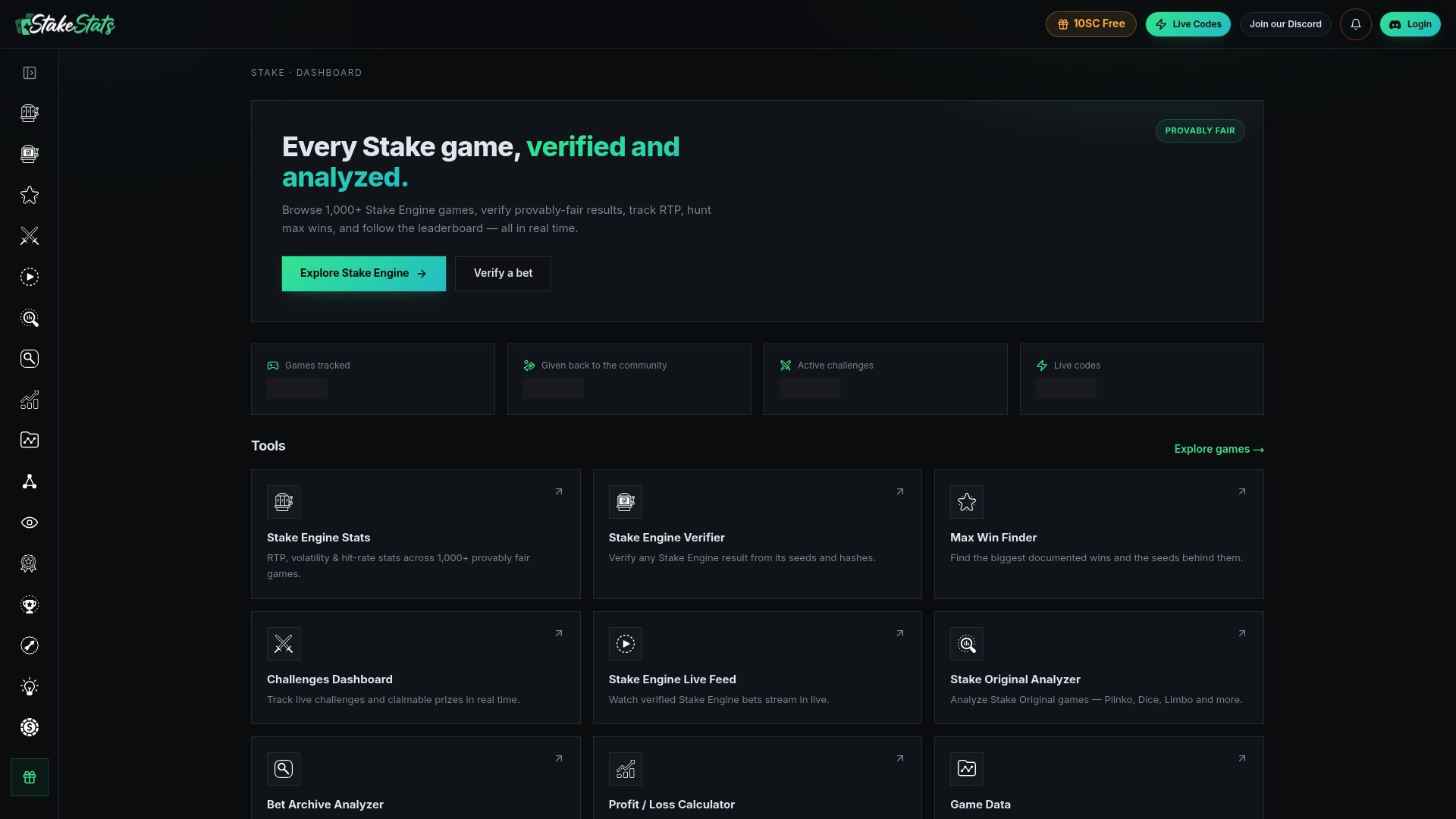
Open a bankroll analyzer before your next session and set your numbers before you spin.
Further reading and primary sources
- UNLV: variance, pay tables and par detection
- UNLV: pay table variance and time on device
- Monetary limits and tools for internet gamblers
- GambleAware resources and guidance
- Penn Entertainment responsible gaming controls
This article is general information, not a substitute for advice from a qualified financial advisor. Consult a qualified financial professional about your own circumstances before acting on anything here.
Sources
- Does Variable Wagering Affect the Ability of Reel Slot Players to Detect Differences in Pars? — UNLV GRRJ (paper)
- Monetary limits and tools for internet gamblers — Responsible Gambling (final report)
- Penn Entertainment — Responsible gaming
- GambleAware — resources and guidance
FAQ
What is the $20 method at the casino?
It's a bankroll approach where a player sets aside a small, fixed amount, often cited informally as $20, and stops once it's lost rather than reloading funds. It works as a stop-loss rule but has no special mathematical advantage over setting any other fixed session bankroll with a clear limit.
How do you play spins on a slot machine?
You place a wager, then trigger the random number generator either by pressing spin manually or by enabling autoplay to repeat the bet automatically. Each spin is independent, so the outcome owes nothing to previous results, and manual play typically runs at a slower pace than autoplay.
Can you tell when a slot machine will hit?
No. Outcomes come from an independent random number generator, and simulation research shows players cannot reliably detect pay table differences from short-term play, let alone predict the next result. Any sense of a machine being "due" is a pattern your brain is imposing on random noise.
What happens if you win a large amount at a casino?
Large wins are typically reported by the operator and may be subject to tax reporting rules that vary by jurisdiction, so check local requirements rather than assuming a single rule applies everywhere. Beyond the paperwork, the math in this guide still applies: lock in part of a big win with a take-profit rule instead of treating it as new session bankroll.