
Stablecoin Gambling Risks: What Can Go Wrong and How to Play Safer

Stablecoins like USDT and USDC take the price swings of Bitcoin out of your bankroll, which is exactly why so many players use them. They do not take out every risk. The dollar peg depends on the issuer's reserves, your funds pass through wallets, networks and a casino's cashier, and a mistaken transaction usually cannot be reversed. This guide covers what can go wrong at each point and how to check it with tools such as Stakestats' provably fair verification, so your bankroll only has to survive the games.
TL;DR
- A stablecoin aims to hold $1, but that is a goal backed by reserves, not a guarantee. Issuers can pause redemptions and market prices can slip below par.
- Most losses outside the game itself come from the chain around the coin: wrong network, wrong address, phishing, a drained hot wallet or a stalled withdrawal.
- U.S. federal law now has a framework for payment stablecoins, but it has no gambling-specific rules, so protections at offshore sites depend on the operator.
- Provably fair verification proves a bet was not rigged. It does not protect the coin you hold, so check both layers.
- Set a loss limit in dollars, keep only a session's bankroll on the site and use self-exclusion tools if play stops being fun.
Table of Contents
- What a stablecoin actually promises
- When the peg breaks
- The chain around the coin
- Provably fair is not the same as safe funds
- The U.S. legal picture
- Your money and your head
- A pre-deposit checklist
- Our perspective
- Check your bets and bankroll with Stakestats
- FAQ
- Sources
What a stablecoin actually promises
The IMF describes stablecoins as crypto assets that aim to keep a stable value against a specified asset, usually the U.S. dollar. Fiat-backed coins are meant to be supported one to one by safe, liquid, short-term assets. The same paper notes that major issuers also hold other kinds of assets, that issuers may limit or charge for redemptions, and that the price on a secondary market can drift away from par.
That last point matters for a player. When you deposit USDT or USDC, you hold a claim whose value rests on reserves you cannot see in real time. For most players on most days the peg holds and none of this matters. The risk is concentrated in the rare bad week, and a bankroll sitting on a casino balance during that week has no say in what happens.
When the peg breaks
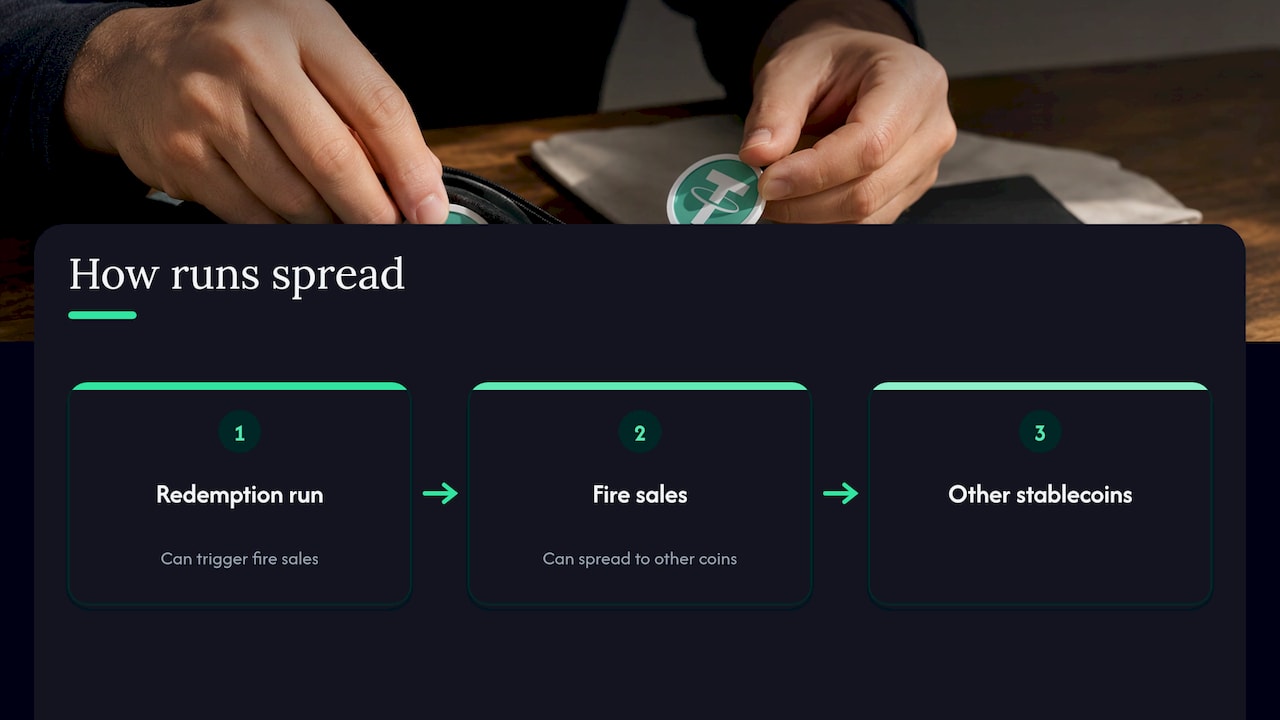
The U.S. Treasury's report on stablecoins lists what can undermine confidence: reserve assets that fall in price or become illiquid, reserves that are not safeguarded, unclear redemption rights, and cybersecurity or operational failures. It also warns that a run of redemptions can turn into fire sales and spread to other stablecoins.
This has happened. The Congressional Research Service notes that USDC traded below $0.90 in February 2023 after its issuer halted redemptions because it could not reach reserves held at Silicon Valley Bank. Algorithmic coins failed harder: the IMF records that TerraUSD collapsed in May 2022, wiping out tens of billions of dollars in market value.
The Philadelphia Fed makes the key point plainly: reserve assets differ in liquidity, and issuers facing distress may suspend convertibility. A dollar peg is not an always-available dollar. Holders may also not have deposit-insurance protection, according to the Treasury report cited above.
What a depeg means at a casino
Picture a $1,000 balance in a stablecoin that trades at $0.92 for a few days. Three things can happen at once:
- Your balance is still shown as 1,000 units, but cashing out to dollars returns less.
- Some sites convert deposits internally at a fixed rate and others use the market rate, so the same event costs two players different amounts.
- Withdrawals can slow down just when you want to move funds.
The Federal Reserve's 2026 analysis adds that safer, more liquid reserves are associated with lower run risk. In practice that means the coin's reserve quality is worth a look before it becomes your bankroll asset. For a head-to-head on the coin choice itself, see our breakdown of USDT versus BTC for gambling bankrolls.
The BIS adds that without private or public backstops, stablecoins can face severe price discounts or self-fulfilling runs, especially when backed by risky or opaque assets. Transparent reserves are the thing to look for.
The chain around the coin
Most problems players actually meet are not a collapse of the issuer. They happen along the route from your wallet to the casino and back.
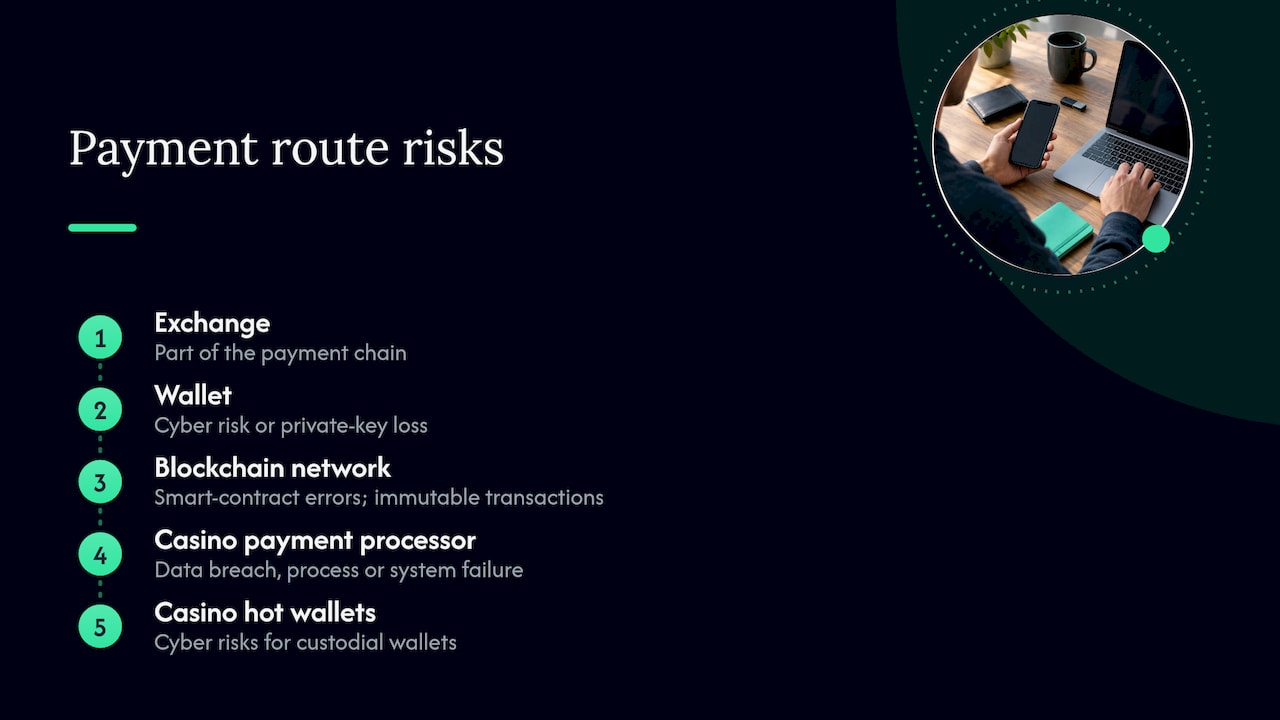
The Fed's April 2026 analysis points out that complex chains of service providers can hide exposures and worsen panic, so risk does not sit only with the token issuer. For a gambler, that chain usually includes an exchange, a wallet, a blockchain network, the casino's payment processor and the casino's own hot wallets.
The IMF lists the failure points: flawed processes, system failures, data breaches, smart-contract coding errors, cyber risks for internet-connected custodial wallets, and loss or theft of private keys for noncustodial wallets. It adds that because transactions are immutable, fixing a mistake is hard.
Mistakes that cannot be undone
Elliptic's explainer puts it simply: a stablecoin sent to the wrong address or approved by mistake usually can't be undone. Stablecoins also live on several networks. The same USDT can exist on Ethereum, Tron and others, and sending it on the network the casino does not support is the classic way to lose a deposit or wait weeks for support to recover it.
Before every deposit:
- Copy the address from the cashier, then compare the first and last six characters after pasting. Clipboard-swapping malware replaces addresses.
- Match the network exactly to the one the cashier names.
- Send a small test amount first when it is your first deposit to that address.
- Do not approve token spending for unknown sites or pop-ups.
Hacks, phishing and drained wallets
A law review article from Florida International University notes that players who connect crypto wallets to gambling sites face ongoing risk from hackers using phishing, malware and brute-force attacks. It also lists trouble disputing funds, unfair-game concerns and a lack of consumer protection as problems particular to crypto casinos.
Two habits cut most of this exposure. Use a separate wallet for gambling, funded only with what you plan to play. And treat every link in a message, even from "support," as hostile until you have typed the site's address yourself. A good primer on the broader habit of questioning what a site tells you is this guide on checking odds transparency before you pay.
Stalled withdrawals
A withdrawal that shows "pending" is often just waiting on network confirmations, not frozen. Learn to read it. Our guides on finding the TXID and fixing a pending crypto casino withdrawal and on how chain confirmations work and how long they take show what the transaction hash tells you and when a delay is normal. If a site goes quiet during a stablecoin stress event, the same documentation helps you show exactly what you sent and when. For an unrelated but instructive look at how withdrawal rules differ across real-money apps, see this page on withdrawing winnings from gaming apps.
Provably fair is not the same as safe funds
Provably fair systems let you confirm that a result was generated from a server seed, your client seed and a nonce, so the casino could not have changed it after your bet. That protects the game outcome. It says nothing about whether your stablecoin holds its peg or whether the site can pay out.
So run two checks. For the game, verify bets with the seeds; our guides on auditing on-chain bet proofs and why seed entropy matters walk through it. For the money, watch the coin's price against $1 and keep your balance small enough that a delay is an inconvenience rather than a crisis.
The U.S. legal picture
The GENIUS Act created the first U.S. federal framework for payment stablecoins. Brookings explains that it covers payment stablecoins but not non-payment types such as algorithmic stablecoins, which stay under state regulators. The Act has no gambling-specific provisions. Rules are still being written and phased in, so check the Treasury and OCC pages for the current status rather than relying on a summary.
On the gambling side, the same law review article says the Unlawful Internet Gambling Enforcement Act bars gambling businesses from accepting certain payments tied to unlawful online gambling but is silent on cryptocurrency, leaving federal treatment of crypto casinos ambiguous. State law then decides what is legal where you live, and it varies widely. Our page on Stake.us legality by state covers how that plays out for U.S. players.
What this means for you: a regulated, insured account has complaint routes and protections that a crypto balance generally does not. When a site operates outside U.S. oversight, your recourse in a dispute is mostly the site's own terms. Read the terms on withdrawals, account verification and what happens to balances in a frozen or restricted account before you fund it.
FATF, the international anti-money-laundering body, reports that over 250 stablecoins were in circulation by mid-2025, with total market value above $300 billion, and that stablecoins are the most popular virtual asset in illicit transactions. The practical result for players is more compliance checking: identity verification and source-of-funds questions can appear at withdrawal, so complete verification early and use funds that come from your own accounts.
Your money and your head
Stable value removes one source of stress, but it also makes the bankroll feel like dollars you can top up in seconds. Instant deposits from an exchange app make it easy to chase a loss. A few controls that work for most players:
- Decide a session budget in dollars before you open the site, and a stop point for losses and wins.
- Keep the rest of your funds in your own wallet or exchange, not on the casino.
- Do not borrow, use credit lines or use money meant for bills.
- Take breaks when you notice you are checking balances compulsively or depositing more than planned.
If you want a hard stop, set one up. Our piece on self-exclusion at U.S. crypto casinos explains why one ban is rarely enough and how to layer limits. If gambling is causing you harm, contact the National Problem Gambling Helpline or a licensed counselor.
A pre-deposit checklist
- Pick the coin on purpose. Prefer a fiat-backed stablecoin with transparent, regularly published reserve reports over an algorithmic one.
- Check the peg. Look at the coin's market price against $1. If it is trading away from par, wait.
- Match the network and confirm the address twice.
- Deposit a test amount and watch it land.
- Verify your bets with the server seed, client seed and nonce, especially after a big result.
- Withdraw wins on a schedule instead of leaving a growing balance on the site.
- Save your records: transaction hashes, timestamps and support chats.
Our perspective
Every question on this list comes down to one idea: you should be able to see what is happening to your money and your bets. Provably fair math gives you that for the game. We built our verification tools, real-time RTP, volatility and hit-rate stats and bankroll analyzers so that the second half, the money side, is something you can plan around too.
Our view is that stablecoins are a sensible bankroll tool when you treat them as a claim with conditions, not as cash. Know the coin, keep a session-sized balance on site, and use the numbers: session calculators, bet replay lookups and seed checks turn a gut feeling into a record.
The players who do best over time are not the ones who find a perfect site. They are the ones who size their risk before they play and check their own results afterward.
Ian
Check your bets and bankroll with Stakestats
Stakestats offers server seed and nonce verification, live RTP, volatility and hit-rate stats for 2,500+ Stake Engine games, max win and bet replay lookup, bankroll analyzers and a bonus code aggregator, all in one place for crypto players. Start at stakestats.net to verify a bet or size your next session.

FAQ
Are stablecoins safer than Bitcoin for gambling?
They remove day-to-day price swings, so your balance does not change in dollar terms while you play. They add issuer and reserve risk instead. The Treasury's stablecoin report names reserve losses, unclear redemption rights and operational failures as the main ways a stablecoin can fail to hold its value.
Can a stablecoin lose its $1 value?
Yes. USDC traded below $0.90 in February 2023 when its issuer could not reach reserves held at a failed bank, and TerraUSD collapsed in 2022. Both events are documented by U.S. government and IMF sources linked above. Checking the price against $1 before depositing is a quick safeguard.
What happens if I send stablecoins to the wrong address or network?
Usually the transaction cannot be reversed. Sometimes a site's support can recover a deposit sent on the wrong network, but it is slow and not guaranteed. Always match the network, check the address and send a small test amount first.
Is stablecoin gambling legal in the U.S.?
It depends on your state and on the site. The GENIUS Act covers payment stablecoins but has no gambling provisions, and the federal gambling law is silent on crypto. Check your state's rules and the site's terms before you play.
Sources
- IMF, Understanding Stablecoins
- U.S. Treasury, Report on Stablecoins
- Congressional Research Service, GENIUS Act overview
- Philadelphia Fed, Stablecoins and the Future of the Dollar
- Federal Reserve, Stablecoins in 2025
- BIS, Stablecoins: risks, potential and regulation
- Elliptic, pros and cons of stablecoins
- FIU Law Review, States Should Legalize Online Casinos
- Brookings, What are stablecoins and how are they regulated
- FATF, Targeted Report on Stablecoins and Unhosted Wallets