
Stake Bet Replay: How to View, Share, and Verify Rounds

Stake bet replay lets you reopen a past betting round and watch its exact outcome again, without placing a new wager. You can find it under My Bets in your game history, or by opening a replay link with the right URL parameters. The mode is strictly read-only, built on parameters like game, version, mode, and event.
- Fastest path: My Bets → find the round → Watch Replay.
- Technical path: append
replay=trueplus the round's identifiers to a game URL. - Neither path lets you re-win or re-lose anything. It's a viewer, not a betslip.
A replay shows you exactly what happened. It never lets you happen it again.
Key Takeaways
Bet replay reconstructs a finished round's stored state and payout on demand, and it never creates a new wager the way rebet does.
| Point | Details |
|---|---|
| Replay shows history only | It pulls stored state and payoutMultiplier, never triggers a new bet. |
| Five parameters matter most | replay, game, version, mode, and event must all match the original round exactly. |
| Save proof immediately | Copy the event parameter and screenshot the payout right after viewing. |
| Missing replays aren't always bugs | Instant-bet modes often don't store full state, so unavailability is expected. |
| StakeStats closes the gaps | Its bet archive and provably-fair tools locate and verify rounds a UI history can't. |
Table of Contents
- What Is Stake Bet Replay (And Why It's Not Rebet)
- How to Find and Watch a Replay
- How Replay Mode Works Under the Hood
- Replay URL Parameters and a Working Example
- Why Bet Replay Matters to Everyone Involved
- What Games Need to Support Replay
- Fixing the Most Common Replay Errors
- Sharing a Replay Without Confusing Anyone
- How StakeStats Speeds Up Replay Verification
- What Regular Replay Users Actually Do Differently
- Verify Faster With StakeStats' Lookup Tools
- Where to Read More
- Frequently Asked Questions
- Sources
What Is Stake Bet Replay (And Why It's Not Rebet)
Replay reconstructs a finished round: the reels, the crash point, the dice roll, and the exact payout tied to it. Nothing about the outcome changes because you're only pulling stored state, not triggering a new game engine call.
Rebet is different, and mixing the two up causes real confusion. Rebet reloads your previous stake and settings into a fresh betslip, then fires a brand new wager with odds that may differ from the original. Replay shows the past. Rebet gambles again with new dice.
People reach for replay for a handful of reasons:
- Confirming a win or loss actually happened the way they remember it
- Sharing proof of a big hit (or a bad beat) in a community or Discord
- Reviewing strategy across a session of rounds
- QA and bug reproduction on the developer side
Any Stake Engine game that stores round state can, in principle, support this. Communities like the Stake community trade tips on which titles do it well, and tools like StakeStats exist specifically to make the underlying data easier to check.
How to Find and Watch a Replay
- Sign in and open My Bets. On desktop this usually sits in your account menu or game history panel; on mobile it's often a clock or history icon inside the game itself.
- Filter to the round you want. Community reports suggest the visible history window commonly caps around the last 1,000 entries, so recent big wins are easy to find and older ones sometimes aren't.
- Click the round, then Watch Replay. Some games route you through an in-game history icon instead of the main bet list, so check both if one comes up empty.
Pro Tip: Once the replay loads, copy the URL's event, game, version, and mode values somewhere safe. That string is your entire proof, and it takes two seconds to grab before you navigate away.
How Replay Mode Works Under the Hood
For developers and power users, replay is a straightforward client to server exchange. The flow generally runs in three calls.
First, isReplayMode() checks whether the current URL carries replay=true. Second, getReplayUrlParams() pulls the structured parameters out of that URL. Third, replay(options) sends those parameters to the replay endpoint and returns the stored round data.
| Response field | What it tells you |
|---|---|
payoutMultiplier | The multiplier applied to the original stake |
costMultiplier | The cost basis used for that round's bet |
state | The array driving the visual replay (reels, crash curve, etc.) |
error | Present instead of the above three when the lookup fails |
Because these endpoints are read-only, they typically don't require authentication the way a live bet does. The pattern looks like GET /bet/replay/{game}/{version}/{mode}/{event}, and a properly built client checks isReplayMode() before rendering anything, then disables all betting controls so nobody mistakes a replay for a live game.
Hide the bet button, show a replay badge, cache the response. Skip any of the three and users will eventually try to bet on history.
A 2026 SDK commit added a requestReplay helper alongside these functions, which tells you the library is still actively maintained around this exact flow rather than a legacy feature nobody touches anymore.
Replay URL Parameters and a Working Example
Opening or sharing a replay comes down to five parameters, two of them optional. Get any of the required ones wrong and the round simply won't load.
A working example looks like this:
https://game.com/play?replay=true&game=slots-adventure&version=1.0.0&mode=base&event=abc123&amount=1.00&rgs_url=api.stakeengine.com
Instant-bet modes and some heavily optimized game flows skip storing full round state, so replay simply won't be available there regardless of how correctly you've built the URL.
Why Bet Replay Matters to Everyone Involved
- Players get a way to double check a payout or drop proof into a community thread instead of relying on a screenshot alone.
- Operators cut down on disputes because a player and a support agent can look at identical stored state instead of arguing over memory.
- Developers get a built-in QA tool: reproduce a reported bug by pulling the exact
eventthat triggered it, instead of guessing.
What Games Need to Support Replay
Not every game ships with replay built in, and that's usually a design decision rather than an oversight.
- The game must persist round state and expose it through a replay endpoint, which means storing more than just the final balance change.
- Titles submitted through Stake Engine documentation are expected to specify their replay support explicitly rather than leaving it implied.
- Replay is read-only by design. Treat it as a viewer, never as proof that overrides an operator's own terms or a formal dispute process.
Replay tells you what happened. It doesn't adjudicate what should happen next.
Fixing the Most Common Replay Errors
- "Replay failed" or blank state. Double check the
event,game,version, andmodevalues match exactly what the original round used, since a single mismatched character breaks the lookup. - Bet not found. The round may have aged out of the retained history window, or it came from an instant-bet mode that never stored full state to begin with.
- Network or endpoint errors. Confirm
rgs_urlis correct if your client requires it, and always catch theerrorfield in the response rather than assuming silence means success.
- If the standard replay link comes up empty, cross check the round through StakeStats' bet archive lookup to confirm the event actually exists before assuming it's a bug.
- A missing replay is more often a mode restriction than a platform failure, so don't burn support tickets chasing what's a documented limitation.
Sharing a Replay Without Confusing Anyone
Sharing proof properly takes thirty seconds and saves you an argument later.
Pro Tip: Screenshot the payoutMultiplier and displayed amount alongside the full replay URL. A link alone can go stale; a screenshot with the URL attached can't be disputed.
- Include the full replay URL with all its parameters intact, not just a shortened game name.
- Add a timestamp so anyone checking later knows when the round happened.
- Never claim a rebet produced "the same result" as an original bet. It didn't run on the same odds, and treating it as equivalent misrepresents the outcome.
- Open the shared link in a separate, unauthenticated browser tab.
- Confirm the
payoutMultiplierandstatearray match what the sender described. - Cross reference against StakeStats data when the game supports it, for an independent second check.
How StakeStats Speeds Up Replay Verification
Chasing down a single round manually through raw URL parameters works, but it's slow. StakeStats builds the shortcuts around exactly this workflow.
- The bet archive lookup helps locate an event ID when the in-game history window has already aged it out.
- The Stake Engine tool page breaks down game metadata and parameters so you're not guessing at a
versionstring. - The provably-fair explainer ties the replayed
stateback to the server seed and nonce that actually produced it. - The bankroll analyzer puts a single replayed round in the context of a full session.
Pro Tip: Locate the event ID first, open the replay second, then cross check the payoutMultiplier against StakeStats records last. Doing it in that order avoids re-searching when a number looks off.
| Point | Details |
|---|---|
| Replay is view-only | It reconstructs stored state and payout, and never places a new wager. |
| Replay is not rebet | Rebet creates a fresh bet at current odds; assuming equal outcomes is a mistake. |
| Save your parameters | Copy game, version, mode, and event immediately for later verification. |
| History windows are finite | Community reports point to roughly the last 1,000 rounds staying visible in some UIs. |
| StakeStats fills the gaps | Its bet archive and provably-fair tools help locate and verify rounds a UI history has aged out. |
What Regular Replay Users Actually Do Differently
Most disputes over a "changed" outcome trace back to someone comparing a rebet against the original round instead of an actual replay. The habit that fixes this is small: grab the event parameter the moment you finish watching a replay, before you navigate anywhere else. It costs nothing in the moment and saves a real headache when you need to prove something a week later.

Verify Faster With StakeStats' Lookup Tools
Digging through raw URL parameters and endpoint responses works fine once. Doing it every time you want to double check a round gets old fast. StakeStats gives you a faster route: search by game or event directly instead of reconstructing a replay link by hand.
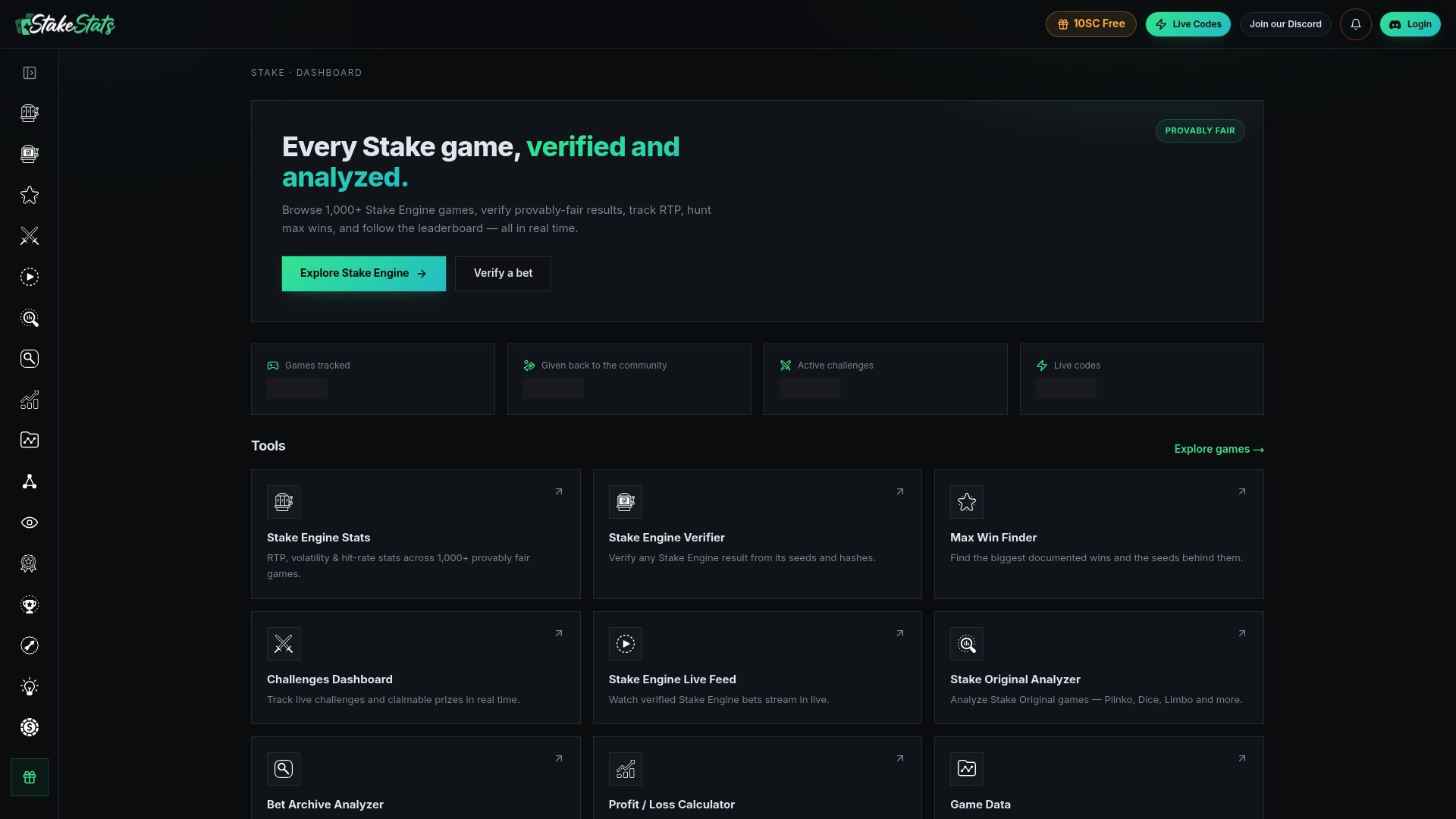
The toolset covers the parts of verification that take the longest manually:
- Quick event search through the bet archive when a round has dropped out of your in-game history
- Payout multiplier cross checks against stored round data
- Plain-English breakdowns of provably-fair verification that connect a replay's state back to its seed and nonce
If you've ever spent ten minutes hunting for a single event ID, start with the Stake tools page and search from there instead.
Where to Read More
- replay wiki on GitHub for the full parameter and response reference
- furic/stake-engine-client for the SDK helpers behind replay detection
- The Stake community for UI specific tips when a platform layout changes
Frequently Asked Questions
Is stake bet replay the same as rebetting? No. Replay shows a stored past round exactly as it happened. Rebet places an entirely new wager, often at different odds, so the outcomes are never guaranteed to match.
How far back can I replay a round? It depends on the platform's retention window. Community reports point to roughly the last 1,000 rounds staying accessible through standard game history, though older rounds may need a bet archive lookup instead.
Why does a replay link say the bet wasn't found?
Usually one of the URL parameters, game, version, mode, or event, doesn't match the stored round exactly, or the round came from an instant-bet mode that doesn't retain full state.
Do I need to be logged in to view a shared replay? Generally no. Replay endpoints are typically read-only and don't require authentication, which is part of what makes them safe to share publicly.
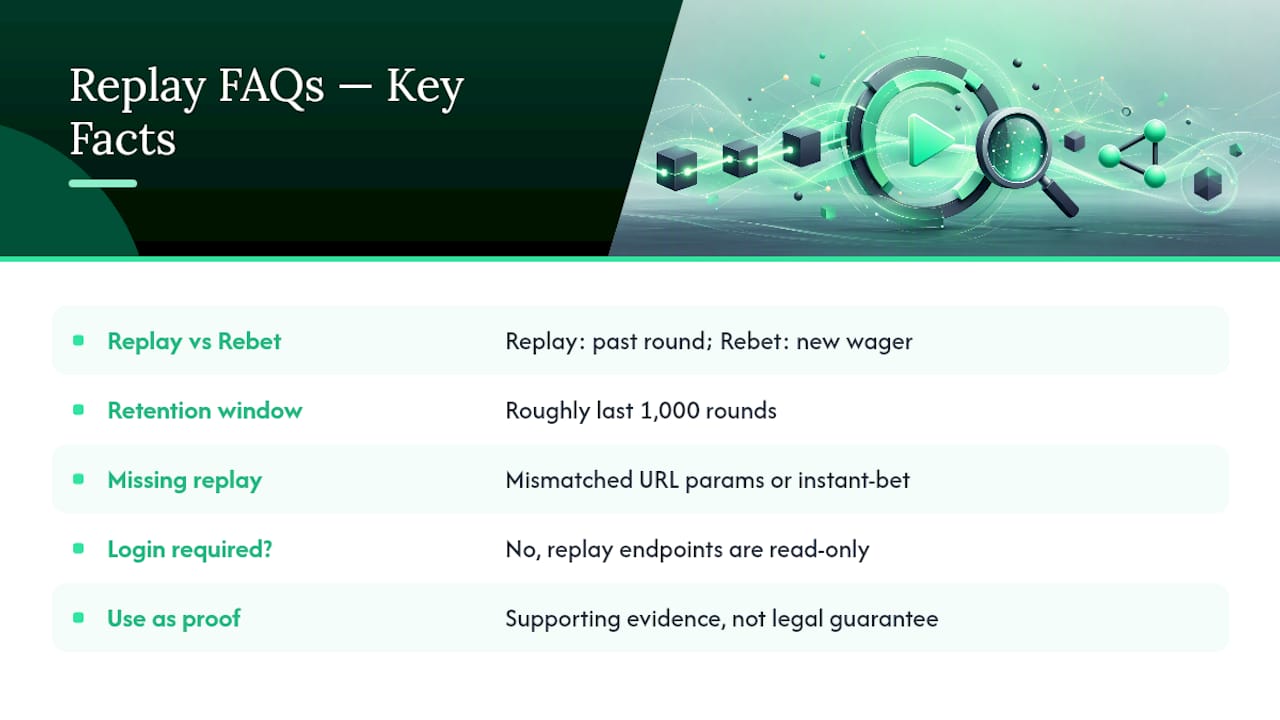
Can I use a replay as proof in a dispute? It's strong supporting evidence, but treat it as read-only documentation rather than a legal guarantee. Check the operator's own terms for how disputes are formally resolved.