
Stake Hit Rate List: What It Shows and How to Read It

A Stake hit rate list ranks games by how often a round pays anything at all. It does not rank them by how much they pay, and it does not predict your next bet. Read it next to RTP and volatility, check how many rounds sit behind each number, and you get a useful picture of how a game will feel to play. Read it alone and it misleads.
This guide explains what the figures mean, how they are calculated, where they come from, and how to confirm results yourself with provably fair tools.
TL;DR
- Hit rate (also called hit frequency) is the share of rounds that return any payout, including payouts smaller than your bet.
- It is separate from RTP, which measures the share of total stakes returned over the long run, and from volatility, which measures how widely results swing.
- Theoretical hit rates come from math, such as Crash odds. Observed hit rates come from real rounds, and they only settle down after thousands of them.
- A high hit rate does not predict or guarantee a win on your next round.
- You can check individual Stake results with the server seed, client seed and nonce, and see live game stats on our Stake Engine stats page.
Table of Contents
- What a Stake hit rate list actually measures
- A hit is not a profit
- Hit rate vs RTP vs volatility vs house edge
- How hit rates are calculated
- How many rounds you need before a hit rate means anything
- Do hit rates predict your next round?
- How to verify a Stake round yourself
- Reading a hit rate list: a checklist
- Using hit rate to choose a game and manage a bankroll
- See live hit rate, RTP and volatility stats
- Legal note for US players
- FAQ
- Sources
What a Stake hit rate list actually measures
A hit rate list answers one question: out of every 100 rounds, how many return something? A game with a 30% hit rate pays on roughly 3 rounds in 10 and returns nothing on the other 7.
Hit frequency is the probability that a slot produces any winning outcome on a single spin, and some provider documents and info panels call it hit rate. The same idea applies to Originals such as Crash, Dice or Limbo, where "a hit" means reaching your chosen target.
There are two kinds of figure, and a good list tells you which one you are looking at:
- Theoretical hit rate. Calculated from the game's math model or published odds. It describes the long-run expectation and does not change from week to week.
- Observed hit rate. Counted from real rounds played over a period. It moves around, and the fewer rounds behind it, the more it moves.
When you see two lists disagree, the cause is usually this split, a different sample, or a different definition of a "hit". Always look for the sample size and the date range next to the number.
A hit is not a profit
The most common misreading is treating a hit as a win in the everyday sense. A hit counts any payout, even one below your stake. If you bet $1 and the game returns $0.40, the spin counts as a hit, but you are still $0.60 down.
Hit frequency also does not distinguish between win sizes: a 0.5x return counts exactly the same as a 100x return. Two games can both show a 30% hit rate while one pays mostly small refunds and the other pays rarely but heavily. That difference is volatility, and it is why a hit rate list is a starting point, not a verdict.

Hit rate vs RTP vs volatility vs house edge
These four numbers describe different things. Here is how they fit together.
| Metric | What it answers | What it ignores |
|---|---|---|
| Hit rate | How often does a round pay anything? | The size of the payouts |
| RTP | How much of total stakes comes back over the long run? | How that return is spread across rounds |
| House edge | What share of stakes the game keeps (100% minus RTP) | Short-term swings |
| Volatility | How widely do results swing around the average? | Frequency of any single win |
A 25% hit frequency does not mean 25% of your money comes back. RTP measures the proportion of total stakes returned over the long run, while hit frequency measures the proportion of spins that return anything. The two are independent.
Volatility is the link between them. High volatility means long dry spells and rare but larger spikes, while low volatility means frequent small hits and gentler curves. So the same RTP can come with a high hit rate and small wins, or a low hit rate and big ones.
A quick way to combine them
- Check the hit rate to see how often you will get a return.
- Check volatility to see how big and how uneven those returns tend to be.
- Check RTP to see what the game returns over the very long run.
- Match the combination to your bankroll and the length of session you plan.
A player with a small bankroll and a long session usually wants a higher hit rate and lower volatility, because the balance moves less. A player chasing a rare large multiplier accepts a low hit rate and long losing runs as the price.
How hit rates are calculated
Crash and target-based games
In Crash-style games the hit rate is a clean formula. The approximate hit probability is (1 minus house edge) divided by the target multiplier. With a published 1.00% house edge, a 2.00x target has a 49.50% hit probability, a 10x target has 9.90%, and a 100x target has 0.99%.
| Target multiplier | Hit probability at 1.00% house edge |
|---|---|
| 2x | 49.50% |
| 10x | 9.90% |
| 100x | 0.99% |
The pattern is the one to remember: a lower target wins more often but pays less each time, and a higher target wins rarely but pays more, with the expected return still anchored by the house edge. That is why "which target has the best hit rate" is the wrong question. Every target returns the same expected share. You are choosing how the return arrives.
Slots and Stake Engine games
Slots do not have a one-line formula. Hit frequency comes from the game's full math model, and players usually see it as a count: rounds that paid divided by rounds played. That is where sample size starts to matter.
How many rounds you need before a hit rate means anything

Observed hit rates are estimates. The standard sample-size formula for a proportion is n = z² × p × (1 − p) ÷ e², where z is 1.96 for 95% confidence, p is the hit rate and e is the margin of error you can accept.
Worked through for a 95% confidence level:
- True hit rate near 30%, error of about ±2 percentage points: roughly 2,000 rounds.
- Same hit rate, error of about ±1 point: roughly 8,000 rounds.
- Hit rate unknown (using the most cautious assumption of 50%): about 2,400 rounds for ±2 points and about 9,600 for ±1 point.
These match the figures a slot sample-size write-up gives for the same inputs.
What this means in practice:
- A hit rate built from 200 rounds can be off by many points. Treat it as a rumor.
- Your own 100-round session tells you almost nothing about the game's true hit rate.
- Rare-event games need far more rounds. A 0.99% outcome shows up about once in 100 rounds on average, so a few hundred rounds can easily show none or several.
When you read any list, look for three things: the number of rounds behind each row, the period it covers, and whether the figure is theoretical or observed.
Do hit rates predict your next round?
No. Each round of a provably fair game is generated independently from the seeds and nonce, so earlier results do not change the odds of the next one. A game that has not hit for 40 rounds is not "due", and a game on a hot streak is not about to cool off because of that streak.
A hit rate describes frequency over many rounds. It cannot tell you what happens in round 41, and it cannot guarantee a win in any session. The same goes for RTP: it is a long-run average spread over huge numbers of rounds, not a promise to any single player.
What a hit rate list can do is set expectations. If a game shows a 15% hit rate, plan for most rounds returning nothing. If you are surprised by a losing run, the list should have told you to expect one.
How to verify a Stake round yourself
Hit rates are only as trustworthy as the rounds behind them. Provably fair games let you recompute any single result, so you do not have to take a figure on faith.
On Stake.us, the help center steps are:
- Open the game ID of the round you want to verify.
- Get the server seed, client seed and nonce.
- Enter them into the verifier on Stake or a third-party verifier.
- Compare the result it shows with the result you got.
Two details trip people up. You need the actual server seed, not its hash, and it is only revealed after you rotate the seed pair. Before you play, you are given an encrypted hash of the server seed, which is generated as a random 64-character hex string. Once you reveal the seed, you can confirm it matches the hash you saw earlier, which shows the seed was not changed after you bet.
The system uses HMAC_SHA256 with the server seed, client seed, nonce and cursor as inputs to produce each result. You can run the same check with our own tools: the bet verifier handles seed and nonce checks, and the Stake Engine verifier covers Stake Engine games. If you want the background first, our provably fair explanation walks through the logic.
Reading a hit rate list: a checklist
Before you act on any list, run through these points:
- Source of the figure. Theoretical, or counted from rounds?
- Sample size. Thousands of rounds, or a handful?
- Date range. A list from one week and one from one year answer different questions.
- Definition of a hit. Any payout, or a payout above your stake? Some lists use the second definition, and the numbers differ a lot.
- Paired metrics. Is RTP and volatility shown beside it?
- Game version. The same title can ship with different RTP settings in different places.
A list that hides these details is hard to use. A list that shows them lets you compare games fairly.
Using hit rate to choose a game and manage a bankroll
Hit rate is most useful for matching a game to how you want a session to feel.
- Longer, steadier sessions. Look for higher hit rates paired with lower volatility. Your balance moves in smaller steps.
- Chasing big multipliers. Accept low hit rates and plan a bankroll that survives long dry runs. Size your bets so a losing streak does not end the session in minutes.
- Target-based games. Pick a target with a hit probability you are comfortable with, knowing the expected return is the same at each one.
The bankroll side matters as much as the game side. Our bankroll analyzer helps you test how bet size relates to the swings a game can produce. Set a budget you can afford to lose before you start, and treat any winnings as a bonus rather than income.
Our perspective
We built Stakestats because a single headline number never tells you how a game behaves. A hit rate on its own sounds reassuring, since who wouldn't want a game that pays often? But a game can pay often and still drain a balance, because hit rate says nothing about the size of what comes back.
That is why we show hit rate, RTP and volatility side by side for 2,500+ Stake Engine games, and why we tie the numbers to provably fair verification. A statistic you cannot check is just a claim. When you can take the server seed, client seed and nonce and recompute a round yourself, the whole picture gets more honest.
Our advice is simple: use hit rate to set expectations, not to forecast. Look at the sample, look at the date, check the paired metrics, and verify a few of your own rounds so you know what the numbers describe. Players who do this make calmer choices and manage their bankrolls better.
Ian
See live hit rate, RTP and volatility stats
If you want the numbers rather than the theory, our Stake Engine stats page lists real-time RTP, volatility and hit rate for 2,500+ Stake Engine games. Pair it with the win finder for max win and bet replay lookups, and with the Stake Originals Analyzer for Originals.
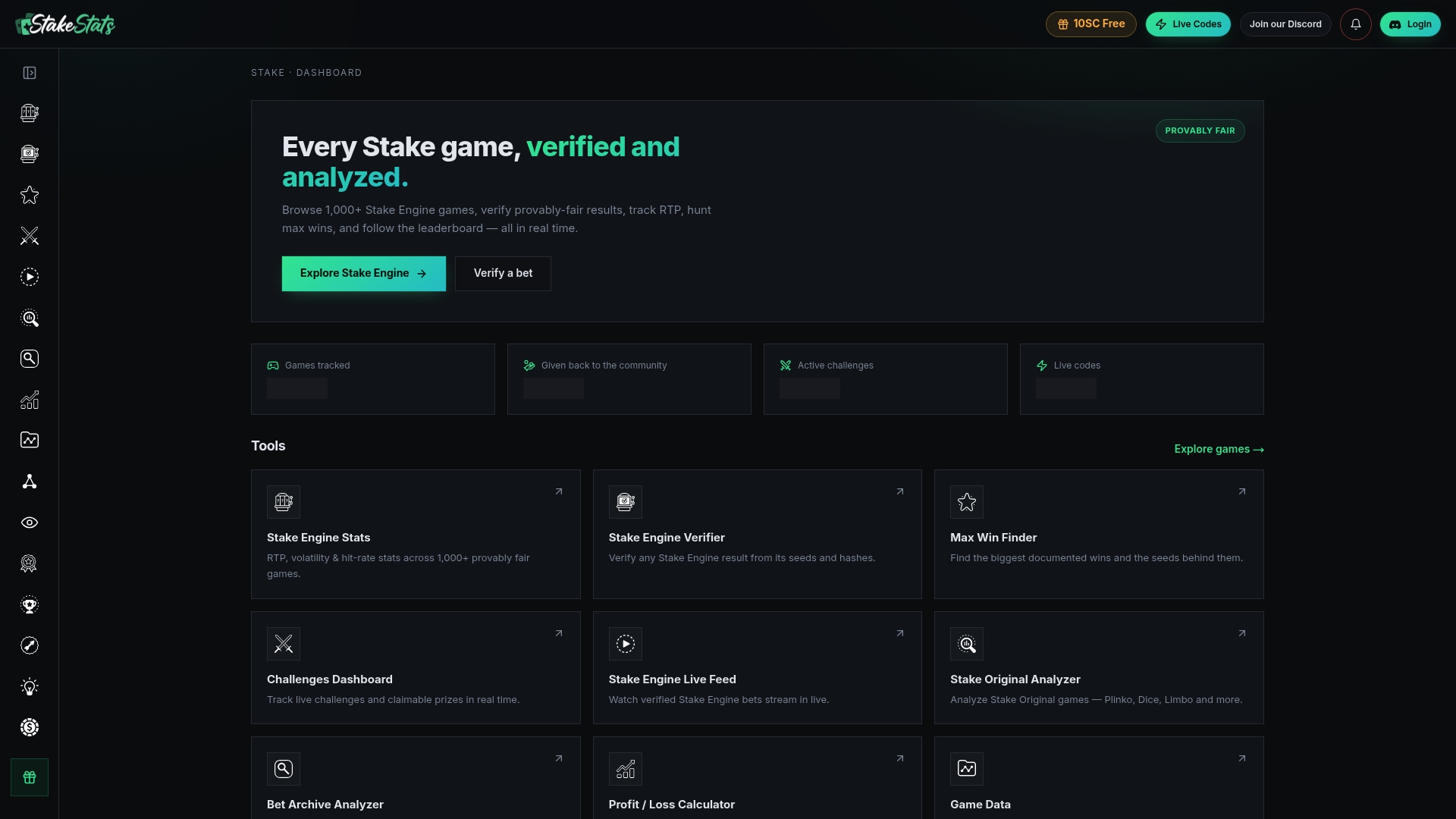
Start at Stakestats, pick a game, and check its hit rate, RTP and volatility together before you place a bet.
Legal note for US players
Availability depends on where you live, so check before you sign up anywhere. Stake.com is not available to players in the United States, and accessing it from within the US violates the platform's terms of service. Stake.us is the US-facing site, and its state coverage is limited. Published counts differ: one review put it at about 36 states as of March 2026, while another lists 22 restricted states, including California, New York, Washington, Michigan and Nevada.
Because the list changes, confirm your state on Stake.us's own terms before you play. You must also be of legal age in your state. If gambling stops being fun, call the National Problem Gambling Helpline at 1-800-GAMBLER.
FAQ
What is a good hit rate on Stake?
There is no single good number. A higher hit rate means you get returns more often, but each one may be small. Judge it alongside RTP and volatility, and choose the combination that fits your bankroll and session length.
Is hit rate the same as win rate?
Not quite. Hit rate counts any payout, including ones below your bet, so a round can be a hit and still lose you money. Win rate, as most players use it, means rounds where you finished ahead. Always check how a list defines a hit.
Are Stake hit rate lists theoretical or observed?
Both kinds exist. Theoretical figures come from the math, such as the Crash formula of (1 minus house edge) divided by the target. Observed figures are counted from real rounds and need thousands of them to be stable. A trustworthy list says which one it shows.
Can a hit rate guarantee I will win?
No. Each round is independent, so past results do not change the next outcome. A hit rate tells you how often to expect a return over many rounds, not what happens in your session.
Can I verify a Stake result myself?
Yes. Take the game ID, then the revealed server seed, client seed and nonce, and enter them into a verifier. You need the unhashed server seed, which appears after you rotate your seed pair. Our verification tool runs the check for you.
Sources
- Hit Frequency Explained
- What Is Hit Frequency, and Why Does It Matter More Than RTP
- Slot Hit Frequency Explained 2026
- Gambling Math Explained: RTP, Hit Rate, Odds & Volatility
- Stake Crash Odds: House Edge and Probability
- Verifying game results | Stake Help Center
- Provably Fair Implementation - Stake.us
- Stake Review 2026: Odds, Bonuses & App Rating
- How Stake.us Works in 2026