
Stake Max Win: How It Works and How to Verify It

A Stake max win is the highest possible payout a game can produce in a single round, calculated as the game's advertised multiplier ceiling multiplied by your base stake, or capped at a platform-imposed cash limit when one applies. Stake Mines, for example, carries a theoretical ceiling of 5,148,297×, meaning a $1 bet could theoretically return over $5 million. Common slot ceilings on Stake run closer to 21,100× or 25,000×. None of these are frequent. The probability of hitting Stake Mines' ceiling is extremely small, and most players will never see a ceiling-level event in their lifetime of play. Before you share or celebrate any reported max win, Stakestats' provably-fair verification tools let you check the server seed and nonce to confirm whether the result is real.
Key Takeaways
A Stake max win is the game's multiplier ceiling multiplied by your base stake, and hitting one at the extreme end of the range is statistically near-impossible for most players in any realistic session.
| Point | Details |
|---|---|
| Max win definition | Ceiling multiplier × base stake, or the platform cash cap if lower, whichever the game enforces. |
| Rarity at extreme ceilings | Stake Mines' ceiling probability is roughly 0.0000194% per round; most players will never see a ceiling event. |
| Max-bet myth | Bet size changes payout value, not RNG probability; max bet only matters for jackpot eligibility or paytable tier access in specific games. |
| Verification workflow | Grab the transaction ID, check the game ceiling on Stake, then run a server-seed/nonce replay via Stakestats to confirm or refute the claim. |
| Stakestats tools | The Stakestats provably-fair checker and game info pages cover 2,500+ Stake Engine titles and take about two minutes to run a full verification. |
Table of Contents
- What "max win" actually means on Stake and how game caps work
- Notable reported max-win examples on Stake
- How unlikely is a max win? Probability intuition without the algebra
- Does betting max change your odds? Clearing up the max-bet myth
- Which Stake games tend to produce the largest multipliers?
- How to verify a reported max win on Stake using provably-fair data
- Practical responsible-play guidance when chasing big multipliers
- Why verification matters more than the win itself
- Stakestats gives you the tools to check before you share
- Sources
What "max win" actually means on Stake and how game caps work
The phrase "max win" covers two distinct things, and mixing them up leads to bad decisions.
The max-win multiplier is the ceiling the game provider publishes: the largest multiplier the math model can produce in a single round. Multiply that ceiling by your base stake and you get the theoretical top payout. A 21,100× ceiling on a $0.20 spin equals a $4,220 max payout; the same ceiling math applies at any stake size, scaling linearly. The ceiling is a property of the game's probability distribution, not a target the game is trying to reach.
The cash cap is different. Stake, like most operators, can impose a site-level payout limit that overrides the multiplier math. If a game's ceiling would pay $500,000 on a given stake but the platform cap is $100,000, you receive $100,000. That cap is not always displayed prominently, so you need to check two places:
- The in-game info panel (the "i" icon on most Stake titles) for the provider's stated multiplier ceiling
- Stake's game pages for any platform-imposed cash-cap disclosures
- The bonus terms if you are playing with a promotional balance, since bonus caps are often lower than cash caps
Pro Tip: *The multiplier ceiling is a statistical horizon, not a promise. Even at provider scale, where millions of rounds are played daily, ceiling events are rare.
Notable reported max-win examples on Stake
The table below lists documented or widely-cited examples. "Reported" means the claim comes from a screenshot, forum post, or media article without a confirmed transaction ID or provably fair replay. "Verified" means a server-seed/nonce check or transaction log has been cross-referenced.
| Game | Reported multiplier / payout | Source type | Verification status |
|---|---|---|---|
| Stake Mines | 5,148,000× (theoretical ceiling) | Provider math / PlayOnStake | Reported ceiling; individual hits unverified |
| Sweet Bonanza | Up to ~21,100× ceiling | Provider game info | Reported ceiling; community claims vary |
| Crash | Varies; community reports of 1,000×+ | Stake community / Reddit | Reported; provably-fair replay available |
| Plinko | High-row multipliers up to thousands× | Forum anecdotes | Reported; replay checkable |
| Video Poker | Royal flush pays fixed odds (800× max on Jacks or Better) | Provider paytable | Verifiable via paytable math |
The Stake community forum thread "Just how unlikely is a maxwin?" is one of the better public records of player-reported ceiling events, with users posting screenshots and debating probability. Deadspin's Stake.us big-wins roundup adds media-reported context for large payouts across game types on the US-facing platform.
A word of caution: community screenshots are useful starting points, not proof. Timestamps can be edited, currency displays can be cropped, and a missing transaction ID is a red flag. Treat every forum claim as "reported" until a provably-fair replay confirms it.
How unlikely is a max win? Probability intuition without the algebra
The short answer: extremely unlikely for high-ceiling games, and the math gets brutal fast.
Here is a practical way to think through the odds without writing a single equation:
- Find the '1 in X' frequency. Game providers or third-party explainers often publish this. CasinoWizard's max-win probability explainer shows how these odds range from roughly 1 in a few hundred thousand for modest ceilings to 1 in tens of millions for extreme ones.
- Estimate your session size. A typical session might be 500 to 1,000 spins. A dedicated grinder might log 10,000 spins in a month.
- Apply binomial logic. If the ceiling hits 1 in 2,500,000 spins, your chance of seeing it at least once across 10,000 spins is roughly 0.4%. That is not zero, but it is close. The GamblingCalc probability calculator does this conversion automatically: paste in the frequency and session size and it returns your session-level chance using binomial distribution.
- Scale to reality. Stake Mines' ceiling probability of approximately 0.0000194% per round means you would need to play an enormous number of rounds before a ceiling hit becomes statistically likely. Even at 1,000 rounds a day, that is a multi-decade proposition.
Statistic callout: A ceiling frequency of 1 in 2,500,000 rounds translates to roughly a 0.4% chance of hitting it at least once across 10,000 rounds. Most players never reach 10,000 rounds on a single game, which means the realistic session chance for extreme ceilings is effectively near zero for the vast majority of players.
Pro Tip: If you want a realistic shot at a large multiplier event (not necessarily the ceiling), size your bankroll to survive at least 200–500 rounds at your chosen stake. The Stakestats bankroll analyzer can simulate session survival at different stake levels and volatility profiles, so you can see how quickly variance depletes a fixed bankroll before a big event arrives.
Does betting max change your odds? Clearing up the max-bet myth
No. Bet size does not change the RNG outcome probability on provably-fair games. It changes the dollar value of every outcome and, in some games, unlocks specific paytable tiers or jackpot eligibility.
The RNG on Stake's provably-fair engine generates a result independently of how much you wagered. A 1,000× multiplier event has the same probability whether your stake is $0.10 or $100. What changes is the cash value: $0.10 × 1,000 = $100 vs. $100 × 1,000 = $100,000. That is a payout difference, not a probability difference.
Where max bet does matter is narrower than most players assume:
- Jackpot eligibility. Some games require a minimum or maximum bet to qualify for a progressive jackpot or a specific bonus tier. If you are below that threshold, you are excluded from those outcomes regardless of how long you play.
- Paytable tier unlocks. A handful of slots scale certain paytable lines or multiplier caps with bet denomination. Playing below the threshold locks you out of the top paytable row.
The WizardOfVegas forum thread on jackpot odds and bet size captures this nuance well: the community consensus is that the RNG is not influenced by bet size, but paytable structure can create situations where a lower bet genuinely excludes you from certain outcomes. That is a feature design choice, not a probability manipulation. On most Stake Engine titles, no such restriction exists, and the ceiling multiplier applies equally at any stake.
Which Stake games tend to produce the largest multipliers?
High ceilings cluster around specific mechanics. The game type matters more than the title name.
| Game / category | Typical ceiling range | Key mechanic driving the ceiling |
|---|---|---|
| Stake Mines | Up to 5,148,000× | Grid-based risk escalation; more mines = higher multiplier |
| Crash | Theoretically unbounded; community reports of 1,000×+ | Multiplier grows until crash; player cashes out or loses |
| Buy-bonus high-volatility slots (e.g., Sweet Bonanza 1000) | 21,100× (Sweet Bonanza); higher on 1000 variant | Cascade multipliers, bonus buy, multiplier stacks |
| Plinko | Hundreds to thousands× on extreme rows | Ball path probability; high-row pegs carry extreme multipliers |
| Video Poker (e.g., Jacks or Better) | ~800× on royal flush | Fixed paytable; low ceiling but high hit frequency vs. slots |
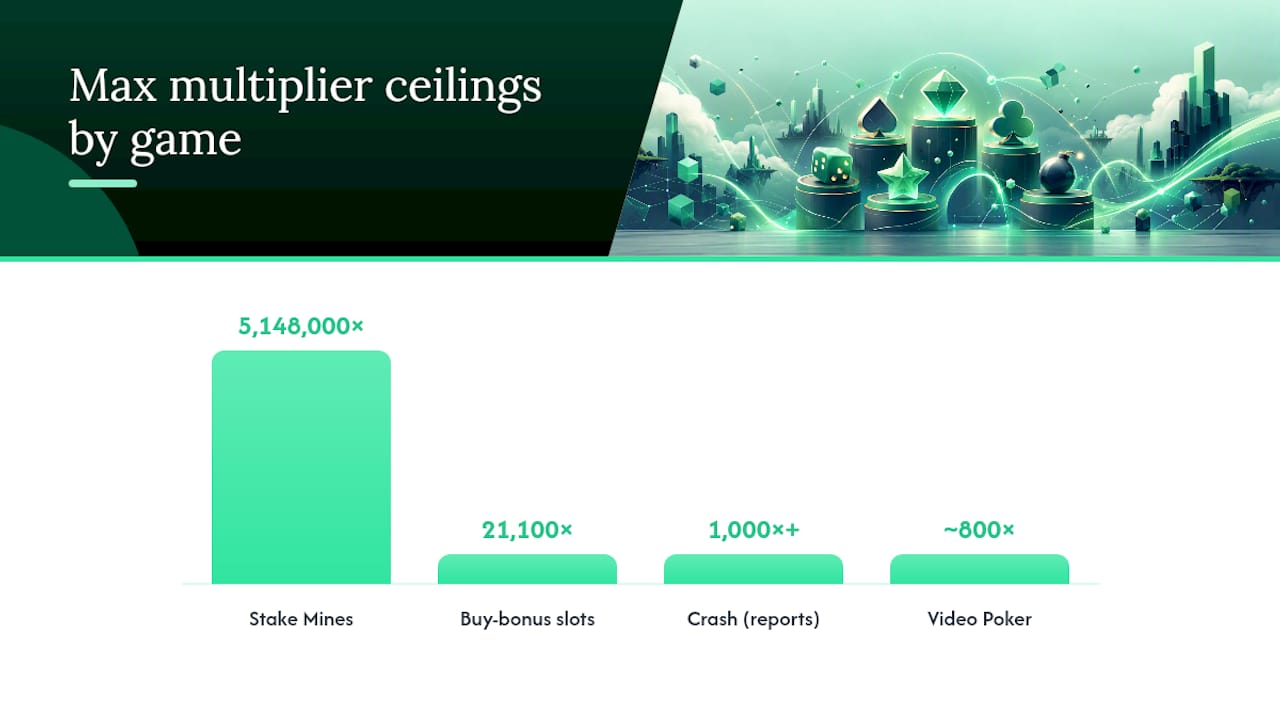
Sweet Bonanza and its 1000× variant are among the most-discussed titles for ceiling chasing on Stake, largely because the bonus-buy mechanic lets players skip straight to the feature round. That convenience comes at a cost: bonus buys are expensive relative to base-game spins, and the ceiling is still a rare tail event even inside the bonus. CasinoWizard's ceiling explainer notes that max-win odds vary from hundreds of thousands to hundreds of millions of rounds depending on the title, and buy-bonus slots sit toward the harder end of that range.
Crash and Plinko are Stake Originals, meaning they run on Stake's own provably-fair engine. That makes them fully verifiable via server-seed/nonce replay, which is a meaningful advantage over third-party slots when you want to confirm a reported result.
How to verify a reported max win on Stake using provably-fair data
You can often confirm or refute a reported max-win claim using the game info panel, transaction logs, and a provably-fair server-seed/nonce check. Here is a reproducible workflow.

Step 1: Gather the claim details. Ask for or locate the screenshot, the transaction ID (visible in the bet history on Stake), the game name, and the stake amount. A claim without a transaction ID is unverifiable from the start.
Step 2: Check the game ceiling and cash cap. Open the game's info panel on Stake and confirm the advertised max multiplier. Cross-reference with Stakestats' game info pages to see whether the claimed payout is even within the game's possible range. A claimed 50,000× on a game with a 21,100× ceiling is mathematically impossible.
Step 3: Run the provably-fair replay. On Stake, navigate to the bet in your history, click "Verify," and enter the server seed, client seed, and nonce. The replay reproduces the exact outcome. Stakestats' provably-fair explanation tool walks through the seed/nonce logic and lets you cross-check the result independently.
Step 4: Cross-check the payout in transaction logs. The transaction log on Stake shows the exact credit applied to the account. If the screenshot shows a $500,000 win but the transaction log shows $100,000, a cash cap was applied, or the screenshot was altered.
Red flags to watch for:
- Missing or refused transaction ID
- Timestamp inconsistencies between the screenshot and the claimed date
- Currency or denomination mismatches (a $0.01 stake producing a six-figure payout that exceeds any known cash cap)
- Multiplier claims that exceed the game's published ceiling
Community screenshots and forum logs are where most big-win claims surface first. They are useful as leads, but a server-seed/nonce replay is the difference between an anecdote and a confirmed result.
Practical responsible-play guidance when chasing big multipliers
Chasing ceiling wins is high-variance play and should represent only a small fraction of a funded bankroll, not a primary strategy.
Five concrete practices worth keeping:
- Set a hard session loss limit before you start. Decide the maximum you will lose in one session and treat it as a stop, not a suggestion. Variance on high-ceiling games can drain a bankroll in dozens of spins.
- Size bonus buys carefully. A bonus buy on Sweet Bonanza 1000 can cost 100× the base stake. Buying repeatedly to chase a ceiling event is one of the fastest ways to exhaust a bankroll, since the ceiling probability does not improve with each purchase.
- Never play on credit or borrowed funds. High-volatility ceiling chasing amplifies losses. Playing money you cannot afford to lose turns a bad session into a financial problem.
- Use the Stakestats VIP tool and bankroll analyzer to understand how your current stake level and session length interact with variance before you commit to a high-ceiling game.
- Step back after large swings in either direction. A big win can trigger the same chase behavior as a big loss. Both are moments to pause, not accelerate.
For US-based players who feel their gambling is becoming a problem, the National Council on Problem Gambling helpline (1-800-522-4700) operates 24/7 and connects callers to local resources. Self-exclusion programs are available through individual state gaming commissions and directly through Stake.us.
Why verification matters more than the win itself
Most big-win content online is built around the thrill of the number. Stakestats is built around whether the number is real.
Provably-fair verification exists precisely because a screenshot proves nothing on its own. When a player posts a claimed 5,000× win on Stake, the community has two choices: take it at face value or check the seed. Stakestats' tools make the second option accessible to anyone, not just developers. That matters because misinformation about max wins distorts how other players assess risk. If a 5,000× hit looks routine in a forum thread, players may underestimate how rare it actually is and size their bankroll accordingly, which is a fast path to ruin.
Verification also protects the player who did hit a legitimate big win. A confirmed server-seed replay is far more credible than a screenshot when disputing a payout or sharing a result publicly.
Stakestats gives you the tools to check before you share
Most players who hit a big number on Stake want to share it immediately. The smarter move is to verify it first, because a confirmed win carries weight that a screenshot never will.

Stakestats can verify server-seed/nonce replays, display max-win ceilings for 2,500+ Stake Engine games, and surface transaction replays to confirm whether a reported payout matches the game's math. The workflow takes about two minutes: grab the transaction ID from your Stake bet history, paste it into the Stakestats provably-fair checker, and the tool reconstructs the round from the seed and nonce. If the result matches the claim, you have confirmation. If it does not, you have your answer before the screenshot goes viral.
For a broader look at game ceilings, RTP, and volatility stats across Stake's full library, the Stakestats Stake overview is the starting point. Run the check, then share the result.
Sources
- Stake Mines Calculator - Multiplier, Payout Chart & Strategy
- Slot Max Win Probability Calculator: Calculate Your Jackpot Odds
- Casinowizard
- Max-win ceiling explained: what the 21,100× and 25,000× numbers actually mean
- Stake
- What Are the Biggest Wins on Stake.us?
This article is general information about how max-win mechanics work on Stake and is not financial or gambling advice. Gambling involves real financial risk. Confirm current platform rules directly with Stake, and contact the National Council on Problem Gambling (1-800-522-4700) if you need support.