
Recompute Any Stake Provably Fair Round With a Copy Ready Checklist

Stake's provably fair system lets players verify a round by comparing a published hash to a later seed reveal, enabling independent recomputation of the result. In plain terms: Stake commits to a secret server seed before you bet, reveals it afterward, and you (or a tool) recompute the outcome to confirm it matches. Both the built-in verifier and third-party calculators can run this check in seconds.
TL;DR:
- Verifying a round requires the revealed server seed, client seed, and nonce, and must match the initial seed hash before recomputation.
- Third-party tools, including Stake Engine and Stakestats, facilitate bulk verification and provide detailed probability tables for transparency.
- Proper verification confirms the seed was committed to before the bet but does not guarantee long-term fairness or validate the platform’s overall trustworthiness.
- Most failed checks stem from input errors, such as using the hashed seed instead of the revealed seed or incorrect nonce, not from actual fairness issues.
- Regularly saving verification data before disputes enhances confidence and provides stronger evidence during any conflict or review.
Table of Contents
- How Does Stake's Provably Fair System Actually Work?
- How Do I Verify a Stake Round Myself?
- Which Verification Tools Should You Use?
- What Provably Fair Does Not Prove
- Why Did My Verification Fail? Common Errors and Fixes
- How Does Stake Compare to Other Provably Fair Platforms?
- How Did Provably Fair Systems Develop and Spread?
- What Myths Get Repeated About Provably Fair Systems?
- Is Provably Fair Gambling Legal and Regulated?
- What Does Provably Fair Mean for Player Trust in Gambling?
- Why Verification Should Be a Habit, Not a One-Time Check
- Run Your Own Verification With Stakestats
- Sources
How Does Stake's Provably Fair System Actually Work?
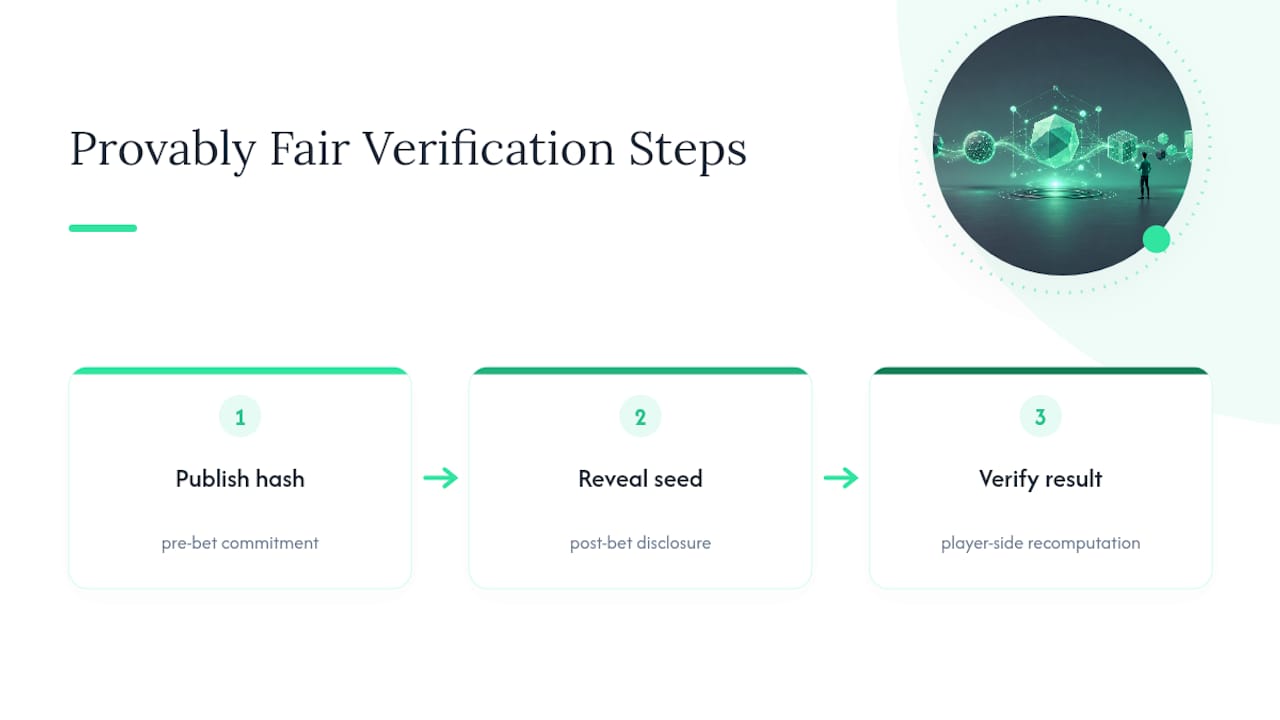
The mechanism behind stake provably fair verification is a cryptographic trick called commit-reveal. Before a round starts, Stake generates a secret server seed and publishes only its hash, a scrambled fingerprint that reveals nothing about the original value but proves the seed already existed. That's the "commitment." After the round resolves, Stake reveals the actual unhashed server seed. If you hash that revealed seed yourself and it matches the hash published earlier, you've proven the operator didn't quietly swap seeds after seeing your bet. This is the same logic European Gaming describes as the backbone of provably fair systems industry-wide: publish first, reveal later, let anyone recompute.
The actual outcome of a bet doesn't come from the server seed alone. Three inputs combine through a hash function, typically HMAC-SHA256, to produce the result:
- Server seed: the operator's secret value, hashed and published before play, revealed after.
- Client seed: a value you control, often editable in your account settings, which stops the operator from being the sole source of randomness.
- Nonce: a counter that increments with every bet, ensuring the same seed pair never produces the same output twice in a row.
Feed those three into the hash algorithm and outcomes a number that maps to your game's result. Chainlink's explainer on provably fair randomness breaks down why this combination matters: any single input on its own is guessable or replayable, but locking all three together, and only revealing the server seed after the fact, closes the loop.
Stake Engine adds another layer for its library of third-party-built games. It publishes math mode details, version numbers, and full result tables so anyone can check that the published probabilities actually match what a game produces over a large sample. That transparency matters more for volatility-heavy titles, where a single round tells you almost nothing about long-run behavior.
How Do I Verify a Stake Round Myself?
Verifying a round is mechanical once you know what to grab and where to paste it. Here's the sequence:
- Collect your bet details. Open the bet in your history and note the revealed server seed, your client seed, and the nonce for that specific wager.
- Confirm the hash match first. Take the revealed server seed, run it through SHA-256, and check it equals the hash Stake published before the round. If it doesn't match, stop. Something is wrong.
- Recompute the result. Feed the server seed, client seed, and nonce into the same hash/HMAC process the game uses, following the provably fair overview Stake publishes for the specific game type.
- Compare outputs. If your recomputed value lines up with the recorded outcome, the round checks out. A mismatch means either you made an input error or something needs escalating.
Stake displays the hashed server seed before the round and the revealed seed afterward directly in your account's fairness or bet details section, both of which you can copy manually. For faster checks across many rounds, a dedicated tool like the provably fair explanation checker on Stakestats does the recomputation for you instead of running the hash by hand.
Pro Tip: Before disputing a result, screenshot the seed hash, the revealed seed, and the nonce together with a timestamp. Support teams move faster when you hand them matched evidence instead of asking them to dig it up.
Which Verification Tools Should You Use?
Stake's built-in verifier handles the basics well: paste the seed, client seed, and nonce, and it recomputes the outcome for that single round. It's fine for spot-checking a big win or settling a quick doubt, but it wasn't built for bulk analysis.
For anything beyond one round at a time, Stake Engine's public interface publishes every possible result and its probability for a given game, plus support for checking across nonce ranges. That's the tool to reach for if you're validating cumulative return over hundreds of spins rather than a single bet.
Community-built verifiers exist too, usually open-source scripts that replicate the hash logic locally. Treat any third-party verifier the way you'd treat a browser extension: check that the source code is public, confirm it isn't phoning your seeds to a remote server, and prefer tools with visible history over anonymous one-off scripts.
Stakestats builds toward the same goal from a different angle. The Stake Originals Analyzer replays past rounds and surfaces the underlying data without you touching a hash function directly, useful when you want the answer, not the arithmetic.
What Provably Fair Does Not Prove
A matching hash confirms one thing precisely: the operator committed to that seed before your bet and didn't alter it afterward. It does not confirm that the game's overall math, its long-run return to player, is what the operator claims.
That distinction trips up a lot of players. Verification checks process integrity for a single round; it says nothing about the aggregate statistics that determine whether a game is generous or brutal over thousands of spins. Independent RNG certification and licensing, not seed verification, cover that ground.
A few other gaps worth knowing:
- Provably fair doesn't replace a gambling license or regulatory oversight of the operator's broader business practices.
- If a server seed leaks before reveal, or an operator manages seed generation poorly, the commitment itself can be undermined even though the math still checks out on paper.
- Successful verification proves one thing was not tampered with. It is a real signal of good faith, but it is one data point, not a full trust audit of the platform.
Why Did My Verification Fail? Common Errors and Fixes
Most failed verifications come down to one of three input mistakes, not an actual fairness problem.
- Using the hashed seed instead of the revealed seed. This is by far the most frequent error. The hash is the pre-round commitment; recomputation needs the unhashed seed revealed after the round, not the published hash.
- Wrong nonce. Grabbing the nonce from an adjacent bet instead of the exact round you're checking throws off the whole calculation.
- Wrong hash algorithm. Different games sometimes use different combination methods; confirm which one applies before assuming a mismatch means foul play.
Pro Tip: If a check fails, save the raw seed strings, the nonce, and the game version number exactly as displayed before reaching out to support. Vague descriptions slow down resolution; exact values speed it up.
How Does Stake Compare to Other Provably Fair Platforms?
Provably fair isn't unique to Stake, though implementations vary in transparency and usability. Most crypto-first casinos that offer it stick to the same commit-reveal skeleton: publish a hash, reveal a seed, let players recompute. Where platforms diverge is in how much they expose and how easy that exposure is to use.
Some operators bury the verification interface several menus deep or skip publishing result tables for third-party game studios entirely, leaving players to trust marketing copy instead of math. Others, including Stake through Stake Engine, publish math mode documentation and version-specific result tables alongside the standard seed and hash workflow, which matters most for games with complex payout structures like crash or plinko variants.
Provably fair also shows up outside traditional casino sites. Onchain games increasingly use Chainlink VRF, an oracle-based verifiable randomness service that supplies smart contracts with randomness nobody, including the game developer, can predict or manipulate in advance. It's a different technical path to a similar promise: prove the outcome wasn't rigged after the fact.
The practical takeaway for comparing platforms is simple. Look for a published hash before the bet, a seed reveal after, and a usable verification interface, whether built-in or third-party. If any of those three pieces is missing, you're trusting the operator's word rather than checking the math yourself.
How Did Provably Fair Systems Develop and Spread?
Provably fair mechanics grew out of the earliest Bitcoin dice sites in the early 2010s, when crypto-native gamblers wanted a way to trust a platform without trusting the platform's operators personally. The commit-reveal pattern wasn't invented for gambling, it's a standard cryptographic primitive, but gambling sites were among the first consumer products to put it in front of everyday users with a "verify this yourself" button.
Adoption spread as crypto casinos multiplied through the mid and late 2010s. What started as a niche feature for a handful of dice and crash games became close to table stakes for any platform marketing itself to a crypto-savvy audience. Games notes it remains most common on crypto-first platforms and in simple, verifiable formats like crash, dice, mines, and plinko, precisely the game types where the math is straightforward enough to expose without giving away a competitive edge.
Stake's own implementation, and later Stake Engine's expansion into publishing full result tables for third-party studio games, reflects the next stage of that evolution: moving from "trust our single-game math" to "here's every possible outcome and its probability, go check it." That's a meaningfully higher transparency bar than the original dice-site model, which typically offered verification without the underlying probability documentation.
Traditional online casinos, by contrast, have been slower to adopt anything resembling provably fair verification, largely because their regulatory model already routes trust through licensing bodies and third-party RNG certification rather than player-side cryptographic proof.
What Myths Get Repeated About Provably Fair Systems?
The biggest misconception is that provably fair means the odds are good. It doesn't. A game can be perfectly, verifiably fair and still carry a house edge steep enough to grind down any bankroll over time. Fairness describes the process; it says nothing about the payout structure.
A second myth: that a successful verification means you can predict future outcomes. You can't. The nonce increments and the client seed changes, so recomputing round 500 tells you nothing about round 501. Verification is retrospective by design, proof that a past round wasn't tampered with, not a forecasting tool.
Third, some players assume provably fair is exclusive to Stake or a handful of crypto casinos. It isn't. The underlying commit-reveal pattern is publicly documented cryptography that any platform can implement, and variations of it show up across the crypto gambling space and in onchain gaming through services like Chainlink VRF.
Finally, there's a belief that if verification passes, the operator is automatically trustworthy across the board. A matching hash proves one specific claim: that seed wasn't swapped after your bet. It says nothing about withdrawal practices, customer support quality, or whether the operator holds a legitimate license. Treat a passed check as one piece of evidence, not a full character reference for the platform.
Is Provably Fair Gambling Legal and Regulated?
Provably fair is a verification technique, not a legal status. Whether gambling on a platform that uses it is legal depends entirely on your jurisdiction's gambling laws and the operator's own licensing, not on whether the math is cryptographically checkable.
Regulators generally focus on licensing, anti-money-laundering controls, and player protection measures, areas where provably fair verification offers no coverage at all. A platform can run flawless commit-reveal cryptography and still operate without a license valid in your location, or without the consumer protections a regulated operator would be required to carry. Verifying a hash tells you nothing about whether the operator is legally permitted to accept your bet.
This is where the "not a substitute" point matters most. Independent RNG certification and licensing exist specifically to cover the ground provably fair doesn't reach: business practices, financial solvency, dispute resolution processes, and responsible gambling requirements. Players who want assurance on those fronts need to check licensing documentation directly rather than treating a passed cryptographic check as a stand-in for it.
Rules also vary sharply by country and even by state or region, so there's no single global answer to "is this legal." Anyone unsure of their local standing should check their own jurisdiction's gambling regulations directly rather than relying on a platform's marketing page or a forum thread.
What Does Provably Fair Mean for Player Trust in Gambling?
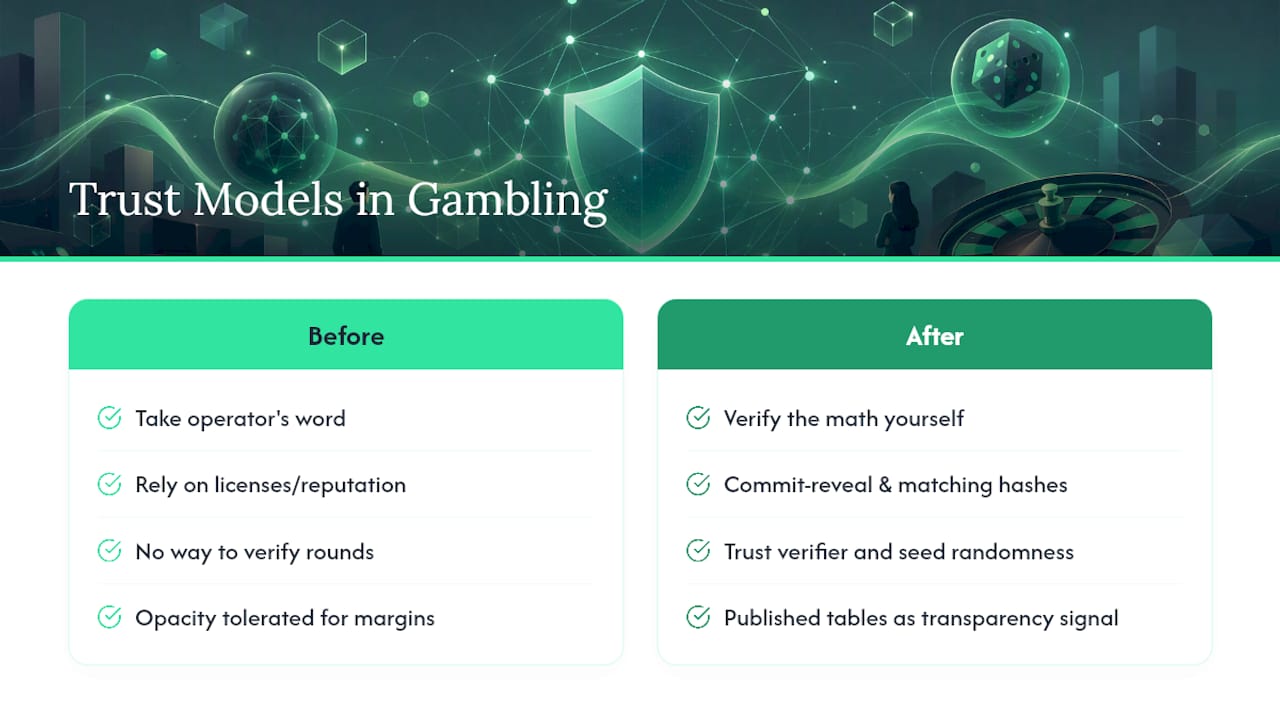
Provably fair shifted the trust conversation in online gambling from "take our word for it" to "check the math yourself." That's a genuine structural change, not just a marketing angle. Before commit-reveal verification became common, players had no independent way to confirm a single round wasn't altered after they placed a bet; they relied entirely on licensing bodies and reputation.
The shift hasn't eliminated the need for trust, it's relocated it. Players now need to trust that the operator's verifier is implemented honestly, that seed generation is genuinely random, and that the published result tables for Stake Engine games reflect the actual math running in production. Deep knowledge from Stake's own documentation notes that a matching hash proves commitment at the time of publication, but if seed generation is predictable or the surrounding business is unlicensed, the broader trust question stays open regardless of how clean the cryptography checks out.
For the industry, publishing verifiable data has become a competitive signal. Operators that expose seed hashes, result tables, and usable verifier tools are implicitly betting that transparency earns loyalty faster than opacity protects margins. Players increasingly treat the presence, or absence, of a working verifier as a screening filter before they deposit anywhere. Whether that screening effect changes actual behavior at scale, or just makes players feel more confident placing the same bets, is still an open question the industry hasn't fully answered.
Why Verification Should Be a Habit, Not a One-Time Check
Most players verify a round once, out of curiosity, then never think about it again. That's a missed opportunity. Verification earns its keep most during a dispute, when you need proof a big loss or a suspicious streak wasn't tampered with, and evidence gathered after the fact is always weaker than evidence saved in the moment.
Stakestats built its tools around that gap: verification for the technically curious, and analytics for anyone running bankroll checks across hundreds of nonces at once. Whether you're spot-checking a single crash round or reviewing cumulative RTP over a session, having the seed, hash, and nonce data organized before you need it, not scrambled together after a dispute, is what actually protects you.
— Ian
Run Your Own Verification With Stakestats
Stakestats gives you the tools to verify any Stake round without learning to hash anything by hand. The provably fair explanation tool walks you through matching a hash to a reveal and recomputing your outcome directly in the browser, no scripting knowledge required.
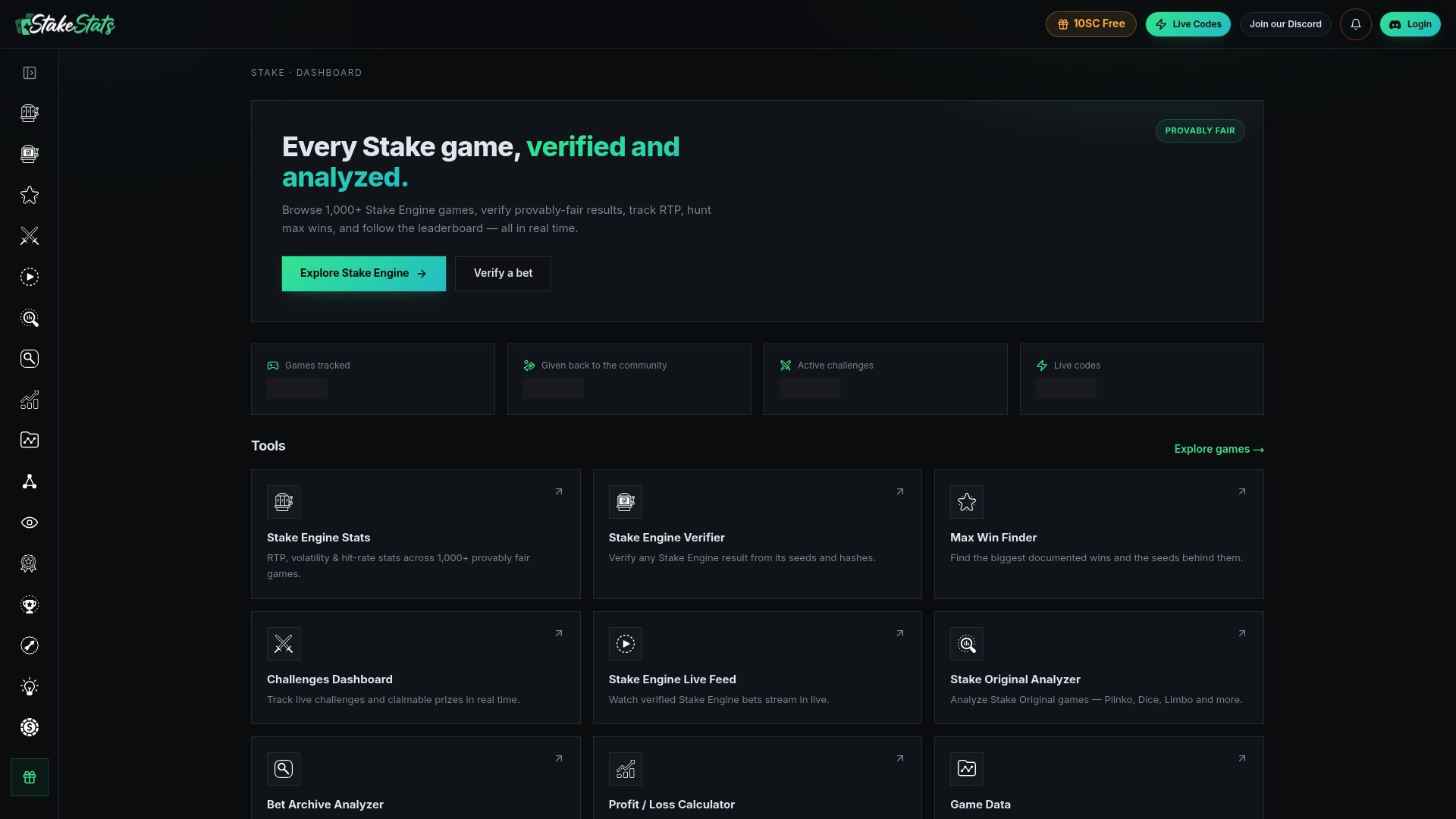
If you're checking a specific game session rather than a single bet, the Stake Originals Analyzer replays past rounds and surfaces the data behind them, which is faster than manually pulling seeds and nonces one bet at a time. Start with a round you already have questions about: grab the hash and revealed seed from your bet history, drop them into the verification tool, and see the recomputed result for yourself in under a minute.
Sources
- Provably fair gambling explained: How it works
- Provably fair randomness
- Provably Fair Overview - Stake
- Verifying game results - Stake Help