
Six Step Stake Session Analysis With Provably Fair Checks

Run a session audit by exporting your Stake bet archive or connecting a live tracker, then check session RTP, net profit/loss, and game-level stats before your next stake decision. Upload the archive to a tool like Stakestats' bankroll analyzer, confirm a handful of bets with provably fair verification, and use the resulting profit curve and drawdown numbers to set your stop rules. That is the whole workflow. Everything below explains how to do each step well.
TL;DR:
- Only verify at least three to five bets per session using the provably fair tool to ensure your data is trustworthy before analyzing overall metrics.
- A session's return to player can vary widely, so tracking multiple sessions helps distinguish random fluctuations from actual performance issues.
- Use drawdown data to set realistic stop-loss levels matching your worst historical losses, avoiding arbitrary thresholds, and rely on ROI to determine when to cash out.
- Live session tracking boosts discipline by providing real-time profit curves and RTP, but only if stop-loss, profit targets, and time limits are pre-set and adhered to.
- Regularly run comprehensive audits after each session, focusing on timestamp correctness and outcome verification, to maintain clean data and reliable analysis.
Table of Contents
- How Do I Import My Stake Bet History for Session Analysis?
- What Do Session Analysis Tools Actually Calculate?
- How Do You Read Session Metrics to Change Strategy?
- What Should You Watch During a Live Session?
- How Do You Verify a Session Is Provably Fair?
- A Six-Step Session Audit You Can Run Right Now
- What Session Analysis Can and Can't Tell You
- Run Your Next Session Audit With Stakestats
- Sources
- FAQ
How Do I Import My Stake Bet History for Session Analysis?
Stake lets you export your wager history as a CSV file from account settings, and some third-party tools accept a JSON export or a read-only API connection instead. Either format works for stake session analysis, but the cleanup step matters more than the format you pick.
Timestamps are the usual mess. Stake logs bets in UTC, and if your analysis tool assumes local time, your "session" boundaries shift and your hourly profit curve gets distorted. Currency fields cause a second headache: if you play in more than one crypto asset, make sure the tool converts each bet to a single reporting currency at the time of the bet, not at today's price.
On privacy, never paste an API key into a public spreadsheet or share your export file in a support forum. A read-only connection is safer than a key with withdrawal permissions, and reputable tools will only ever ask for read access.
- Export your archive from Stake account settings (CSV or JSON).
- Open it once to confirm timestamps and currency columns look correct.
- Upload it to a bet archive analyzer rather than a generic spreadsheet macro.
- If bets fail to import, check for duplicate rows or a currency symbol embedded in a number field. That is the most common parsing failure.
What Do Session Analysis Tools Actually Calculate?
A session analysis dashboard is doing arithmetic you could do by hand, just faster and without the errors that creep in after your fortieth bet. Knowing what each number measures keeps you from misreading a good tool's output.
The core metrics almost every tool surfaces:
- Total wagered: the sum of every stake in the session, regardless of outcome.
- Net profit/loss: what you walked away with versus what you put in.
- Session RTP: your actual return, calculated as total returned divided by total wagered, expressed as a percentage.
- ROI: net profit divided by total wagered, a normalized way to compare sessions of different sizes.
- Peak drawdown: the largest drop from a high point in your balance during the session, which tells you how much heat you took even if you finished up.
- Per-game stats: bet count, average stake, hit rate, and average multiplier for each game you played.
Here is the number that trips people up: session RTP and theoretical game RTP are not the same thing. A slot advertised at 96% RTP can post a 60% session RTP over 200 spins and a 140% session RTP over the next 200. The Session Evaluation Questionnaire makes a related point about session-level metrics generally: single-session readings are noisy, and averaging across several sessions produces a far more stable picture than trusting any one number in isolation.
Time-series outputs, like a profit curve or a streak detector, exist for exactly this reason. They show you the shape of a session, not just its endpoint, which matters when two sessions with identical net P/L can have completely different risk profiles.

How Do You Read Session Metrics to Change Strategy?
Numbers on a dashboard mean nothing until you attach a rule to them. Here is a simple framework for turning stake session analysis output into an actual decision.
- Negative P/L with high variance in a small sample: don't overreact. A single 200-bet session on a high-volatility slot can swing wildly below theoretical RTP by chance alone. Wait for more data before you conclude the game or the strategy is broken.
- Steady negative P/L with low variance across multiple sessions: this is a different signal. Low-variance games that consistently underperform their advertised RTP over many sessions suggest your assumptions about the game, or your stake sizing within it, need a second look.
- Use drawdown to set a stop-loss: if your worst historical drawdown at a given stake size is 40% of your session bankroll, a stop-loss set below that threshold is arbitrary comfort, not protection.
- Use running ROI to set a session target: once ROI crosses a level you defined before you started playing, that is your cue to bank the win rather than let variance take it back.
Watch for red flags while you review: RTP that diverges sharply from the published game RTP over a large sample, timestamps that don't match the order bets were placed, or deposits and withdrawals appearing mid-session that you don't remember making. Any of those deserves investigation before you trust the rest of the report.
Pro Tip: Set your stop-loss and profit target in writing before the session starts, not while you're staring at a drawdown number in real time. The whole point of pre-committing is that it works even when your judgment is compromised by being 300 spins deep.
What Should You Watch During a Live Session?
Live tracking isn't about predicting the next outcome. Nothing in a provably fair game lets you do that. It's about giving your discipline something concrete to check against instead of a gut feeling that's usually wrong after a long losing stretch.
The signals worth watching, bet by bet:
- Your running profit curve, updated after every bet rather than reconstructed afterward.
- Live session RTP, so you can see in real time whether you're tracking near, above, or well below the game's theoretical return.
- Elapsed stake versus your planned session stake, which tells you how much of your budget is already committed.
- Alerts for unusual streaks or an anomalous multiplier that's well outside the game's normal distribution, the kind of event worth double-checking against the verifier later.
Set your rules before you're in the middle of a session: a stop-loss level, a profit goal, and a hard time limit. A live dashboard only helps if you've already decided what you'll do when it hits those numbers.
How Do You Verify a Session Is Provably Fair?
Provably fair systems work off three pieces: a server seed the casino commits to before the round, a client seed you control, and a nonce that increments with every bet. Combine all three through the published hash algorithm and you get a result that can't be altered after the fact without the casino's committed hash no longer matching.
Verifying one bet is a quick sanity check that your tracker is reading events correctly before you trust the aggregated numbers.
- Pull the server seed, client seed, and nonce for a specific bet from your history.
- Run them through the provably fair verifier using the game's published algorithm.
- Compare the calculated outcome to what your bet history logged.
- If they match, your data pipeline is trustworthy. If they don't, the discrepancy is worth chasing before you draw conclusions from a full session.
Verification confirms the outcome was generated fairly and wasn't tampered with after the bet. It cannot fix a logging error on your end, like a missed bet or a mistimed export, so run it as a spot check, not a substitute for clean data.
Trust signals worth looking for in any tool: visible verifier logs, a bet replay function, and checksum availability so you can confirm nothing was altered between the casino's record and the tool's report.
A Six-Step Session Audit You Can Run Right Now
This is the checklist version of everything above, condensed into something you can run after any session in under ten minutes.
- Verify a handful of sample bets. Confirm at least three to five outcomes match your logged history using the provably fair verifier.
- Compute session metrics. Total wagered, net P/L, session RTP, and ROI, ideally through a profit/loss tool rather than manual spreadsheet math.
- Inspect the profit curve and drawdown. Look for the shape of the session, not just the ending number.
- Note your action triggers. Did you hit a stop-loss, a profit target, or a time limit? Record whether you honored it.
- Save the report. Export it so you can compare it against future sessions rather than relying on memory.
If you're short on time, verify first and compute metrics second. A perfectly calculated session built on unverified data isn't worth much.
Pro Tip: Keep a simple running log of timestamps, stake ranges, and any anomalous multipliers across sessions. Six months of that log is worth more than any single session's numbers, because it's the pattern across sessions, not one night, that tells you whether a strategy actually holds up.
What Session Analysis Can and Can't Tell You
Session analysis makes you more disciplined and better at spotting when your assumptions about a game don't match reality. What it can't do is predict the outcome of your next bet in a provably fair game. Structured evaluation, the kind Sessionize's playbook describes for tracking outcomes against intentions, works the same way here: it tells you what happened and whether it matched what you expected, not what happens next.
Pair the numbers with strict staking rules and firm loss limits. The data is only as useful as your willingness to act on it when it says stop.
— Ian
Run Your Next Session Audit With Stakestats
You've seen what a proper session audit requires: clean bet history, real metrics instead of gut feelings, and verification you can actually check. Certain session audit tools build all three into one workflow, so you're not stitching together a spreadsheet and a separate verifier by hand.
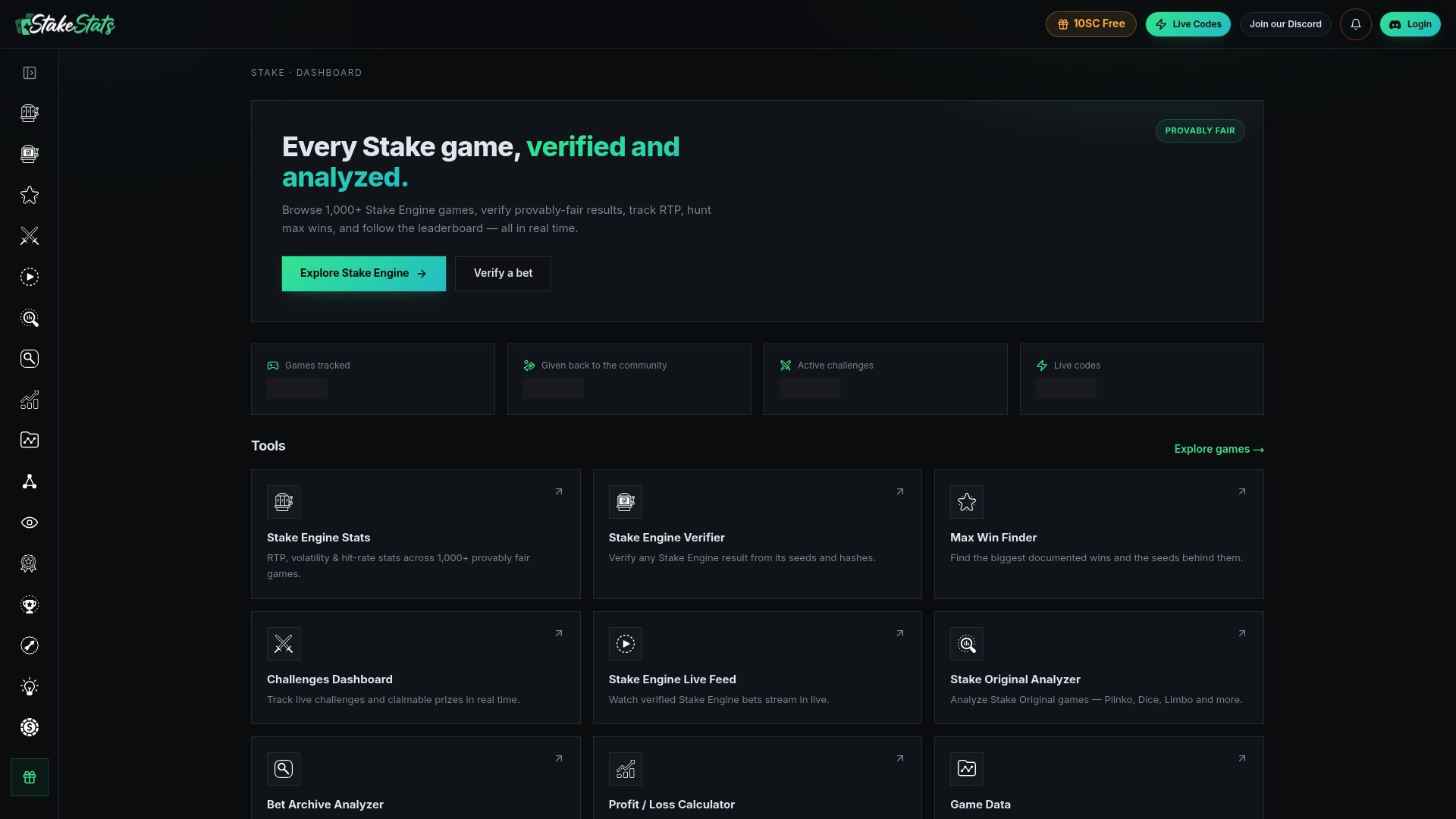
Upload your export directly into the bet archive analyzer and it handles the timestamp and currency cleanup automatically. Run the numbers through the bankroll analyzer to get session RTP, drawdown, and ROI without a formula in sight, and cross-check any bet in question with the built-in provably fair verifier. If you've been tracking sessions in a notebook or trusting memory, upload your last archive now and see what the numbers actually say.
Sources
FAQ
What Does "Stake 5" Mean?
In Stake community shorthand, a number like "stake 5" usually refers to a bet size or a specific stake level being discussed in a strategy conversation rather than any official platform term. Check the context of where you saw it, since it isn't a standardized metric inside session analysis tools.
Is Stake Actually Good for Serious Players?
Stake offers provably fair verification and a wide game catalog, which gives serious players the raw data needed for real session analysis, but the platform itself doesn't run that analysis for you. Pairing your bet history with a dedicated tool like Stakestats is what turns raw data into decisions.
What Does "Stake 10" Mean?
Like "stake 5," this typically refers to a specific bet amount or stake tier mentioned in a discussion rather than a fixed platform term, so its meaning depends on the context it appears in.
Is Stake Safe to Use?
Stake's provably fair system lets you verify that individual bet outcomes weren't altered after the fact, which is a meaningful safety feature for outcome integrity. Safety around your bankroll still depends on your own staking discipline and loss limits, which is exactly what session analysis is built to support.
How Often Should I Run a Session Audit?
Run a quick audit after every session and a deeper review, checking metrics across four to six sessions, on a regular basis. Single-session numbers are noisy, and looking at several sessions together gives you a far more reliable read on whether your strategy is working.