
Staking Reward Gaming: What Every Gamer Should Know

A staking reward in gaming is defined as the passive return a player earns by locking game-native tokens or NFTs into a smart contract to support the game's blockchain ecosystem. This is the industry-standard term: "staking rewards in gaming," and it covers everything from token dividends to in-game power-ups. Understanding what is a staking reward gaming means recognizing that the mechanic serves two purposes at once. It generates passive income, and it deepens your connection to the game world itself. Staking rewards are not a side feature. On well-designed platforms, they are a core part of how the game economy functions and how players build long-term value.
What is a staking reward in gaming?
Staking rewards in gaming are incentives distributed to players who commit their tokens or NFTs to a smart contract for a set period. The smart contract holds the assets, tracks each player's share of the total pool, and calculates rewards proportionally. Locking tokens into smart contracts transforms traditional passive mining into an active ecosystem commitment, giving players a direct stake in the game's health.
The rewards themselves vary widely. Some games pay out additional tokens. Others grant NFT items, crafting materials, or access to exclusive content. The common thread is that you contribute to the ecosystem by locking assets, and the ecosystem pays you back for that commitment. This is fundamentally different from simply playing and earning. Staking ties your financial interest directly to the game's long-term success.

Smart contracts make this process transparent in a way traditional gaming never could. Players can verify contract code and reward calculation rules before committing a single token. No developer can quietly change the payout formula after you have already locked your assets.
How staking works in gaming ecosystems
The staking process follows a clear four-step structure on most blockchain gaming platforms.
- Connect your wallet. You link a non-custodial wallet (such as MetaMask) to the game's staking interface. Your tokens stay in your control throughout.
- Select a staking pool. You choose a pool based on lock-up duration, reward multiplier, or reward type. Longer commitments typically offer higher multipliers.
- Confirm the transaction. You approve the smart contract interaction on-chain. The contract records your stake size and start time.
- Claim your rewards. Rewards accumulate in real time. Many protocols let you claim and unstake anytime without penalty, especially in non-custodial systems.
Non-custodial staking is the gold standard for player safety. In a non-custodial system, the smart contract never takes ownership of your tokens. You retain full control and can withdraw instantly. Custodial staking, by contrast, transfers token control to a platform wallet, which introduces counterparty risk.
Lock-up durations range widely. Seasonal lock-up periods run from 30 to 365 days, with multipliers reaching up to 3x earnings for the longest commitments. That multiplier structure rewards players who believe in the game long-term, not just those chasing short-term yields.
Pro Tip: Always check whether a staking protocol is non-custodial before committing. If the platform holds your tokens in a centralized wallet, you carry platform risk on top of market risk.
What types of staking rewards can gamers earn?
Gaming rewards through staking fall into several distinct categories, each with different gameplay implications.
- Token dividends. The most common reward type. You earn additional game tokens proportional to your stake size. These can be sold, reinvested, or used in-game.
- NFT rewards. Some platforms distribute unique NFT items to stakers. These might be cosmetic, functional (power-ups), or collectible.
- Loyalty points and Shards. Seasonal staking programs often award loyalty points called "Shards" or similar branded currencies. These unlock exclusive seasonal content.
- Crafting boosts. Staking can unlock crafting recipes or accelerate crafting timers, giving stakers a gameplay edge that non-stakers cannot access.
- Social status proof. Staking can serve as identity verification within a game community, marking long-term holders as trusted or high-status players.
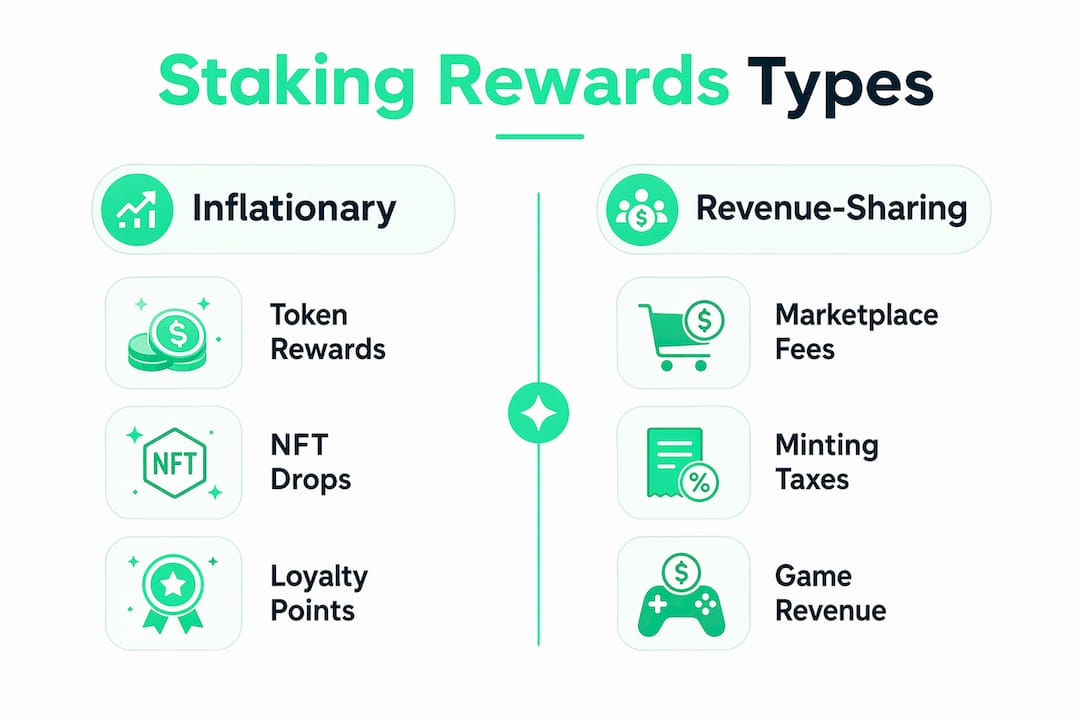
The distinction between revenue-sharing rewards and inflationary rewards matters enormously for long-term value.
| Reward model | Source of funds | Long-term sustainability |
|---|---|---|
| Inflationary token rewards | New token emissions | Low without demand growth |
| Revenue-sharing rewards | Marketplace fees, minting taxes | High when game activity grows |
| NFT and item rewards | Game treasury or drops | Moderate, depends on item utility |
| Loyalty point rewards | Seasonal allocation | Moderate, tied to season design |
Revenue-sharing models pay stakers from marketplace fees or minting taxes generated by actual game activity. This creates a direct link between game health and staker income. Inflationary models simply mint new tokens, which dilutes supply over time and can collapse reward value if player growth stalls.
Are staking reward models in gaming sustainable?
Sustainability is the central challenge for staking reward gaming in 2026. Many early blockchain games launched with high annual percentage yields to attract players quickly. Those yields were funded by token inflation, not real game revenue. The result was predictable: token prices fell as supply grew, and stakers who held long-term lost value.
The industry has shifted. Major gaming platforms now reduce staking rewards over time, cutting emissions aggressively to prevent token oversupply. Some platforms cut rewards by a set percentage every few days to extend the life of the staking program indefinitely. This approach keeps the program running without flooding the market.
Staking rewards must be fueled by actual game revenue rather than inflationary token emissions. Revenue-sharing models use marketplace fees or minting taxes as reward sources, creating healthy circularity. Purely inflationary rewards attract mercenary capital that exits the moment yields drop, harming both the token price and the game community.
The risk of "mercenary capital" is real. Players who stake only for yield and have no interest in the game will unstake and sell the moment a better opportunity appears. Gamifying staking by locking characters or pledging assets creates genuine community conviction. When your staked asset is also your in-game avatar or a tool you use daily, you have a reason to stay beyond the yield.
Pro Tip: Before staking in any game, check whether the reward source is listed in the smart contract or whitepaper. If the platform cannot explain where the rewards come from, treat that as a red flag.
Smart contract transparency is a genuine security advantage here. Because the contract code is publicly auditable, players can verify that reward rules cannot change without a governance vote or a new contract deployment. This level of accountability does not exist in traditional gaming economies.
How do staking rewards enhance the gaming experience?
The most forward-thinking games treat staking as a gameplay mechanic, not just a financial product. This distinction separates healthy gaming ecosystems from speculative token schemes.
- Character and asset locking. Some games require you to stake a character NFT to enter high-level content. The staking mechanic doubles as an access gate and a commitment signal.
- Crafting integration. Staked tokens can unlock crafting recipes or reduce crafting costs, giving stakers a direct in-game advantage that compounds over time.
- Community governance. Stakers often receive voting rights on game updates, new content, or economic policy. This turns passive holders into active community members.
- Seasonal progression. Seasonal staking programs reward players who stay committed across a full season with exclusive items or status markers unavailable to late joiners.
- Social proof and identity. Long-term stakers build visible on-chain histories. In some communities, a long staking record carries genuine social weight.
The benefits of staking in games extend well beyond passive income when the design is intentional. A player who stakes their main character NFT to earn crafting boosts is more engaged than one who simply deposits tokens for yield. The staking mechanic becomes part of the daily game loop.
Warning signs of an unhealthy staking system include rewards with no in-game utility, no lock-up requirements, and yields that seem too high to be funded by real game activity. These systems attract speculators, not players, and they tend to collapse quickly.
Practical tips for gamers interested in staking rewards
Participating wisely in staking rewards requires checking a few key factors before you commit any assets.
- Verify non-custodial control. Confirm that your tokens stay in your wallet. Non-custodial staking with instant unstake and claim is the safest structure available.
- Check the reward source. Ask whether rewards come from token emissions or real game revenue. Revenue-sharing models are more durable.
- Understand lock-up terms. Know exactly how long your assets will be locked and what the penalty is for early withdrawal. Some platforms have no penalty; others do.
- Look for multiplier structures. Longer lock-ups with higher multipliers reward conviction. Flat-rate programs with no multipliers offer less incentive to commit long-term.
- Balance yield with gameplay. If you are not enjoying the game itself, staking rewards will not compensate for a poor experience. The best staking programs enhance a game you already want to play.
Pro Tip: Use a provably fair verification tool to confirm that the game's reward distribution follows the rules stated in its smart contract. Transparency is not optional in a healthy staking ecosystem.
Key Takeaways
Staking rewards in gaming deliver the most value when they are tied to real game revenue, built on non-custodial smart contracts, and integrated into gameplay rather than offered as standalone financial products.
| Point | Details |
|---|---|
| Core definition | Staking rewards are passive returns earned by locking game tokens or NFTs in a smart contract. |
| Non-custodial safety | Always confirm your tokens stay in your wallet with instant unstake available. |
| Revenue-sharing beats inflation | Rewards funded by marketplace fees are more sustainable than those funded by token emissions. |
| Gameplay integration matters | Staking tied to crafting, access, or identity creates genuine engagement beyond yield chasing. |
| Transparency is verifiable | Smart contract code is publicly auditable, so players can confirm reward rules before staking. |
Staking as a game mechanic, not just a financial tool
I have watched the staking rewards conversation in gaming shift dramatically over the past few years. Early on, the pitch was almost entirely financial. Lock your tokens, earn 200% APY, get rich. That framing attracted the wrong crowd and burned a lot of players who did not understand what they were actually buying into.
The projects that have survived and grown are the ones that treated staking as a design problem, not a marketing problem. When a game requires you to stake your main character to access endgame content, you are not just a yield farmer. You are a committed player with skin in the game. That changes your behavior, your community participation, and your tolerance for short-term price swings.
My honest advice: ignore the APY headline entirely when evaluating a staking program. Ask instead whether the rewards make you a better player or a more connected community member. If the answer is yes, the economics tend to follow. If the answer is no, the yield will not save you when the token price corrects.
The future of staking rewards in gaming belongs to games that make staking feel like a natural part of playing, not a separate financial decision you make on a spreadsheet.
— Ian
Stakestats tools for smarter staking decisions
Staking in blockchain gaming rewards players who do their homework. Stakestats gives you the tools to do exactly that, with transparent verification and real-time data built for provably fair gaming environments.
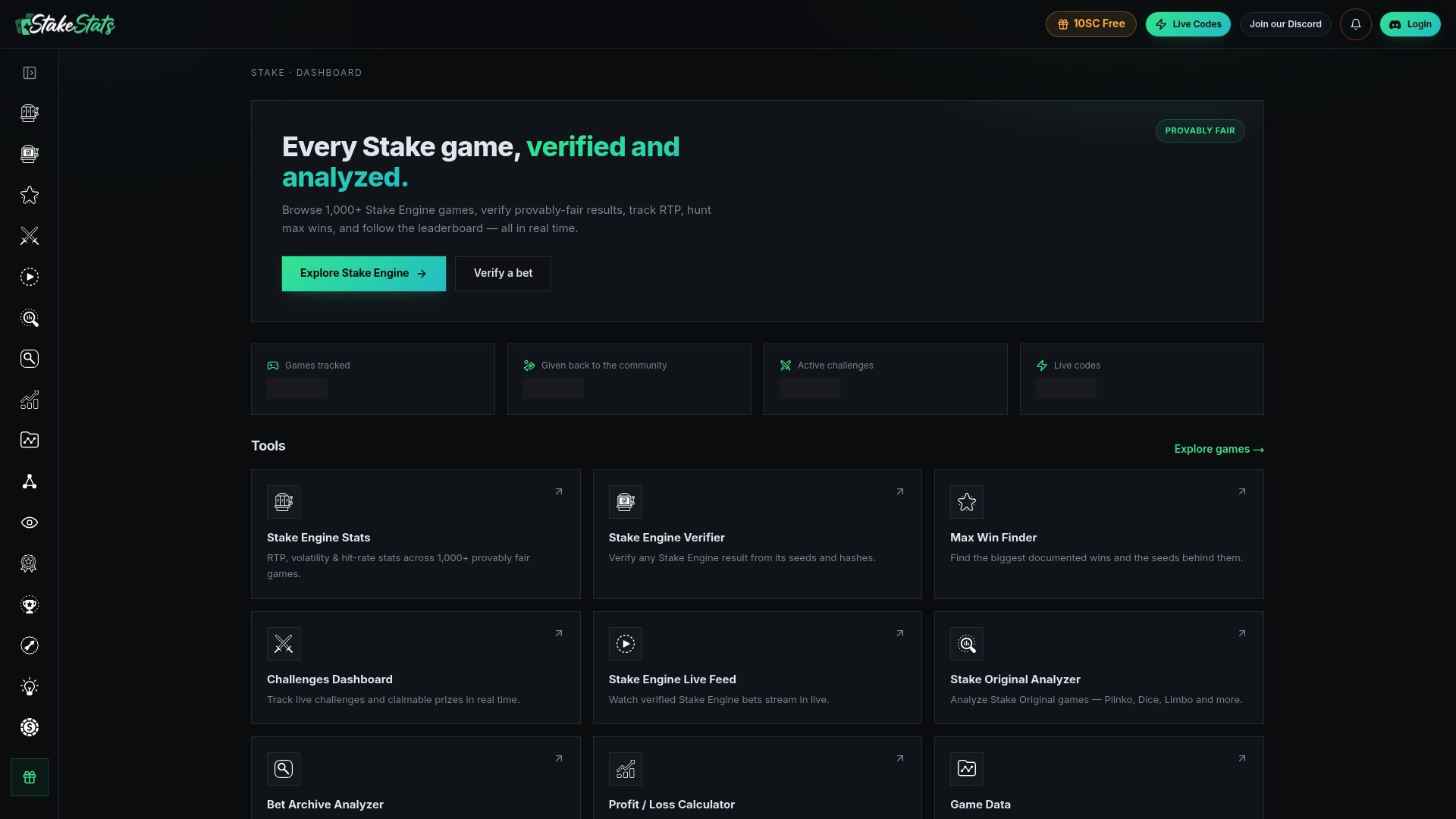
The staking bonuses tracker on Stakestats shows you current reward structures so you can compare programs before committing your assets. The Stake Engine tool breaks down reward calculations and helps you model outcomes across different lock-up durations. For players who want to verify fairness before staking, Stakestats provides provably fair verification tools that confirm reward distribution follows the rules stated on-chain. No guesswork, no hidden mechanics.
FAQ
What is a staking reward in gaming?
A staking reward in gaming is a passive return earned by locking game tokens or NFTs into a smart contract that supports the game's blockchain ecosystem. Rewards can include additional tokens, NFT items, crafting boosts, or loyalty points.
How does staking work in a blockchain game?
Staking follows a four-step process: connect your wallet, select a staking pool, confirm the on-chain transaction, and claim rewards. Many non-custodial protocols allow instant unstaking and reward claiming without any penalty.
Is staking worth it in gaming?
Staking is worth it when rewards are funded by real game revenue rather than token inflation, and when the staking mechanic integrates with gameplay. Programs that offer only high APY with no gameplay connection tend to be unsustainable.
What types of staking rewards exist in games?
The main types are token dividends, NFT drops, loyalty points, crafting boosts, and governance voting rights. Revenue-sharing models that pay from marketplace fees are more durable than inflationary token reward programs.
How do I know if a staking program is safe?
Verify that the staking contract is non-custodial, meaning your tokens stay in your wallet. Check that the smart contract code is publicly auditable so you can confirm reward rules cannot be changed without your knowledge.