
Players: Size Bankroll for Sticky Wilds, Verify with Seed Checks

A sticky wild is a wild symbol that locks into place after it lands and stays there for a set number of spins instead of disappearing after one. During its active window, it can push hit frequency per spin from roughly 20% up toward 35% in some implementations. That boost usually comes bundled with higher volatility, so the trade-off is fewer dead spins against bigger, streakier swings. Always confirm the exact rules in the paytable before you bet.
TL;DR:
- Sticky wilds often lock into place during bonus features, increasing hit frequency to around 35%, but they do not improve the game's overall payout expectancy.
- The wilds typically remain for a fixed number of spins, until a specific condition, or for the duration of a bonus round, with stacking and expanding effects amplifying volatility.
- Confirm the exact rules—such as duration, caps, and removal conditions—directly from the paytable or provider before betting, especially for feature-hunting strategies.
- Sticky wilds tend to concentrate payouts into the active feature window, shifting volatility and bankroll management rather than increasing long-term return.
- Verification tools can ensure that game outcomes match official rules, helping players avoid assumptions based on marketing or superficial paytable summaries.
Table of Contents
- What Sticky Wilds Are and Where They Show Up
- How the Lock, Duration, and Stacking Actually Work
- Walking Wilds, Expanding Wilds, and Multiplier Hybrids
- Reading Volatility Through the Sticky Wild Lens
- Playing Sticky Wilds Without Getting Burned
- What Sticky Wilds Don't Actually Change
- Why Verifying the Mechanic Matters More Than Trusting the Icon
- Tools for Checking Sticky-Wild Sessions Before You Commit
- Where to Check the Rules Yourself
- Sources
- FAQ
What Sticky Wilds Are and Where They Show Up
A standard wild substitutes for other symbols on a single spin and then vanishes. A sticky wild does the same substitution job but refuses to leave. Once it lands, it stays locked in that reel position through however many spins the game grants, continuing to substitute for other symbols the entire time.
Developers rarely drop sticky wilds into ordinary base-game spins. They save the mechanic for moments designed to feel like a payoff:
- Free spins rounds, where a wild landing early can sit through the rest of the bonus
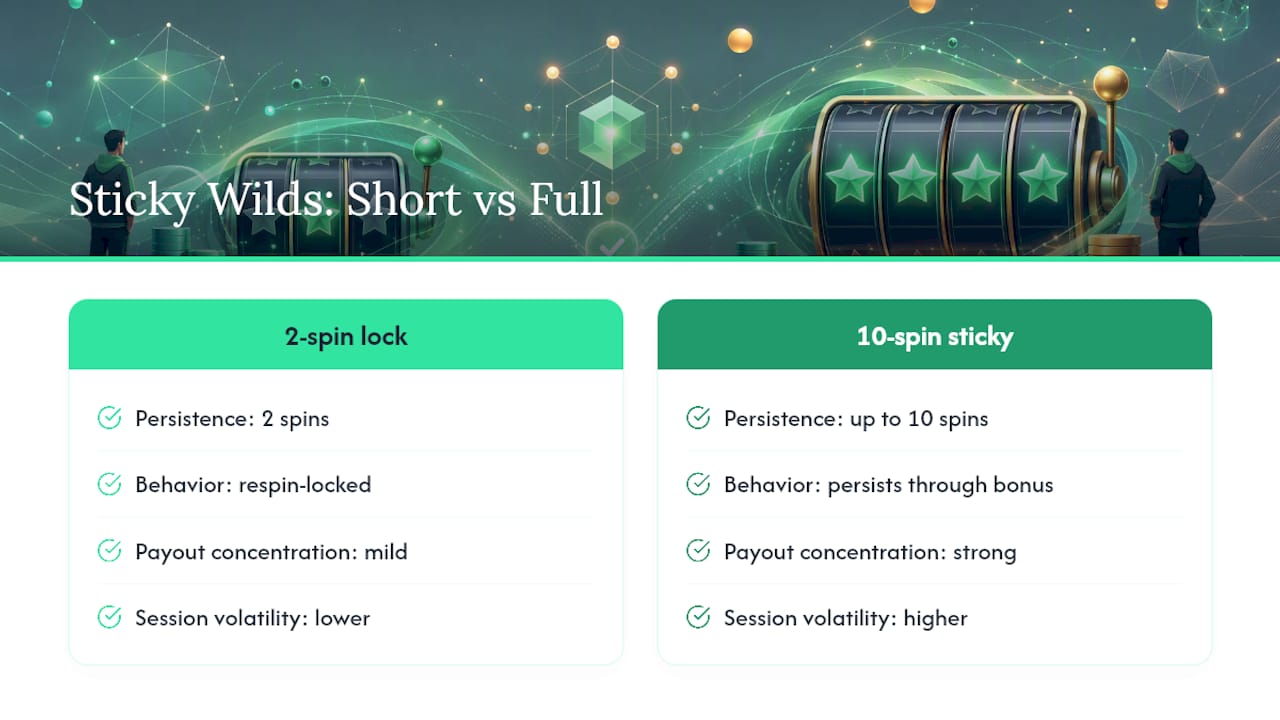
- Base-game respin features, where a wild locks for a short burst of two or three extra spins
- Meter-collect mechanics, where sticky wilds accumulate toward a threshold that triggers a bigger payout or upgrade
Studios favor the mechanic because it turns a bonus round into a visible countdown. Every locked wild changes the board permanently for the rest of that feature, so players watch coverage build in real time instead of just waiting for a multiplier to tick up.
How the Lock, Duration, and Stacking Actually Work
When a sticky wild lands, the game engine follows a specific sequence rather than just freezing a symbol at random.
- The reel stops and a wild symbol lands on an eligible position.
- The game evaluates the spin for wins as normal, with the wild substituting where needed.
- Before the next spin, the engine "locks" that wild in place instead of clearing the reel.
- The locked position stays wild on every subsequent spin until a removal condition triggers.
Removal conditions vary by title, and this is where reading the paytable actually pays off. Some sticky wilds are fixed duration: they lock for a specific number of spins (say, three) and then clear regardless of what happens. Others last for the entire feature, only clearing when the bonus round itself ends. A smaller group use condition-based removal, where the wild disappears only after it contributes to a win, or once a cap on total locked positions is reached.
Accumulation is what makes the mechanic interesting for volatility. Each new sticky wild adds to the ones already locked, so a free spins round can go from one locked position to five or six by the final spin. That stacking effect is a primary reason sticky-wild slots trend toward medium and high volatility: the board gets progressively easier to hit as the round goes on, concentrating payout potential into the closing spins rather than spreading it evenly.
Walking Wilds, Expanding Wilds, and Multiplier Hybrids
Not every sticky wild behaves the same way once it locks. Three variations show up often enough that it's worth knowing the difference before you judge a game by its paytable icon alone.
- Fixed sticky wilds stay on the exact tile where they landed for the rest of the feature. This is the base version of the mechanic.
- Walking or roaming wilds shift one position (usually left to right) each spin instead of staying put, sweeping across more of the board over time rather than covering one fixed spot.
- Expanding sticky wilds grow to fill an entire reel or row when they lock, multiplying their coverage instantly rather than gradually.
- Multiplier-linked sticky wilds carry a value multiplier attached to the lock. Some implementations pair the lock mechanic with a multiplier or a bonus respin trigger, so a single wild that lands late in a round can be worth several times more than one that lands early.
Full-feature sticky wilds, where every wild landed during free spins stays locked until the bonus round closes, are especially common in modern free spins design. That structure is what creates the compounding effect: a wild that lands on spin two of ten keeps paying through spin ten, and every wild after it stacks on top.
Reading Volatility Through the Sticky Wild Lens
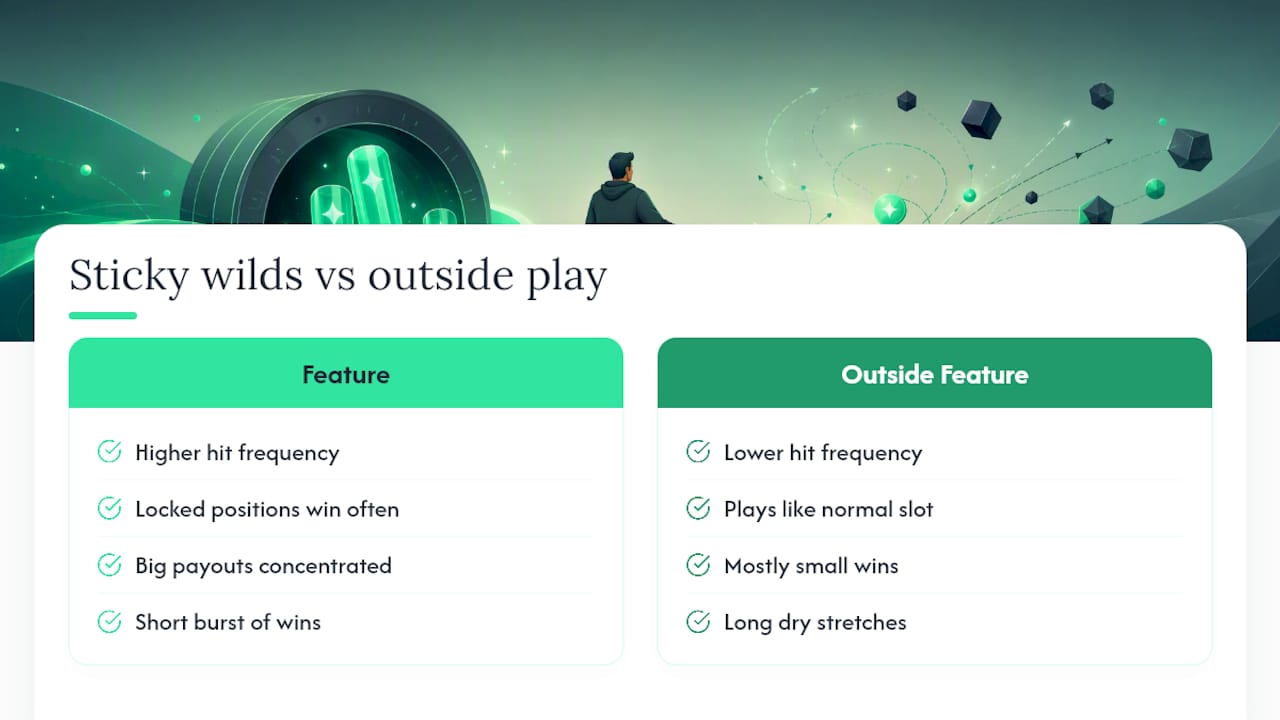
Hit frequency and volatility move in opposite directions here, and understanding why helps you set realistic session expectations. During the active sticky-wild window, more of the board is guaranteed wild, so more spins produce some kind of win. That is a straightforward statistical effect: locked positions cannot come up blank.
The volatility trade-off: the same accumulation that raises hit frequency inside the feature also concentrates the game's biggest payouts into that narrow window. Outside the feature, most sticky-wild slots play like any other medium or high-variance title, meaning long stretches with no bonus and comparatively small wins. Accumulated sticky wilds are a major reason these games skew medium-to-high volatility overall, because the design intentionally saves the payout potential for a feature that doesn't trigger every spin.
That matters for bankroll math. A game's stated volatility rating already accounts for how often the feature triggers and how much it typically adds once it does. Cross-checking that rating against a bankroll model built for the specific variance you're facing beats guessing, and a bankroll analyzer built around volatility inputs is a faster way to size sessions than trial and error.
Playing Sticky Wilds Without Getting Burned
Before you spin a single credit, run through the paytable with a specific checklist in mind rather than skimming it for the biggest number.
- Duration: is the sticky wild locked for a fixed number of spins, the whole feature, or until a condition is met?
- Caps: is there a maximum number of positions that can lock at once, or a maximum multiplier value?
- Removal rules: does the wild clear automatically, or only after it contributes to a win?
- Multiplier stacking: do multiple locked wilds combine their multiplier values, or does only the highest one count?
Once you know the rules, size your bets around the volatility they create rather than the average bonus footage you've seen online. Feature-hunting (buying into or chasing the bonus round directly) demands a deeper bankroll cushion than casual spinning, since you're deliberately targeting the game's highest-variance segment.
Pro Tip: Treat sticky-wild slots as two different games in one: a slower, lower-variance base game and a short, high-variance bonus round. Budget for both separately instead of averaging them into one number.
If you're playing casually with a fixed budget for entertainment, standard flat betting works fine. If you're specifically chasing the feature, drop your bet size slightly and extend your spin count so you can realistically reach a few bonus triggers without going bust first.
What Sticky Wilds Don't Actually Change
The most common misread is thinking sticky wilds raise the game's overall return. They don't. Sticky wilds reallocate payout distribution rather than increasing long-term expected value: the math redistributes returns into concentrated bursts instead of adding to them.
Players also confuse short, respin-locked wilds with true full-feature sticky wilds. That distinction is the single biggest factor in estimating a session's real volatility, because a two-spin lock behaves nothing like a wild that persists through an entire ten-spin bonus. And no matter how many wilds stack up, the mechanic raises your odds of a bigger hit. It never guarantees the top prize on the paytable.
Why Verifying the Mechanic Matters More Than Trusting the Icon
Paytables and provider help files remain the only authoritative source for a specific game's sticky wild rules, duration caps included. We push readers toward those documents first because marketing copy and forum chatter routinely simplify or misstate them.
Where provably fair verification helps is confirming that outcomes match the stated math once you're actually playing, using seed and nonce checks rather than guesswork.
— Ian
Tools for Checking Sticky-Wild Sessions Before You Commit
Reading a paytable tells you the rules. Confirming a game actually plays by them is a different job, and it's the one Stakestats is built for. Our provably fair verification tools let you check server seed and nonce data against real spin outcomes, so you're not relying on marketing copy to know how a sticky-wild feature really behaves across thousands of rounds.

If you're specifically feature-hunting, the bankroll analyzer models session size against a game's actual volatility profile instead of a generic rule of thumb, which matters more for sticky-wild titles than almost any other mechanic given how concentrated their payouts get. Hunting for the bonus round itself rather than grinding the base game? The bonus and feature tool aggregates where those triggers show up across the Stake Engine catalog. Start by running your next sticky-wild pick through the bankroll analyzer before you set a session budget.
Where to Check the Rules Yourself
Before you play, confirm the mechanic directly rather than relying on secondhand summaries.
- The game's own paytable or help file, which lists exact duration, caps, and removal rules
- BeGambleAware, for limits, session tools, and self-exclusion guidance on high-volatility features
- The provider's official game page or developer notes, when available, for the precise feature description
Sources
FAQ
What is a sticky wild in slots?
A sticky wild is a wild symbol that locks into its landed position and stays there for multiple spins instead of clearing after one, continuing to substitute for other symbols the whole time.
Do sticky wilds increase my odds of winning?
They raise hit frequency during their active window, sometimes from around 20% up to 35% per spin in some implementations, but they redistribute payouts rather than raising the game's overall return.
Are sticky wild slots always high volatility?
Not always, but the accumulation effect tends to push them toward medium or high volatility since payout potential concentrates into the feature window instead of spreading evenly.
How is a sticky wild different from an expanding wild?
A sticky wild stays fixed in one reel position across spins, while an expanding wild grows to cover a full reel or row the moment it lands, though some games combine both effects in one symbol.
Where can I confirm a specific game's sticky wild rules?
Check that title's own paytable or help file first, since duration, caps, and removal conditions vary by game and Stakestats's provably fair tools can help verify how those rules play out across real spin data.