
Use 2SD Math to Set Stop-Losses for Gambling

A stop-loss is the exact dollar amount you decide, before you sit down, marks the point where you quit for the session. Set your session bankroll first, then walk away when you lose a fixed percentage of it or a set number of buy-ins, whichever you pick before the cards are dealt or the reels spin. The rest of this comes down to picking a number you'll actually respect, whether that's a simple rule of thumb or one built from real math.
TL;DR:
- A proper stop-loss should be based on your session bankroll, game volatility, and a predetermined limit, not arbitrary guesses or past losses.
- Using buy-ins, time caps, and math-based standard deviation calculations helps set realistic and effective stop-loss amounts for different games and volatility levels.
- Recording your planned limits and session outcomes with screenshots and logs is crucial to sticking to your stop-loss and for accurate tax reporting.
- Platform features like deposit and loss limits, along with cooling-off periods, reinforce discipline when you are prone to breaking your own rules.
- Seeking external support is advised if you repeatedly ignore limits or exhibit risky gambling behaviors, as self-control alone may not suffice.
Table of Contents
- What Do Stop-Loss and Stop-Win Actually Mean?
- How Do You Pick a Stop-Loss Amount That Actually Works?
- Why Does Volatility Change What Your Stop-Loss Should Be?
- How Do You Make a Stop-Loss Stick When You're Losing?
- When Does a Stop-Loss Stop Working, and Where Can You Get Help?
- Do You Need to Track Gambling Wins and Losses for Taxes?
- How Stakestats Tools Fit Into Your Stop-Loss Plan
- The Honest Take on Stop-Losses
- Set Your Limits Before You Sit Down to Play
- Sources
- FAQ
What Do Stop-Loss and Stop-Win Actually Mean?
A stop-loss is the amount you're willing to lose in one session before you stop playing, full stop. A stop-win is its mirror image: the profit level where you cash out and quit while you're ahead, instead of donating it back to the house edge. Neither term means much without a session bankroll attached to it, which is the specific chunk of money you've set aside for that sitting, separate from your rent, groceries, or savings.
Your total bankroll might be $2,000 across a month of play. Your session bankroll for tonight might be $100 of that.
Here's where most people go wrong:
- They pick a stop-loss out of thin air ("I'll stop if I'm down $50") with no link to their actual bankroll or the game's volatility.
- They confuse total bankroll with session bankroll, then panic when a bad run eats into money they needed for something else.
- They set a unit size too large for their session bankroll, so two or three losing bets blow past the limit before it even registers.
A reasoned limit ties the number to your bankroll and the game's swings; an arbitrary one is just a guess dressed up as a plan.
How Do You Pick a Stop-Loss Amount That Actually Works?
Three simple methods cover most situations, and you don't need a spreadsheet for any of them.
On a $100 session bankroll, that's $1 to $2 per unit and a stop-loss around $20 to $30.
Buy-in rule. Decide how many buy-ins you'll allow yourself before you're done, typically 1 to 3. A buy-in is one full load of your session bankroll. Two buy-ins on a $75 session means you stop at $150 lost, no exceptions.
Time cap. Pair either rule above with a hard clock limit, say 60 or 90 minutes. Volatility isn't just about dollars. Long sessions on high-speed games like slots grind through your bankroll fast even when your stop-loss is technically wide enough, because you're getting far more decisions per hour than you would at a blackjack table.
Translating buy-ins into dollars depends on the game. A slots session might run a moderate amount per buy-in at low denominations. A blackjack table minimum of $10 to $25 per hand means a buy-in of $200 to $500 covers a reasonable number of rounds without you going broke on a short losing streak, per Gambling101's bankroll management guidance.
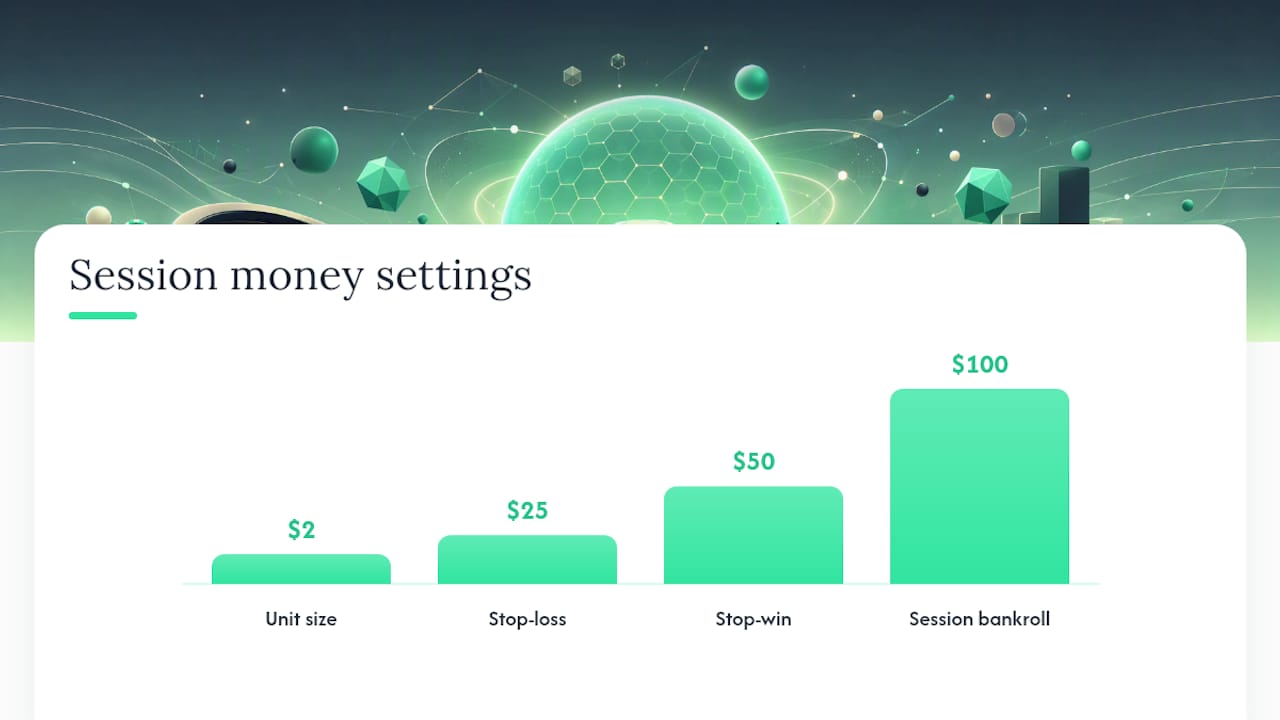
Write the plan down before you play, literally, on a note on your phone. Include your session bankroll, unit size, stop-loss dollar amount, stop-win amount, and time cap.
- Set session bankroll: $100.
- Set unit size: $2 per bet.
- Set stop-loss: $25 lost, or 25% of bankroll.
- Set stop-win: $50 profit, or 50% gain.
- Set time cap: 60 minutes.
- Close the app or leave the table the moment any one of those lines is hit.
Pro Tip: Screenshot your written plan before you start playing. When you're three drinks in or down $40 and tempted to "just get even," that screenshot is a lot harder to argue with than a memory you've already talked yourself out of.
Why Does Volatility Change What Your Stop-Loss Should Be?
Not every game burns through a session bankroll at the same speed, and that's the single biggest reason a flat dollar stop-loss fails so often. A slot spin might take four seconds. A hand of blackjack takes closer to a minute at a full table. That gap in rounds-per-hour means slots hit variance far harder and far faster, which is exactly why Casino recommends smaller unit sizes relative to bankroll for high-speed games, not a smaller stop-loss.
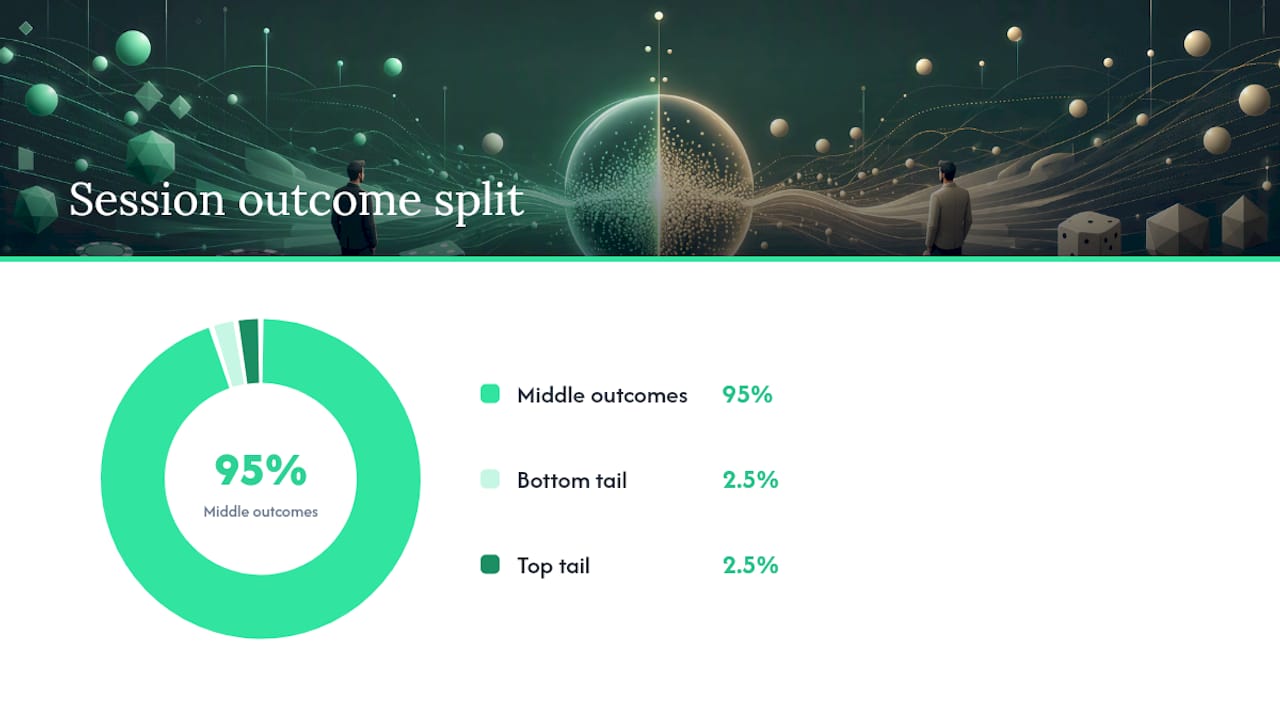
The math version of a stop-loss uses expected value (EV) and standard deviation (SD). EV is your predicted average result over a session, almost always negative on casino games because of the house edge. SD measures how wildly your actual results are likely to swing away from that average. The 2 standard deviations (2SD) rule sets your stop-loss at EV minus 2×SD and your stop-win at EV plus 2×SD, which brackets roughly the middle 95% of likely outcomes and flags the bottom 2.5% as a real losing streak rather than normal variance, according to Gamblingcalc's 2SD calculator methodology.
- A low-volatility game like blackjack might produce a moderate 2SD stop-loss on a typical session bankroll.
- A high-volatility slot with the same bankroll and bet size usually requires a much wider 2SD stop-loss, per comparisons of slot volatility to table-game volatility.
If a calculator spits out a stop-loss bigger than your entire bankroll, that's your answer: the game or bet size doesn't fit your bankroll, and you need to shrink your unit size before you play, not raise your budget to match the math.
How Do You Make a Stop-Loss Stick When You're Losing?
Setting the number is the easy part. Sticking to it when you're down $30 and convinced the next spin is "due" is where almost everyone breaks.
Set your limits before you open the app, not after the first losing hand, and write them somewhere you'll actually see mid-session, not buried in a notes app you'll ignore. Most licensed operators let you set deposit limits, loss limits, stake limits, and session-time limits directly on the account, and these work far better than willpower alone because they don't care how you feel in the moment, according to guidance on setting operator-side limits.
- Set a deposit limit that matches your session bankroll.
- Turn on a cooling-off period if your platform offers one; it locks you out temporarily, often for a day or more.
- Remove saved payment methods from the device you're playing on so a limit breach requires extra friction, not one tap.
- If you're playing live or in person, physically move away from the table the second you hit your number.
Pro Tip: The single worst moment to "just check the math again" is right after a loss. Decide your rule in a calm state, days before you play, and treat mid-session recalculating as a warning sign, not a strategy.
If you break a limit anyway: stop playing immediately, log the session honestly, and lower your stop-loss for next time instead of raising it to make up the difference. Raising a limit after a loss is the single most common way a reasonable plan turns into a bad night.
When Does a Stop-Loss Stop Working, and Where Can You Get Help?
A stop-loss is a tool, not a cure, and for some people it stops functioning entirely. Watch for a few specific warning signs: hiding losses from a partner or family, using rent or grocery money to keep playing, repeatedly raising or ignoring your own limits, and chasing a loss with a bigger bet to "win it back."
Any one of those on a regular basis is a signal to stop relying on self-control alone.
- Trigger a cooling-off period or full self-exclusion on the platform immediately, not after "one more session."
- Talk to someone. GambleAware offers free, confidential support and practical tools for people whose limits keep failing.
- Gambling Therapy runs online counseling and forums specifically for people showing these red flags, available in multiple languages.
None of this means you failed at math. It means the problem moved past what a spreadsheet can fix.
Do You Need to Track Gambling Wins and Losses for Taxes?
Yes, and most casual gamblers underestimate how strict this is. You're required to report gambling winnings on your federal tax return, and a Form W-2G may be issued to you for certain wins, but you can only deduct your losses if you itemize deductions and keep accurate records to back them up, per IRS Topic No. 419.
That means the same session log you're using to track your stop-loss doubles as tax documentation.
- Keep a simple gambling diary: date, game, location or platform, buy-in, and result.
- Save screenshots of session summaries, especially on crypto or online platforms where records disappear from view fast.
- Hold onto physical tickets, receipts, and account statements as backup.
Recent changes to federal deduction rules make accurate, contemporaneous records more important than ever, since the IRS won't take your word for a loss you can't document.
How Stakestats Tools Fit Into Your Stop-Loss Plan
Picking a defensible stop-loss starts with knowing your real numbers, not guessing them. The bankroll analyzer helps you size units and session bankrolls against actual game volatility instead of a gut feeling. The profit/loss calculator logs session outcomes automatically, which doubles as the recordkeeping the IRS expects if you ever itemize gambling losses. Provably fair replay verification on the Stakestats blog adds a layer of trust to whatever outcome your session actually produced.
The Honest Take on Stop-Losses
Math gives you a defensible number. Behavior and account tools are what actually make you honor it once you're down and irritated. A stop-loss reduces how much a bad night costs you. It does nothing to change the house edge sitting underneath every bet you make.
— Ian
Set Your Limits Before You Sit Down to Play
Every rule in this article works better when you know your real numbers instead of guessing them. The bankroll analyzer does exactly that: plug in your session bankroll and it helps you size your unit bets and test stop-loss scenarios against the actual volatility of the game you're playing, not a rough estimate.

Pair it with the profit/loss tool to log every session automatically, which gives you a clean record if you ever need to itemize gambling losses at tax time. Verification on games across the Stake Engine catalog means the numbers you're tracking reflect what actually happened, not a black box. Open the bankroll analyzer, run your next session's numbers before you play, and export the log when you're done.
This article is general information, not a substitute for advice from a qualified financial advisor. Consult a qualified financial professional about your own circumstances before acting on anything here.
Sources
- IRS: Topic No. 419 Gambling Income and Losses
- Bankroll Management for Beginners | Gambling101
- Stop-Loss Calculator — Set Statistically Sound Gambling Limits
- GambleAware
- Gambling Therapy
FAQ
What Is the 90% Rule in Gambling?
It's most commonly used informally to describe how a large majority of recreational gamblers end a losing streak still chasing losses rather than walking away, which is exactly what a written stop-loss plan is designed to prevent.
What Is the Golden Rule for Stop-Loss?
Set the number before you play and never raise it after a loss. A stop-loss decided in a calm moment, based on your session bankroll and the game's volatility, works; one adjusted mid-session to "get even" usually doesn't.
Can You Still Lose Money With a Stop-Loss?
Yes. A stop-loss caps how much you can lose in a single session, but it doesn't change the underlying house edge or guarantee a profit over time. It limits the damage of one bad session rather than eliminating losses altogether.
Is a Stop-Loss a Good Strategy?
It's one of the most reliable ways to keep a single session from turning into a much bigger loss than you intended. Combined with a written session plan and, ideally, a 2SD calculator check for the specific game's volatility, it gives you a defensible number instead of a guess.