
When to Switch Gambling Strategies Mid-Session

When and why you should switch gambling strategies mid-session
Switching gambling strategies mid-session works best when triggered by objective checkpoints, not gut feelings. The players who do it well aren't reacting to a bad beat or chasing a hot streak. They're following a pre-set plan that tells them exactly when conditions have changed enough to warrant a different approach.
Three situations genuinely justify a mid-session strategy change: your bankroll has dropped to a predefined threshold, the game's volatility is burning through your runway faster than expected, or you've hit your profit target and want to protect gains by shifting to lower-risk play. Everything else is usually emotion dressed up as strategy.
The core do's and don'ts:
- Do set checkpoints before you start, not during the session
- Do lower your stake or switch to a lower-volatility game when your balance drops significantly from your session start
- Do switch games entirely at a substantial drawdown to reset the hit pattern
- Do lock in a profit floor after reaching a significant profit and continue with a smaller stake
- Don't increase bet sizes after a losing streak to recover faster
- Don't switch strategies after a single bad spin or hand
- Don't treat a new strategy as a reset button that erases prior losses
- Don't make any mid-session change without knowing what triggered it and what you expect it to accomplish
The biggest mistake players make is confusing activity with strategy. Changing your approach every few minutes feels like control. It isn't. Structured checkpoints at predefined intervals, like every 50 spins or at specific bankroll thresholds, are what separate disciplined adjustment from impulsive chasing.
What the gambling community actually does when adjusting tactics mid-session
Community consensus on mid-session strategy shifts is surprisingly consistent on one point: the trigger matters more than the switch itself. Players who report positive outcomes from changing betting strategies mid-session almost always describe a specific, observable condition that prompted the change, not a vague feeling that things weren't working.
The debates get louder around frequency. Some experienced players advocate for a single checkpoint at the session midpoint. Others use a tiered system tied to bankroll percentage. A smaller group switches games freely throughout a session, treating game selection as the primary lever rather than bet sizing.
Where the community diverges sharply is on what counts as a valid trigger. Veteran players tend to dismiss variance-based triggers entirely. A run of 10 losses on a high-volatility slot isn't a signal to switch; it's expected math. Newer players often interpret the same run as evidence the game is "cold" and switch immediately, which community veterans point out usually just resets the variance clock without improving expected outcomes.
The most common successful pattern reported across gambling forums: a player sets three checkpoints before the session starts, hits the first one (typically a 20% drawdown), drops stake size by one step, and continues. The switch is mechanical, not emotional. That's the version that tends to hold up.
Psychological traps that wreck mid-session decision-making
Tilt is the single most destructive force in mid-session strategy changes. It's not a personality flaw; it's a documented cognitive state where recent losses distort risk assessment and push players toward larger bets at exactly the wrong moment. Objective analysis over emotion is what separates players who survive a bad session from those who blow their bankroll trying to recover it.

The mechanics of tilt follow a predictable pattern. You lose two or three bets in a row. The brain registers this as a correctable injustice rather than normal variance. The impulse to bet larger to "get it back" feels rational in the moment. It isn't. You're increasing risk exposure precisely when your confidence and decision quality are at their lowest.
Impulsive chasing compounds the problem. Increasing stakes after a losing streak is the most destructive error a player can make mid-session. The correct response is maintaining consistent unit sizing and reviewing losses after the session, not during it.
Pro Tip: Before your session, write down your three checkpoints and the specific action each one triggers. When you hit a checkpoint, execute the pre-planned response without deliberation. The decision was already made when you were calm. Trust it.
Anchoring bias also shows up frequently. Players anchor to their session high point and treat any drop from that peak as a loss to recover, even if they're still ahead of their starting balance. This creates phantom losses that drive unnecessary strategy changes. Your reference point should always be your starting session bankroll, not your peak balance.
Smart bankroll management when making mid-session adjustments
Your session bankroll determines everything else: your bet size, your checkpoints, and your exit conditions. Bet size should be anchored to your starting session bankroll, not your current balance mid-session. A win that takes you from $100 to $140 doesn't mean you should now risk $2.80 per bet instead of $2. Stay anchored to the original figure.
The standard professional range for bet sizing is 1–2% of your total bankroll per unit. For slots, the guidance is tighter: 0.5–1.5% per spin on low-to-medium volatility games, and 0.25–0.75% per spin on high-volatility titles. The lower figure on high-volatility games isn't caution for its own sake. It's the math of surviving long enough for the game's variance to play out.
Checkpoint system for mid-session bankroll protection:
- At a moderate drawdown: reduce stake by one step or switch to a calmer game
- At a larger drawdown: switch games entirely and hold the lower stake
- After reaching a significant profit: lock a profit floor, then continue with a smaller stake or lower volatility
- At any point: never reload beyond your original session bankroll
Stop-loss threshold: A 20% session bankroll stop-loss is the industry standard for responsible play. Losing 20% from a $100 session bankroll requires only an 11.1% gain to break even. Let losses run to 50%, and you need a 100% gain to recover.
Runway matters as much as bet size. A practical target for slots is 200–400 spins per session. If you're tracking fewer spins than your session target (200–400 per session) on your current stake, you're burning through your bankroll too fast. Lower the stake or switch to a lower-volatility game before the checkpoint forces your hand.
Automated betting tools enforce preset loss limits mechanically and prevent impulsive mid-session bet size increases. If your platform supports auto-bet scripts, configure hard stop conditions before each session: maximum loss, maximum bet size, profit target.
How mid-session strategy adjustments play out across different games
Strategy shifts look different depending on the game. The triggers are similar, but the specific adjustments vary by game mechanics, volatility, and the pace at which your bankroll moves.
Slots: stake sizing and volatility switching. On a high-volatility slot, a 20% drawdown in roughly 80 spins is a clear signal your stake is too large for the game's rhythm. The right move is dropping to 0.5% per spin and extending your runway, not switching to a different high-volatility title hoping for better luck. If you're at 40% down, switch to a low-volatility slot entirely. The hit frequency resets, and your remaining bankroll lasts longer.
Craps: line bet discipline under pressure. Craps players often shift from pass line bets to proposition bets mid-session when they're losing. Proposition bets carry a much higher house edge, so this switch accelerates losses rather than reversing them. The disciplined mid-session adjustment in craps is the opposite: strip back to the lowest-edge bets (pass line, come bets) and reduce unit size until the session stabilizes.
Blackjack: bet spread management. In blackjack, mid-session adjustments should track the count, not your emotional state. A player who flattens their bet spread after a losing run because they're frustrated is abandoning the one edge available to them. The correct adjustment is maintaining your spread discipline and, if your session bankroll has dropped below your pre-set threshold, reducing your base unit proportionally.
Sports betting: unit sizing after a losing run. The correct response to three consecutive losses is not to increase the next bet. It's to confirm your unit size is still within 1–2% of your current bankroll and review whether the losses were variance or analytical errors. Change the unit only if your bankroll has moved enough to warrant a recalibration, not because you want to recover faster.
Case study: game switching to extend session longevity. A player starts a session on a high-volatility slot with a $60 session bankroll, staking 0.5% per spin. After 120 spins they're down 35%, sitting at $39. Rather than continuing on the same title or increasing the stake, they switch to a low-volatility slot and drop to 0.3% per spin. The lower hit variance stabilizes the balance, extends the session to 280 total spins, and the player exits at $44, a smaller loss than the trajectory suggested at the 120-spin mark.
How Stakestats tools support better mid-session decisions
Transparent data changes the quality of mid-session decisions. When you can see your actual session performance in real time, checkpoints stop being guesswork and start being math. Stakestats builds its tools around exactly this principle: giving players on Stake.com and other provably fair platforms the visibility they need to make objective adjustments rather than emotional ones.
The bankroll analyzer tracks your session balance against your starting point, making it straightforward to see when you've crossed a 20% or 40% drawdown threshold. That's the difference between knowing you should switch and actually knowing when. The profit and loss analysis tool extends this across sessions, so you can see whether your mid-session adjustment patterns are helping or hurting your results over time.
Provably fair verification adds a layer that matters specifically for mid-session trust. When a game's outcomes are cryptographically verifiable, you can confirm that a losing streak is variance, not a rigged result. That confirmation makes it easier to stick to your checkpoint plan instead of abandoning it based on suspicion.
| Stakestats tool | Mid-session use case | What it replaces |
|---|---|---|
| Bankroll Analyzer | Track drawdown against session start | Manual balance tracking |
| Profit and Loss Analysis | Review adjustment patterns across sessions | Gut-feel performance assessment |
| Bonuses Analyzer | Identify bonus conditions affecting strategy | Missed bonus threshold awareness |
| Provably Fair Verification | Confirm variance vs. outcome manipulation | Suspicion-driven strategy changes |
The bonuses analyzer is underused for mid-session decisions. Bonus wagering requirements often change the optimal bet size mid-session, and players who aren't tracking those conditions make adjustments that work against their bonus completion. Knowing your remaining wagering requirement before you switch strategies is a concrete edge most players leave on the table.
How switching strategies affects your long-term gambling results
Frequent, unplanned strategy switches erode long-term results more reliably than almost any other single behavior. The math is straightforward: every time you change your approach mid-session without a pre-set trigger, you introduce a decision made under emotional pressure. Those decisions systematically favor higher risk at lower-probability moments.
Mid-session emotional reactions and impulsive attempts to recover losses cause negative long-term effects. The pattern compounds. A player who increases bet sizes after losses doesn't just lose more in that session. They train themselves to associate losing with larger bets, which makes the behavior more automatic over time.
Planned strategy shifts, by contrast, tend to improve long-term outcomes by compressing losing streaks. When you drop your stake at a 20% drawdown, you're reducing the dollar amount at risk during the period when variance is working against you. When conditions improve, your bankroll is still intact enough to benefit. That asymmetry, protecting more during downswings and participating during upswings, is what percentage-based unit sizing accomplishes mechanically.
The long-term record also benefits from consistency in a less obvious way. Players who follow a written plan accumulate data on what actually works for them. Players who switch freely mid-session accumulate noise. After 50 sessions, the first player can identify which game types, stake sizes, and checkpoint rules produce the best outcomes. The second player has a collection of anecdotes.
A step-by-step decision framework for switching strategies mid-session
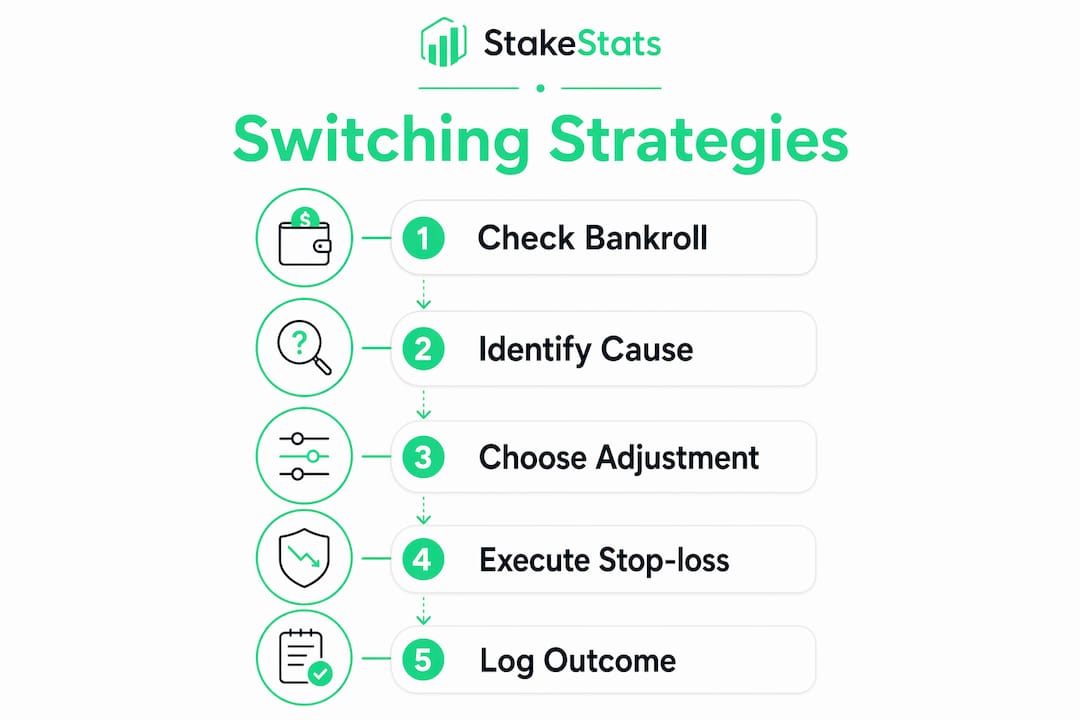
This framework works for any casino game format. Run through it at each checkpoint, not in response to a single bad outcome.
Step 1: Check your bankroll position. Calculate your current balance as a percentage of your starting session bankroll. If you're within 20% of your start, no change is needed. If you're down 20–40%, move to Step 2. If you're down more than 40%, move directly to Step 4.

Step 2: Identify the cause. Is the drawdown happening faster than the game's normal variance would predict? On a high-volatility slot, 20% down in 80 spins is expected. On a low-volatility game, it's a signal. If the pace is abnormal for the game type, a strategy change is warranted. If it's within normal variance, reduce stake by one step and continue.
Step 3: Choose the adjustment. Reduce stake size, switch to a lower-volatility game, or shift to lower-edge bets depending on your game. Do not increase bet size. Do not switch to a higher-volatility option. The goal at this step is extending runway, not accelerating recovery.
Step 4: Execute the stop-loss if triggered. At 40% down, switch games and hold the reduced stake. At your pre-set session stop-loss (20% of session bankroll is the standard), close the session. No exceptions. The decision was made before the session started.
Step 5: Log the session outcome. Record what triggered the adjustment, what you did, and what happened afterward. This is the data that improves your framework over time. Without it, you're repeating the same session indefinitely.
Signals that tell you a strategy switch is actually warranted
Not every bad run is a signal. Distinguishing genuine indicators from noise is the skill that separates disciplined players from reactive ones.
Bankroll runway is burning too fast. On slots, if you're below 150 spins on your current stake with significant balance remaining, your stake is too large for the game's volatility. This is a mechanical signal, not an opinion.
You've crossed a pre-set drawdown threshold. A 20% drop from your session start is a checkpoint, not a catastrophe. It triggers a specific, pre-planned response. The signal is the threshold crossing, not the feeling of being behind.
The game's volatility doesn't match your session bankroll. If you started a high-volatility game with a session bankroll that only supports 100 spins at your current stake, the mismatch is the signal. Switch to a game whose volatility fits your runway.
You've hit your profit target. This is the most overlooked signal. Hitting your daily profit target and continuing to play re-exposes your gains to the house edge. The signal to switch here is a positive one: lock the profit floor and either stop or shift to a lower-stake, lower-volatility game.
Your emotional state is elevated. Rate your emotional state on a scale of 1–10 before any mid-session change. If you're at 7 or above, the signal is to pause, not to switch strategies. A strategy change made in an elevated emotional state is almost always a tilt decision wearing a rational disguise.
When experts say you should change strategies, and how often
Expert guidance converges on one timing principle: strategy changes belong at checkpoints, not in response to individual outcomes. The checkpoint approach uses predefined intervals, like every 50 spins or at specific bankroll thresholds, to review data and consider adjustments. This prevents the "strategy soup" that results from reacting to every swing.
Frequency recommendations are consistent across professional bankroll frameworks: one to three planned checkpoints per session is the practical range. More than three and you're reviewing too often to let variance play out. Fewer than one and you may miss a genuine signal until it's too late to protect your bankroll.
Timing within a session also matters. The first 20% of a session is the worst time to switch strategies. You don't yet have enough data to distinguish variance from a genuine mismatch between your approach and the game's current behavior. The middle of a session, after you've accumulated meaningful data, is when checkpoint reviews carry the most information.
Post-session review is where the real strategy work happens. Experienced players don't just adjust mid-session; they analyze what triggered each adjustment and whether the outcome justified it. That review cadence, weekly at minimum, is what turns mid-session adjustments from reactive guesses into a tested, improving system.
Key Takeaways
Switching gambling strategies mid-session produces better outcomes when driven by pre-set checkpoints and bankroll thresholds, not emotional reactions to individual results.
| Point | Details |
|---|---|
| Use pre-set checkpoints | Review strategy at fixed intervals or bankroll thresholds, not after single bad outcomes. |
| Follow the 20% stop-loss rule | Close the session or reduce stake when your balance drops 20% from your session start. |
| Anchor bets to session start | Keep bet sizing tied to your starting bankroll, not your current balance mid-session. |
| Switch games at 40% drawdown | Changing the game title resets the hit pattern without abandoning your bankroll rules. |
| Log every adjustment | Recording what triggered each change and its outcome is what improves your framework over time. |