
Time to Bonus: How Long a Slot Bonus Really Takes

In online slots, "time to bonus" is the number of spins you wait, on average, before the bonus round triggers. A game with a published trigger rate of 1 in 200 will give you a bonus about once every 200 spins over a very long run. In any single session you can wait far longer or get two in a row, and a dry streak never makes the next spin more likely to hit. Treat the number as a planning tool for your bankroll, not as a countdown.
This guide explains where the number comes from, how to turn it into a budget, and how to check what a game actually does.
TL;DR
- Time to bonus is an average: spins divided by bonus triggers. "1 in 200" is a long-run mean, not a schedule.
- Every spin starts from scratch. After 50 or 500 dead spins, your odds on the next spin are unchanged.
- At 1 in 200, you have about a 63% chance of at least one bonus in 200 spins, so roughly 37% of sessions of that length end with none.
- Budget for the wait: multiply your bet by the spins you may need, not by the average alone.
- Check the paytable, then compare the published figures with observed stats before you commit real money.
Table of Contents
- What "time to bonus" means
- Why you can wait so long: the design behind the wait
- A long wait does not make a bonus "due"
- Turning "1 in 200" into a real plan
- How to find the numbers for the game you play
- How to plan a session around the wait
- Bonus buy and "ante bet": paying to shorten the wait
- What Stakestats gives you for this
- Our view: the wait is a math problem, so treat it like one
- FAQ
- Sources
What "time to bonus" means
A bonus round is the feature that pays most of a modern slot's big wins: free spins, a pick-and-win game, a hold-and-win respin round. "Time to bonus" counts the ordinary spins between one bonus and the next.
The math is simple. Take the ordinary spins you played, divide by the number of natural bonus triggers, and you get the interval. If you play 10,000 spins and trigger 50 bonuses, the interval is 1 in 200. Flip it around and you get a per-spin probability of 0.5%, or 5 triggers per 1,000 spins.
Two details trip up new players:
- Natural triggers only. A bonus you buy with a bonus-buy button skips the wait entirely. The trigger rate describes the base game, not purchased entries. Our bonus buy breakdown covers what the math says about paying to skip it.
- Mean, not typical. Because bonuses arrive randomly, the gaps between them vary widely. Some arrive back to back, and some take three times the average.
Why you can wait so long: the design behind the wait
A slot has a fixed payout budget, the RTP (return to player, the share of wagers a game pays back over a very large number of spins). That budget is split between the base game and the bonus. When a game stores a big share of its return in a bonus that can pay hundreds of times your stake, the base game has less to give, and the bonus has to trigger rarely to keep the books balanced.
That is why high-volatility games have long dry stretches. A USA Today guide to online slots describes high-volatility titles as producing stretches of 30, 40 or 50 spins with nothing before a bonus that can pay 500x or more. Those are the short droughts. In games with trigger rates of 1 in 200 or worse, waits of several hundred spins are routine.
Lower-volatility games usually do the opposite: bonuses show up more often and pay less, and the base game carries more of the return. If you want to understand the difference in more depth, read variance vs volatility in slots and how RTP and volatility decide a short session.

A long wait does not make a bonus "due"
This is the single most expensive misunderstanding in slots. If a bonus has a 1 in 80 chance on each spin, that chance is still 1 in 80 after 80 spins, 100 spins or 224 spins without one. Casino writer John Grochowski explains in Casino City Times that every spin starts from scratch, so long bonus-less streaks are not just possible but inevitable, and so are several bonuses within a few spins.
Think of rolling an 80-sided die. Rolling a 1 is the bonus. Having rolled 224 times without seeing it does not make the die more likely to land on 1.
Certified online slots work this way by design. At regulated U.S. casinos, the random number generators are tested by independent labs, and state regulators check that actual results match published return percentages, according to the USA Today slots guide. A "cold" game is not saving up a bonus for you, and a "hot" game is not about to stop.
One caution: a few modern titles use meters, collectible symbols or guaranteed-feature counters. In those games the wait is not purely random, and the paytable usually says how the counter works. Read it before you assume the standard rule.
Turning "1 in 200" into a real plan
Here is the calculation that matters for your wallet. If the bonus chance is p = 1/200 = 0.5% per spin, the chance of at least one bonus in n spins is 1 − 0.995^n.
| Spins played | Chance of at least one bonus | Chance of none |
|---|---|---|
| 50 | 22.2% | 77.8% |
| 100 | 39.4% | 60.6% |
| 200 | 63.3% | 36.7% |
| 400 | 86.6% | 13.4% |
| 600 | 95.1% | 4.9% |
Three lessons come out of this table:
- The average spin count is not a safe session length. At exactly 200 spins, more than one session in three has no bonus at all.
- You need about three times the average for confidence. Roughly 600 spins gets you to about 95%.
- The chances are the same wherever you start. Whether 0 or 1,500 spins have gone by since your last bonus, your chance of a bonus in the next 100 spins is still 39.4%.
A worked example
Say you play a game with a published trigger rate of 1 in 200 at $1 per spin. Planning around the average means a $200 budget. But if you want about a 95% chance of seeing at least one bonus, you are looking at around 600 spins, or $600 of total wagering. That is total wagered, not total lost: the base game returns part of each bet as you go. The real cost is the difference between what you wager and what comes back, which is governed by the game's RTP.

Then comes the payout side. Seeing a bonus is not the same as getting paid. Bonus payouts are heavily skewed: a few huge hits pull the average far above what a typical bonus returns. So set your budget on the spin count you can afford, not on the single hit you are hoping for.
How to find the numbers for the game you play
Start with the paytable
Every slot has an info screen, usually behind an "i", "?" or "Info" button. A paytable guide from Chase The Scatter lists what to check: RTP and whether the game has several RTP versions, the volatility rating, how many scatter symbols trigger the bonus, the bonus rules, bet range, max win and bonus-buy cost, which typically runs 50x to 100x the base bet.
The paytable tells you the awards. It rarely tells you the real trigger frequency. Some games publish a figure such as "1 in 240", and many do not. A calculator that takes a published "1 in 200" will treat it as a mean waiting time, which is exactly what it is. Do not type in your last drought or your last lucky double bonus as if it were the game's true parameter.
Then compare published with observed
A published number is a claim about the long run. Observed data from many spins tells you whether a game behaves the way it says. Two points help when you read any stats:
- Sample size. A few hundred spins say almost nothing about a 1 in 300 bonus. Thousands of spins start to be useful, and the more the better.
- Check the version. Some slots run at different RTP settings depending on the operator, so confirm which version you are playing. Our guide on checking a slot's RTP, published vs. observed walks through it.
If the game is a hold-and-win title, the bonus can have rules that reset a respin counter. See how to spot the reset rule before you judge how long it takes to land.
Know what a bonus is worth before you chase it
The wait is half the question. The other half is what the bonus pays. Check the game's max win, and make sure the figure is real rather than a marketing line: how to find a slot's max win and verify it covers that. If a game shows multipliers, read how multiplier slots are verified so that a "5x" does not surprise you when your stake is $10. And if the bonus you want comes from a casino promotion rather than a game feature, our explainer on sticky vs. cash bonuses shows how each pays out.
How to plan a session around the wait
Volatility decides how a sitting feels. In a high-volatility game, expect long quiet stretches punctuated by a few big moments. Our piece on what one sitting really looks like shows the shape. For hit rate, the share of spins that return anything at all, see how to plan 100 to 500 spins.
A practical routine:
- Set the budget first. Decide the total you can afford to lose before you open the game, then divide it by your bet to get your spin count.
- Compare that spin count with the trigger rate. If your budget covers only 100 spins and the bonus is 1 in 300, expect to finish without a bonus more often than not. Lower the bet, or pick a game with more frequent bonuses.
- Pick the bet size from the wait, not the dream. A smaller stake buys more spins and a smoother session.
- Do not raise the bet to "catch up." A drought changes nothing about the next spin.
- Stop at your limit. A bonus is never owed, and chasing one to recover losses is how small sessions turn into large ones.
Tools that help you stay within a plan are available at licensed U.S. online casinos: deposit limits, cool-off periods and self-exclusion. If gambling stops feeling like entertainment, confidential help is available through the National Council on Problem Gambling's helpline, 1-800-GAMBLER. Gambling is for adults only, and you should play only at operators licensed where you live. The Free Press suggests looking for a license from a U.S. state regulator such as the New Jersey Division of Gaming Enforcement, Michigan Gaming Control Board or Pennsylvania Gaming Control Board, and notes that games at state-licensed casinos must be certified by an independent testing lab before going live.
Bonus buy and "ante bet": paying to shorten the wait
Many games let you pay to skip the wait. A bonus buy gives immediate entry for a fixed multiple of your bet, typically 50x to 100x according to the paytable guide above. Ante or double-chance options raise your stake per spin in exchange for more scatter chances.
Both change the shape of your session rather than the game's published return. A bonus buy compresses play into back-to-back bonuses, so your results swing faster in both directions. If you use one, size your budget by the buy price, not by the base bet: at a 100x buy on a $1 base bet, a single purchase is $100. The full numbers are in our bonus buy analysis.
What Stakestats gives you for this
Guessing at trigger rates from a handful of spins is unreliable, and published figures are only a starting point. Stakestats shows real-time RTP, volatility and hit rate stats for more than 2,500 Stake Engine games, so you can compare what a game says with what it has actually done. You can also look up a game's max win and replay a bet, and verify your own bets using the server seed and nonce, the two values that let you check a provably fair result yourself.
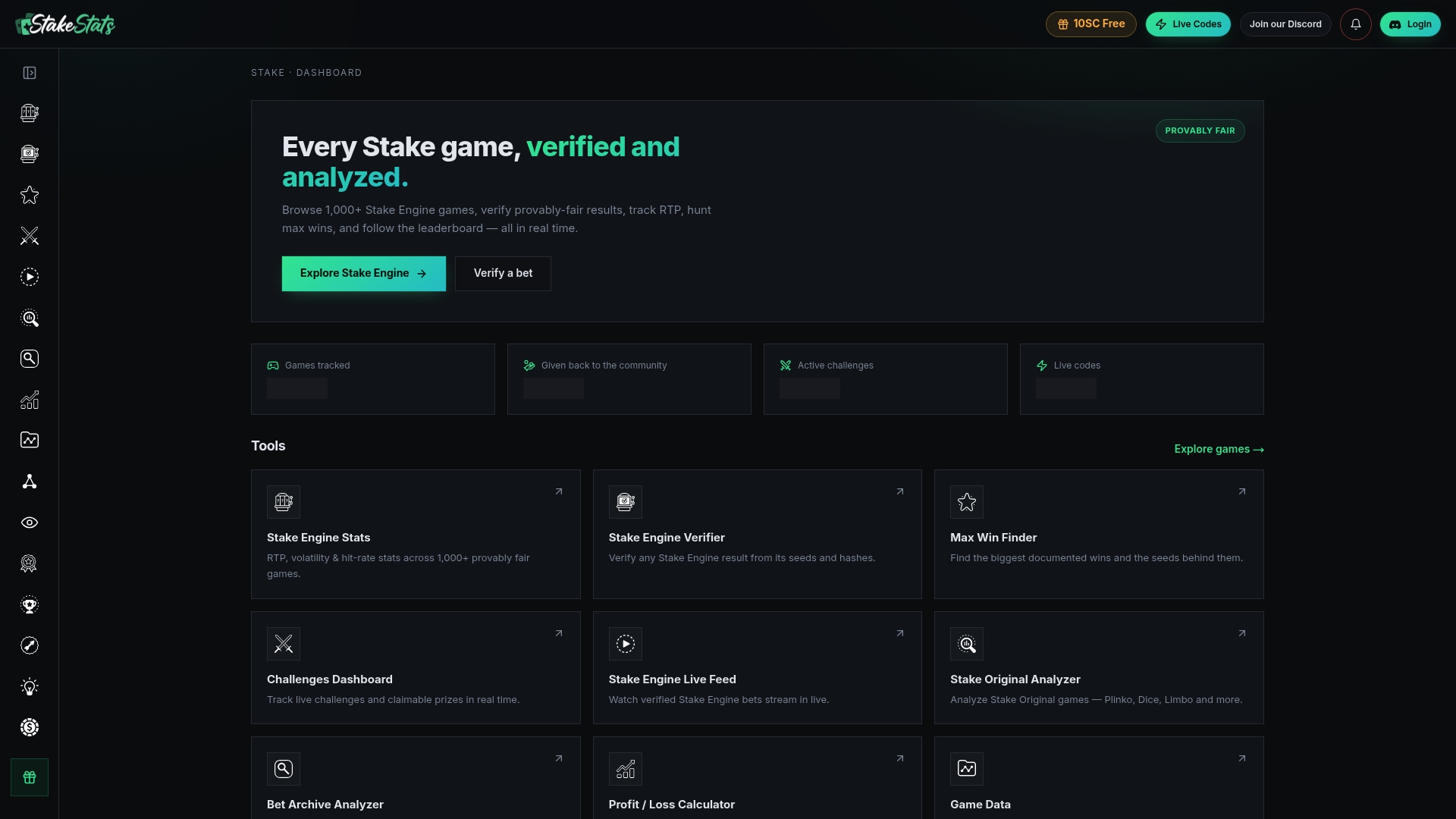
If you are choosing a game for your next session, start from the Stakestats home page, find the title, and set your spin budget against its numbers before you play.
Our view: the wait is a math problem, so treat it like one
Most of the frustration around bonus waits comes from treating them as a feeling. A game "feels cold," so players raise the bet. A bonus "feels due," so they stay ten minutes longer. Neither feeling has any basis in how the game works.
We built Stakestats around the idea that players deserve the numbers. When RTP, volatility and hit rate are visible for thousands of games, and when you can verify a bet with its server seed and nonce, the conversation changes from superstition to arithmetic. You can see how a game behaves, size your session to match, and decide before the first spin how much waiting you can afford.
Our guides follow the same approach: practical verification steps, math-driven planning and transparent payout data. A bonus round is a feature with a probability and a price. Once you know both, you play on your terms.
Ian
FAQ
How many spins does it usually take to hit a slot bonus?
It depends on the game. Many high-volatility slots trigger a bonus roughly once in 200 to 400 spins on average, while lower-volatility titles trigger more often. Treat that as an average over a very long run. Plan for about three times the published interval if you want a high chance of seeing one in a session.
Is a slot bonus "due" after a long dry streak?
No. Each spin is independent, so the odds are the same after 20 dead spins or 600. Long streaks without a bonus are normal and so are bonuses that come back to back. Raising your bet to catch up does not improve your chances.
Does a bonus buy change the time to bonus?
It removes the wait by charging you up front, usually 50x to 100x your base bet. The game's published return is unchanged, but your session becomes more concentrated and swings more. Budget based on the buy price, not the base bet.
Where do I find a game's bonus frequency?
Open the in-game paytable for the rules, RTP and volatility rating, and then check observed hit rate and RTP stats for the game on Stakestats. A few hundred spins of your own are too few to judge a rare bonus, so rely on large samples.
Sources
- USA Today: How to Play Online Slots for Real Money
- Casino City Times: Slot odds and bonuses
- Chase The Scatter: How to Read a Slot Paytable
- Free Press: How to play slots for real money online in the U.S.
- BonusScorer: Set Your Own Bonus Limits