
Use Game Theory in Betting: A Practical Crypto Guide

Treating a sportsbook or provably-fair casino as a passive payout machine is the single most expensive mistake a serious bettor makes. A game-theory approach reframes every wager as a strategic interaction: the book, the sharps, and the recreational public are all agents with their own incentives, and your edge depends on modeling them, not just the outcome. Start with three moves: verify your provably-fair seed, read the line-movement signal, and pick a mixed-strategy template before sizing.
- Nash equilibrium sets the theoretical floor: no agent can improve by changing strategy alone, so your goal is to find where the market has drifted away from that equilibrium.
- Kelly criterion converts your probability edge into a stake size, but it needs a game-theoretic wrapper when outcomes are correlated or opponents are adaptive.
- Stakestats provides the verification, replay, and bankroll tools that make this framework operational on provably-fair platforms.
Table of Contents
- How to use game theory in betting: the core concepts
- When should you use game theory vs. pure Kelly sizing?
- Step-by-step: build a strategy on provably-fair crypto platforms
- Tools and data feeds you need to run this
- Worked numeric examples
- Model limits, detection risk, and legal notes for U.S. bettors
- How to backtest and monitor your strategy
- Key Takeaways
- Why game theory is the right lens for provably-fair crypto betting
- Stakestats gives you the data layer this strategy requires
- Useful sources
How to use game theory in betting: the core concepts
Game theory treats the betting market as a multi-agent system where your payoff depends on what everyone else does, not just what the outcome is. That single shift in framing changes everything about how you prepare.
GTO (Game Theory Optimal) means playing a mixed strategy so no opponent can exploit a predictable pattern in your selections or stakes. In poker it is well-documented; in sports betting it means varying which lines you take and when, so the book cannot profile your action.
Mixed strategies are the practical output of GTO thinking. Instead of always backing the sharp side when steam moves a line, you randomize your entry point and occasionally fade the move. The goal is not to be random for its own sake but to stay unexploitable while still capturing expected value.

Nash equilibrium in a two-agent spread market means both the book and the bettor have settled into strategies neither wants to deviate from unilaterally. When a line moves without obvious public cause, that equilibrium has been disrupted by private information — a sharp bet. Line movement is therefore a signal to decode, not just a price to react to.
| Concept | What it means in practice |
|---|---|
| GTO / mixed strategy | Randomize selection and timing so the book cannot model your behavior |
| Nash equilibrium | Identifies where market pricing has drifted from the strategic balance |
| Information asymmetry | Sharp line moves signal private information; public moves signal bias |
| Signaling | Early steam = institutional edge; late public surge = fading opportunity |
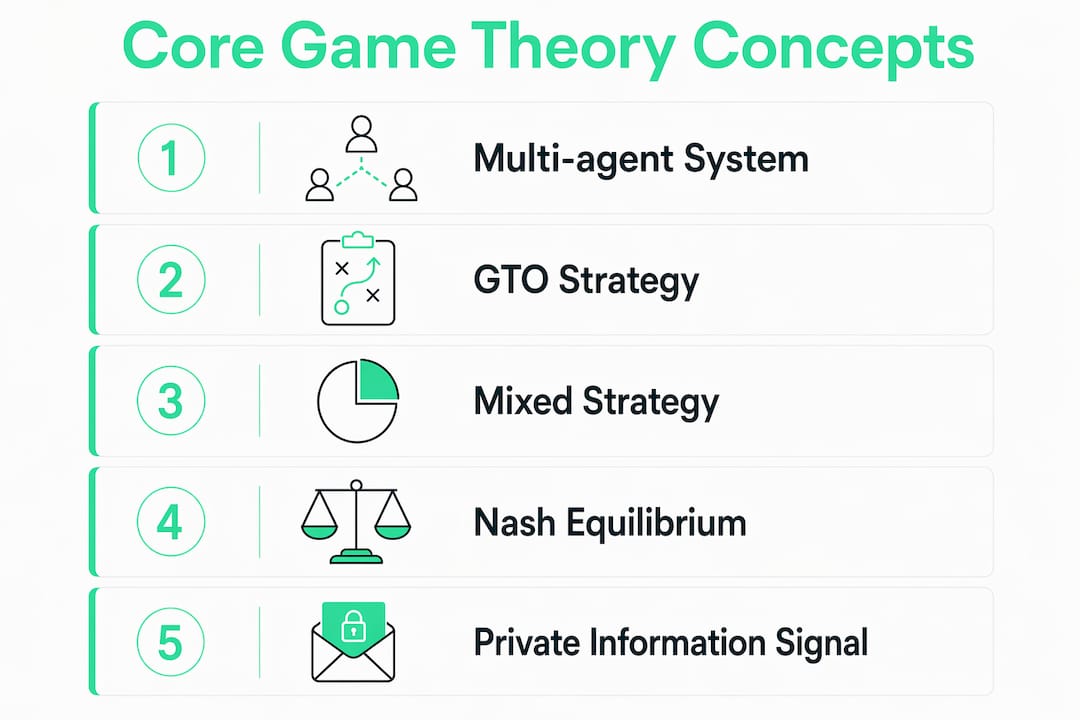
Pro Tip: When a line moves two or more points before significant public volume, treat it as a private-information signal and update your model probability before deciding whether to follow or fade.
When should you use game theory vs. pure Kelly sizing?
The answer depends on market conditions, not personal preference. Prediction markets are N-player imperfect-information games, and the right tool shifts with the competitive environment.
UC Berkeley research on betting pools shows that strategies modeling opponent behavior significantly outperform simple score-maximizing approaches, sometimes by orders of magnitude. That gap widens in larger pools where crowd avoidance becomes the primary lever.
Karl Whelan's work on utility-maximizing strategies adds a critical nuance: when outcomes are correlated, the optimal allocation sometimes deviates from two-outcome Kelly, occasionally recommending a negative-EV hedge to protect aggregate utility.
| Market condition | Recommended approach |
|---|---|
| Low liquidity, personal model edge | Exploitative sizing (full or fractional Kelly) |
| High-volume, sharp-heavy market | GTO mixed strategy to reduce detectability |
| Correlated multi-bet portfolio | Utility-based sizing with hedging (Whelan framework) |
| Soft recreational market | Hybrid: exploit bias, randomize execution timing |
Pro Tip: Use fractional Kelly (half or quarter) as your default. Full Kelly is theoretically optimal but requires a perfectly calibrated model — a standard no live bettor consistently meets.
Step-by-step: build a strategy on provably-fair crypto platforms
- Verify the provably-fair seed. Before any session, confirm the server seed hash and client seed via the provably-fair verification tool. This is not optional — it is the foundation of your model assumptions.
- Profile market participants. Identify whether the current market is sharp-dominated or public-heavy by watching line movement relative to volume. Sharp markets require GTO play; soft markets reward exploitation.
- Choose a mixed-strategy template. Define your randomization rule: for example, follow steam 60% of the time and fade 40%, varying the ratio based on your read of the information signal.
- Set sizing via Kelly or hybrid utility. Calculate your edge against the closing line, then apply fractional Kelly. For correlated bets, apply the Whelan utility framework to avoid over-concentration.
- Randomize execution timing. Vary the gap between your decision and your bet placement. Consistent timing patterns are detectable. Use TWAP-style spacing when placing multiple bets in a session.
- Configure monitoring. Log every stake, the line at bet placement, and the closing line. Set alerts for sudden divergence between your model probability and market movement.
Pro Tip: Add small random noise to your stake sizes within your confidence bounds — for example, ±5% of your calculated Kelly stake. This preserves expected return while making your sizing pattern harder to fingerprint.
Tools and data feeds you need to run this
The data layer is where most bettors underinvest. A game-theory strategy without live feeds is just theory.
- Provably-fair seed logs: Stakestats' seed verification tool gives you a replay-ready audit trail for every game outcome.
- Stake Originals Analyzer: The Originals Analyzer surfaces RNG patterns and replay data, which is the closest equivalent to order-flow analysis on a provably-fair platform.
- Bankroll analyzer: The bankroll analyzer maps Kelly sizing recommendations to drawdown scenarios so you can stress-test your allocation before going live.
- Line-movement trackers: For sports markets, live odds APIs and closing-line trackers are your primary signal feeds. U.S.-facing users should confirm geo-availability for any third-party odds service.
- On-chain transaction feeds: For crypto platforms, public blockchain data can confirm deposit and withdrawal patterns that correlate with sharp action timing.
| Tool | Primary use | Maps to step |
|---|---|---|
| Provably-fair verification | Seed audit, RNG confirmation | Step 1 |
| Stake Originals Analyzer | Replay, pattern detection | Steps 2, 6 |
| Bankroll analyzer | Kelly sizing, drawdown planning | Step 4 |
Worked numeric examples
Example A: mixed-strategy frequency for a two-outcome market
Assumptions: Market implied probability for Team A is slightly over half after vig removal. Your model probability suggests a higher chance of winning. The vig is moderate.
Your edge = 57% − 52% = 5 percentage points. In a GTO framework, you do not bet Team A every time. You bet Team A with frequency f such that the book cannot profitably adjust its line against you alone.
A simple mixed-strategy frequency might be to bet Team A most of the time and occasionally abstain or take the other side. This preserves expected value while reducing your detectability profile.
Example B: Kelly-augmented allocation with correlated outcomes
Assumptions: Two correlated bets, both on the same game (moneyline + total). The model suggests a small positive edge on each. The correlation between outcomes is moderate.
The Whelan adjustment recommends reducing each stake to account for the shared variance. Placing full Kelly on both bets would over-expose the bankroll to a correlated outcome.
Pro Tip: Run this calculation in a spreadsheet before every multi-bet session. The math takes two minutes and prevents the most common bankroll blowup pattern: stacking correlated bets at full size.
Model limits, detection risk, and legal notes for U.S. bettors
Every model breaks eventually. The two most common failure modes are overfitting to a short sample and assuming market stationarity when books are actively adjusting their pricing algorithms.
Sportsbooks detect patterns through stake-size consistency, timing regularity, and closing-line value that persistently favors one account. When they identify a sharp bettor, account limits follow. Randomizing your sizing and timing, as described in Step 5, extends your runway but does not eliminate the risk.
Manage variance by treating your active bets as a portfolio. Hedge correlated outcomes when the cost of the hedge is less than the reduction in worst-case loss. Use drawdown limits, not single-bet EV, as your primary risk metric.
U.S. bettors: follow your state's gambling laws and report winnings per IRS requirements. This article is general information, not legal or tax advice — confirm current rules with a qualified professional for your situation.
How to backtest and monitor your strategy
- Design the backtest. Select a sample of at least 200 historical bets. Split into training and validation sets. Simulate line movement to test whether your edge survives closing-line pressure.
- Run cross-validation. Test your mixed-strategy frequency across different market conditions: sharp-heavy weeks, public-heavy weeks, and low-liquidity periods.
- Stress-test information asymmetry. Introduce simulated sharp moves into your historical data and measure how often your model would have correctly identified the signal.
- Go live at minimum stakes. Use provably-fair replays via the Stake Originals Analyzer to verify RNG behavior before scaling. Log every bet with the line snapshot at placement.
- Monitor closing-line value (CLV). Positive CLV over 50+ bets is the strongest signal that your model has real edge. Negative CLV means the market consistently knows more than you do.
- Watch for detection signals. If lines move against you immediately after placement more than 30% of the time, your flow is being read. Adjust timing and sizing.
Track these metrics weekly: edge over closing odds, drawdown duration, strike rate vs. model probability, and frequency of adverse line moves post-bet. Any metric that deteriorates for three consecutive weeks triggers a model review.
Key Takeaways
Game theory converts betting from outcome prediction into strategic interaction modeling, and that shift is what separates durable edges from lucky streaks on provably-fair crypto platforms.
| Point | Details |
|---|---|
| Verify provably-fair first | Confirm server and client seeds before every session using Stakestats's verification tool. |
| Use mixed strategies | Randomize selection frequency and timing to stay unexploitable, not just to be unpredictable. |
| Adjust Kelly for correlation | Apply the Whelan utility framework when bets share outcomes; full Kelly overstates safe stake size. |
| Monitor closing-line value | Positive CLV over 50+ bets is the clearest evidence your model has genuine edge. |
| Stakestats tools map to each step | The Originals Analyzer, bankroll analyzer, and seed verification tool cover Steps 1, 4, and 6 of the how-to checklist. |
Why game theory is the right lens for provably-fair crypto betting
Most bettors spend 90% of their prep time on outcome prediction and almost none on market structure. That is backwards. On a provably-fair platform, the RNG is auditable, which means the information asymmetry problem shifts: the question is no longer whether the game is fair but whether your strategy is unexploitable by the platform's pricing and the behavioral patterns of other players.
Game theory forces you to ask the right question: not "will this outcome happen?" but "given what every other agent knows and will do, what is my optimal response?" That reframe is what makes the methodology durable. Provably-fair transparency shortens the detection latency for RNG anomalies and gives you a replay layer that traditional sportsbooks never offer. Stakestats is built around exactly that transparency layer, which is why the verification and analyzer tools map so cleanly to the steps above.
Stakestats gives you the data layer this strategy requires
The game-theory framework above only works if you can verify, replay, and monitor. Stakestats covers all three for provably-fair platforms.

The provably-fair verification page handles Step 1 of the checklist. The Stake Originals Analyzer gives you replay and pattern detection for Steps 2 and 6. The bankroll analyzer converts your Kelly calculations into a staking plan with drawdown guardrails. Start by verifying one past game session, run the Originals Analyzer on your recent history, and use the bankroll tool to set your sizing before your next session. All three are available at Stakestats.
Useful sources
- Optimal Strategies for Sports Betting Pools — UC Berkeley paper; start here for the mathematical case that modeling opponent behavior outperforms score maximization.
- On Optimal Betting Strategies — Karl Whelan — The foundational paper on utility-based sizing and correlated-outcome hedging.
- Game Theory and Sports Betting — Ariel Calista (Part 1) — Applied primer on market structure and information asymmetry.
- Playing with the House — Ariel Calista — Practical guide to reading line movement as an adversarial signal.
- Game Theory for Prediction Market Agents — AgentBets — Covers Nash framing, Kyle lambda, and execution techniques (TWAP/VWAP) for live markets.
- Unlocking Sports Betting Success with Game Theory — t-bet.gr — Applied overview of Bayesian updating and mixed strategies for sports bettors.
- Stakestats provably-fair explanation — Seed verification mechanics and how transparency changes your model assumptions.
- Stake Originals Analyzer — Stakestats — Replay and RNG pattern detection for Stake engine games.