
Players: Verify Any Game's RTP With Play Logs and Lab Certificates

Using RTP data means one thing in practice: divide total wins by total turnover for a real play sample, then compare that number to the game's certified theoretical RTP. If the gap is small, the game is behaving normally. If it's large and the sample is big enough to matter, verify the build against an independent lab certificate before you trust the published number.
TL;DR:
- Small short-term deviations from theoretical RTP are normal due to random variance, especially with fewer than several thousand spins on high-volatility games.
- Published RTP figures often vary between different game versions, and operators may run lower-RTP bands for profit, so verify the specific build or certification date whenever possible.
- Achieving a reliable assessment of a game's RTP requires large sample sizes, typically tens of thousands of rounds, and should include cross-referencing with independent lab reports.
- Using tools that track real-time RTP and reconstruct provably fair outcomes enables players to independently verify if the game is behaving according to its certified parameters.
- RTP should not be mistaken for short-term predictability or a guarantee; it is a long-run average that depends heavily on sample size, volatility, and accurate certification.
Table of Contents
- How Do You Calculate Actual RTP From Play Logs?
- Why Do Short Sessions Deviate So Much From Theoretical RTP?
- Why Does Published RTP Sometimes Not Match What You Actually Get?
- What's the Actual Workflow for Verifying RTP Data?
- What Documents Actually Prove a Game's Certified RTP?
- What Is RTP and Why Does It Matter to You as a Player
- What Do People Get Wrong About RTP Most Often?
- What Regulations Govern RTP Disclosure?
- How Does RTP Relate to House Edge?
- Do Slots and Table Games Have Different RTP Ranges?
- A Verification Habit Worth Building
- Turn RTP Data Into Something You Can Actually Verify
- Sources
- FAQ
How Do You Calculate Actual RTP From Play Logs?
Return to Player, in its simplest form, is a ratio: RTP = Total Wins ÷ Total Turnover, expressed as a percentage. Turnover means every dollar wagered, not your deposit amount and not your net result. Wins means every dollar returned to you across those same bets, including pushes and partial payouts.
Here's the arithmetic with real numbers.
To pull the real inputs for this calculation:
- Export your session history from the casino's account statement or bet log, which most licensed sites provide as a downloadable CSV.
- Pull provably fair logs if you're playing on a provably fair platform. Each bet's server seed, client seed, and nonce let you reconstruct outcomes independently rather than trust a dashboard number.
- Cross-check against site-published stats where available, since some platforms display running RTP for specific games in real time.
- Sum turnover and wins separately before dividing. Mixing net profit into the formula is the single most common calculation error players make.
The Gambling Commission's worked example uses this exact wins-over-turnover method. It's the same math regulators use to audit operators.
Why Do Short Sessions Deviate So Much From Theoretical RTP?
A single session almost never matches the certified number, and that's not a red flag. It's math. RTP is a long-run average built on the law of large numbers: the more independent trials you run, the closer your realized RTP converges toward the theoretical figure. Each spin or hand is statistically independent of the last, so a cold streak doesn't "owe" you a hot one.
Volatility (also called variance) determines how wide that short-term spread gets. A low-volatility game might keep your realized RTP within a couple of points of theoretical after just a few hundred rounds. A high-volatility slot with rare, massive jackpots can run thousands of dollars below theoretical RTP for tens of thousands of spins, then spike hard on one hit.
Key factors that widen or narrow your confidence band:
- Sample size: more rounds narrows the tolerance range around theoretical RTP.
- Volatility rating: higher variance means wider swings before convergence.
- Bet consistency: flat betting produces cleaner data than wildly varying stake sizes.
- Game type: jackpot slots deviate further than fixed-payout table games over the same sample.
Statistic Callout: Sample-size tolerance tables from the Gambling Commission show confidence bands narrowing as play volume increases. A few hundred rounds can produce deviations of several percentage points, while tens of thousands of rounds bring realized RTP much closer to the certified figure.
If your sample is small, a deviation of a few points isn't evidence of anything broken. If your sample is large and the deviation persists, that's when it's worth asking questions.
Why Does Published RTP Sometimes Not Match What You Actually Get?
Here's something a lot of players never learn: the RTP printed on a game info screen isn't always the RTP that game is running. Studios frequently build multiple RTP versions of the same title, sometimes called bands, and operators choose which version to deploy on their platform.
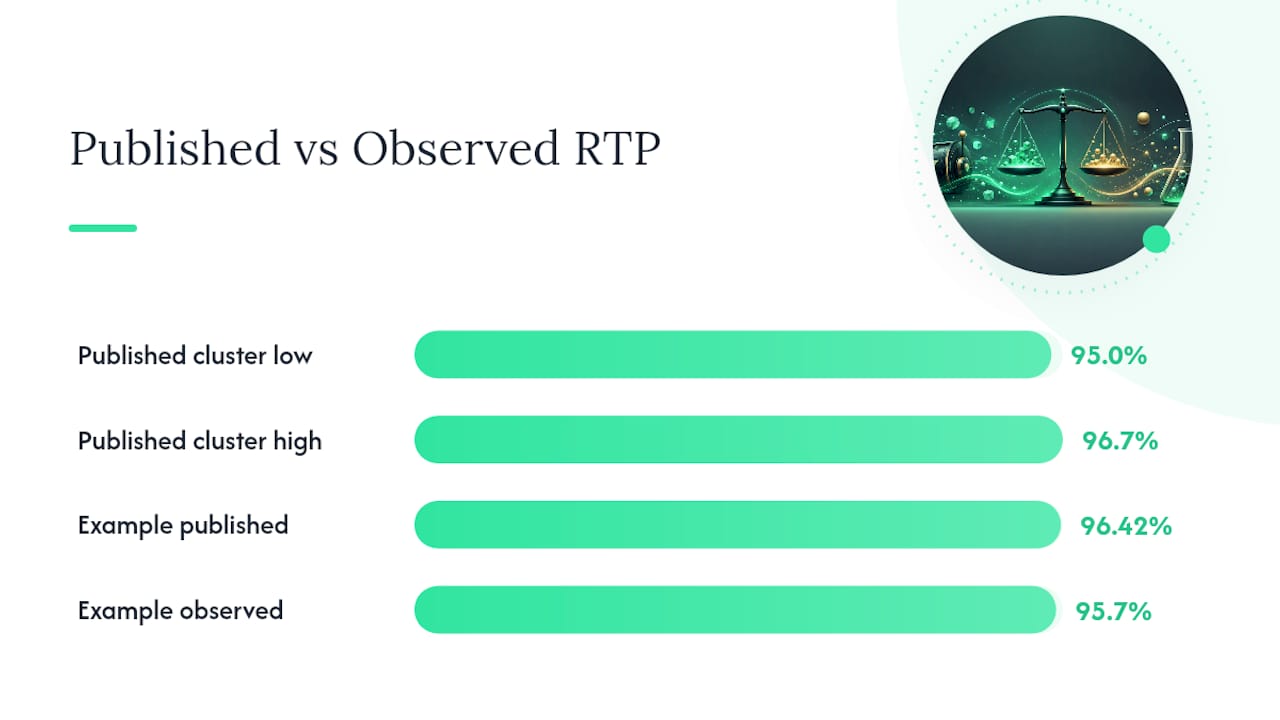
Published slot RTP defaults typically cluster between 95.0% and 96.7% industry-wide, according to provider benchmark data.
Why does this happen?
- Regulatory minimums set a floor, not a fixed value, so operators have room to choose within an approved range.
- Commercial incentives push some operators toward lower-RTP bands on higher-traffic titles to improve margins.
- Marketing materials often cite the studio's default or "reference" build rather than the specific configuration live on that operator's platform.
- Promotional periods sometimes run a temporarily boosted band, which reverts afterward.
Pro Tip: Never trust an RTP number that isn't paired with a build or certification identifier. If a site can't tell you which version is running, treat the published figure as a marketing default, not a guarantee.
An open-source measurement project comparing published versus observed returns found spreads where a site listed 96.42% but measured performance came in closer to 95.7%. One example isn't proof of a pattern, but it shows measurement and marketing don't always agree.
What's the Actual Workflow for Verifying RTP Data?
A repeatable process beats a one-off spreadsheet. Here's the sequence that turns raw play data into a defensible verdict on whether a game is behaving as advertised.
- Export turnover and wins for the full period you want to measure, ideally from account statements rather than memory or screenshots.
- Compute realized RTP using wins divided by turnover, exactly as covered above.
- Estimate your confidence interval using the game's stated volatility, or approximate it with a regulator sample-size table if you don't have exact variance figures.
- Compare realized RTP to the certified theoretical RTP for that exact build, not a generic figure from a review site.
- Check certification date and build identifier to confirm you're comparing against the version actually running.
- If the deviation exceeds your tolerance band, request RGS configuration logs or lab certificates from support before concluding anything is wrong.
For monitoring beyond a single audit, several tool categories matter. Live RTP dashboards recalculate running return metrics at short intervals using telemetry from active play data, which is useful for spotting anomalies but doesn't replace the certified theoretical figure as your baseline. Provably fair proofs let you reconstruct individual bet outcomes cryptographically rather than trust a summary number. Independent lab reports remain the authoritative record of what a game is certified to pay out long-term.
Bankroll sizing matters just as much as the math. If you're testing a volatile slot, a session of 200 spins tells you almost nothing statistically reliable. Standard guidance treats RTP as a long-run expectation and recommends sizing your bankroll to survive variance, not to chase a short-term number back toward theoretical.
Pro Tip: If you're tracking RTP across a large session, size your bankroll to withstand at least 200 to 500 bets on high-volatility games before drawing any conclusion from the data.
What Documents Actually Prove a Game's Certified RTP?
Not every "certificate" you see referenced is worth much. The documents that matter carry specific fields: the exact game build or version number, the certification date, and the testing lab's name.
Independent labs calculate theoretical RTP through exhaustive combination evaluation or simulator programs for games with too many outcomes to enumerate by hand. That lab report, not a casino's marketing page, is the authoritative source for a specific build's certified RTP.
What to check and ask for:
- The build/version identifier tied to the RTP figure, since one title can have several certified versions.
- The certification date, because a game can be recertified after a math update.
- The testing lab's name (GLI and similar independent labs are common in the industry).
- RGS configuration logs for your specific play period, if you're disputing a discrepancy with support.
If support can't produce a build identifier or certification date, escalate. A vague "our games are certified fair" answer with no document attached isn't verification, it's a slogan.
What Is RTP and Why Does It Matter to You as a Player
RTP tells you what percentage of everything wagered on a game gets returned to players over a very large number of rounds.
This number matters because it's the closest thing gambling offers to a published price tag. Two slots that look identical in theme and pacing can have meaningfully different long-run costs to play.
RTP also tells you nothing about short-term outcomes on its own. It's a statistical destination, not a session forecast. That distinction trips up more players than any other single misunderstanding about how these games work, and it's why pairing RTP awareness with basic bankroll discipline matters more than memorizing percentages.
Different game categories express RTP differently too. A single number represents an entire paytable and bonus structure on a slot, while a table game's RTP often comes from a fixed, calculable rule set. Understanding which type you're looking at changes how much weight the number deserves in your decision making.
What Do People Get Wrong About RTP Most Often?
The biggest misconception is treating RTP as a per-session guarantee. It means that outcome emerges only after an enormous number of independent rounds, often far more than any individual plays in a lifetime on one specific game.
A second common error: assuming RTP predicts your next spin. Each round is statistically independent. A machine that's paid out well below its RTP for the last thousand spins isn't "due" for a correction on the next one, and a machine running hot isn't about to cool off because the math says so.
A third mistake is confusing RTP with your odds of winning any given bet. RTP describes long-run payout proportion, not win frequency. A game can have a high hit rate (you win often) but a low RTP (the wins are small relative to turnover), or the reverse: rare wins that are large enough to keep RTP high.
Finally, plenty of players assume RTP is fixed and universal for a named title. As covered earlier, operators often run different certified bands of the same game, so the RTP quoted in a review might not match what's live on your specific platform. Always anchor your expectations to the certified figure for the exact build you're playing, not a number pulled from a general search result.
What Regulations Govern RTP Disclosure?
Licensed operators in regulated markets are generally required to make RTP information available to players, though the specific disclosure format and minimum RTP thresholds vary by jurisdiction and license type. The UK's Gambling Commission, for instance, publishes formal guidance on how RTP must be calculated and communicated, including the sample-size and tolerance methodology referenced earlier in this piece.
Independent testing labs play a central regulatory role here. Before a game reaches a regulated market, it typically needs certification from an accredited testing lab confirming the theoretical RTP matches what the operator claims. This certification process, using exhaustive mathematical evaluation, is what gives the number legal weight rather than just marketing weight.
Where regulation gets less consistent is in real-time disclosure. Some jurisdictions require RTP to be visible within the game's information screen; others leave display practices largely up to the operator. This patchwork is part of why independent verification tools and provably fair systems have become valuable additions rather than regulatory replacements. Regulation confirms the theoretical number is accurate; it doesn't guarantee an operator prominently displays the correct build's figure in every market.
How Does RTP Relate to House Edge?
RTP and house edge are two sides of the same coin. There's no separate calculation needed. One is just the inverse expression of the other.
The distinction matters for how you think about a game. RTP frames the number as what you get back; house edge frames it as what the operator structurally keeps over the long run. Both describe identical math, but house edge tends to make the cost of play more intuitive, since it directly states the percentage the house retains from every dollar wagered across a large enough sample.
This relationship holds across every casino game category, from slots to table games to live dealer formats. Neither number changes what happens in your next ten hands, but over thousands of hands the gap compounds meaningfully in your favor or against it.
Do Slots and Table Games Have Different RTP Ranges?
Yes, and the gap is bigger than most players realize. Slots as a category show the widest RTP range of any casino game type, with published defaults commonly landing between 95.0% and 96.7%, though configured floors can drop into the mid-80s depending on the specific build an operator chooses to run.
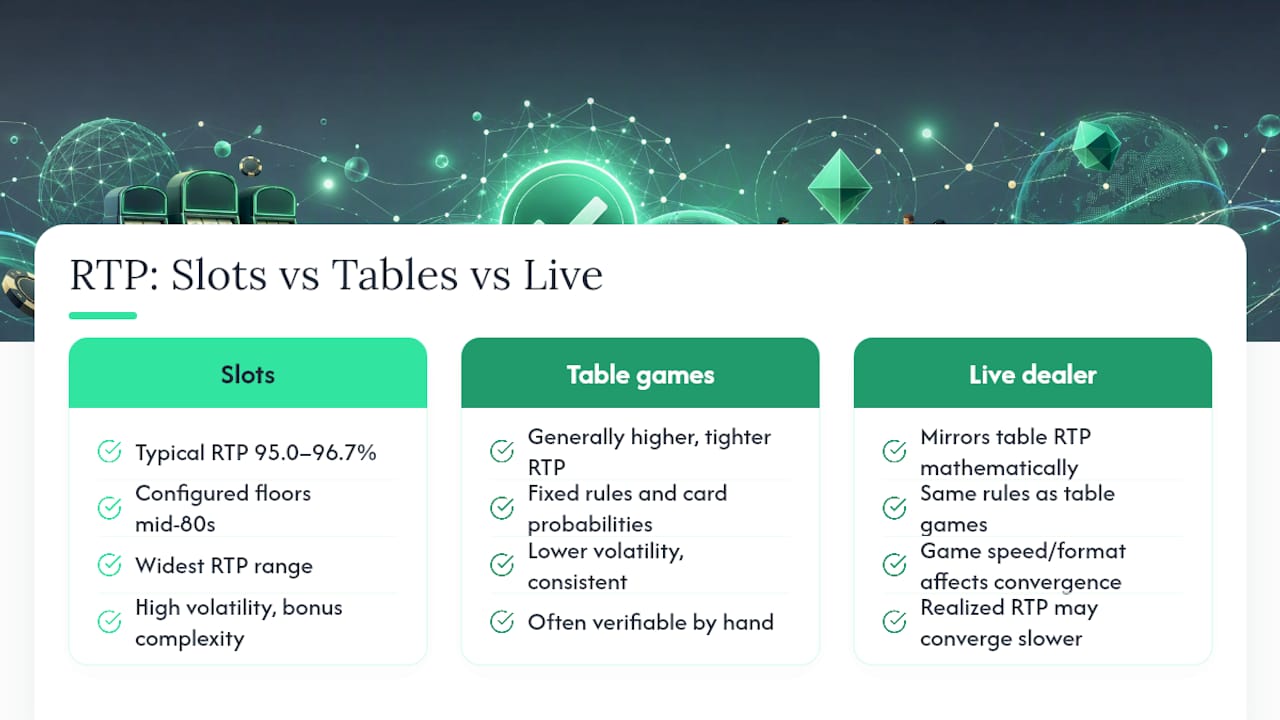
Table games tend to run tighter and generally higher. These figures come from fixed rule sets and card probabilities rather than a programmable paytable, which is part of why they're more consistent from one operator to the next.
Live dealer games generally mirror their table game equivalents mathematically, since the underlying rules don't change, but the game speed and format can affect how quickly your realized RTP converges toward the theoretical number.
The practical takeaway: don't compare a slot's RTP directly against a table game's RTP as if they're interchangeable metrics for the same kind of risk. Slot RTP incorporates far more bonus feature complexity and volatility, while table game RTP reflects a more direct mathematical relationship you can often verify by hand using basic probability.
A Verification Habit Worth Building
Ian's take, grounded in years of watching provably fair data get misread: most players never check the build identifier behind a published RTP, they just trust the number on the screen. Once you start cross-referencing realized RTP against certified figures instead of marketing claims, you stop arguing with variance and start asking better questions of operators.
— Ian
Turn RTP Data Into Something You Can Actually Verify
Reading about RTP math is one thing. Having the numbers in front of you, updated as you play, is another. Stakestats gives you real-time RTP, volatility, and hit rate stats across more than 2,500 Stake Engine games, so you're comparing your realized numbers against live data instead of a static review page.

If you're auditing your own play, the provably fair verifier lets you reconstruct server seed and nonce data directly rather than take a dashboard's word for it. Pair that with the bankroll analyzer to size your sessions properly before drawing conclusions from a small sample, and check the transparency tools page to see live RTP monitoring in action. Start by pulling up a game you already play and compare its realized numbers against what's certified.
Sources
- Slot RTP Benchmarks by Provider 2026: Reference Table
- How to calculate return to player (RTP)
- Casino & Gaming RTP Analysis (Percentage Return to Player) - GLI
- The evolution of RTP live: tracking short-term variance in modern systems - UsbDaily
FAQ
What Is RTP in Gambling?
RTP, or Return to Player, is the percentage of total wagers a game returns to players over a very large number of rounds, calculated as total wins divided by total turnover.
How Do I Calculate Actual RTP From My Own Play?
Divide your total wins by your total turnover for the session or period you're measuring, using exported account statements or provably fair logs rather than net profit figures.
Why Doesn't My Realized RTP Match the Published Number?
Short-term variance, small sample sizes, and the possibility that your operator runs a different certified RTP band than the one referenced in reviews or marketing materials.
How Many Rounds Do I Need for RTP to Be Reliable?
There's no single fixed threshold, but regulator sample-size tolerance tables show confidence bands narrowing substantially only after tens of thousands of rounds, especially on higher-volatility games.
Can I Verify RTP Without Waiting for a Support Response?
Yes. Tools like Stakestats provide real-time RTP tracking and provably fair verification, so you can check server seed and nonce data directly instead of relying solely on operator disclosures.