
Verify Server Seeds in Seconds: SHA-256 and HMAC for Crypto Gamblers

To verify a server seed hash, run the revealed server seed through SHA-256 and confirm the digest matches the pre-bet commitment the operator published before you played. Then reproduce the round itself: use the server seed as the HMAC key together with your client seed and nonce, and check that the output maps to the result you were shown. A matching hash confirms the operator did not swap seeds after the fact, and nothing more. It says nothing about house edge, payout accuracy, or whether the game is worth playing.
TL;DR:
- Verifying a server seed hash with SHA-256 confirms the seed was not swapped after the round but does not verify payout accuracy or fairness over time.
- Accurate reproduction of a game's outcome requires using HMAC-SHA256 with the server seed as the key, formatted message, and correct slice/conversion steps.
- Common verification errors include hashing the wrong string, using digest instead of HMAC, or mismatched nonces and message formatting.
- Tools like the Stake Originals Analyzer can automate round checks but only confirm round integrity, not operator solvency or long-term fairness.
- Regularly recording commitments before betting and running independent verifications improve transparency and trustworthiness of provably fair gameplay.
Table of Contents
- Step-by-step checklist to verify and reproduce a round
- Which cryptographic tools handle each step safely
- What a matching hash actually proves
- Why your verification failed and how to fix it
- Where StakeStats fits into this checklist
- A habit worth building into your sessions
- Put the checklist to work on your own rounds
- Sources
- FAQ
Step-by-step checklist to verify and reproduce a round
Before touching a calculator, gather everything the check depends on. You need the pre-bet hash the operator showed you (the commitment), the revealed server seed, your client seed, the nonce or cursor for that specific bet, and the operator's documented message format and conversion formula. Skipping any one of these is the most common reason a verification attempt fails before it starts.
- Check the commitment. Hash the revealed server seed with SHA-256 and compare the result, character for character, against the commitment you were shown before the bet. If they do not match, stop and record everything: the mismatch itself is the finding.
- Identify the algorithm. Find out whether the operator uses HMAC-SHA256 (the common approach) or a plain digest over a fixed message. This detail decides which function you run next, and guessing wrong produces a hash that looks valid but proves nothing.
- Confirm the message format. Operators format the input string differently, often something like
clientSeed:nonceorgame-clientSeed:nonce. Get this exact, including separators and capitalization, from the operator's own provably fair verification guide, which describes this two-step process of checking commitment first and reproducing the outcome second. - Compute the HMAC and convert. Run HMAC-SHA256 with the server seed as the key and the formatted message as the input, then take the documented slice of hex characters (often the first 8), convert that to an integer, and apply the operator's modulo or division rule. For a simple dice game, that might look like:
hmac = HMAC-SHA256(key=serverSeed, message="clientSeed:nonce"), thenroll = parseInt(hmac.slice(0,8), 16) % 10000 / 100, giving a result between 0 and 100. - Log the round. Save the commitment, the revealed seed, the client seed, the nonce, and your computed digest before you move to the next bet, since seeds and nonces are much harder to reconstruct after the fact.
Pro Tip: Keep a plain text file of every commitment the moment you see it, before the round resolves. If you only save the revealed seed afterward, you have no independent record to check it against.
Which cryptographic tools handle each step safely
The commitment check and the outcome check use two different cryptographic primitives, and mixing them up is the single most common source of confusion. A plain digest, produced by crypto.subtle.digest('SHA-256', data), takes one input and returns a fixed-length hash. This is enough to confirm the revealed seed matches the pre-bet commitment. Reproducing the actual game result is a different job: it requires a keyed HMAC, computed through crypto.subtle.sign after importing the server seed as an HMAC key, according to the Web Crypto API documentation. An ordinary SHA-256 digest of the same concatenated string is not interchangeable with HMAC-SHA256 output, even when the inputs look similar.
You can run both checks in a browser without installing anything, using the Web Crypto API directly, or using a vetted independent calculator. A few rules keep that process safe:
- Never paste a wallet seed phrase or private key into any verification tool. Server seeds for provably fair games are unrelated to wallet security, but the habit of pasting sensitive strings into unknown pages is the risk.
- Confirm any third-party calculator runs the computation locally in your browser rather than sending the string to a server, since a local computation cannot leak your inputs.
- Prefer open, inspectable scripts over black-box tools when reproducing an outcome, since you want to see the exact message format and slice logic being applied.
SubtleCrypto's digest() method returns an ArrayBuffer, not a readable string, so MDN's documentation shows converting it to a hex string before comparison, and includes fallback code for browsers that lack newer typed-array helpers. That conversion step is where a surprising number of manual verifications go wrong.
What a matching hash actually proves

A matching SHA-256 digest proves commitment integrity: the server seed you were shown after the round is the same one the operator locked in before it started. NIST's cryptographic hash function guidance explains why this works. Secure hashes are collision resistant and produce a fixed-length digest, which makes it computationally infeasible for an operator to substitute a different seed after seeing your bet while still matching the published commitment.
That is a narrower claim than most players assume. A matched hash does not tell you anything about:
- Return to player or house edge. Reproducibility confirms the math behind one round, not whether the underlying odds favor you over time.
- Payout accuracy. The digest check has no connection to whether winnings are credited correctly or paid out at all.
- Long-run fairness. A single reproduced roll shows the formula worked once. Continuous nonce sequences and accessible round records across many bets give you a stronger picture than any one check.
If a hex digest is 4f2a9c1e... and the operator's rule takes the first eight characters, converts them to an integer, and applies modulo 100, you can confirm the displayed roll matches that math. That proves the round was generated as described. It says nothing about whether the game's payout table is generous.
Why your verification failed and how to fix it
Most failed verifications come down to a handful of repeatable mistakes rather than a broken system. Work through them in order before concluding anything is wrong on the operator's end.
- Wrong string hashed. Confirm you hashed the revealed server seed itself, not the pre-bet hash or a truncated copy of the seed. This is the single most common error.
- Digest instead of HMAC, or the reverse. If you're trying to reproduce a result and only ran a plain SHA-256 digest, you used the wrong primitive; check the operator's documentation again for which one applies.
- Missing or wrong nonce. A single off-by-one error on the nonce produces a completely different digest, so confirm the nonce matches the exact bet you're checking, not an adjacent one.
- Wrong separator or encoding. A message format of
clientSeed:nonceversusclientSeed-nonceproduces different results; copy the separator exactly as documented, including case sensitivity. - Wrong hex slice or conversion rule. If your digest is correct but the final number is off, recheck how many hex characters the operator's formula uses and what modulo or division step follows.
If the commitment itself never matches any published hash, or the same mismatch repeats across multiple independent rounds, stop and treat that as a genuine finding rather than a calculation error. A break in the nonce sequence, where numbers jump or repeat unexpectedly, is worth documenting the same way.
Pro Tip: When a check fails, redo the SHA-256 commitment comparison alone before troubleshooting HMAC logic. Isolating the simpler check first tells you whether the problem is your input data or your conversion math.
Where StakeStats fits into this checklist
The steps above map directly onto tools built for exactly this workflow. The Stake Originals Analyzer lets you pull past rounds and replay seeds without manually re-typing every field, which is useful once you're checking more than a handful of bets. The provably fair explanation page breaks down how the commitment and reproduction steps apply specifically to Stake Engine games, including the message formats those games use.
A few things to keep in mind about scope:
- These tools automate verification for algorithms that are documented and known; an operator running an undocumented or proprietary variation still requires manual checking against whatever they publish.
- Automated verification confirms round integrity, not operator solvency or whether withdrawals process as expected.
- Batch analysis is a starting point for spotting anomalies across many rounds, not a substitute for understanding the underlying math yourself.
An expert who covers provably fair mechanics built these tools around the same checklist described above: check the commitment, then reproduce the outcome.
A habit worth building into your sessions
Quick commitment checks take a few seconds and are worth running on every session, not just when something feels off. Full HMAC reproduction is heavier, so save it for rounds where the outcome surprised you or where you want a periodic sanity check on an operator you play often.
Over time, the habits that matter most are simple: capture every commitment before you bet, rotate client seeds regularly, log nonces as you go, and run an independent verifier every so often rather than trusting the same source every time. None of this removes the underlying risk of gambling. It just means you're not taking the operator's word for the math.
— Ian
Put the checklist to work on your own rounds
Reading through the steps once is useful, but the checklist above is built to run against a real round rather than sit as reference. 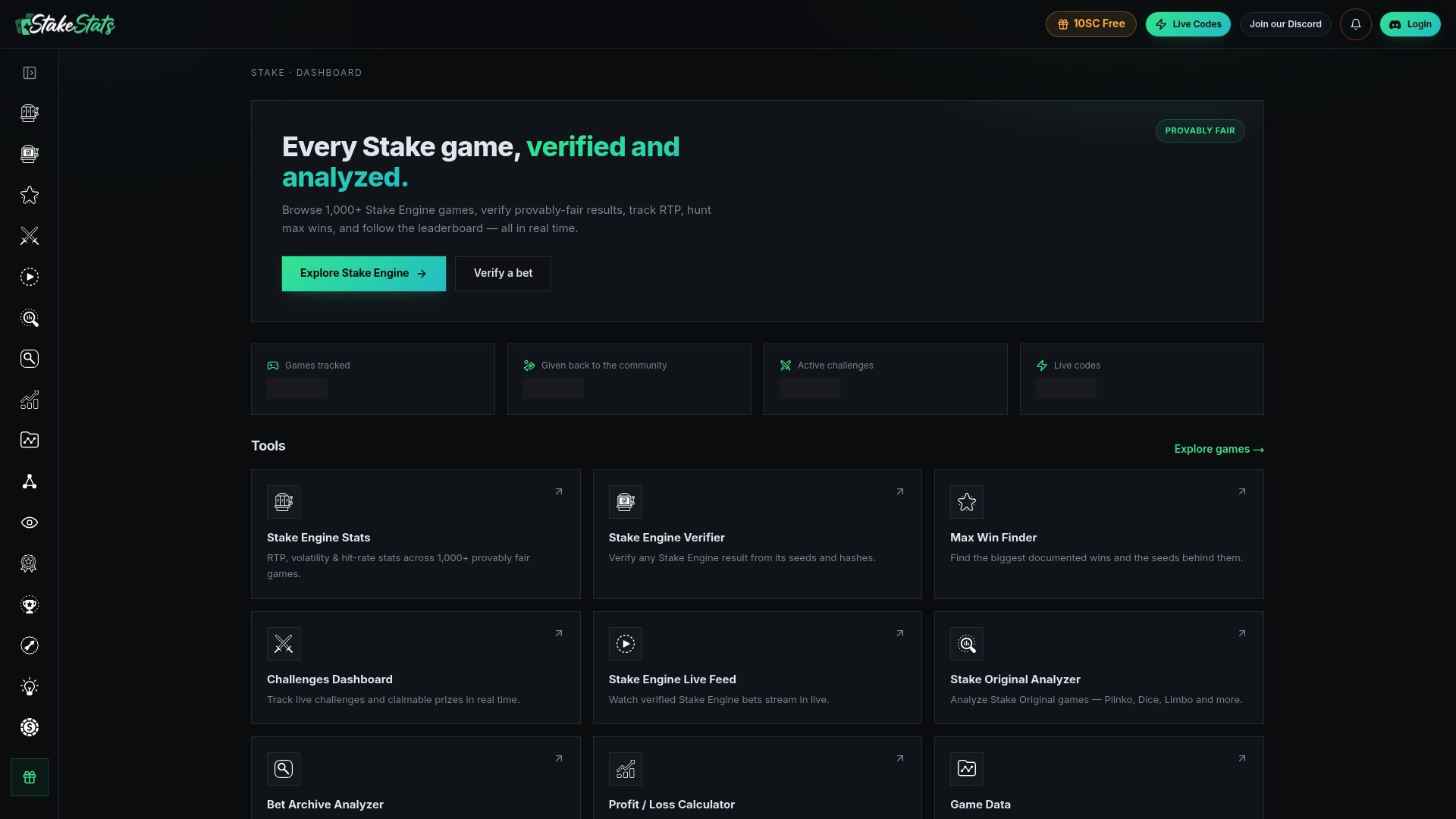
Paste a single past bet into the Stake Originals Analyzer and walk through the commitment check and HMAC reproduction side by side, without switching between three different calculator tabs. If you want the underlying mechanics explained game by game first, the provably fair explanation page covers the message formats and conversion rules for Stake Engine titles specifically.
- Start with one round you already have the commitment and revealed seed for, so you can confirm the tool's output against your own manual check.
- Once the commitment side checks out, use the same round to test the HMAC reproduction step and confirm the displayed result.
- Bookmark the bonuses and tools hub if you want quick access to the verifier alongside other utilities.
Sources
FAQ
How do I check a server seed?
Hash the revealed server seed with SHA-256 and compare it to the pre-bet commitment the operator showed you before the round. If they match, the seed was locked in before betting; if you also want to reproduce the actual result, you need to run HMAC-SHA256 with the server seed as the key, your client seed, and the nonce.
How do I reset a seed on a provably fair site?
Most provably fair platforms let you generate a new client seed from your fairness or provably fair settings page, which also reveals the current server seed and issues a new hashed commitment for the next one. Check the specific site's help documentation for the exact menu location, since the process varies by operator.
How can I see a server seed without an operator revealing it first?
You generally cannot, and that is intentional: the provably fair verification guide warns that a site publishing its raw server seed before betting undermines the entire fairness model, since it would let anyone predict outcomes in advance. The seed is only meant to be revealed after the round or seed pair ends.
What does seed mean in this context?
A seed is a string of characters used as input to a cryptographic function to generate a game outcome. In provably fair systems, the server seed is generated and hashed before play, while the client seed usually comes from the player, and together with the nonce they determine each round's result.
Does a matching hash guarantee the game is fair to play?
No. A matching SHA-256 hash confirms the server seed wasn't swapped after your bet, which NIST's hash function guidance explains is what collision-resistant digests are designed to prove. It says nothing about the game's house edge, return to player, or whether payouts are processed correctly.