
Volatility Index Gambling: What Every Player Must Know

A slot's volatility index tells you one thing: how often it pays and how big those payouts tend to be. High volatility means rare but large wins; low volatility means frequent but smaller ones. That single number should shape your stake size and session length before you spin once.
Quick actions before you play:
- Match volatility to your bankroll. High-volatility games need a much larger cushion than low-volatility ones.
- Choose low volatility for bonus clearing. Frequent small wins keep your wagering requirement moving without draining your balance.
- Shrink your bet size, not your spin count, when variance is high. More spins give variance time to even out.
Key Takeaways
Volatility index in gambling measures how often a game pays and how large those payouts tend to be, and it is the primary driver of bankroll risk in any single session, independent of RTP.
| Point | Details |
|---|---|
| Volatility vs. RTP | RTP is a long-run average; volatility shapes short-term outcome dispersion. Both figures matter before choosing a stake. |
| Hit-frequency benchmarks | Low volatility: 30–45% hit rate; medium volatility: 22–32%; high volatility: 17–25%; extreme volatility: 12–18%. |
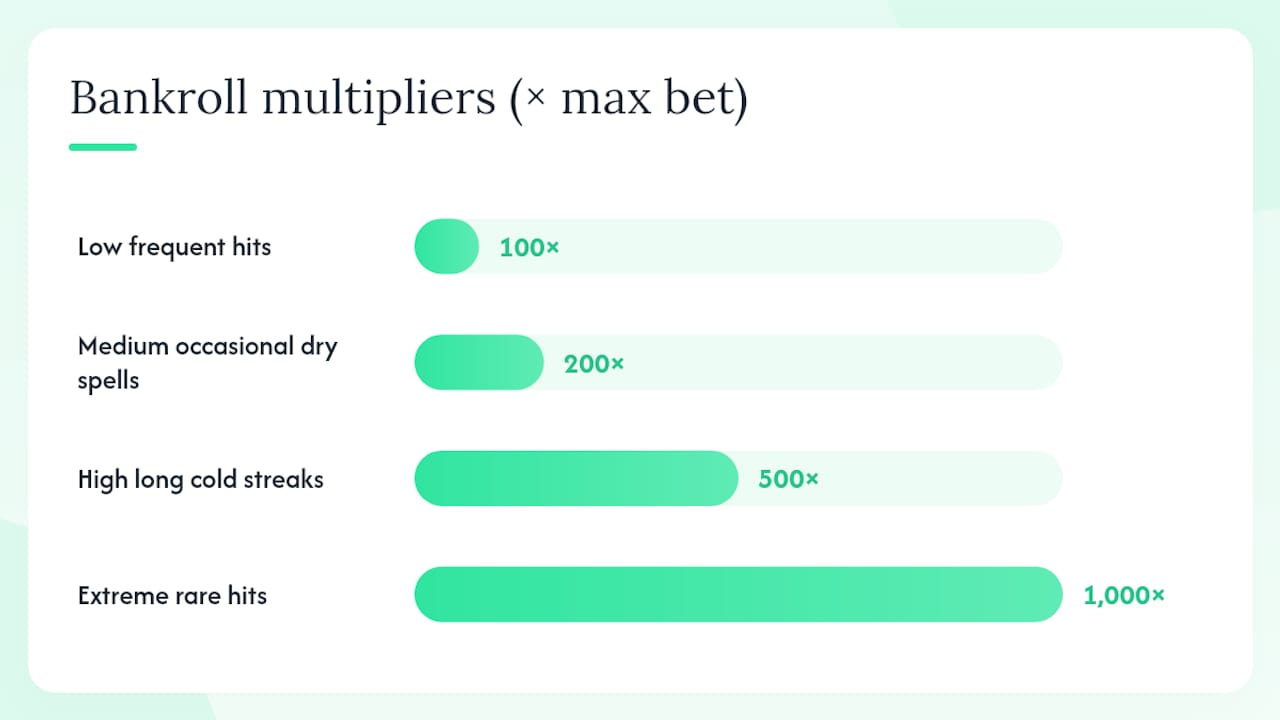
| Bankroll multipliers | Low roughly 100 times, medium roughly 200 times, high roughly 500 times, extreme roughly 1,000 times max bet to safely absorb variance. |
| Finding volatility data | Check in-game panels, developer sheets, or pull verified hit-rate samples from provably-fair analytics. |
| Stakestats measurement | Stakestats provides live hit-rate stats and provably-fair verification for 2,500+ Stake Engine games, letting you measure volatility from real bet data. |
Table of Contents
- What does the volatility index mean in gambling?
- How do volatility and RTP work together?
- Where can you find a game's volatility rating?
- How should you size your bankroll around volatility?
- How does variance show up in table games?
- Common myths about volatility that cost players money
- How Stakestats helps you measure hit rate and approximate volatility
- The number that actually changes your session
- Stakestats gives you the volatility data to plan smarter sessions
- Useful sources
What does the volatility index mean in gambling?
Volatility, also called variance, measures how far individual results scatter around a game's average payout. Think of it as the spread of outcomes rather than the average itself. The Cboe Volatility Index (VIX) does something similar in financial markets: it gauges expected short-term dispersion in S&P 500 prices and is often called the "fear gauge." Slot volatility works on the same logic, just applied to spin outcomes instead of stock prices.
The critical point most players miss: volatility and RTP are completely independent. Two slots can both return 96% to players over millions of spins yet feel nothing alike in a single session. One might pay on 38% of spins with modest amounts; the other might pay on 14% of spins but occasionally deliver a 2,000× multiplier. Same RTP, completely different ride.
Hit frequency is the clearest window into volatility. It answers: "On what percentage of spins does the game return anything at all?" A low-volatility slot might register a win on roughly 35–40% of spins. A high-volatility title can drop that to 12–20%, meaning you can easily go 50 or 80 spins without a single return.
Statistic callout: Typical hit-frequency ranges by tier: low around one-third to two-fifths, medium around one-fifth to one-third, high around one-sixth to one-quarter, extreme around one-tenth to under one-fifth.
Here is a simple numeric comparison. Imagine two slots, both with 96% RTP, each played for 100 spins at $1 per spin ($100 total wagered):
| Metric | Slot A (Low Volatility) | Slot B (High Volatility) |
|---|---|---|
| RTP | 96% | 96% |
| Hit frequency | ~38% | 12–20% |
| Typical win size | 1×–5× bet | 500× bet |
| Expected return (long run) | $96 | $96 |
| Likely 100-spin range | $80–$100 | $20–$200+ |
Slot B's expected value is identical, but the range of realistic outcomes is enormous. That dispersion is what volatility measures, and it is why variance, not RTP, drives bankroll risk.
- RTP is a long-run average across millions of spins.
- Volatility describes the shape of the distribution around that average.
- Hit frequency is the most player-readable proxy for volatility.
How do volatility and RTP work together?
RTP is a long-run mean. Given enough spins, every 96% RTP game returns $96 per $100 wagered. Volatility shapes what happens between now and "enough spins," which for most players is never actually reached in a single session.
Here is a concrete example. Two games, both 96% RTP, $1 stake, 200-spin session:
- Low-volatility game: Expected loss ≈ $8 (4% house edge × $200 wagered). Realistic range: $160–$220 remaining from a $200 starting bankroll.
- High-volatility game: Same expected loss of $8. Realistic range: $50–$400+ remaining, because the variance stretches outcomes dramatically in both directions.
The expected loss is identical. The risk of ruin, meaning the chance of losing your entire session bankroll before 200 spins are up, is far higher in the high-volatility game. That is the practical difference volatility makes.
Pro Tip: Before choosing a stake size, check both RTP and volatility. A 97% RTP high-volatility game can drain a $100 bankroll faster than a 94% RTP low-volatility game at the same stake. RTP alone does not tell you how much cushion you need.
Key distinctions to keep straight:
- RTP answers: "What percentage of wagered money returns to players over time?"
- Volatility answers: "How wild will the ride be getting there?"
- Both figures together determine whether a stake size is appropriate for your bankroll.
Where can you find a game's volatility rating?
Volatility information is more accessible than most players realize, but the quality varies widely by source.
Step-by-step checklist for finding or estimating volatility:
- Use provably-fair analytics. For Stake Engine and similar crypto games, tools like Stakestats pull verified hit-rate samples from real bet data, giving you a measured approximation rather than a label.
Developers use simulations and confidence intervals to assign volatility index scores to their games. The Volatility Index (VI) is a formal metric that maps win frequency against payout size, and it is what drives the Low/Medium/High labels you see in game info panels.
Warning: Anonymous community-sourced volatility claims on forums and social media are unreliable. A player who hit a big win on a "low volatility" game and reclassified it based on that one session is not a data source. Treat any volatility label without a developer or verified-analytics source as directional at best. Proxies like max-win multiplier and paytable shape are useful starting points, but a 500-spin demo sample gives you far more signal than any single anecdote.
How should you size your bankroll around volatility?
FINRA's guidance on market volatility recommends diversification and avoiding impulsive decisions during volatile periods. The parallel for gambling is straightforward: when variance is high, you need more capital to absorb swings, and you need a plan before you start.
Industry rule-of-thumb bankroll multipliers by tier:
| Volatility tier | Bankroll (× max bet) | Why |
|---|---|---|
| Low | ~100× | Frequent hits cushion the balance naturally |
| Medium | ~200× | Occasional dry spells need a modest buffer |
| High | ~500× | Long cold streaks are normal; you need runway |
| Extreme | ~1,000× | Rare hits mean you must survive many losing spins |
Sample bankroll calculation: You want to play a high-volatility slot at $0.50 per spin. The recommended bankroll is 500× max bet. If max bet is $0.50, you need $250 before sitting down. Set a stop-loss at 50% of that ($125 lost = session over) and a win target at 150% of starting bankroll ($375 = take profit and leave). That gives you roughly 250 spins at full stake before hitting your stop-loss, which is enough sample size for variance to express itself without catastrophic ruin risk.
Pro Tip: Think in spins, not dollars. A $50 loss feels different at $0.10/spin (500 spins of data) than at $1/spin (50 spins). More spins give variance time to work. If your bankroll is shrinking faster than expected, drop stake size rather than ending the session, unless you have hit your stop-loss.
Session tactics that actually matter:
- Set a spin-count budget, not just a dollar budget. Know how many spins your bankroll covers at your chosen stake.
- Use a hard stop-loss. Decide before you start what loss amount ends the session, and honor it.
- For bonus clearing, use the bonuses tool to calculate wagering requirements and pick a low-volatility game that keeps your balance alive throughout the grind.
- Drop stake size rather than chasing losses when you hit a cold streak on a high-volatility game.
- Win targets prevent giving back a big hit. A 50% profit target is a reasonable default for high-volatility sessions.
How does variance show up in table games?
Slots have no skill component, so volatility is purely a function of the math. Table games are more complicated.
Blackjack has relatively low variance compared to high-volatility slots. Basic strategy reduces the house edge to around 0.5%, and because most hands pay 1:1 (with 3:2 for blackjack), the payout distribution is tight. Skill genuinely compresses variance here. A player using basic strategy will see far less dramatic swings than one playing by feel, because correct decisions eliminate the high-variance mistakes (like hitting 17) that inflate outcome dispersion.

Roulette sits at fixed odds per spin. A single-number bet on European roulette pays 35:1 with a 2.7% house edge. Each spin is independent, and the variance per spin is high relative to even-money bets, but the game offers no skill lever to adjust it. You can choose between high-variance bets (single numbers) and low-variance bets (red/black), but the house edge stays the same either way.
Poker is player-versus-player, which means variance is driven by both the cards and your opponents' decisions. A strong player reduces long-run variance by making better decisions, but short-run swings can be enormous, especially in no-limit formats. Bankroll requirements for poker are typically expressed as 20–30 buy-ins for cash games, which reflects the high variance of the format.
Comparing a high-volatility slot session to roulette: 100 spins at $1 on a high-volatility slot might produce outcomes ranging from $0 to $500+. One hundred spins at $1 on a single-number roulette bet produce a similar range of outcomes, but the math is fixed and transparent. The slot's volatility is opaque unless you have access to verified analytics; roulette's is calculable from the published odds.
- Blackjack: skill reduces variance; basic strategy is the lever.
- Roulette: bet selection shifts variance, not house edge.
- Poker: player skill and bankroll depth are the primary variance controls.
- Slots: volatility is set by the developer and cannot be influenced by play decisions.
Common myths about volatility that cost players money
Myth: The machine is "due" for a win. Every spin on a certified RNG slot is independent. A slot that has not paid in 200 spins is not more likely to pay on spin 201. The RNG has no memory. This is the gambler's fallacy, and it is the single most expensive misconception in gambling.
Myth: High volatility means better RTP. Volatility and RTP are independent metrics. A high-volatility game can have a 94% RTP while a low-volatility game has 97%. The volatility label says nothing about how much the game returns over time.
Myth: A big recent payout means the game is now cold. Related to the first myth. Past outcomes do not affect future ones. A slot that just paid a 1,000× jackpot has exactly the same probability distribution on the next spin as it did before the jackpot.
Myth: Volatility changes based on bet size. The math does not work this way. A certified slot's volatility profile is fixed by its paytable and RNG. Changing your stake changes the dollar amount of wins and losses, not the underlying probability distribution.
Myth: Community forums know a game's "real" volatility. Lab certifications and developer simulations verify RTP and volatility over millions of spins. A player's 500-spin session is a sample, not a measurement. Certified RNGs and independent lab audits are the only reliable source of long-run RTP and volatility data.
Fact to carry with you: certified RNGs verify that each spin outcome is random and independent. They do not guarantee even spacing of wins. Long cold streaks are mathematically expected in high-volatility games, not evidence of a rigged machine.
How Stakestats helps you measure hit rate and approximate volatility
For Stake Engine and provably-fair crypto games, volatility does not have to be a label you take on faith. Provably-fair mechanics let you verify individual spin outcomes using server seeds and nonces, which means you can build your own hit-rate sample from real, auditable data.
Stakestats provides live analytics for 2,500+ Stake Engine games, including real-time RTP, hit-rate stats, and max-win lookups. Here is how to use those tools to approximate a game's volatility:
- Open the Stake Bet Archive and pull a sample of at least 500 recent bets for the game you are evaluating.
- Count the number of bets that returned more than the stake (hit frequency = winning bets ÷ total bets).
- Record the payout amounts and calculate the mean and spread of winning payouts.
- Compare your hit-frequency result to the tier benchmarks: above 30% suggests low volatility, 17–25% suggests high, below 17% suggests extreme.
- Use the provably-fair verification tool to confirm that the sample outcomes are reproducible and not manipulated.
Sample metrics from a 500-spin analysis (illustrative framework):
| Metric | What it tells you |
|---|---|
| Hit frequency (%) | Approximates volatility tier |
| Mean winning payout (× bet) | Indicates typical win size |
| Max win in sample (× bet) | Flags extreme-volatility potential |
| Standard deviation of payouts | Measures dispersion directly |
Pro Tip: 500 spins is a minimum for directional signal; 2,000+ spins gives a reliable estimate. A sample standard deviation more than 5× the mean payout is a strong indicator of high or extreme volatility. Use the bankroll analyzer to translate that estimate into a stake size before you play.
One important caveat: these measurements are sample-based estimates, not guarantees of future performance. Always set responsible-play limits before starting any session. If gambling is causing financial or personal harm, GambleAware provides free, confidential support.
The number that actually changes your session
Most players obsess over RTP and ignore volatility. That is backwards. RTP tells you the house edge over a lifetime of play; volatility tells you whether your $200 session bankroll will last 20 minutes or two hours. Those are very different problems, and only one of them you can actually do something about before you sit down.
The practical move is to treat volatility as a session-planning input, not a curiosity. Before any session, check the volatility tier, size your stake to the appropriate bankroll multiplier, and set a stop-loss. For bonus grinding, low-volatility games are almost always the right call because they keep your balance alive long enough to clear the requirement. For jackpot chasing, high volatility is the point, but only if your bankroll can genuinely absorb 500 spins of cold before the big hit arrives.
What I find underappreciated is how much provably-fair analytics change this calculation for crypto gamblers. Instead of trusting a label a developer assigned, you can pull 500 or 2,000 real, verifiable spins from Stakestats, calculate your own hit frequency, and size your stake accordingly. That shifts volatility from a marketing descriptor into a number you actually measured. For anyone serious about session planning, that is a meaningful difference.
Stakestats gives you the volatility data to plan smarter sessions
Knowing a game's volatility tier is useful. Having the actual hit-rate data from thousands of verified spins is better.
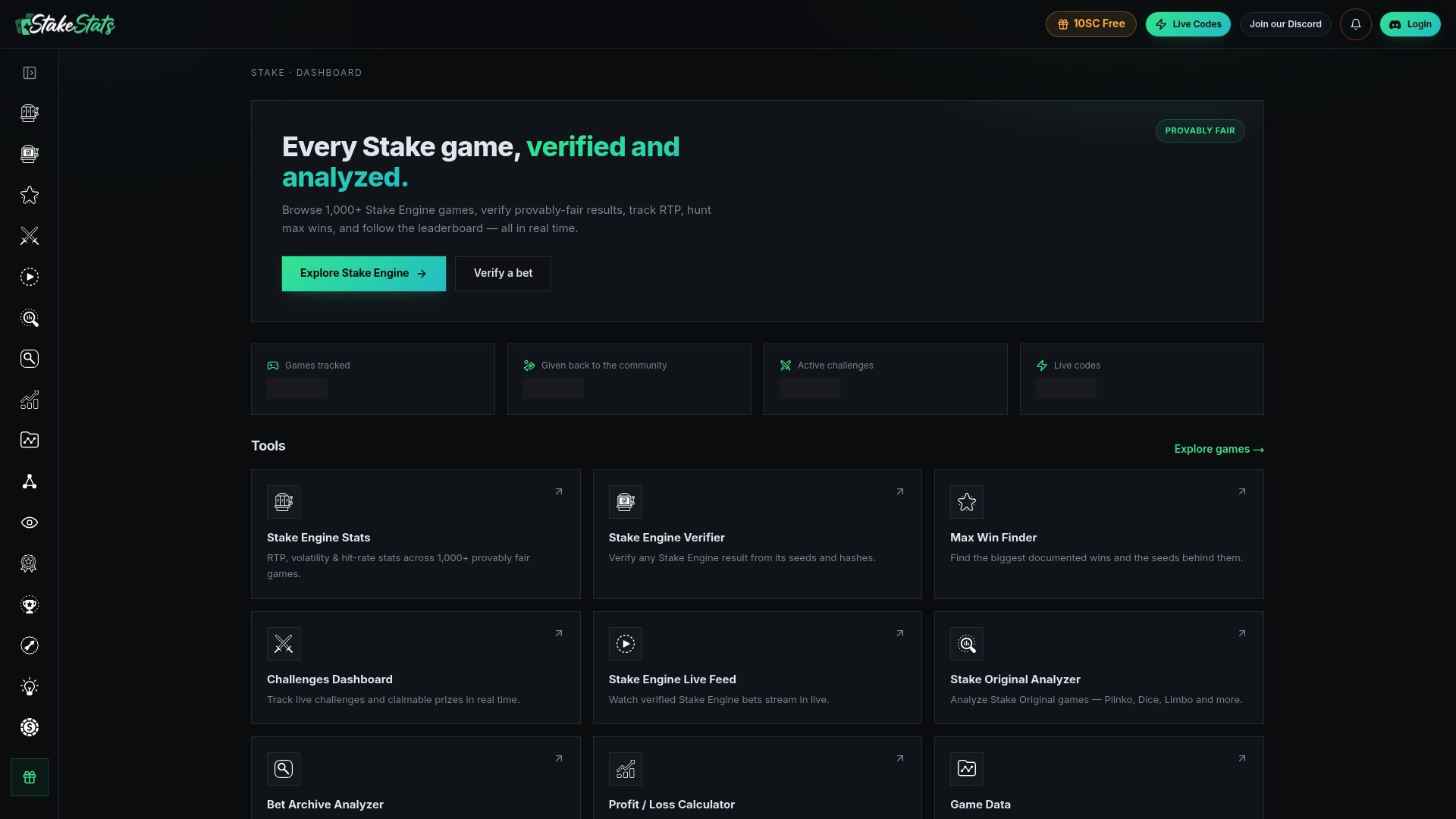
Stakestats covers 2,500+ Stake Engine games with live RTP tracking, hit-rate statistics, and provably-fair verification that lets you confirm every spin outcome using server seeds and nonces. The bankroll analyzer translates your volatility estimate into a concrete stake size and session plan. The transparency tools show you exactly how provably-fair mechanics work so you are not relying on a label you cannot verify.
For players clearing bonuses, the bonus calculator helps you pick the right volatility tier for your wagering requirement and bankroll. No promises about outcomes, because variance is real and no tool changes the math. What Stakestats does is replace guesswork with measured data so your decisions are grounded in something real.
Head to Stakestats and pull the hit-rate stats for the game you are planning to play before your next session.
This article is general information about gambling mechanics, not financial or gambling advice. Gambling involves real financial risk. Confirm applicable laws in your jurisdiction and play within your means. If gambling is affecting your life negatively, contact GambleAware or call the National Problem Gambling Helpline at 1-800-522-4700.
Useful sources
- Slot Volatility Explained: Same RTP, Different Ride — Wild.io Academy
- Slot Variance & Volatility Explained 2026 — RTP vs Risk
- Volatility Index - TC Gaming iGaming
- Slot Volatility Explained: What It Means & How to Choose — Sigma.world
- Slot Volatility Explained — Low, Medium, High, Extreme | iGaming Wheel
- Volatility definition and VIX context — Investopedia
- FINRA: Volatility (investing basics)
- StakeStats — Stake Engine Games & Provably Fair Verification
- GambleAware