
Web3 Gambling Explained: A 2026 Player's Guide

Web3 gambling is defined as online betting that runs on blockchain technology, smart contracts, and provably fair mechanisms instead of centralized casino software. Unlike traditional online casinos, web3 gambling replaces blind trust in an operator with cryptographic verification that any player can check independently. The core components are a decentralized ledger, automated smart contracts, and provably fair randomness using server seeds, client seeds, and nonces. Understanding web3 gambling means understanding how these three layers interact to produce outcomes that are transparent by design, not by promise.
What are the core technical components of web3 gambling?
Web3 gambling uses blockchain to record every transaction on an immutable public ledger. No single operator can alter those records after the fact. That is the foundational shift from traditional online casinos, where transaction history lives inside a private database you cannot inspect.
Smart contracts sit on top of the blockchain and automate game logic and payouts. When a bet resolves, the contract executes the payout according to pre-written code, with no human intervention required. This removes the most common point of manipulation in centralized systems: the payout process.
Provably fair systems add a third layer of verification. Each game round uses three inputs:
- Server seed: A random value the platform commits to before the round begins, hashed so you cannot see it yet.
- Client seed: A value you supply or modify, proving the outcome was not predetermined without your input.
- Nonce: A counter that increments with each bet, making every round unique even if seeds stay the same.
After a session, you can verify each round by unhashing the server seed and running the same calculation the platform ran. If the result matches, the outcome was fair.
Pro Tip: Change your client seed before every major session. A fresh client seed guarantees the platform had no way to pre-calculate your results.
These three components work together. The blockchain records what happened. The smart contract enforces what should happen. The provably fair system proves the randomness was not rigged. Remove any one of them, and the system loses a layer of trust.
How do custody and game execution models differ?
Not all platforms that call themselves "web3" operate the same way. Decentralization is layered, covering custody, fairness, and settlement independently. A platform can be decentralized at one layer and fully centralized at another.

Three custody models define how your funds are held:
| Model | How funds are held | Key risk |
|---|---|---|
| Centralized | Operator holds your balance | Insolvency or fund freezing |
| Non-custodial | Funds stay in your wallet until a bet is placed | You are responsible for key management |
| Hybrid | Blockchain handles payments; custody remains centralized | Partial transparency, centralized withdrawal control |
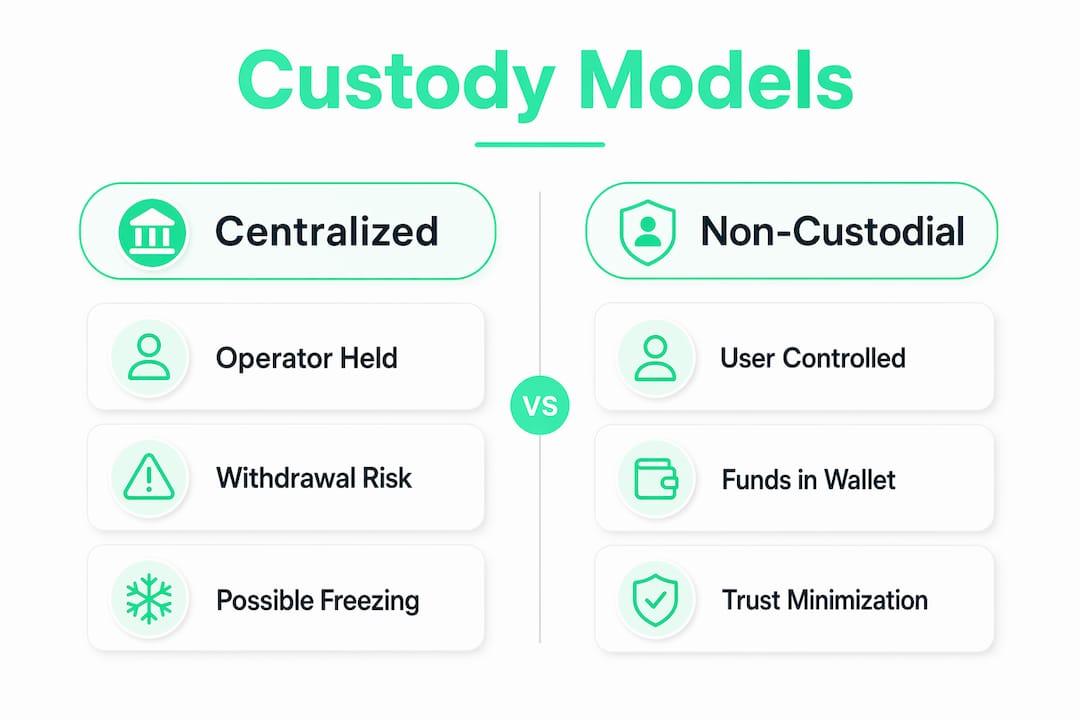
Game execution follows a similar split. Fully decentralized platforms run game logic on-chain via smart contracts, meaning every outcome is publicly verifiable on the blockchain. Hybrid platforms run game outcomes off-chain and use the blockchain only as a payment or verification layer. Many platforms market themselves as "blockchain-powered" while executing all game logic off-chain. That gap between marketing and technical reality is where players get misled.
The non-custodial model gives you the most control. Your funds never sit on the platform between bets. The trade-off is that losing your private key means losing your funds permanently, with no customer support to recover them.
Pro Tip: Before depositing on any platform, look for a published smart contract address. If the platform cannot provide one, game logic is almost certainly off-chain.
Hybrid models are the most common in 2026. They offer a better user experience than fully decentralized apps while providing more transparency than traditional casinos. The practical question is always: which layers are actually decentralized, and which are just using crypto as a payment method?
What are the real benefits and risks of web3 betting?
The benefits of web3 betting are concrete and measurable, not just theoretical. Transparency through public ledgers means anyone can audit transaction history without requesting records from an operator. That is a structural advantage no traditional casino can match.
Key benefits include:
- Faster settlements: Crypto transactions settle in minutes rather than the days required by bank transfers or card processors.
- Lower fees: Cutting out payment processors reduces transaction costs significantly, especially for high-volume players.
- True asset ownership: In non-custodial models, your bankroll stays in your wallet. No platform can freeze it without your private key.
- Privacy: Most platforms require only a wallet address to play, with no identity verification required for basic access.
The risks are equally concrete. Many crypto casinos operate under minimal regulation, often holding only a Curaçao license that costs approximately $47,000 per year. That licensing level provides far fewer consumer protections than jurisdictions like the United Kingdom or Malta. If a platform becomes insolvent, recovery options are limited.
Custody risk is the most underappreciated danger. A centralized platform holding your balance can freeze withdrawals, restrict accounts, or simply shut down. Non-custodial models shift that risk to you: lose your seed phrase, and your funds are gone. Neither model is risk-free. They carry different types of risk that suit different types of players.
Privacy is a genuine advantage, but it cuts both ways. Without identity verification, dispute resolution is nearly impossible. You are trading consumer protection for anonymity, and that trade-off deserves careful thought before you deposit.
How does provably fair gambling actually work?
Provably fair gambling is a cryptographic system that lets you verify the randomness of any game outcome after it happens. The mechanism shifts trust from the operator's word to independently verifiable math. The house edge still exists. Provably fair does not make gambling profitable. It only proves the randomness was not manipulated.
The verification process works in four steps:
- Before the round, the platform generates a server seed and publishes its SHA-256 hash. You can see the hash but not the seed itself.
- You provide or modify a client seed. This proves you had input into the outcome.
- The round plays out using a combination of the server seed, client seed, and nonce.
- After the round, the platform reveals the original server seed. You hash it yourself and confirm it matches what was published. Then you run the full calculation to confirm the outcome.
Provably fair systems prove that the randomness generating a game outcome was not manipulated after the fact. They do not remove the house edge, and they do not guarantee wins. What they guarantee is that the platform could not have known your result before you placed your bet.
A subtler risk exists in multiplayer games. Commit-reveal timing is critical: if an operator can observe other players' actions before committing their own seed, they gain an informational advantage. Well-designed systems enforce strict timing windows to prevent this. Naive on-chain randomness without proper commit-reveal protocols can actually be more manipulable than a well-audited centralized RNG.
The Stake Originals Analyzer is one practical tool for running these verifications on Stake.com games without doing the cryptographic math manually. Checking your results periodically is the single most effective habit a web3 gambler can build.
Key Takeaways
Web3 gambling delivers verifiable fairness through blockchain, smart contracts, and provably fair cryptography, but the level of actual decentralization varies widely by platform and requires player verification at every layer.
| Point | Details |
|---|---|
| Three core components | Blockchain, smart contracts, and provably fair RNG work together to create transparent outcomes. |
| Custody model matters | Centralized, non-custodial, and hybrid models carry different risks for fund control and insolvency. |
| Provably fair has limits | It verifies randomness integrity, not profitability; the house edge always remains. |
| Decentralization is layered | Assess custody, fairness, and settlement layers separately before trusting any platform's claims. |
| Regulation is thin | Most platforms hold only a Curaçao license, offering limited consumer protection compared to regulated markets. |
Why the "web3" label deserves more skepticism than most players give it
The most important thing I have learned from watching this space closely is that "web3 gambling" is a marketing term as often as it is a technical description. Platforms slap the label on anything that accepts crypto, regardless of whether any game logic actually touches a blockchain.
The custody layer is where most players get burned. They assume that because they deposited in Ethereum, their funds are somehow protected by the blockchain. They are not. If the platform holds your balance in a centralized database, you have the same insolvency exposure as any traditional casino, just with faster deposits.
Verifying true decentralization takes about ten minutes of research. Look for a published smart contract address on a block explorer like Etherscan. Check whether game outcomes are recorded on-chain or just payments. Read the custody section of the terms of service, not the marketing page. Most platforms that are genuinely decentralized make this information easy to find because it is their competitive advantage.
The user experience trade-off is real and worth acknowledging. Fully decentralized apps are slower, more expensive per transaction due to gas fees, and harder to use for casual players. Hybrid models exist because they solve a genuine UX problem. The question is whether the transparency trade-off is worth it for your specific situation.
My honest expectation for the next two to three years: better tooling will close the UX gap. Verifiable randomness protocols are maturing, layer-2 scaling solutions are reducing gas costs, and more platforms are publishing auditable smart contracts. The players who understand these layers now will be far better positioned to evaluate platforms as the space matures.
— Ian
How Stakestats helps you verify what platforms claim
Stakestats is built for players who want to move beyond taking a platform's word for it.
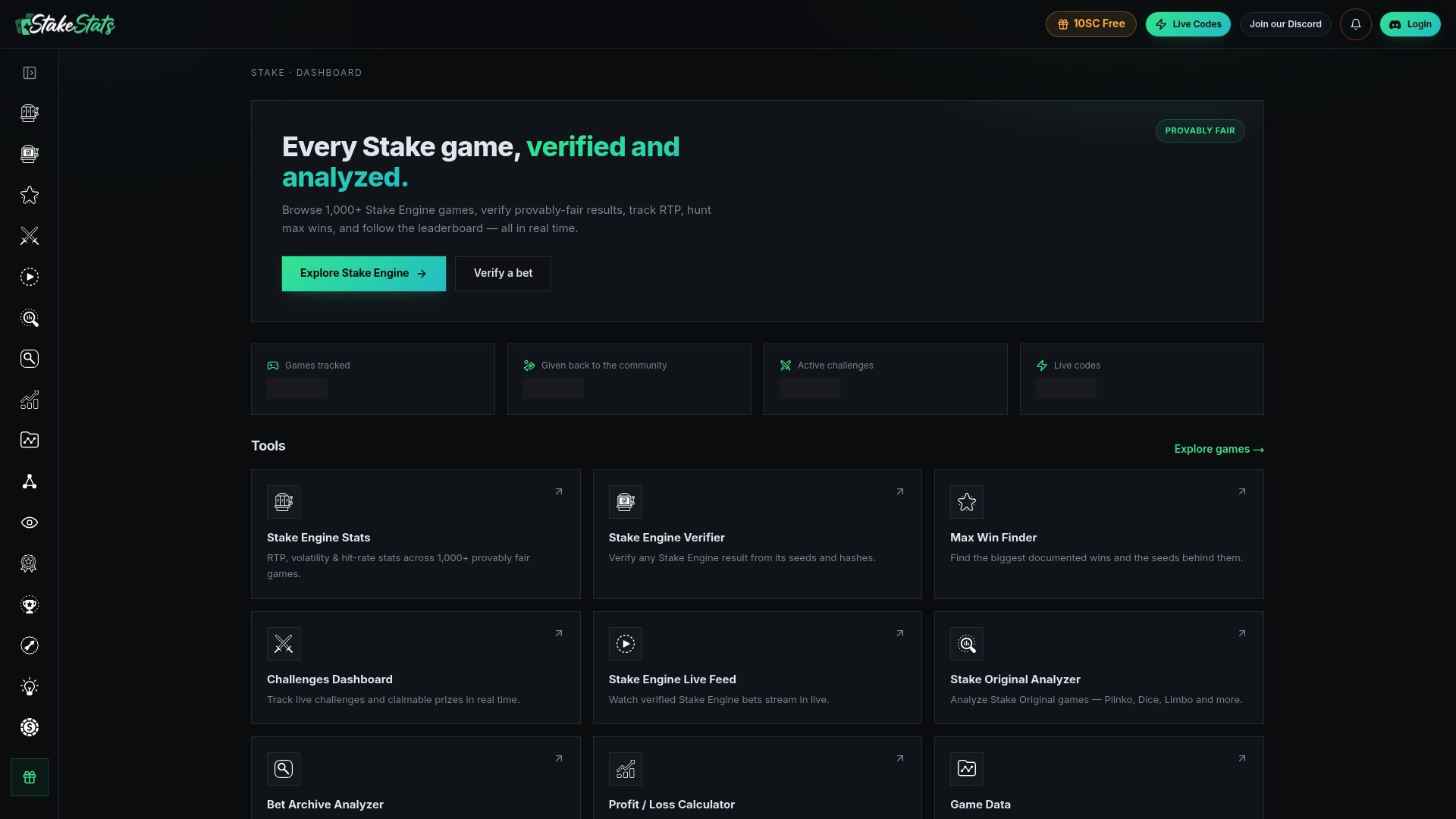
The provably fair verification tools on Stakestats walk you through the exact cryptographic process for checking game outcomes on Stake.com, with no manual hashing required. The bankroll analyzer gives you a clear picture of your session performance using transparent, immutable data. For players exploring bonuses, the bonuses tool cuts through the fine print and shows you what you are actually working with. Stakestats exists because transparency in web3 gambling should not require a computer science degree to access.
FAQ
What is web3 gambling in simple terms?
Web3 gambling is online betting that uses blockchain technology and smart contracts instead of centralized casino software. Players can verify game outcomes independently using provably fair cryptographic tools.
Does provably fair mean the casino has no house edge?
No. Provably fair systems verify that randomness was not manipulated, but the house edge is built into the game math and always applies. You can confirm a game was fair and still lose over time.
What is the safest custody model for web3 gambling?
Non-custodial models give players the most control because funds stay in a personal wallet until a bet is placed. The trade-off is full responsibility for private key security, with no recovery option if keys are lost.
How can I tell if a platform is truly decentralized?
Check all three layers: custody, fairness, and settlement. A published smart contract address on a block explorer is the clearest signal that game logic actually runs on-chain.
Are web3 gambling platforms regulated?
Most operate under a Curaçao license, which provides minimal consumer protections compared to regulators like the UK Gambling Commission or Malta Gaming Authority. Players should treat regulatory coverage as limited and factor that into their risk assessment.