
What Does Expected Value Mean in Gambling?

Expected value (EV) in gambling is the average amount you can expect to win or lose per bet if you placed the same wager repeatedly under identical conditions. This single number tells you whether a bet favors you or the house over the long run. A positive EV bet means profit over time. A negative EV bet means you lose money on average, no matter how good your short-term results look. Every casino game, sports wager, and poker hand carries an EV, and understanding it separates disciplined bettors from gamblers who rely on gut feeling alone.
What does expected value mean in gambling, and how does it work?
Expected value is the mathematical foundation of every betting decision. It combines the probability of each possible outcome with the profit or loss attached to that outcome. The result is a single number that tells you the average return per dollar wagered over thousands of repetitions.
The house edge is EV made visible. A $1 bet with a 2% house edge carries an EV of approximately -$0.02. That means for every dollar you bet, you lose two cents on average. Casino games are built on this principle. The house does not need to cheat. It just needs a small, consistent edge repeated across millions of bets.

Professional gamblers use EV as their primary filter. Before placing any wager, they ask one question: is this bet positive or negative EV? If the answer is negative, they pass. If positive, they size the bet according to their bankroll strategy. EV removes emotion from the process entirely.
How to calculate expected value in gambling
The EV formula is straightforward. You multiply the probability of winning by your net profit, then subtract the probability of losing multiplied by your stake.
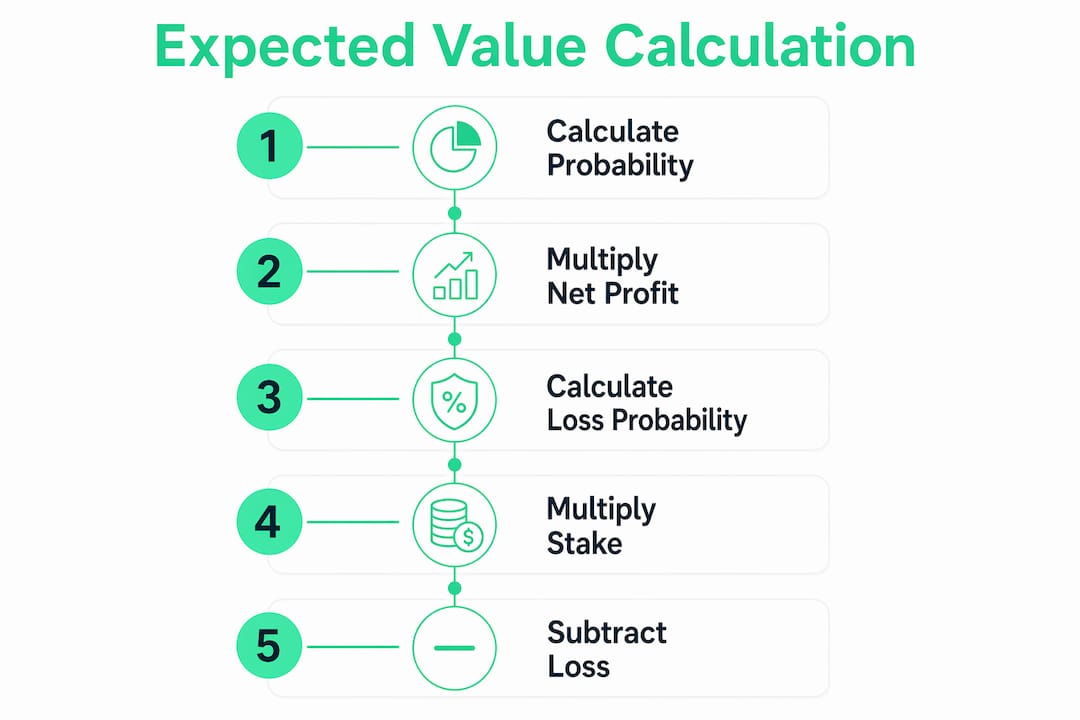
EV = (Probability of Win × Net Profit) − (Probability of Loss × Stake)
Here is how that works in practice:
- Identify all possible outcomes. For most bets, there are two: win or lose.
- Convert odds to implied probability. American odds of -110 imply a break-even hit rate of 52.4%. Odds of +200 imply 33.3%.
- Calculate net profit, not total payout. On a $10 bet at decimal odds of 2.0, your profit is $10, not $20. The $20 payout includes your original stake returned. Beginners frequently miscalculate by using total payout instead of net profit, which inflates EV estimates.
- Plug in the numbers. Suppose you bet $10 at +200 odds. Your probability of winning is 33.3%, and your net profit is $20. Your probability of losing is 66.7%, and your stake at risk is $10. EV = (0.333 × $20) − (0.667 × $10) = $6.66 − $6.67 = −$0.01. That bet is essentially break-even at those odds.
- Interpret the sign. Positive EV means the bet is profitable over time. Negative EV means the house or market has the edge.
Pro Tip: Always double-check whether you are using net profit or total payout in your EV formula. Using total payout is the single most common calculation error among new bettors, and it produces misleadingly positive EV figures.
What does EV actually tell you about your chances?
EV is a long-run average, not a prediction for your next bet. A negative EV bet can still win roughly half the time. A positive EV bet can lose ten times in a row. The math only reveals itself over thousands of repetitions.
This is where variance enters the picture. Variance measures how much individual results swing around the expected average. High-variance bets, like longshot parlays, produce wild swings even when the EV is positive. Low-variance bets, like wagering on heavy favorites, produce steadier results but smaller swings. EV and variance are separate forces. You need to understand both.
The critical distinction every serious bettor must make is this:
- Bad variance means you lost a +EV bet. The process was correct. The outcome was unlucky.
- Bad process means you made a -EV bet and happened to win. The outcome was lucky. The decision was still wrong.
Experts stress that EV is a framework to remove emotion from betting. The goal is +EV decision-making, not chasing short-run wins or avoiding short-run losses. A bettor who focuses on process quality will outperform one who focuses on results every time, given enough volume.
Consistent profit only comes from consistently placing +EV bets. One winning session proves nothing. Ten thousand bets at positive EV proves everything.
How do gamblers find profitable, positive EV opportunities?
Finding +EV bets requires one thing above all else: a more accurate probability estimate than the market has already priced in. Sportsbooks set odds using sharp money, public betting patterns, and their own models. To beat the market odds, you need information or analysis the market has not fully accounted for.
Understanding the vig and fair odds
Every sportsbook charges a commission called the vig or juice. At standard -110 odds on both sides of a bet, the book collects roughly 4.5% of every dollar wagered regardless of the outcome. Fair odds would be +100 on both sides. The vig is the built-in negative EV baked into every market. Your job as a bettor is to find spots where the true probability of an outcome is higher than the implied probability in the odds.
Closing line value as a quality check
Closing line value (CLV) is the most reliable metric for confirming that your bets are consistently positive EV. CLV measures whether the odds you got were better than the odds available at game time, after the market has absorbed all available information. If you consistently beat the closing line, your process is sound. Raw win-loss records are noisy over short samples. CLV cuts through that noise.
Bankroll management and the Kelly Criterion
Finding +EV bets is only half the equation. Sizing those bets correctly is the other half. The Kelly Criterion is a formula that calculates the optimal percentage of your bankroll to wager based on your edge and the odds. Without proper sizing, even a bettor with a genuine +EV edge can go broke during a losing streak driven by variance. Kelly Criterion prevents overbetting, which is the fastest way to destroy a profitable strategy.
| Betting approach | EV orientation | Risk profile |
|---|---|---|
| Flat betting on market odds | Negative EV (vig drag) | Low variance, steady losses |
| Sharp line shopping | Potentially +EV | Moderate variance |
| CLV-focused betting | Confirmed +EV process | Managed variance |
| Kelly-sized +EV bets | +EV with optimal growth | Controlled risk of ruin |
Pro Tip: Line shopping across multiple sportsbooks is the fastest way to improve your average EV per bet. A half-point difference in odds on a key number can shift a -EV bet to a +EV one.
What common misconceptions do gamblers have about EV?
Most gamblers misuse EV in predictable ways. Recognizing these errors will save you money and frustration.
- EV predicts your next result. It does not. EV is a long-run average. Any single bet is governed by chance. A -EV bet wins all the time in the short run. That does not make it a good bet.
- Winning proves you had +EV. Winning proves nothing about process. You can win consistently for months on -EV bets through variance alone. The math catches up eventually.
- A positive EV guarantees profit. Positive EV is necessary for long-term profit, but not sufficient on its own. You also need accurate probability estimates, sufficient bet volume, and sound bankroll management. One weak link breaks the chain.
- The house edge is unfair or hidden. The house edge is transparent and quantifiable. Casino games carry a typical house edge of 1–5% per dollar wagered, depending on the game. That is the cost of entertainment, not a scandal. Professional gamblers treat it as a known expense and budget accordingly.
- EV applies only to sports betting. EV applies to every gambling format: casino games, poker, daily fantasy, and provably fair games. The formula is identical. Only the inputs change.
The most dangerous misconception is believing that a hot streak means you have found an edge. Streaks are variance. Edge is EV. They are not the same thing.
Key Takeaways
Expected value is the single most important concept in gambling because it separates profitable decisions from losing ones, regardless of short-term results.
| Point | Details |
|---|---|
| EV definition | EV is the average profit or loss per bet over many repetitions, not a single-outcome predictor. |
| Core formula | EV = (Probability of Win × Net Profit) − (Probability of Loss × Stake); always use net profit, not total payout. |
| Variance vs. EV | Short-term results reflect variance; long-term profitability reflects EV. Judge your process, not your results. |
| Finding +EV bets | Beat the market by estimating probabilities more accurately than the odds imply, then confirm quality with CLV. |
| Bankroll management | Pair +EV betting with Kelly Criterion sizing to avoid ruin during inevitable losing streaks. |
Why EV changed how I think about every bet I place
I spent years watching gamblers confuse a winning month with a winning strategy. The two are not the same thing, and the difference is EV. Once you internalize that concept, you stop celebrating wins and start evaluating decisions.
The most common mistake I see is bettors who dismiss EV as "too theoretical." They want to trust their instincts. But instincts are just pattern recognition built from a sample size too small to be statistically meaningful. EV forces you to quantify what your gut is actually saying. If you cannot express your edge as a probability estimate, you do not have an edge. You have a feeling.
What I find genuinely useful is combining EV with CLV tracking. When I beat the closing line consistently, I know my process is working even during losing stretches. That feedback loop keeps me from abandoning a sound strategy during bad variance, which is the moment most bettors make their worst decisions.
The house edge reframing also matters. Knowing that a roulette spin costs roughly $0.05 per dollar wagered does not make me stop playing for entertainment. It makes me budget for it honestly. EV turns gambling from a mystery into a cost-benefit calculation. That clarity is worth more than any single winning bet.
— Ian
How Stakestats helps you apply EV analysis to real bets
Knowing the EV formula is one thing. Having the data to feed it accurately is another.

Stakestats gives online gamblers the transparency and analytical tools to apply EV thinking to provably fair games on Stake.com and similar platforms. The platform surfaces game statistics, outcome distributions, and historical data that help you build accurate probability estimates instead of guessing. When your inputs are accurate, your EV calculations are reliable. When your EV calculations are reliable, your betting decisions improve. Visit Stakestats to put real numbers behind your next wager.
FAQ
What does expected value mean in gambling?
Expected value is the average profit or loss per bet if the same wager were placed repeatedly under identical conditions. A positive EV means the bet is profitable over time; a negative EV means the house has the edge.
How do you calculate EV for a sports bet?
Use the formula: EV = (Probability of Win × Net Profit) − (Probability of Loss × Stake). Always use net profit, not total payout, to avoid overstating your edge.
Can you win money on a negative EV bet?
Yes. A negative EV bet can win in the short run due to variance. Over thousands of bets, however, negative EV produces consistent losses regardless of short-term results.
What is closing line value and why does it matter?
Closing line value (CLV) measures whether the odds you placed a bet at were better than the final market odds before the event started. Consistently beating the closing line confirms your bets are positive EV before outcomes are known.
Does the Kelly Criterion work with EV?
The Kelly Criterion uses your EV edge and the odds to calculate the optimal bet size as a percentage of your bankroll. It prevents overbetting, which protects you from ruin during losing streaks even when your long-term EV is positive.